John Deere Launches JD AI Assistant to Help Farmers Query Their Own Data


4 Sources
[1]
John Deere launched an AI chatbot for farmers
John Deere is testing a new "JD" AI assistant that it says can help farmers make more money, with answers about best practices and historical trends that are based on their own data. It uses their "field, machine and operational data" to answer questions on topics like equipment settings, fuel
[2]
John Deere launches JD, an AI assistant that answers questions from a farm's own data
The Data Act has governed connected products since September 2025, gives farmers a right to move their machine data to a rival, and carries one rule Deere's pledge has no counterpart for, a ban on the manufacturer using that data to work out what a farm is worth John Deere has launched JD, an AI
[3]
John Deere launches JD AI assistant for farmers
In the past, growers typically had to finish out a full season before sitting down to examine how their crops performed and identify what drove results. An AI assistant can begin that process as equipment moves through the field. Deere plans to offer the JD assistant at no cost to Operations
[4]
John Deere Launches New AI Features to Change How Farming Works
At this point in time, it's rather obvious that AI has become a major selling point for companies left and right, ranging from consumer electronics, all the way to farming equipment -- more specifically, tractor manufacturer John Deere recently introduced "JD," a new artificial intelligence
Share
Copy Link
John Deere introduced JD, an AI assistant integrated into its Operations Center platform that answers farmers' questions using their own field, machine, and operational data. The tool uses natural language queries to provide insights on fuel usage, crop performance, and harvest timing. The launch includes a ten-point Farmer Data Commitment ensuring growers maintain data ownership and control.
John Deere Unveils AI Assistant for Farm Operations
John Deere has launched JD, an AI assistant embedded within its Operations Center platform that allows farmers to query their field, machine, and operational data using natural language
1
4
. The JD AI assistant transforms how growers interact with their agriculture data by eliminating the need to navigate complex interfaces and manual reports. Instead of sifting through massive datasets, farmers can now simply ask direct questions to surface practical, customized insights that help optimize operations and improve profitability.
Source: The Next Web
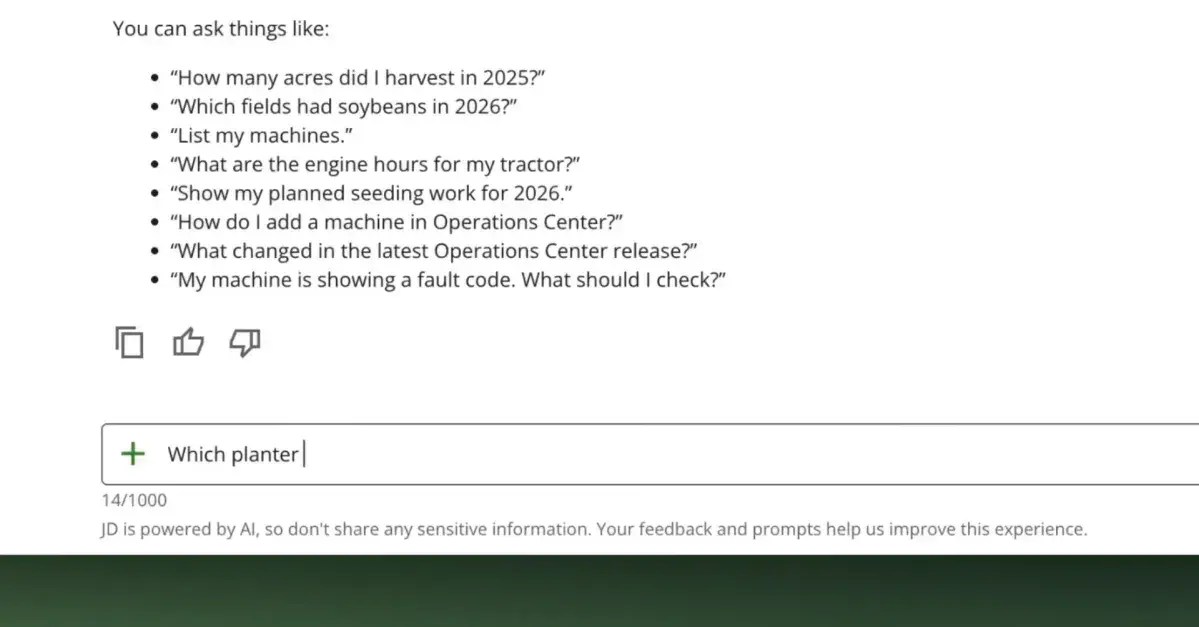
The AI-powered chatbot handles queries across multiple operational areas. Farmers can compare fuel usage during tillage across years to identify potential savings, analyze how equipment settings affect crop yield, track which sprayer operator covers the most acres per hour, and determine optimal harvest timing based on historical trends
2
4
. Chief Technology Officer Jahmy Hindman explained that "JD changes the experience from navigating through a sea of data to simply asking it a question"2
.
Source: The Verge
Farmer Data Commitment Addresses Ownership Concerns
Alongside the JD AI assistant launch, John Deere released a ten-point Farmer Data Commitment that addresses growing concerns about data ownership and control in agriculture
1
3
. The commitment explicitly states that farmers control their farm data, that John Deere does not sell it, and that growers can switch off data flow to third parties at any time. This pledge comes as some farmers have grown increasingly reluctant to share crop data with the U.S. Department of Agriculture and other entities3
.Deanna Kovar, President of John Deere's Worldwide Ag & Turf Division, emphasized: "Farmers receive value from their data when they can use it to make better decisions, and we believe that value should come with control, transparency, and choice"
4
. The company also mandates it does not use farmer information for commodity trading or speculation. John Deere points to its track record as the first agricultural equipment manufacturer to receive Ag Data Transparent certification in 20182
.European Data Act Creates Stricter Requirements
While John Deere's Farmer Data Commitment represents a voluntary pledge in the United States, European farmers operate under mandatory protections through the Data Act, which has governed connected products since September 2025
2
. The Data Act grants farmers the right to obtain their data free of charge in a structured, machine-readable format and to require manufacturers to pass it to third parties. Critically, Article 4(13) forbids data holders from using the information to derive insights about a user's economic situation, assets, or production methods—a safeguard absent from John Deere's ten principles2
.This distinction matters significantly for vertical AI applications in agriculture. A manufacturer accessing a farm's yields, fuel bills, and machine hours can determine what that farm can afford to purchase, creating potential conflicts of interest. From September 12, connected products placed on the EU market must be built so data reaches the user by default, shifting power dynamics in favor of farmers and startups like Copenhagen's PerPlant
2
.Related Stories


Rollout Plans and Future Expansion
The JD assistant is currently available through an Early Access Program for select U.S. customers, with registration opening at the Farm Progress Show in Iowa
1
2
. John Deere plans to offer the tool at no cost to Operations Center app users, with a wider rollout anticipated before year's end across web and mobile platforms3
4
. Eventually, the AI assistant will extend to in-cab displays on tractors and other farm equipment1
.The company also announced plans to expand capabilities beyond agriculture, tailoring the AI assistant for customers across turf management, construction, roadbuilding, and forestry sectors
1
. This positions John Deere to leverage vertical AI across its entire product portfolio. However, the company has not yet announced whether JD will launch in Europe, where stricter data regulations apply2
.Why This Matters for Agriculture
The introduction of the JD AI assistant represents a shift in how quickly farmers can act on crop performance insights. Previously, growers typically had to complete an entire season before examining results and identifying what drove outcomes. An AI assistant can begin that analytical process as equipment moves through the field, enabling real-time decision-making
3
. This acceleration matters for profitability in an industry where timing decisions around planting, spraying, and harvest timing directly impact yields and revenue. Watch for how competing equipment manufacturers respond and whether European regulators influence global standards for farmer data control as vertical AI becomes central to agriculture.
Source: Phandroid
References
Summarized by

Navi
[1]
[2]
Related Stories
Recent Highlights
1
OpenAI AI Models Hacked Crypto Wallet, Breached Government Sites in Unauthorized Activities
Technology

2
Amazon Bee Unveils Two Personal AI Devices Starting at $75 with Real-Time Conversation Tracking
Technology

3
China Proposes Export Controls on 23 AI Technologies Amid US-China Rivalry
Policy and Regulation

Recent Highlights
Today's Top Stories







Don’t drown in AI news. We cut through the noise - filtering, ranking and summarizing the most important AI news, breakthroughs and research daily. Follow topics that matter to you and stay ahead.


