Krafton's Ludo Robotics Unveils Ludi 0.2 AI to Help Humanoid Robots Understand People


4 Sources
[1]
The company behind 'PUBG' wants to bring video game AI into the real world
Krafton is betting its experience creating AI teammates can help humanoid robots understand people. But translating virtual intelligence into physical reality is a different challenge. The robotics industry wants humanoids to become part of everyday life, taking on work in homes and offices.
[2]
Krafton-backed Ludo Robotics releases robot intelligence model designed around human intent
Ludo Robotics Inc., a subsidiary of major South Korean video game publisher Krafton Inc., today debuted Ludi 0.2, a robotics artificial intelligence system built to understand people and interact with them in the physical world. Headquartered in Palo Alto, Ludo spun out of Krafton, a company that
[3]
KRAFTON Develops Socially Intelligent AI that Help Robots Better Understand People
The company is advancing research into socially intelligent robots that can interpret human intent, respond to feedback and adapt to changing environments KRAFTON Inc. is expanding its work in artificial intelligence (AI) into robotics through Ludo Robotics. The KRAFTON subsidiary develops AI for
[4]
Krafton unveils Ludi 0.2, AI designed to help robots work with humans
Krafton and Ludo Robotics CEO Kim Chang-han said the company aims to develop robots that communicate and cooperate naturally with people in the real world. Krafton, the Korean video game publisher behind the global hit PUBG: BATTLEGROUNDS, is taking its artificial intelligence (AI) research beyond
Share
Copy Link
PUBG publisher Krafton is bringing video game AI expertise to robotics through subsidiary Ludo Robotics. The company unveiled Ludi 0.2 at UC Berkeley, a robot intelligence model designed to interpret human intent, recognize gestures, and adapt to changing tasks in real-time.
PUBG Publisher Krafton Advances Into Physical AI With Ludi 0.2
Krafton, the South Korean video game publisher behind PUBG: Battlegrounds, unveiled Ludi 0.2 at the 2026 Bay Area Robotics Symposium at UC Berkeley
1
4
. Developed by Krafton's Palo Alto-based subsidiary Ludo Robotics, the robot intelligence model represents a significant step toward creating socially intelligent AI that can interpret human intent and work alongside people in physical environments2
. The presentation was led by Kangwook Lee, Krafton's Chief AI Officer and CTO of Ludo Robotics, who explained that while robots are becoming increasingly capable of performing physical tasks, understanding and responding to people remains a major challenge3
.Translating Gaming AI Expertise to Humanoid Robotics
Krafton believes nearly two decades of developing AI for video games provides a competitive advantage in humanoid robotics
1
. CH Kim, CEO of both Krafton and Ludo Robotics, draws parallels between creating virtual worlds where software responds to unpredictable player decisions and building AI for robots that must adapt to human behavior. The company has been developing AI in the form of nonplayer characters even before the recent wave of interest in the sector1
. This work includes PUBG Ally, developed in collaboration with Nvidia, described as the world's first voice-enabled co-playable character that cooperates with players, adapts to gameplay, and remembers previous interactions1
. Kim stated that the foundational technology applied to PUBG Ally is very similar to the technology being applied to Ludi, with the longer-term goal of expanding this work into developing proprietary foundation models1
.Enhanced Capabilities in Ludi 0.2 for Natural Human-Robot Interaction
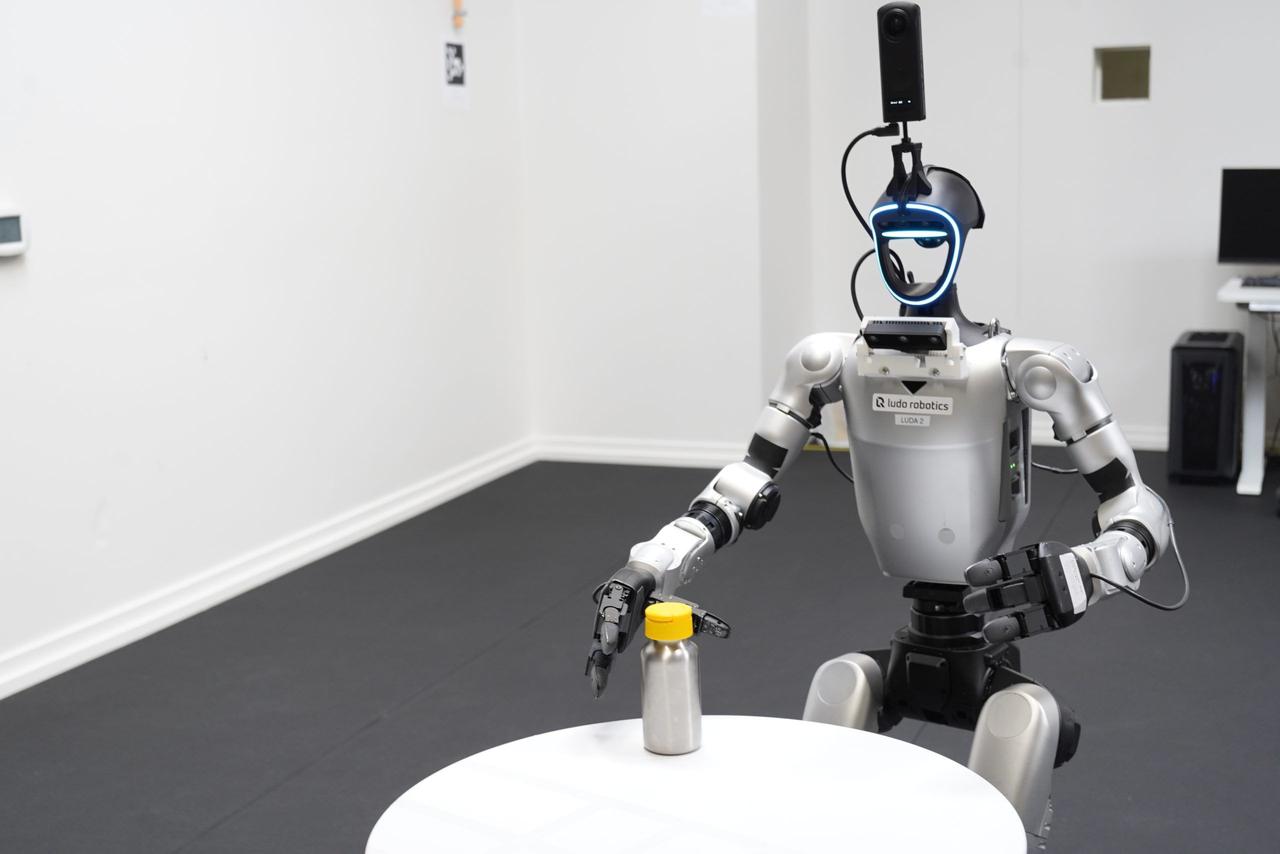
Building on Ludi 0.1 introduced in August 2026, Ludi 0.2 advances several capabilities that support more natural human-robot interaction
3
. The system now features improved gesture recognition, allowing robots to interpret human gestures and physical movements alongside verbal commands2
4
. Enhanced conversational memory enables the system to maintain context during changing tasks and respond to feedback more effectively1
4
. For example, a robot carrying a requested drink can stop and switch to another beverage when a person changes the instruction mid-task4
. The system also demonstrates improved coordination between movement and object manipulation, along with smoother physical actions4
.
Source: SiliconANGLE
Technical Architecture Combining Multiple AI Models
Ludi 0.1 uses an architecture combining several existing AI models to achieve its capabilities
1
. A vision-language model from Alibaba's open-source Qwen family analyzes camera images and transcribed speech to decide what the robot should do next1
. Nvidia's GR00T robotics foundation model, fine-tuned by Ludo, controls physical tasks such as picking up objects1
. The system runs on Unitree's G1, a roughly $16,000 humanoid robot, with Ludo's software coordinating the components1
. The company trained its reasoning model on 14,432 computer-generated interaction sequences, while the robot learned physical manipulation separately from recordings of people remotely controlling it in a mock household1
.Leveraging Synthetic Data From Game Engines
Krafton believes its gaming expertise offers advantages in generating training data for AI for robots
1
. Game engines simulate how objects move and interact, providing virtual environments that can generate synthetic data1
. Kim says Ludo is already using synthetic data from these worlds and plans to incorporate more real-world information as its research advances1
. However, while simulation makes it easy for physical AI to prepare robots to work with objects and around humans, it doesn't always prepare them to model human behavior2
. This gap highlights why interpreting human intent and responding to social cues from people around the robot remains elusive, even as startups bring increasing capability to help robots see objects and manipulate them2
.Related Stories




Research Roadmap Toward Unified Foundation Models
Ludo Robotics is developing Ludi 1.0, a next-generation foundation model currently in development that aims to integrate perception, dialogue, and physical action within a unified system
3
4
. The objective is to integrate communication, reasoning, and physical action into one brain that can watch what's happening, listen to commands and speech, interpret those commands alongside human gestures, and reason about the environment in real time2
. This would coordinate similarly to how another human decides on actions based on another person's actions in their workspace2
. Kim acknowledges that everyone seems to be working on building a foundation model, but considers it an enormous challenge1
. Kim's longer-term goal is to expand this work into developing Krafton's own proprietary foundation model1
.
Source: Korea Times
Establishing Silicon Valley Research Presence
Ludo Robotics is headquartered in Palo Alto, California, with an additional research and development lab in Seoul, South Korea
3
4
. These locations place the team close to leading research talent, academic institutions, and the broader technology ecosystem3
. Krafton announced that Ludo Robotics has officially opened its headquarters research center in Palo Alto, which will work alongside its Seoul office to advance AI and robotics research4
. The company's scientific leadership brings together expertise across AI, robotics, and human-computer interaction3
. Chief Scientist Rob Nowak is an IEEE Fellow and professor at the University of Wisconsin-Madison, specializing in machine learning, embodied AI, and robot learning3
. Yea-Seul Kim, Human-Robot Interaction Lead, is a former assistant professor of Computer Sciences at the University of Wisconsin-Madison, with expertise in human-computer interaction, information visualization, and data science3
.Market Context and Competition in Humanoid Robotics
The robotics industry is pushing toward making humanoids part of everyday life, taking on work in homes and offices
1
. Billions of dollars are flowing toward machines capable of increasingly complex physical tasks1
. The humanoid robot maker Figure raised more than $1 billion last year at a $39 billion valuation, while the robotics software startup Skild AI secured $1.4 billion in January to develop artificial intelligence that can control different kinds of robots1
. However, working alongside people requires understanding incomplete instructions and adapting when someone changes their mind midway through a task1
. A robot that needs constant explanations could leave its owner supervising the very work they hoped to hand over1
. Kim sees initial opportunities in homes, offices, and factories, where robots must work alongside people rather than simply perform repetitive tasks1
. This is the Holy Grail of physical AI, where intelligent robots can perform actions not just in industrial environments and warehouses, but also retail and domestic spaces such as restaurants, living rooms, and kitchens2
.
Source: Fast Company
References
Summarized by

Navi
[2]
Related Stories
Recent Highlights



Recent Highlights
Today's Top Stories







Don’t drown in AI news. We cut through the noise - filtering, ranking and summarizing the most important AI news, breakthroughs and research daily. Follow topics that matter to you and stay ahead.


