Lockheed Martin Uses 5G Networks to Detect and Track Drones Without New Infrastructure


2 Sources
[1]
Existing 5G networks can now detect and track drones in real time
The US is testing a new way to spot drones without building a separate detection network. A new system uses existing 5G infrastructure to detect, track, and monitor unmanned aircraft. Lockheed Martin and its partners demonstrated the technology near Miami in July. The test showed how commercial
[2]
Lockheed Martin Demonstrates NetSense Airspace Awareness-As-A-Service System For UAS Detection
Lockheed Martin, in collaboration with Verizon, NVIDIA, Keysight Technologies, ODC and Astris AI, recently showcased how commercial off-the-shelf (COTS) technologies can make detecting and tracking unmanned aircraft systems (UAS) more accessible, faster to deploy, and easier to scale for public and
Share
Copy Link
Lockheed Martin, Verizon, and NVIDIA demonstrated NetSense in Miami, showing how existing 5G networks can detect and track drones using AI-powered analysis of radio-frequency signals. The system offers airspace awareness for critical infrastructure without requiring dedicated hardware, with pilot deployments planned for late 2026.
5G Networks Transform Into Drone Detection Systems
Lockheed Martin demonstrated a breakthrough approach to drone detection that converts existing 5G networks into airspace monitoring tools. The NetSense Airspace Awareness-as-a-Service system, tested near Miami in July, showed how commercial wireless infrastructure can detect and track drones without requiring dedicated sensors or specialized hardware.
1
The demonstration involved collaboration with Verizon, NVIDIA, Keysight Technologies, ODC, and Astris AI, proving that unmanned aircraft systems detection can leverage infrastructure already deployed across cities.2
How AI-Powered Drone Detection Works
The system analyzes radio-frequency disturbances around cellular networks to identify drone activity and maintain tracking as aircraft move through airspace. NetSense combines several commercial technologies: Verizon provided the 5G network spectrum, ODC supplied AI-native radio software, and NVIDIA's AI Aerial platform performed real time signal analysis of RF signals.
1
Keysight Technologies contributed RF simulation technology, while Lockheed Martin's systems processed the data to detect and track drones. During the Miami demonstration in a high-traffic urban area, NetSense detected a drone, alerted operators, and maintained track custody throughout the flight.2
NVIDIA executive Ronnie Vasishta explained that the technology brings AI-powered sensing closer to the network edge, enabling rapid analysis of RF disturbances and faster alerts.
1
The system requires no changes to existing cellular radio deployments, making large-scale implementation feasible for infrastructure operators without recapitalization of cellular infrastructure.Critical Infrastructure and Airspace Security Applications
The NetSense system addresses growing airspace awareness needs as drones become cheaper and more accessible. Airports, hospitals, power plants, stadiums, and government facilities can gain another layer of airspace security through this technology.
1
Critical infrastructure operators face increasing drone activity around sensitive sites, making counter-drone methods essential for protection. City, state, and federal government customers can gain proactive monitoring and alerts, with applications spanning large-scale events, utilities, schools, and everyday public spaces.2

Source: Interesting Engineering
Verizon's Anil Guntupali noted that existing 5G signals provide useful sensing data when paired with intelligent software, transforming communications networks into security tools without replacing core infrastructure.
1
This approach proves more scalable than traditional counter-drone systems requiring dedicated sensors.Related Stories

Open Architecture Enables Future Expansion
The system's open architecture design allows additional sensors and interceptors to connect with existing platforms without requiring entirely new hardware.
2
Engineers can expand capabilities as technologies emerge, with continuous enhancements possible including improved data interpretation and target classification. Lockheed Martin confirmed the system complements future 6G Integrated Sensing and Communication networks, currently working with 5G spectrum while providing a path toward broader cellular integration.1
The competitive commercial market driving the solution can reduce costs and foster innovation compared to custom-built systems. NetSense's scalability ranges from protecting a single critical site to supporting mobile command and control systems for larger operations.
2
Deployment Timeline and Subscription-Based Model
Lockheed Martin plans to offer NetSense through a subscription-based model that interfaces with customers' existing security operations rather than requiring separate command structures.
1
Pilot deployments are scheduled for the second half of 2026 and early 2027, with commercial general availability planned for 2027. Initial customers will include organizations with urgent airspace security requirements, with early deployments limited to select customers needing immediate capability.2
The technology demonstrates how ordinary communications infrastructure can gain a secondary security role, making drone awareness more accessible without rebuilding America's wireless infrastructure. As drone proliferation continues, the ability to monitor low-altitude airspace using existing networks could become standard practice for protecting populated areas and sensitive locations.
References
Summarized by

Navi
[1]
Related Stories
Czech startup's AI acoustic drone detection targets power grids with €150 sensors
16 Jun 2026•Technology
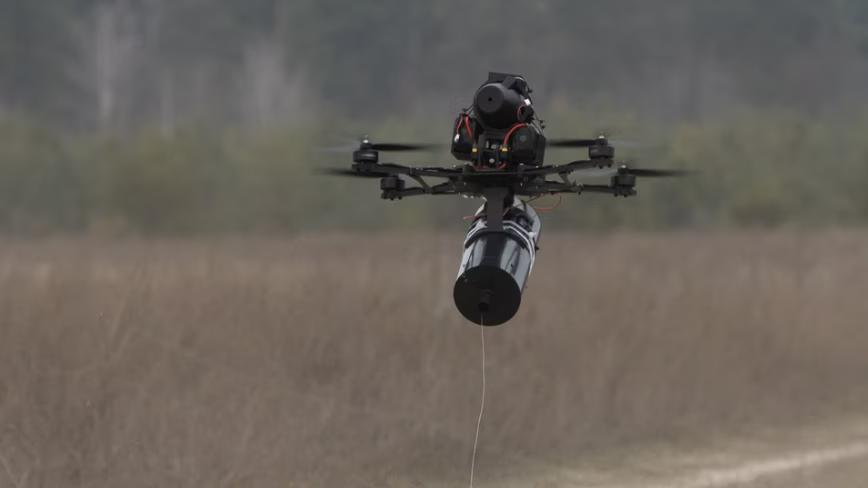
Europe Deploys AI-Powered Anti-Drone Systems as Russian Incursions Expose NATO Vulnerabilities
06 Nov 2025•Technology

Lockheed Martin Tests AI Battle Manager to Defend Guam from Missile Attacks
27 Aug 2026•Technology

Recent Highlights
1
Microsoft and Nvidia Launch Surface Laptop Ultra: A $2,599 AI-Ready PC With RTX Spark Chip
Technology

2
OpenAI Releases 722 AI-Generated Math Papers on GitHub, Igniting Fury Among Mathematicians
Science and Research

3
Trump Consulted Grok AI Before Ordering Venezuela Invasion and Capture of Nicolás Maduro
Policy and Regulation

Recent Highlights
Today's Top Stories









Don’t drown in AI news. We cut through the noise - filtering, ranking and summarizing the most important AI news, breakthroughs and research daily. Follow topics that matter to you and stay ahead.


