Lumilens Exits Stealth at $5.5B Valuation to Fix AI Data Centers' Connectivity Crisis


3 Sources
[1]
Optical networking firm Lumilens valued at $5.5 billion in latest funding round
Aug 6 (Reuters) - Optical networking startup Lumilens said on Thursday it was valued at $5.51 billion in its latest funding round, as surging investment in AI data centers fuels demand for high-speed connectivity technologies. The San Jose, California-based company designs and manufactures optical
[2]
Lumilens leaves stealth at $5.5bn to fix AI's wiring problem
The hard part of building AI is no longer buying the chips. It is wiring them together, and a two-year-old startup called Lumilens has raised more than $700m betting the fix is light, not copper. Lumilens came out of stealth on Thursday with a big number and a bigger claim. It announced more than
[3]
Optical networking startup Lumilens launches with $900M in funding
Lumilens Inc., a provider of optical networking chips for artificial intelligence clusters, launched today with $900 million in funding. The company raised the bulk of the capital, $700 million, through a Series C round that valued it at $5.51 billion. Atreides Management, Bain Capital Ventures,
Share
Copy Link
San Jose-based Lumilens emerged from stealth mode with $700 million in Series C funding, achieving a $5.51 billion valuation. The optical networking startup is already shipping products under a multi-billion-dollar agreement with a hyperscaler, addressing the critical bottleneck in AI infrastructure where connecting GPUs has become harder than acquiring them.
Lumilens Emerges from Stealth with $5.51 Billion Valuation
Optical networking startup Lumilens exited stealth mode with a significant announcement: more than $700 million raised in a Series C funding round, bringing total capital to over $900 million and valuing the San Jose-based company at $5.51 billion
1
2
. The round was co-led by Atreides Management, Bain Capital Ventures, Meritech, Seligman Ventures and Spark Capital, with participation from Qualcomm Ventures and JPMorgan among more than a dozen investors3
. Mayfield's Navin Chaddha, who has backed founder Ankur Singla three times, stated he had never witnessed growth like this in the firm's 56-year history2
.Solving AI's Wiring Problem Through Optical Innovation
The two-year-old company addresses a fundamental shift in AI infrastructure constraints. "The constraint on AI has shifted from how many GPUs you can buy to how many you can connect," explained Ankur Singla, Lumilens CEO
1
. Modern AI models run across hundreds of thousands of chips that must function as a single computer, making GPU connectivity the new bottleneck2
. Hyperscalers told Lumilens they need two critical capabilities: significantly more optical capacity for current networks and a path to directly connect thousands of GPUs into a single cluster1
.Why Copper Hit a Wall in AI Data Centers
The AI industry faces two interconnected challenges that Lumilens targets. Across racks, every GPU added multiplies the optical transceivers required—a single 400,000-GPU site demands more than 2.4 million transceivers, exceeding market capacity
2
. Inside racks, copper interconnects have reached their physical limits. At AI speeds, electrical signals survive approximately 1.5 meters over copper, capping tightly linked clusters at a few hundred chips2
. "The distance limitation starts to come in the moment you get to 1.6 Tb/s, you're actually at one meter or so in distance with copper. That basically is within the rack," Singla explained3
. To wire thousands of GPUs together, the industry must replace copper with light-based solutions.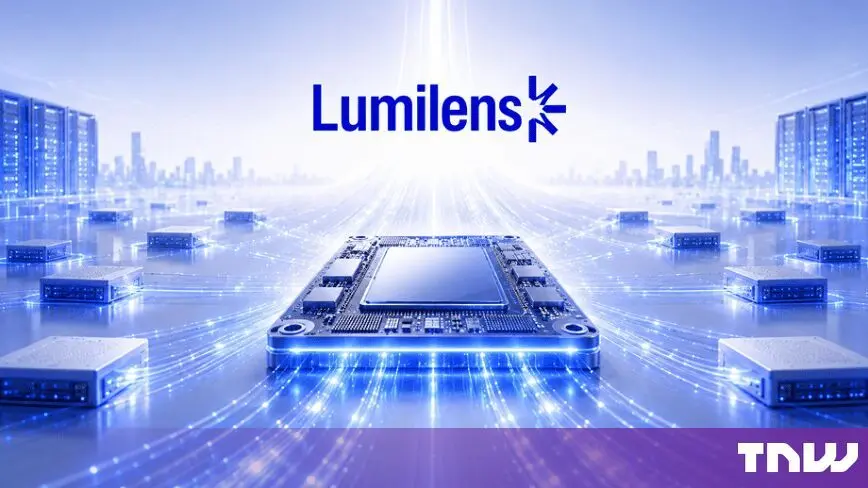
Source: The Next Web
LumiCore Architecture Powers Scale-Up and Scale-Out Networks
Lumilens designs and manufactures optical and networking products that enable AI data centers to move data faster while consuming less power
1
. The company's technology addresses both scale-up networking, which links chips within a single rack, and scale-out networking, which connects different racks3
. For scale-up applications, Lumilens offers two product families: co-packaged optics (CPO) chips that integrate directly into GPUs for maximum power-efficient performance, and near-packaged optics (NPO) chips that sit on the motherboard hosting GPUs3
. "We believe that we're still about two to three years away when it comes to large-scale volume deployment of co-packaged optics and the interim solution is near-packaged optics," Singla noted, adding that Lumilens pioneered this approach with its first chip taping out in 20243
.
Source: SiliconANGLE
For scale-out transceivers, Lumilens ships silicon as part of pluggable devices attachable to switches, supporting connections at 800 gigabits per second, 1.6 terabits per second, or higher bandwidths without the range limitations plaguing copper
3
. All products are built on the LumiCore architecture, a common set of building blocks including photonic components, mixed signal integrated circuits, and interposers that reduce chip development time from years to months3
.Multi-Billion-Dollar Agreement Signals Market Validation
Lumilens is already shipping products under a multi-billion-dollar agreement with an unnamed customer identified as one of the four hyperscalers—Amazon, Alphabet, Microsoft, or Meta
1
. The company says it has received billions of dollars worth of chip orders, demonstrating market validation beyond typical startup milestones3
. This deployment into live data centers gives Lumilens what the market values most: a product already solving real-world problems2
. The funding arrives as hyperscalers spend billions expanding AI data centers to meet surging demand for artificial intelligence services, with Citigroup forecasting AI infrastructure outlays exceeding $2.8 trillion by 20292
.Related Stories

Proven Leadership and Competitive Landscape
Ankur Singla brings credibility through his track record of building and selling two infrastructure companies: Contrail to Juniper and Volterra to F5, for a combined $676 million
3
. Lumilens has assembled a team of executives and engineers from Cisco, Juniper Networks, Meta, Marvell, Lumentum and Coherent, bringing deep expertise in photonics and large-scale networking1
. However, the company faces intense competition. Co-packaged optics represents one of the hottest corners of the chip world, contested by Nvidia, Broadcom, and numerous startups2
. Chinese rivals including Eoptolink are pursuing the same prize, and while a substantial private valuation is notable, maintaining a durable lead requires continuous innovation2
.What to Watch: Manufacturing Scale and Market Expansion
Lumilens plans to use the fresh capital to scale engineering and manufacturing operations
1
. The company has developed a custom manufacturing workflow incorporating robots and AI software to ease chip assembly processes3
. With its second generation of chips taped out and preparing for commercial deployment next year, the company's ability to execute at volume will determine whether it can maintain its early advantage3
. The broader implication is clear: in high-speed optical networking for AI, moving data has become harder than processing it, and the companies that solve this wiring problem will shape the future of AI infrastructure.References
Summarized by

Navi
[2]
Related Stories
Photonic Startups Attract Major Investments as AI Data Centers Seek Efficiency Boost
16 Oct 2024•Technology

Ayar Labs Raises $500M to Mass-Produce Optical Chips That Connect Thousands of GPUs
04 Mar 2026•Startups

Celero Raises $275M to Connect AI Chips with Coherent DSP Technology at $3B Valuation
09 Sept 2026•Technology
Recent Highlights



Recent Highlights
Today's Top Stories






Don’t drown in AI news. We cut through the noise - filtering, ranking and summarizing the most important AI news, breakthroughs and research daily. Follow topics that matter to you and stay ahead.


