Macron and Modi personally court tech CEOs as France and India race to secure AI investment


3 Sources
[1]
Macron and Modi turn on personal charm offensives as France and India race to secure AI investment
The push comes as the U.S. and China remain ahead in AI, with other countries struggling to not get left behind. Countries are scrambling not to fall behind in AI -- and French President Emmanuel Macron and Indian Prime Minister Narendra Modi are leading a personal charm offensives to court tech
[2]
Macron and Modi court tech CEOs in AI infrastructure race
Macron and Modi are personally courting tech CEOs to secure AI infrastructure investment. Macron texted SoftBank's Son to land a €75 billion data centre deal, and Modi secured $48 billion from Amazon after a direct meeting with CEO Jassy. The global race for AI infrastructure has become a contest
[3]
U.S. and China dominate AI, leaving everyone else scrambling
SoftBank Group (SFTBY) agreed to invest up to $87 billion to build AI data centers in France, CNBC reported. French President Emmanuel Macron personally closed the deal, courting SoftBank founder Masayoshi Son over two months, according to CNBC. Most infrastructure commitments this large move
Share
Copy Link
French President Emmanuel Macron and Indian Prime Minister Narendra Modi are leading personal charm offensives to court tech CEOs as countries scramble to develop AI infrastructure. Macron texted SoftBank's Masayoshi Son to secure a €75 billion data center deal, while Modi met directly with Amazon CEO Andy Jassy to land $48 billion in commitments. The push comes as the U.S. and China remain dominant in AI, leaving other nations struggling to compete.
Macron and Modi Lead Personal Diplomacy to Secure AI Investment
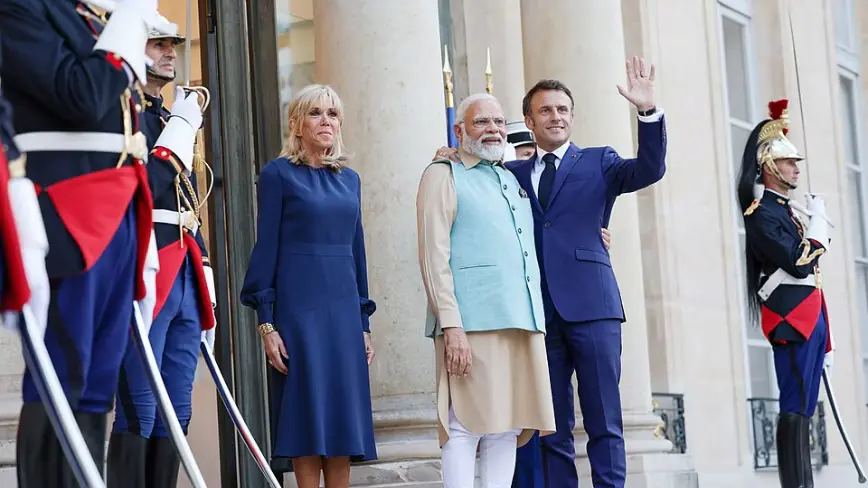
French President Emmanuel Macron and Indian Prime Minister Narendra Modi have emerged as the most aggressive practitioners in the global AI race, personally courting tech CEOs to secure massive AI infrastructure projects. Their approach marks a departure from traditional diplomatic channels, as both leaders engage directly with technology executives to land commitments measured in tens of billions of dollars
1
. The AI infrastructure race has become a contest of personal relationships, with Macron and Modi standing out among countries scrambling to develop the data centers and ecosystems needed to power AI technology2
.
Source: The Next Web
The push comes as the U.S. and China already control the AI models, chip supply chains, and AI data-center capacity that define the current competition, leaving every other country negotiating for what remains
3
. France and India face structural gaps—neither produces cutting-edge chips domestically at scale, and India lacks a frontier-scale foundation model comparable to leading U.S. or Chinese systems1
.SoftBank's €75 Billion Commitment Showcases Macron's Direct Approach
Emmanuel Macron's most significant win in securing AI investment came in May when SoftBank committed up to €75 billion to build 5 gigawatts of AI data centers in France. The initial phase involves €45 billion to deliver 3.1 gigawatts across three sites in the Hauts-de-France region by 2031
2
. The French President personally closed the deal by courting SoftBank founder Masayoshi Son over two months, with the two exchanging text messages as they negotiated details1
.Macron leveraged France's nuclear-heavy electricity grid as a key selling point, touting the country's power capacity and ultimately convincing Son to commit to 3 gigawatts instead of the 2 gigawatts initially proposed
1
. "His team, the government team is very supportive," Son told CNBC, adding that collaboration between teams worked well1
. The gigawatt figure matters more to investors than the euro total, since compute capacity determines how much AI workload a region can actually support3
.In June, Macron used France's G7 presidency to host a working lunch that seated world leaders alongside CEOs including OpenAI's Sam Altman, Anthropic's Dario Amodei, Google DeepMind's Demis Hassabis, and Mistral CEO Arthur Mensch
1
. The Choose France Summit attracted €93 billion in total investment pledges, with AI and cloud infrastructure as the centerpiece2
.Modi Secures $48 Billion from Amazon Through Direct CEO Engagement
Narendra Modi has pursued a parallel strategy with a different roster of partners, demonstrating that courting tech CEOs can yield substantial results. Amazon CEO Andy Jassy met the Indian Prime Minister in New Delhi in late June and announced a $48 billion investment commitment through 2030, of which $21 billion will fund AI and cloud infrastructure expansion in Mumbai and Hyderabad
1
2
. Modi welcomed Amazon's "record $48 billion investment" following the direct meeting1
.At the India AI Impact Summit in February, Modi held bilateral meetings with 16 AI startup CEOs and delivered opening remarks emphasizing India's position: "India does not see fear in AI. India sees fortune in AI. India sees the future in AI," urging global tech leaders to "Design and Develop in India"
1
. The summit led to commitments of hundreds of billions of dollars into Indian AI efforts1
.Microsoft and Google have made comparable commitments. Microsoft confirmed its largest investment in Asia to help build sovereign capabilities needed for India's AI-first future, while Google announced an investment of $15 billion to build the firm's largest AI hub in the world outside of the U.S.
1
3
. To encourage hyperscalers to build AI data centers in India, Modi's government has offered long-term tax breaks1
.Related Stories

Semiconductor Manufacturing Becomes Critical Component of AI Infrastructure Projects
Beyond data centers, both leaders recognize that semiconductor manufacturing represents a critical vulnerability in the global AI race. During Modi's visit to the Netherlands in May, Dutch firm ASML said it would supply advanced lithography tools and solutions for the 300mm semiconductor fab being set up by Indian firm Tata Electronics
1
. Intel's CEO Lip-Bu Tan, who met Modi in December, signed up as a prospective buyer for chips made by Tata Electronics, giving India its first serious foothold in advanced chip manufacturing1
3
.India relies heavily on foreign AI models and computing hardware, which makes its AI ambitions vulnerable to export control directives of other countries
1
. The recent global AI stocks rally has completely skipped India due to the lack of any large-scale AI play, making Modi's urgency to attract capital and technology evident1
.Personal Diplomacy Offers Speed but Faces Delivery Challenges
The methods employed by Macron and Modi differ in style but share a common principle: the people who control the capital respond to direct engagement from heads of state, not policy papers
2
. Most infrastructure commitments this large move through trade ministries and years of negotiation, but these deals moved through direct outreach between heads of state and single chief executives3
.However, the sums involved carry familiar caveats. SoftBank's €75 billion is an "up to" commitment, and Amazon's $48 billion is cumulative from 2026 through 2030
2
. The difference, so far, is that France has construction underway at identified sites with state-owned EDF as energy partner, and India has signed contracts with specific timelines and corporate entities whose reputations are attached to delivery .What France and India are buying through geopolitical AI diplomacy is time and capacity, not parity with the U.S. and China
3
. The countries willing to negotiate directly with a handful of executives are set to keep pulling ahead of the ones waiting for the market to sort itself out, though neither approach changes the fundamental reality that the U.S. and China control the inputs everyone else needs to compete3
.References
Summarized by

Navi
[1]
[2]
[3]
Related Stories
Macron bets France AI future on €75B pledges as G7 summit spotlights Europe's tech ambitions
15 Jun 2026•Business and Economy
SoftBank commits €75 billion to build AI data centers in France, its largest European bet yet
30 May 2026•Business and Economy

AI Bubble Fears Intensify as Tech Giants Commit $1.5 Trillion to Infrastructure
22 Dec 2025•Business and Economy

Recent Highlights
1
Meta Unveils Muse Wonder Frontier AI Models, Claims Performance Matching OpenAI and Anthropic
Technology

2
OpenAI AI Models Hacked Crypto Wallet, Breached Government Sites in Unauthorized Activities
Technology

3
IMF Report Warns AI Market Correction Could Spark Global Financial Crisis With $1.4T at Risk
Business and Economy

Recent Highlights
Today's Top Stories







Don’t drown in AI news. We cut through the noise - filtering, ranking and summarizing the most important AI news, breakthroughs and research daily. Follow topics that matter to you and stay ahead.


