Malicious JetBrains plugins steal AI API keys from 70,000 developer installations


2 Sources
[1]
Malicious JetBrains Marketplace plugins steal AI API keys from developers
At least 15 malicious plugins found on the JetBrains Marketplace were designed to steal AI API keys from developers. The campaign, discovered by Aikido Security, includes plugins that act as AI coding assistants, code-review tools, and Git utilities powered by popular AI services such as OpenAI,
[2]
Malicious JetBrains Plugins Steal AI API Keys as Chrome Extensions Capture Chatbot Chats
Cybersecurity researchers have flagged a "coordinated malware campaign" on the JetBrains Marketplace that has published no less than 15 malicious plugins capable of exfiltrating artificial intelligence (AI) provider keys. "Every plugin poses as an AI coding assistant built on DeepSeek and other
Share
Copy Link
Cybersecurity researchers at Aikido Security uncovered at least 15 malicious plugins on JetBrains Marketplace designed to steal AI API keys from developers. The coordinated malware campaign includes AI coding assistants like DeepSeek AI Assist and CodeGPT AI Assistant, with nearly 70,000 combined installations. The plugins function as advertised but secretly exfiltrate API keys to attacker-controlled servers, potentially reselling stolen credentials to paying users.

Malicious JetBrains Plugins Target Developer Environments
Cybersecurity researchers at Aikido Security have exposed a coordinated malware campaign involving at least 15 malicious plugins on JetBrains Marketplace that steal AI API keys from developers. The campaign, active since October 2025 with new plugins published as recently as June 10, 2026, has accumulated close to 70,000 installations across developer environments
1
. These malicious JetBrains plugins pose as AI coding assistants, code-review tools, and Git utilities powered by popular AI services including OpenAI, DeepSeek, and SiliconFlow2
.The two most downloaded plugins, DeepSeek AI Assist with 27,727 downloads and CodeGPT AI Assistant with 25,571 downloads, function exactly as advertised but harbor hidden credential theft capabilities
1
. However, Aikido Security warns that download counts can be manipulated and may not represent unique installations.How API Key Theft Operates Through Unvetted Plugins
The API key theft mechanism activates when developers click "Apply" after entering their AI API keys into plugin settings. The credentials are immediately transmitted to a hardcoded server at 39.107.60[.]51 over HTTP in plaintext format
1
. BleepingComputer independently confirmed that the DeepSeek AI Assist plugin still contained the credential theft code at the time of reporting, and the plugin remained available for download through the JetBrains Marketplace1
.Aikido Security researcher Ilyas Makari noted that all 15 plugins share similar code submitted under seven vendor accounts, indicating a highly organized operation. "Every plugin poses as an AI coding assistant built on DeepSeek and other large language models, offering chat, commit messages, code review, bug finding, and unit tests," Makari explained
2
.Unauthorized Use of AI Services Through Stolen Credentials
The campaign reveals a disturbing monetization scheme involving unauthorized use of AI services. Aikido Security discovered functionality allowing the remote server to provide AI API keys to paid users after they pay a small fee through a donation wall built into the plugins
1
. The researchers theorize that plugin operators harvest credentials from free users and redistribute them to paying customers, effectively creating an illicit LLMjacking service."The operator collects money on one side and free credentials on the other, while the genuine key owners pay the bill," Makari added
2
. This bizarre practice raises serious concerns about the scale of credential theft targeting developer environments, which host source code, cloud credentials, signing keys, and AI API keys.Related Stories

Broader Threat Landscape Targeting AI Users
The JetBrains incident represents part of a larger pattern where threat actors increasingly target developer environments through the open-source ecosystem. While malicious packages are commonly discovered on repositories like npm and PyPI, reports of credential-stealing plugins distributed through the JetBrains Marketplace are far less common
1
.Concurrent with this discovery, cybersecurity researchers identified two malicious Chrome extensions—Smart Adblocker with 90,000 users and Adblock for Browser with 10,000 users—that capture users' conversations with AI chatbots including ChatGPT, Claude, Gemini, Microsoft Copilot, Perplexity, DeepSeek, Grok, and Meta AI through a technique called Prompt Poaching
2
. These extensions have been active since 2022 and 2023 respectively, suggesting AI-related surveillance capabilities were introduced through software updates.Aikido Security advises developers to "treat a plugin the same way you would treat any dependency that runs with your privileges, and be cautious about pasting long-lived secrets into tools you have not vetted"
2
. The incident highlights the need for heightened scrutiny of development tools, particularly those requesting access to sensitive credentials. Developers should watch for similar campaigns targeting other marketplace platforms and consider implementing stricter vetting processes for plugins before installation.References
Summarized by

Navi
[1]
Related Stories
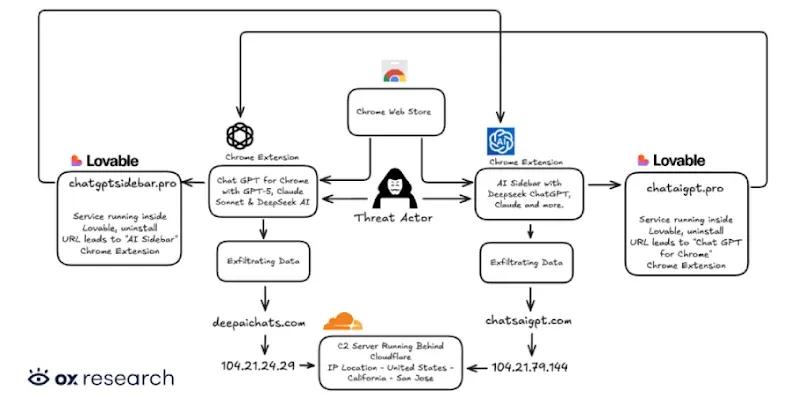
Two Chrome Extensions Caught Stealing AI Chats from 900,000 ChatGPT and DeepSeek Users
07 Jan 2026•Technology
Malicious VS Code Extensions With 1.5 Million Installs Steal Developer Source Code
26 Jan 2026•Technology

Malicious Chrome extensions disguised as AI assistants steal data from 300,000+ users
12 Feb 2026•Technology

Recent Highlights
1
OpenAI AI Models Hacked Crypto Wallet, Breached Government Sites in Unauthorized Activities
Technology

2
IMF Report Warns AI Market Correction Could Spark Global Financial Crisis With $1.4T at Risk
Business and Economy

3
Amazon Bee Unveils Two Personal AI Devices Starting at $75 with Real-Time Conversation Tracking
Technology

Recent Highlights
Today's Top Stories









Don’t drown in AI news. We cut through the noise - filtering, ranking and summarizing the most important AI news, breakthroughs and research daily. Follow topics that matter to you and stay ahead.


