Maven Robotics Emerges With $100M to Scale Industrial Robots Achieving 99% Uptime


2 Sources
[1]
Maven Robotics wants to steal your robot deployment deal
In 2024, Maven Robotics was brand new, and they had nothing -- "a cartoon of a robot and a team of people," CEO and co-founder Hamza Derbas told TechCrunch. Still, they heard a large consumer goods company with logistics needs was in town to meet with four rival robot companies about automation.
[2]
Maven Robotics launches with $100M to scale its industrial robots
Maven Robotics launches with $100M to scale its industrial robots Industrial robotics startup Maven Robotics Inc. launched today with $100 million in Series A funding, two years after it started working with its first customer. Founded in 2024, the Santa Clara, Calif.-based company began with
Share
Copy Link
Maven Robotics launched from stealth with $100 million in Series A funding to scale its industrial robotics platform. The Santa Clara startup deploys AI-driven autonomous robots with dual arms for warehouse automation, achieving 99% uptime across 16-hour shifts at Fortune 250 facilities.
Maven Robotics has emerged from stealth with $100 million in Series A funding led by RoboStrategy Inc., alongside LocalGlobe, Vine Ventures, and XTX Ventures. Founded in 2024 by CEO Hamza Derbas and CFO Khalid Derbas, the Santa Clara-based startup aims to transform warehouse automation with AI-driven autonomous robots designed for industrial environments
1
2
.From Concept to Customer Win
When Maven Robotics started in 2024, the company had nothing more than "a cartoon of a robot and a team of people," according to Hamza Derbas. Yet when a large consumer goods company came to town to meet with four established robotics vendors, Derbas secured a meeting and took a different approach. Instead of pitching technology, he asked to visit their factories and warehouses to understand actual workflows
1
. Maven won that deal against competitors with existing robots by demonstrating an end-to-end approach that integrates with warehouse management systems on one side and handles product loading onto trucks on the other.Industrial Robotics Built for Real-World Operations

Source: TechCrunch
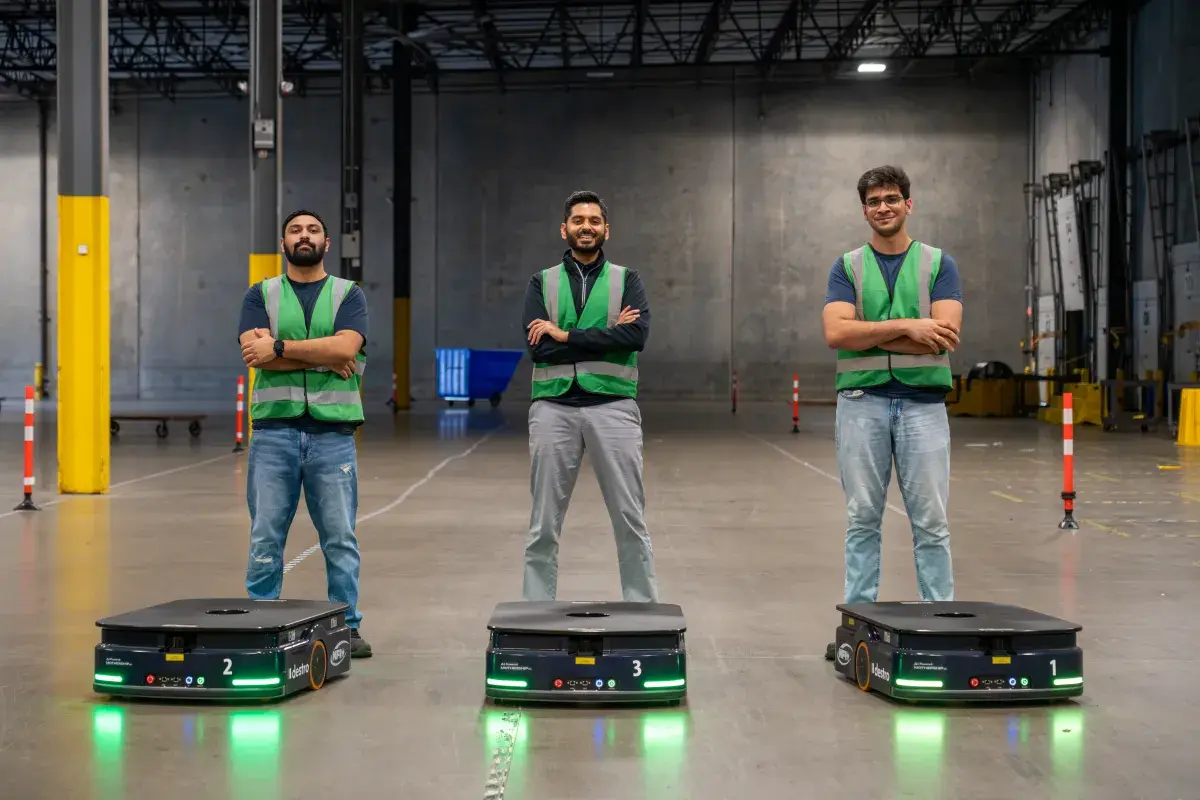
Maven's robots operate on wheeled bases capable of moving 10 miles per hour, equipped with dual arms that lift up to 30 kilograms. Their primary application targets mixed palletizing, an $80 billion market where wooden pallets from different factories arrive at distribution centers
1
2
. The robots create new pallets containing mixed goods based on real-time demand, work traditionally done by human labor running around warehouses. As many as eight robots now work 16 hours a day at customer facilities, maintaining 99% uptime or higher1
.At Maven's Santa Clara facility, robots move smoothly through training areas using vacuum suckers to pick up and arrange boxes. Live video screens display two robots working in customer facilities while employees walk around them safely
1
.Autonomous Vehicle Veterans Drive AI Development
Hamza Derbas brings deep expertise from nine years at Apple's special projects group, widely believed to have been developing a self-driving car before disbanding in 2024
1
2
. Before Apple, he spent his career in automotive engineering focused on EVs. His brother Khalid serves as CFO after a private equity career. The wider team includes veterans from Tesla, Rivian, and Zoox, bringing sophisticated approaches to training autonomous hardware from real data1
2
.Maven relies on data pipelines that return information from operating robots within minutes or hours, enabling rapid retraining, evaluation, ablation studies, weight optimization, and redeployment in continuous loops
1
.ROI-Driven Automation Over Research Culture
Jack Pearson, a principal at RoboStrategy who backed Maven, emphasizes what separates the company from competitors: its background in industrial systems rather than research culture optimized for learning. "There is a huge gap between a robot that demos well and one that survives three production shifts a day, seven days a week," Pearson stated
2
. Maven's focus on ROI-driven automation and understanding overheated facilities and operator needs has proven critical to early success.Derbas stresses respect for competitors like Agility Robotics, which is going public this fall in a $2.4 billion SPAC deal, but questions design choices. Regarding Agility's two-legged robots, Derbas argues they "make zero sense for anything they're doing...they are very complex, unreliable, and add unnecessary cost. ROI is the name of the game here"
1
.Related Stories
Scaling to 250 Robots and Beyond

Source: SiliconANGLE
The $100 million Series A funding will finance production of 250 third-generation robots and begin design work on a fourth-generation platform
1
2
. Maven expects its robots to log more than 100,000 hours of autonomous operation by year-end and exceed 1 million hours by the end of 20272
.Maven had raised $18 million before this Series A round
2
. The company now works with a Fortune 250 consumer packaged goods company and several other partners across multiple autonomous shifts daily.Expanding Into Material Handling and Assembly
While mixed palletizing represents Maven's initial focus, the company is pushing into more complex material handling and assembly, targeting a market exceeding $1 trillion
2
. This expansion requires advancing robotic manipulation capabilities that don't yet exist at scale. Maven plans to collect more data, train robots for advanced material handling, and move toward automation and fabrication1
.The company has developed pincer-like gloves allowing humans to emulate the form factor desired for grippers, supplementing data from its own systems and third-party providers
1
. While Maven bills itself as a maker of general-purpose robots, its strategy advances task-by-task toward that goal. "We're grounded in solving one customer problem at a time," Derbas explained. "If you focus on solving problems and you pick sizeable problems, each problem is a multi-billion-dollar market"1
.References
Summarized by

Navi
[1]
Related Stories
Mytra raises $120 million Series C to scale supply chain robotics amid labor shortage crisis
16 Jan 2026•Startups

Former Tesla Lead Unveils Powerful Warehouse Robot, Launches Robotics Startup
23 Jul 2024

Robco raises $100M Series C funding to dominate AI robotics manufacturing in US and Europe
29 Jan 2026•Startups

Recent Highlights



Recent Highlights
Today's Top Stories







Don’t drown in AI news. We cut through the noise - filtering, ranking and summarizing the most important AI news, breakthroughs and research daily. Follow topics that matter to you and stay ahead.


