Mercedes-Benz Drive Assist Pro brings AI-powered autonomous driving to US city streets


7 Sources
[1]
Mercedes teaches its driver assist how to handle surface streets
There's some debate as to when adaptive cruise control first showed up, but if you ask Mercedes-Benz, it will say in 1999 with that year's S-Class. Instead of just keeping a set speed, radar-enabled adaptive cruise control allowed the car to react to deceleration by the car ahead, and thus was
[2]
What I Learned 'Driving' a Mercedes With Next-Level AI
MB.Drive Assist Pro uses a combination of cameras, radar sensors, and ultrasonic sensors, along with Nvidia's AI end-to-end stack, to provide a safe and efficient driving experience. In October, Nvidia Corp. became the first public company to be worth $5 trillion -- then promptly lost hundreds of
[3]
Mercedes to offer autonomous driving tech for US city streets
Jan 5 (Reuters) - Mercedes-Benz (MBGn.DE), opens new tab said on Monday it will launch a new advanced driver-assistance system in the United States later this year that lets its vehicles operate autonomously on city streets under driver supervision. The system, which enables a vehicle to drive
[4]
This is what impressed me most about Mercedes' new driver-assist tech
QuickCharge: This Week in EV This story is part of our regular series, QuickCharge: This Week in EV Updated less than 5 minutes ago It's a remarkably sunny day for San Francisco. The fog that often encases the city in the morning has lifted, opening up spectacular views of Golden Gate and its
[5]

I Tried Mercedes' Answer To Tesla Full Self-Driving. It Handles City Streets -- With One Major Caveat
Riding shotgun next to Lucas Bolster in a prototype Mercedes-Benz CLA-Class, I tried to keep up as he explained his company's artificial intelligence strategy. I was there to see how MB.Drive Assist Pro -- Mercedes' new urban-focused automated driving system -- would handle San Francisco traffic,
[6]

NVIDIA DRIVE AV Software Makes Production Debut in New Mercedes-Benz CLA | AIM
Mercedes-Benz's latest CLA recently earned a five-star safety rating from the European New Car Assessment Programme (Euro NCAP) NVIDIA's DRIVE AV software is set to hit US roads later this year with its first production deployment in the all-new Mercedes-Benz CLA, as per the NVIDIA's official
[7]

Mercedes to offer autonomous driving tech for US city streets
Jan 5 (Reuters) - Mercedes-Benz said on Monday it will launch a new advanced driver-assistance system in the United States later this year that lets its vehicles operate autonomously on city streets under driver supervision. The system, which enables a vehicle to drive from a parking lot to a
Share
Copy Link
Mercedes-Benz launches Drive Assist Pro, an advanced driver-assistance system that handles urban navigation from parking lot to destination. Using Nvidia's AI technology and 30 sensors, the system navigates intersections, obeys traffic lights, and manages complex city driving scenarios. Available later this year for $3,950 for three years, it positions Mercedes as Tesla's main competitor in urban autonomous driving.
Mercedes-Benz Brings Autonomous Driving to City Streets
Mercedes-Benz announced it will launch Drive Assist Pro in the United States later this year, marking a significant expansion of autonomous driving capabilities beyond highways to urban environments
3
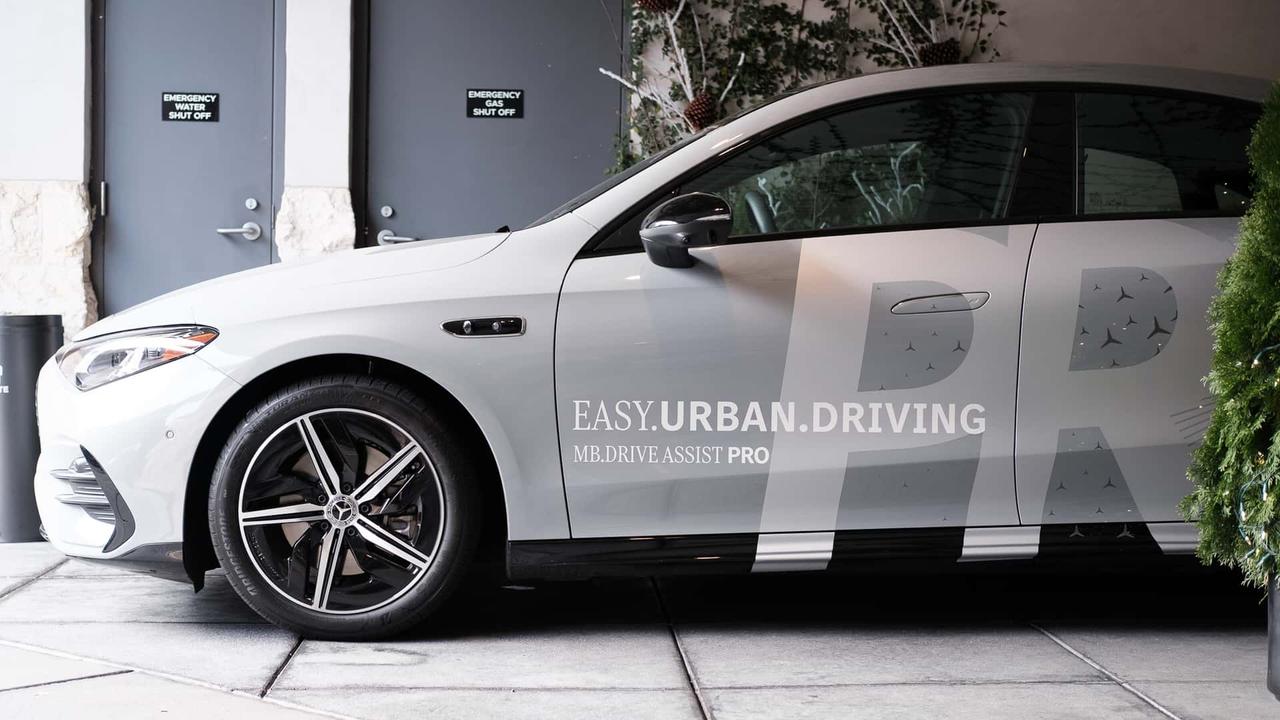
. The advanced driver-assistance system enables vehicles to operate autonomously on city streets under driver supervision, navigating from parking lots to destinations while handling intersections, turns, and traffic signals. Already available in China since late 2024, the system will debut in the US market with the redesigned CLA-Class, priced at $3,950 for a three-year subscription3
.
Source: InsideEVs
This positions Mercedes-Benz as the primary competitor to Tesla's Full Self-Driving system, which currently costs $8,000 as a one-time purchase or $99 per month
3
. The German automaker takes a distinctly different approach to safety and implementation, emphasizing what Chief Software Officer Magnus Östberg describes as collaborative human-machine interaction rather than pursuing full autonomy1
.AI-Powered Driving Systems Transform Urban Navigation
Drive Assist Pro represents a fundamental shift in how Mercedes-Benz approaches autonomous driving on city streets. The system employs approximately 30 sensors, including 10 cameras, five radar sensors, and 12 ultrasonic sensors, feeding data to a computer capable of processing up to 508 trillion operations per second
3
5
. Unlike earlier rule-based systems, the technology utilizes an end-to-end AI model that tokenizes input and output trajectories, backed by a rules-based safety guardrail to catch any AI trajectory mistakes before execution1
.
Source: Digital Trends
Nvidia plays a central role in this advancement, providing its Orin computer to handle perception and path planning
1
. Ali Kani, Nvidia's vice president of automotive, explained the AI model functions "like an LLM, but for vision," enabling the system to synthesize decisions from sensor data while maintaining strict adherence to traffic regulations4
. This collaboration represents part of Nvidia's estimated $5 billion automotive business in 2025, which includes partnerships with Toyota, Volvo, BYD, Li Auto, Lucid, NIO, Rivian, and General Motors2
.Level 2 Automated Driving System Requires Hands-On Navigation
Despite its advanced capabilities, Drive Assist Pro operates as a Level 2 automated driving system according to SAE standards, meaning drivers must remain alert and ready to intervene at all times
3
. However, Mercedes introduces what it calls "collaborative steering," allowing drivers to keep hands off the wheel or intervene with steering inputs without deactivating the entire system4
. This contrasts sharply with hands-free systems like General Motors' Super Cruise or Ford's BlueCruise, which allow drivers to remove their hands entirely on highways.Lucas Bolster, Mercedes' manager of automated and assisted driving, defended this approach, stating, "I think we don't see a good safety case for that in urban driving right now. As soon as your hands are off the wheel, you automatically bring in a prolonged reaction time"
5
. The system monitors driver attention through cameras perched atop the infotainment screen, ensuring eyes remain on the road while allowing flexible human intervention when needed2
.During demonstrations in San Francisco, the system successfully navigated Waymo-crowded streets, handling construction zones, double-parked cars, speed bumps, and complex multi-lane turns without human intervention
1
. The technology reads traffic lights and stop signs, though its cautious approach to complete stops may frustrate drivers accustomed to California rolling stops1
.
Source: Bloomberg
Related Stories




Software-Defined Vehicle Architecture Enables Advanced Features
The CLA-Class serves as Mercedes-Benz's first software-defined vehicle, replacing dozens of discrete control units with four powerful computers running all electronics
1
. This architecture enables over-the-air updates for continuous improvements to autonomous driving capabilities, with Mercedes officials suggesting quarterly software enhancements5
. The vehicle features the new MB.OS platform, integrating Nvidia's DRIVE AV software, AI infrastructure, and accelerated compute capabilities3
.Starting under $50,000, the CLA represents an entry-level option that brings advanced autonomous driving technology to a broader market
1
4
. This strategic positioning differs from Mercedes' typical approach of debuting technology in the flagship S-Class. The system runs two AI models in parallel for validation and safety assurance, training on both real-world data from current Mercedes vehicles and simulated scenarios5
.Market Implications and Competitive Landscape
The launch of Drive Assist Pro intensifies competition in the autonomous driving market, particularly challenging Tesla's dominance in urban ADAS. While Tesla has faced criticism and regulatory scrutiny over how Full Self-Driving capabilities are marketed, Mercedes emphasizes redundant sensor modalities and multiple safety layers
1
. Nvidia's Kani claimed, "There's not a passenger car they can drive this safely, other than when Mercedes is showing today. We are doing something that the entire industry has been trying to do for 10 years, and no one has done it before"5
.Investors view autonomous technology as a potential long-term revenue driver for automakers, with software advances moving capabilities from limited testing toward commercial rollout
3
. However, safety concerns and regulation continue to constrain full autonomy in personal vehicles. Mercedes already offers Level 3 Drive Pilot in Nevada and California, though only for low-speed freeway traffic jams1
.For consumers, the experience of AI-powered city driving may reshape expectations. One journalist noted after testing the system, "An hour in a car driven by AI makes everything else feel, well, dumb," predicting that once consumers feel safe relinquishing control of daily commutes, AI-driven cars will become status symbols in urban centers
2
. The system's ability to handle real-world scenarios like construction zones, pedestrian crossings, and unpredictable driver behavior suggests autonomous driving on city streets is approaching viability for mass-market deployment.References
Summarized by

Navi
[1]
[4]
Related Stories
Recent Highlights
1
Meta Unveils Muse Wonder Frontier AI Models, Claims Performance Matching OpenAI and Anthropic
Technology

2
IMF Report Warns AI Market Correction Could Spark Global Financial Crisis With $1.4T at Risk
Business and Economy

3
OpenAI Releases 722 AI-Generated Math Solutions, Triggering Existential Crisis in Mathematics
Technology

Recent Highlights
Today's Top Stories







Don’t drown in AI news. We cut through the noise - filtering, ranking and summarizing the most important AI news, breakthroughs and research daily. Follow topics that matter to you and stay ahead.


