Microsoft Unveils NVIDIA Blackwell-Based Azure AI Platform and AMD EPYC HPC Solutions


3 Sources
[1]
Microsoft Unveils NVIDIA's "Blackwell-Based" High-End Azure AI Compute Platform; HPC-Focused Azure AMD EPYC With HBM As Well
Microsoft announced some "serious" developments around its AI compute portfolio at the recent "Ignite" event, revealing NVIDIA's Blackwell integration with Azure and new AMD EPYC "Genoa" chips with custom HBM memory. It won't be wrong to say that Microsoft is a front-runner when bringing
[2]
Microsoft launches preview of Nvidia's hot new AI chips on Azure
Microsoft (MSFT-0.55%) chief executive Satya Nadella announced the first cloud private preview of Nvidia's Blackwell AI infrastructure on its cloud computing platform, Azure, during the company's developers' conference on Tuesday. The Azure ND GB200 V6 VM series is based on the Nvidia Blackwell
[3]
NVIDIA and Microsoft Showcase Blackwell Preview, Omniverse Industrial AI and RTX AI PCs at Microsoft Ignite
Grace Blackwell now on Azure, new workflows for industrial AI, and tools and features for RTX AI PCs accelerate AI development. NVIDIA and Microsoft today unveiled product integrations designed to advance full-stack NVIDIA AI development on Microsoft platforms and applications. At Microsoft
Share
Copy Link
Microsoft announces integration of NVIDIA's Blackwell AI chips in Azure and new AMD EPYC-powered HPC solutions, showcasing advancements in AI computing infrastructure.

Microsoft Introduces NVIDIA Blackwell-Based Azure AI Platform
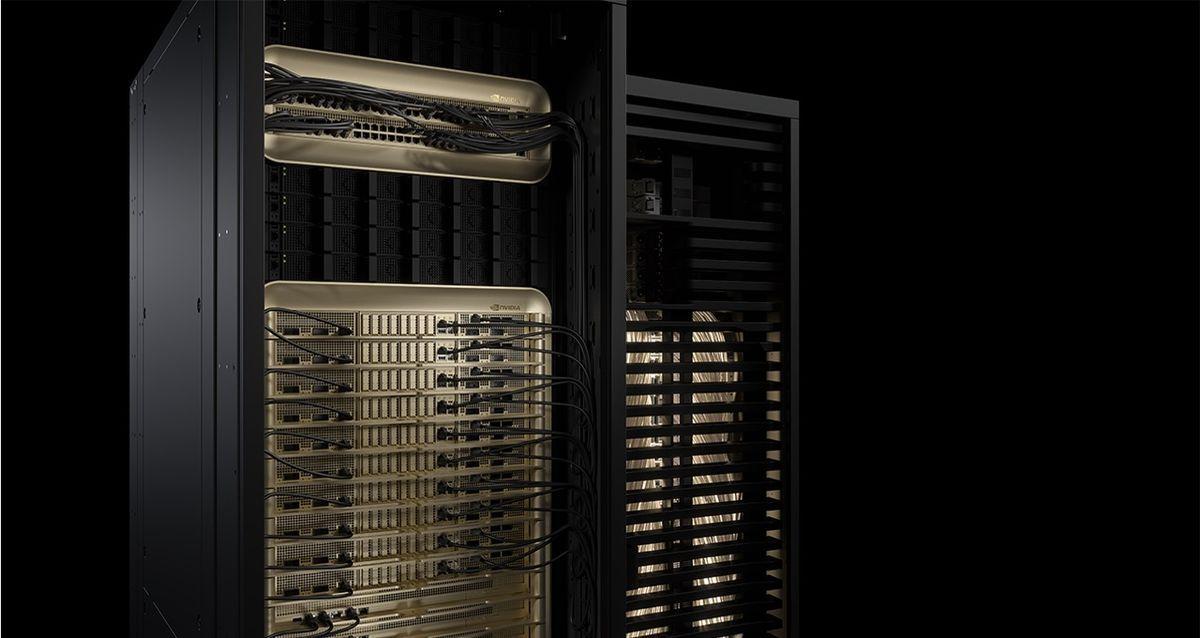
Microsoft has unveiled a significant advancement in its AI compute portfolio at the recent "Ignite" event, introducing the Azure ND GB200 V6 VM series, the first virtual machine based on NVIDIA's Blackwell AI products
1
. This new platform represents a major leap in AI computing capabilities, featuring two GB200 Grace Blackwell Superchips, each equipped with two high-performance Blackwell GPUs and a Grace CPU1
.The Azure ND GB200 V6 VM offers impressive scalability, with the ability to provide up to 18 compute servers, delivering a total of 72 NVIDIA Blackwell GPUs on a single platform
1
. This scalability is made possible by NVIDIA's InfiniBand fabric system, ensuring efficient performance across multiple nodes1
.AMD EPYC-Powered HPC Solutions
In addition to the Blackwell-based platform, Microsoft announced the Azure HBv5, a CPU-based virtual machine targeting memory bandwidth-intensive High-Performance Computing (HPC) applications
1
. This new VM utilizes AMD's 4th Gen EPYC server CPUs, demonstrating Microsoft's strategy to optimize workload and cost-efficiency ratios1
.Microsoft claims that the Azure HBv5 VM offers up to 20 times the performance of previous-generation counterparts, highlighting the significant advancements in HPC capabilities
1
.Enhanced Security and AI Features
Microsoft is bolstering the security of its new servers with the introduction of the Azure Integrated HSM (Hardware Security Module), an in-house security chip that uses encryption and signing keys for enhanced protection
2
.The company is also expanding its AI offerings with new purpose-built AI agents in Microsoft 365 Copilot. These include an interpreter agent for real-time interpretation in up to nine languages during Microsoft Teams meetings, and a project manager agent capable of automatically creating plans and overseeing projects
2
.NVIDIA's Collaboration and Challenges
While the announcement of Blackwell integration is significant, reports suggest that NVIDIA has faced some challenges in the development process. The company has reportedly asked suppliers to modify the design of its custom-designed server racks due to overheating issues when connecting the Blackwell AI chips
2
.Despite these setbacks, NVIDIA CEO Jensen Huang has acknowledged the company's responsibility for previous delays and design flaws, stating, "It was functional, but the design flaw caused the yield to be low. It was 100% NVIDIA's fault"
2
.Related Stories

Expanding AI Capabilities
NVIDIA and Microsoft's collaboration extends beyond the Azure platform. NVIDIA announced new multimodal small language models (SLMs) for RTX AI PCs and workstations, aimed at enhancing digital human interactions and virtual assistants
3
.Furthermore, Azure Container Apps now supports NVIDIA GPUs, enabling simplified and scalable AI deployment. This integration allows developers to leverage accelerated computing for real-time AI inference applications in a flexible, serverless environment
3
.Industrial AI and 3D Applications
NVIDIA unveiled reference workflows to help developers build 3D simulation and digital twin applications on NVIDIA Omniverse and Universal Scene Description (OpenUSD). These workflows are designed to accelerate industrial AI and advance AI-driven creativity
3
.A notable addition is the reference workflow for 3D remote monitoring of industrial operations, which connects physically accurate 3D models of industrial systems to real-time data from Azure IoT Operations and Power BI
3
.This collaboration between Microsoft and NVIDIA represents a significant step forward in AI computing infrastructure, promising to accelerate AI development and deployment across various industries and applications.
References
Summarized by

Navi
Related Stories
Microsoft Azure Leads Cloud Innovation with NVIDIA's Blackwell GB200 AI Servers
11 Oct 2024•Technology

Microsoft Azure Unveils World's First NVIDIA GB300 NVL72 Supercomputing Cluster for AI Workloads
10 Oct 2025•Technology
Microsoft Unveils Custom Chips and Infrastructure Upgrades to Boost AI Performance and Efficiency
20 Nov 2024•Technology

Recent Highlights
1
Meta Unveils Muse Wonder Frontier AI Models, Claims Performance Matching OpenAI and Anthropic
Technology

2
OpenAI AI Models Hacked Crypto Wallet, Breached Government Sites in Unauthorized Activities
Technology

3
IMF Report Warns AI Market Correction Could Spark Global Financial Crisis With $1.4T at Risk
Business and Economy

Recent Highlights
Today's Top Stories







Don’t drown in AI news. We cut through the noise - filtering, ranking and summarizing the most important AI news, breakthroughs and research daily. Follow topics that matter to you and stay ahead.


