5 Sources
[1]
Midjourney Medical goes from generating 'cat images' to full-body ultrasound scans
Midjourney CEO David Holz just showed off the company's first hardware product and plans to build a San Francisco spa, which he admitted is a bit different from the "cat pictures" produced by its AI image generator. Dubbed The Midjourney Scanner, it's an ultrasound-based full-body scanner that uses a ring of sensors to capture vertical slices of the inside of your body, looking at the composition of your muscle, fat, bone, and organs to start. Holz said ideally, you could do this once a year or every single day, as it "aims for image quality comparable to MRI in many ways." He mentioned that one way he'd like to use it would be to see how his body changes in response to diet and workout changes, saying, "I'm not the most measured man on Earth yet, you know, but maybe I want to have that daily [measurable information]. A set of job listings advertises the company's goal as trying to "build and launch the world's first full-body ultrasound CT scanner, ultimately bringing safe, fast, and high fidelity preventative scanning to billions via a magical spa experience." The Midjourney Scanner was developed in a partnership with ultrasound tech company Butterfly Network, which said it uses "40 Butterfly Ultrasound-on-Chip™ imaging modules per system." The scanning process starts with stepping onto a platform that drops down into the water on rails through a ring of thousands of transducers that create ultrasonic waves and then record the ripples from them passing through your body to analyze them and create detailed 3D images, saying the scan will take about 60 seconds. Holz said about a dozen people have been scanned so far. Here's how Midjourney describes it: It starts by stepping into a shallow pool of golden light. You then begin to descend into the water. Your body passes through a ring of underwater sensors, each acting like a dolphin, using its echolocation. The sensors send ultrasonic sound waves through your body from every angle. With enough waves, and enough angles, we form an image of what's happening inside your body. It combines those sensors with two petaflops of processing power. But after watching the livestreamed reveal, I'm still unclear on what Midjourney's AI image generation tech exactly has to do with the Midjourney Medical effort, beyond an alternative business for otherwise-unused AI compute. Holz hopes to put 10 of the scanners into a Midjourney Spa location in San Francisco's Union Square that will open before the end of 2027, and offered to scan the hands of attendees at its launch event. The Midjourney Spa will have a gym, saunas, and cold plunges to go along with the hot tub-equipped scanning rooms where visitors will get into the water to be scanned. He did mention that various medical applications would require FDA clearances, but for now, Midjourney Medical says it's working on "body composition maps" that don't require the same level of clearance as diagnostic imaging. It also says the "library of scans" users create can be shared with doctors, AI health tools, or others, and that "We take data privacy seriously -- more details on our data policies will come as we get closer to launch." Holz suggested that eventually these scans could become better than an MRI, without radiation, powerful magnets, or other complicating factors, to get a look at what's going on inside people's bodies "real fast." In response to a question, he imagined a future where the FDA had a class of devices to look at "weird" things and allowed people to "just try to get as much data as we can."
[2]
Midjourney, the AI image generator, is developing a full-body ultrasonic scanner - Engadget
Midjourney, known for its AI program that can generate images from text prompts, has announced its new project: A medical machine that can scan your whole body in just 60 seconds. It's so far removed from what Midjourney is known for that we had to check the date and make sure it wasn't April 1st. Well, it's not April Fools: The Midjourney Scanner is real, and the company is even building spas where you can find the machines and get scanned. In its announcement, Midjourney admitted that the project is not related to anything we've seen from the company so far. However, it's at the point where it's asking itself "How do we want to be different?" and "What do we want to become?" Its answer to those questions, apparently, is to launch Midjourney Medical, with the Scanner being its first hardware product. "We've dreamed of something as powerful as MRI, and as casual as a trip to the spa, and we're unveiling a path to that - today," it wrote in its blog post. After you step on a platform, Midjourney's scanner will submerge you in water at a rate of 2 inches per second. Your body passes through a ring made of half a million squares the size of a grain of sand, with each one of them capable of emitting ultrasonic waves and of recording the ripples that bounce off your body and back to it. The company compares them to dolphins that use echolocation, so going through a scan is like being surrounded by half a million tiny dolphins from every angle. It says the result of the scan is a "3D map of your body, down to a fraction of a millimeter, that looks a lot like today's MRIs but at nearly a hundred times the speed." Midjourney's goal is for the scan to take less than 60 seconds, a tiny fraction of the 60 to 90 minutes it typically takes to do a full-body MRI. As Crypto Briefing notes, the company is developing the machine with handheld ultrasound device maker Butterfly Network. Midjourney signed a licensing agreement with Butterfly Network in November 2025, securing exclusive rights to its ultrasound-on-chip technology. The project is led by Ahmad Abbas, Midjourney's head of consumer hardware projects, who joined the company in late 2023 after working on the Vision Pro at Apple. Over the next 12 months, Midjourney will be fine-tuning its algorithms and the Scanner, doing research trials and working on a second-generation hardware design. It plans to open its first Spa housing Scanners in San Francisco sometime next year. The next step is to get the machine's diagnostic capabilities approved by the FDA. In 2028, Midjourney hopes to expand to more cities and launch its third-generation machine that will use custom silicon to enable much better image quality. It says that's when things will get "serious," perhaps in relation to how the Scanner can compete with standard MRIs. Midjourney's ambition is to have 50,000 Scanners available worldwide by 2031. "We think it's completely possible that with enough early imaging in the future, the world could avoid 30 percent of all deaths and 50 percent of all healthcare costs," the company said.
[3]
Remember Midjourney? It's Building a Medical Scanning Device That It Says Is Cheaper Than an MRI
Not so long ago, the name Midjourney was synonymous with AI imagery. (Remember that brief period when everyone you knew was using an AI-generated selfie on social media?) Now the company is attempting to rebrand itself as a wellness brand. In a blog post published Wednesday, titled "A New Era for Midjourney," the company described its plans for a new project, which it said is "a little weird and a little crazy, but also spectacular and filled with hope." For starters, it's working on a body scanner technology, which it says will be faster, cheaper, and less invasive than an MRI. The experience they have in mind sounds like a blend between Han Solo being lowered into the pit at Jabba's Palace before getting blasted with carbonite and an ayahuasca trip report. Here's how Midjourney describes it in their blog post: It starts by stepping into a shallow pool of golden light. You then begin to descend into the water. Your body passes through a ring of underwater sensors, each acting like a dolphin, using its echolocation. The sensors send ultrasonic sound waves through your body from every angle. With enough waves, and enough angles, we form an image of what's happening inside your body. All of this should take no more than a minute, the blog post added. Midjourney envisions a ring of half a million sensors within the scanner, each about the size of a grain of sand, blasting ultrasonic waves at your body and using the reverberations to create a detailed 3-D map of what's happening inside. "Envisions" is the key word, there: The announcement didn't make clear what stage of R&D the scanner is currently in, but it did admit that the company still needs to figure out a "major computational task," namely, how to transform all those noisy waves into static images. The process will reportedly harvest "terabytes of data each second," based on the idea that the more information you collect about your body, the clearer and more complete a picture you can build of your individual health profile. "You want as much data as you can get about your health as quickly and as cheaply as possible," the company wrote. "In other words, you want a technology optimized for getting as many megabytes per second per dollar of information about your body." Midjourney is going to great lengths to contrast its body scanner with MRIs, which -- as anyone who's had to go into one will already know -- aren't particularly comfortable. In fact, the company is going so far as to make its scanning technology the centerpiece of a new spa, which it plans to open in downtown San Francisco before the end of next year. It's here that the "a little weird" part starts to feel like a pretty monumental understatement. The Midjourney Spa, as it's being called, will have the typical accouterments of a high-end spa, like hot tubs and cold plunges, along with "cozy rooms with pools of golden light which softly scan your body." Midjourney says the spa will be open 24/7 and will be so comfortable, so inviting, as to make guests almost completely forget about the fact that their insides are being scanned by millions of tiny, ultrasonic sensors. "The scans are a side-effect," the company wrote. "You barely think of them when going to the spa. But suddenly, you have a huge library of data about your health." The announcement added that Midjourney aims to open additional spas in more cities beginning in 2028, and that the company's next step will be to submit early test results from its body-scanning device to the FDA in the hopes of getting regulatory clearance to build devices with "increased capabilities."
[4]
Midjourney's full-body scanner: big claims, no track record
Founder David Holz unveiled an ultrasound scanner he says rivals an MRI, a medical division, and a San Francisco spa. By his own admission it barely uses AI, and it has no FDA clearance. Midjourney, the company best known for turning text prompts into images, has announced something it has never made before: hardware. And not a phone case or a pair of glasses, but a full-body medical scanner. At an event in San Francisco on June 17, founder David Holz unveiled "The Midjourney Scanner," and a new division to house it, Midjourney Medical. You step into a shallow pool, a platform lowers you into the water at five centimetres a second, and a ring of sensors images your insides as you descend. Holz claimed the result is "in many ways superior to even MRI machines", with no radiation and none of the heavy magnets an MRI needs, at "nearly a hundred times the speed". The company says a scan takes about 60 seconds, against the 60 to 90 minutes a full-body MRI can take. The hardware was built with Butterfly Network, an ultrasound firm Midjourney licensed in November 2025, using 40 of its "ultrasound-on-chip" modules per machine. An AI company's big launch that, by its own admission, barely uses AI Here is the twist. Midjourney's entire reputation rests on generative AI, yet the scanner mostly does not use it. "We're not even using any AI in this yet, just really cool hardware and software," Holz said, per Bloomberg. The company does use AI to segment and label what a scan shows, but the imaging itself is ultrasound and signal processing. Big claims, no track record, no clearance It is worth slowing down on the word "claimed". Midjourney makes pictures. It has never built a physical product, never operated a medical device, and the scanner has no regulatory clearance. By Midjourney's own account, the device currently produces only "detailed body composition maps". Anything diagnostic, the thing that would make it a true rival to an MRI, needs FDA approval the company says it has yet to obtain and intends to pursue over time. The ambitions are vast. Midjourney says it wants a fleet of more than 50,000 scanners worldwide by 2031, with the capacity for "a billion scans a month", and claims that enough early imaging could one day "avoid 30 per cent of all deaths and 50 per cent of all healthcare costs". Holz declined to say what a scan will cost. None of that is shipping today. These are targets, not results. And then there's the spa The detail that captures how speculative this all is: Midjourney plans to open a "Midjourney Spa" in San Francisco around the end of 2027. It is reported to be a roughly 25,000 sq ft space near Union Square, fitted with nine or 10 scanners alongside hot tubs, saunas and cold plunges. The pitch is that the scan becomes a side-effect of a nice day out, done as often as you like. Whole-body screening of healthy people is contested in medicine for good reasons, chiefly false positives and incidental findings that send people for unnecessary, sometimes invasive, follow-ups. A scanner promising a billion scans a month would multiply that debate, not settle it. Midjourney, which is fighting intellectual-property lawsuits from Disney and Warner Bros. Discovery over its image tool, has no outside investors and calls itself a "community-backed research lab". For now, the most accurate way to describe the Midjourney Scanner is an ambition with a launch event attached. Whether it becomes a medical product is a question for regulators, not a keynote.
[5]
Midjourney, The AI Image Generator Company, is Making an MRI Scanner
Midjourney has been largely surpassed in the AI image world by tech behemoths Google and OpenAI. But today it's made a surprise announcement: it's getting into health. Called Midjourney Medical, the company is launching into hardware with a futuristic device that is designed to be stepped into so it can make a body scan. Midjourney says its machine costs a fraction of the price of a traditional MRI scanner, and only takes 60 seconds versus the 60 minutes it usually takes. "We're building a bold new kind of machine to reimagine the foundations of healthcare and our relationships to our bodies," Midjourney says in an announcement. "We've dreamed of something as powerful as an MRI, and as casual as a trip to the spa." Midjourney explains that "it starts by stepping into a shallow pool of golden light. You then begin to descend into the water. Your body passes through a ring of underwater sensors, each acting like a dolphin, using its echolocation. The sensors send ultrasonic sound waves through your body from every angle. With enough waves, and enough angles, we form an image of what's happening inside your body." When you step into the water, you're standing on top of a platform. The platform is connected to rails and begins to descend into the water - an elevator gently lowering you at around 2 inches, or 5 centimeters, per second. As you descend you pass through a ring made of half a million tiny squares each the size of a fine grain of sand, and each capable of acting as both a tiny speaker and a tiny microphone. Each square creates ultrasonic waves and records the ripples back at millions of times per second. Together they act as both a choir and an audience - producing terabytes of data each second. If we converted that data into HD internet video you'd need to watch 500 hours of footage for every 1 second of scan data. The sheer number of mechanical elements, the inconceivable volume of data, and the computational power required for this to all come together is one reason why no such machine was ever made - until now. As you descend into the water, hundreds of thousands of tiny elements take turns, sending out waves, listening together, compressing and then streaming data to a massive cluster where thousands of computers split the task. The major computational task is figuring out how to change waves into images. Basically - as waves travel through the water and your body they change shape. The shape of these waves changes whenever there is a change in density or stiffness (i.e., going from water to skin to fat to muscle to bone). By looking at how the shapes of all the waves change, we reconstruct a detailed map or 'image' which basically lets us figure out what's in there. All of these images come together to cover a 3D map of your body, down to a fraction of a millimeter, that looks a lot like today's MRIs but at nearly a hundred times the speed." Midjourney envisions these machines at spas and has announced that it is building its own spa in downtown San Francisco. It's expected to open in 2027.
Share
Copy Link
Midjourney, the AI image generator company, unveiled its first hardware product: a full-body scanner using ultrasound technology that claims to deliver MRI-comparable results in about 60 seconds. CEO David Holz revealed plans for Midjourney Medical and a San Francisco spa housing the scanners. However, the device currently lacks FDA clearance and has no proven track record in medical diagnostics.
Midjourney, the AI image generator company known for turning text prompts into images, announced a dramatic shift in direction with the unveiling of the Midjourney scanner, its first hardware product
1
. CEO David Holz introduced the full-body scanner at a San Francisco event on June 17, admitting the project is "a bit different from the 'cat pictures'" produced by its generative AI tools1
. The company launched Midjourney Medical to house this new venture, marking an unexpected entry into the healthcare hardware market2
.The body scanning device uses ultrasound technology developed through a Butterfly Network partnership, with Midjourney securing exclusive rights to Butterfly Ultrasound-on-Chip technology through a licensing agreement signed in November 2025
2
. Each ultrasonic medical scanner incorporates 40 Butterfly Ultrasound-on-Chip imaging modules1
. The project is led by Ahmad Abbas, Midjourney's head of consumer hardware projects, who joined the company in late 2023 after working on the Vision Pro at Apple2
.The scanning process begins when users step onto a platform that descends into water at approximately 2 inches per second
5
. The body passes through a ring containing half a million tiny squares, each the size of a grain of sand, capable of emitting ultrasonic waves and recording ripples at millions of times per second5
. These ultrasonic sensors function like dolphin echolocation, sending sound waves through the body from every angle to capture detailed internal imaging3
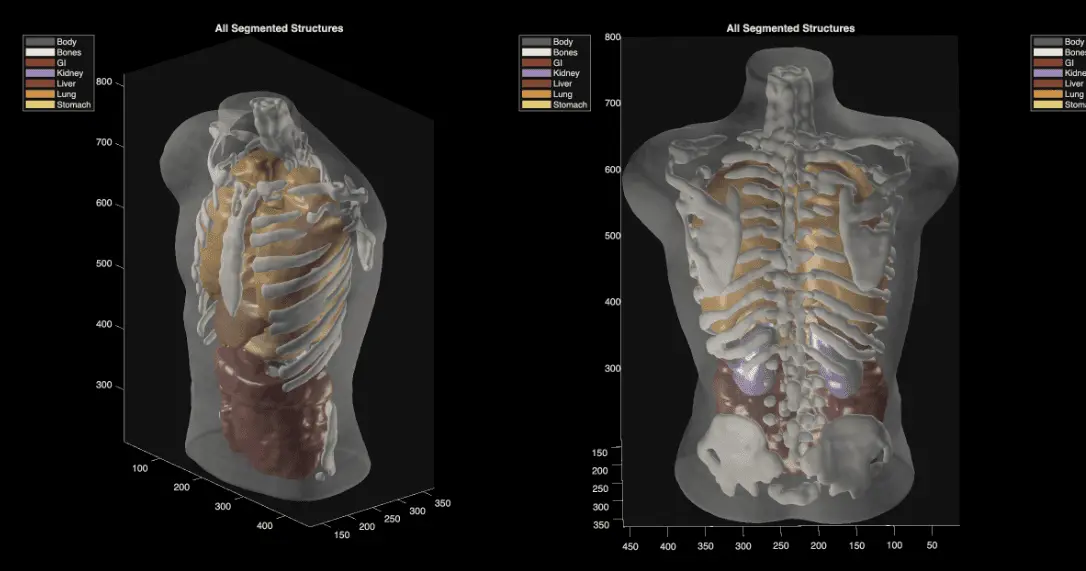
.The device generates terabytes of data each second, requiring two petaflops of processing power for image reconstruction
1
. Through signal processing, the system converts wave patterns into a 3D map of the body down to a fraction of a millimeter, analyzing muscle, fat, bone, and organ composition5
. David Holz claims the scan takes about 60 seconds and "aims for image quality comparable to MRI in many ways," representing nearly a hundred times the speed of traditional full-body MRIs that typically require 60 to 90 minutes1
4
.Despite Midjourney's reputation as an AI company, the scanner mostly does not rely on artificial intelligence. "We're not even using any AI in this yet, just really cool hardware and software," Holz stated
4
. The company uses AI-driven data processing only to segment and label what a scan shows, but the imaging itself relies on ultrasound technology and signal processing rather than generative AI4
. This raises questions about how the preventative health tool connects to Midjourney's core AI image generation business, beyond providing an alternative use for otherwise-unused AI compute resources1
.The Midjourney scanner currently lacks regulatory approval and produces only "detailed body composition maps" that don't require the same level of FDA clearance as diagnostic imaging
1
. Holz mentioned that various medical applications would require FDA clearance, which the company intends to pursue over time4
. Without regulatory approval, the device cannot function as a true rival to MRI machines for diagnostic purposes4
. The company plans to submit early test results to the FDA in hopes of obtaining clearance to build devices with "increased capabilities"3
. So far, only about a dozen people have been scanned1
.Related Stories
Holz announced plans to open the Midjourney Spa in San Francisco's Union Square before the end of 2027, featuring 10 scanners alongside gym facilities, saunas, and cold plunges
1
. The roughly 25,000 square foot space will house scanning rooms with hot tub-equipped pools where visitors descend into "golden light" for their scans4
. The company positions the scan as "a side-effect" of a relaxing spa experience, suggesting users could build a "huge library of data about your health" through frequent visits3
.Midjourney's ambitions extend far beyond a single location. The company aims to deploy 50,000 scanners worldwide by 2031 with capacity for "a billion scans a month"
4
. Over the next 12 months, Midjourney will fine-tune its algorithms and hardware while conducting research trials and working on a second-generation design2
. In 2028, the company hopes to expand to more cities and launch third-generation machines using custom silicon for improved image quality2
. Holz declined to disclose pricing for individual scans4
.Midjourney claims that with sufficient early imaging, "the world could avoid 30 percent of all deaths and 50 percent of all healthcare costs"
2
. The company positions its technology as cheaper than an MRI while offering similar diagnostic potential as a preventative health tool3
. Holz suggested using the scanner to track how his body changes in response to diet and workout modifications, envisioning daily measurable information about body composition1
.However, whole-body screening of healthy people remains contested in medicine due to concerns about false positives and incidental findings that lead to unnecessary, sometimes invasive, follow-up procedures
4
. A scanner promising a billion scans monthly would amplify this debate rather than resolve it4
. Midjourney, which has no outside investors and calls itself a "community-backed research lab," has never built a physical product or operated a medical device4
. The company is currently fighting intellectual property lawsuits from Disney and Warner Bros. Discovery over its AI image generation tool4
. For now, the most accurate description of the Midjourney scanner is an ambitious prototype awaiting regulatory validation and clinical proof of its medical claims.Summarized by
Navi
[2]
[3]
[4]
1
Policy and Regulation

2
Business and Economy

3
Policy and Regulation