MIT Researchers Develop AI Model That Learns Audio-Visual Connections Without Human Intervention


2 Sources
[1]
AI learns how vision and sound are connected, without human intervention
Caption: The researchers split the audio into smaller windows before the model computes its representations of the data, so it generates separate representations that correspond to each smaller window of audio. Pictured is a figure showing the separate representations of "speech" and "toot"
[2]
AI learns how vision and sound are connected, without human intervention
Humans naturally learn by making connections between sight and sound. For instance, we can watch someone playing the cello and recognize that the cellist's movements are generating the music we hear. A new approach developed by researchers from MIT and elsewhere improves an AI model's ability to
Share
Copy Link
MIT and IBM researchers have created an improved AI model called CAV-MAE Sync that can learn to associate audio and visual data from video clips without human labels, potentially revolutionizing multimodal content curation and robotics.
Breakthrough in AI Audio-Visual Learning
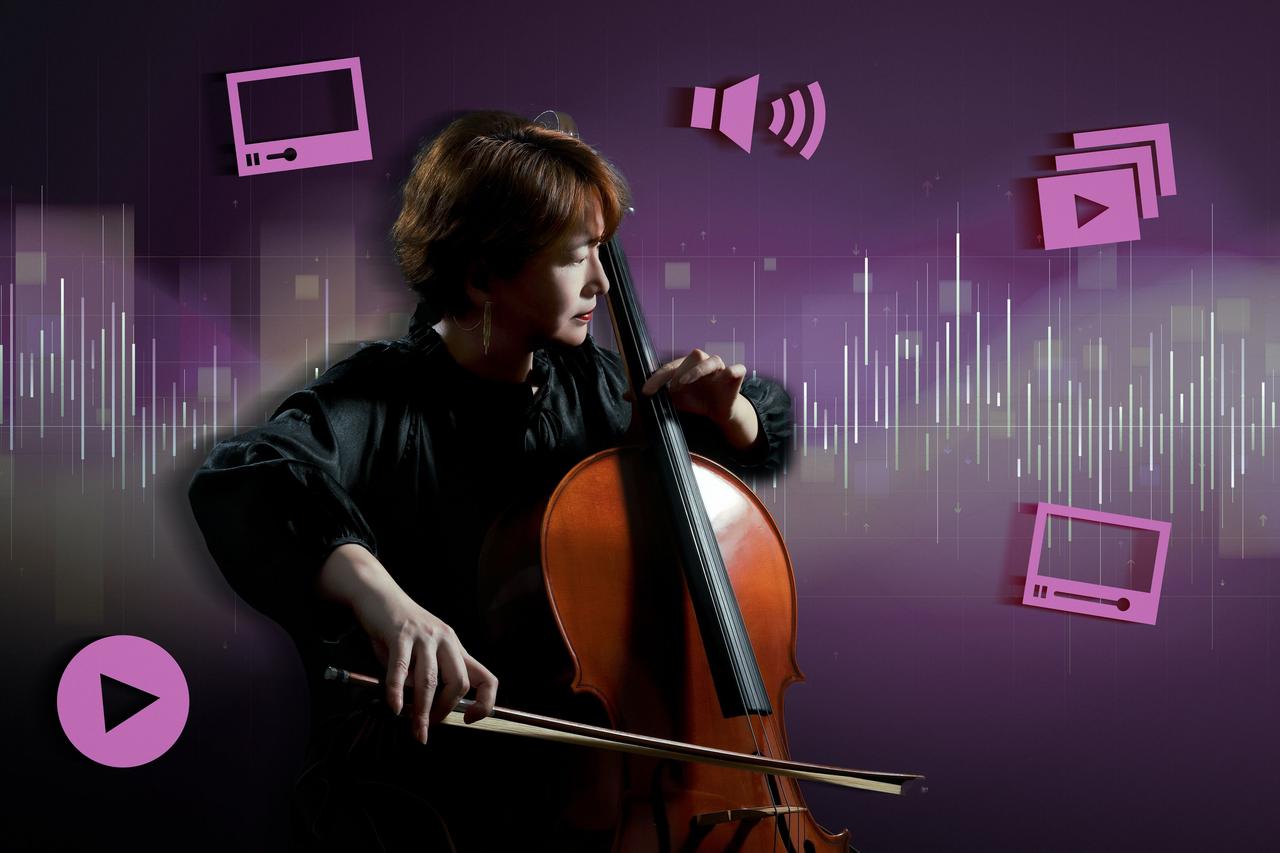
Researchers from MIT and other institutions have developed a groundbreaking AI model that can learn to connect visual and auditory information without human intervention. This advancement mimics the natural human ability to associate sights and sounds, such as linking a cellist's movements to the music being produced
1
.
Source: MIT
The CAV-MAE Sync Model
The new model, called CAV-MAE Sync, builds upon previous work and introduces several key improvements:
- Finer-grained correspondence: The model splits audio into smaller windows, allowing it to associate specific video frames with the corresponding audio
1
. - Architectural tweaks: The researchers incorporated dedicated "global tokens" and "register tokens" to help balance two distinct learning objectives: contrastive and reconstructive
2
. - Improved performance: These enhancements boost the model's accuracy in video retrieval tasks and classifying audiovisual scenes
1
.
How CAV-MAE Sync Works

Source: Tech Xplore
The model processes unlabeled video clips, encoding visual and audio data separately into representations called tokens. It then learns to map corresponding pairs of audio and visual tokens close together within its internal representation space
2
.Potential Applications
This technology has several promising applications:
- Journalism and film production: The model could assist in curating multimodal content through automatic video and audio retrieval
1
. - Robotics: In the long term, this work could improve a robot's ability to understand real-world environments where auditory and visual information are closely connected
2
. - Integration with language models: Researchers suggest that integrating this audio-visual technology into tools like large language models could open up new applications
1
.
Related Stories

The Research Team
The study was conducted by a collaborative team including:
- Andrew Rouditchenko, MIT graduate student
- Edson Araujo, lead author and graduate student at Goethe University
- Researchers from IBM Research and the MIT-IBM Watson AI Lab
- James Glass, senior research scientist at MIT CSAIL
- Hilde Kuehne, professor at Goethe University and affiliated professor at the MIT-IBM Watson AI Lab
1
2
The research will be presented at the upcoming Conference on Computer Vision and Pattern Recognition (CVPR 2025) in Nashville
2
.Future Implications
This advancement in AI's ability to process multimodal information could have far-reaching implications. As Andrew Rouditchenko states, "We are building AI systems that can process the world like humans do, in terms of having both audio and visual information coming in at once and being able to seamlessly process both modalities"
1
. This development brings us one step closer to AI systems that can interpret the world in a more human-like manner, potentially revolutionizing various fields from entertainment to robotics.References
Summarized by

Navi
Related Stories
New AI Model Mimics Toddler Learning, Offering Insights into Human Cognition and AI Development
24 Jan 2025•Science and Research

MovieNet: Brain-Inspired AI Revolutionizes Video Analysis with Human-Like Accuracy
10 Dec 2024•Science and Research

SonicSense: Robots Gain Human-Like Perception Through Acoustic Vibrations
23 Oct 2024•Science and Research

Recent Highlights



Recent Highlights
Today's Top Stories



Don’t drown in AI news. We cut through the noise - filtering, ranking and summarizing the most important AI news, breakthroughs and research daily. Follow topics that matter to you and stay ahead.


