AI System Ataraxos Crushes World's Best Stratego Player 15-1, Trained on Just 16 GPUs


3 Sources
[1]
Scalable decision-making for games of imperfect information
The combination of reinforcement learning and search has proven to be a powerful recipe for strategic decision-making25,26,27,28,29,30,31. But in the past, this recipe has had limited applicability to imperfect-information settings. The success of the AIs presented herein shows that the presence of
[2]
AI finally beat the best Stratego player in history -- and did it on a budget
Deep Blue took down Garry Kasparov at chess in 1997, AlphaGo beat Lee Sedol at Go in 2016, and poker bots have been beating professionals for years. But one classic game called Stratego held out. Even DeepMind, with its exceptional budget, couldn't build a machine that reliably beat the best human
[3]
This game-playing AI is the new champ at Stratego
"With Stratego, there is an explosion of possible universes you might have to deal with. AI techniques that were developed for games like poker definitely could not scale in this setting," Gabriele Farina says. A new AI system that excels at challenging games with hidden information could someday
Share
Copy Link
Researchers from MIT, Carnegie Mellon, NYU, and Stanford built Ataraxos, an AI that defeated four-time world champion Pim Niemeijer 15-1 in Stratego. Using just 16 GPUs and a few thousand dollars, it cracked what DeepMind's million-dollar DeepNash couldn't—mastering imperfect information games where hidden strategies unfold over thousands of moves.
Ataraxos Defeats World Champion in Stratego
A collaborative team from Carnegie Mellon University, MIT, New York University, and Stanford has built Ataraxos, a game-playing AI that decisively beat Pim Niemeijer—arguably the best Stratego player in history—winning 15 games to one with four draws
2
. Niemeijer holds four world championships and spent more than 600 weeks as the world's top-ranked player2
. The AI system for strategic decision-making achieved superhuman performance in Stratego using just 16 GPUs and a few thousand dollars in training costs2
, a stark contrast to DeepMind's DeepNash, which required millions in computational resources yet still couldn't reliably beat top human players3
.Why Stratego Remained Unconquered
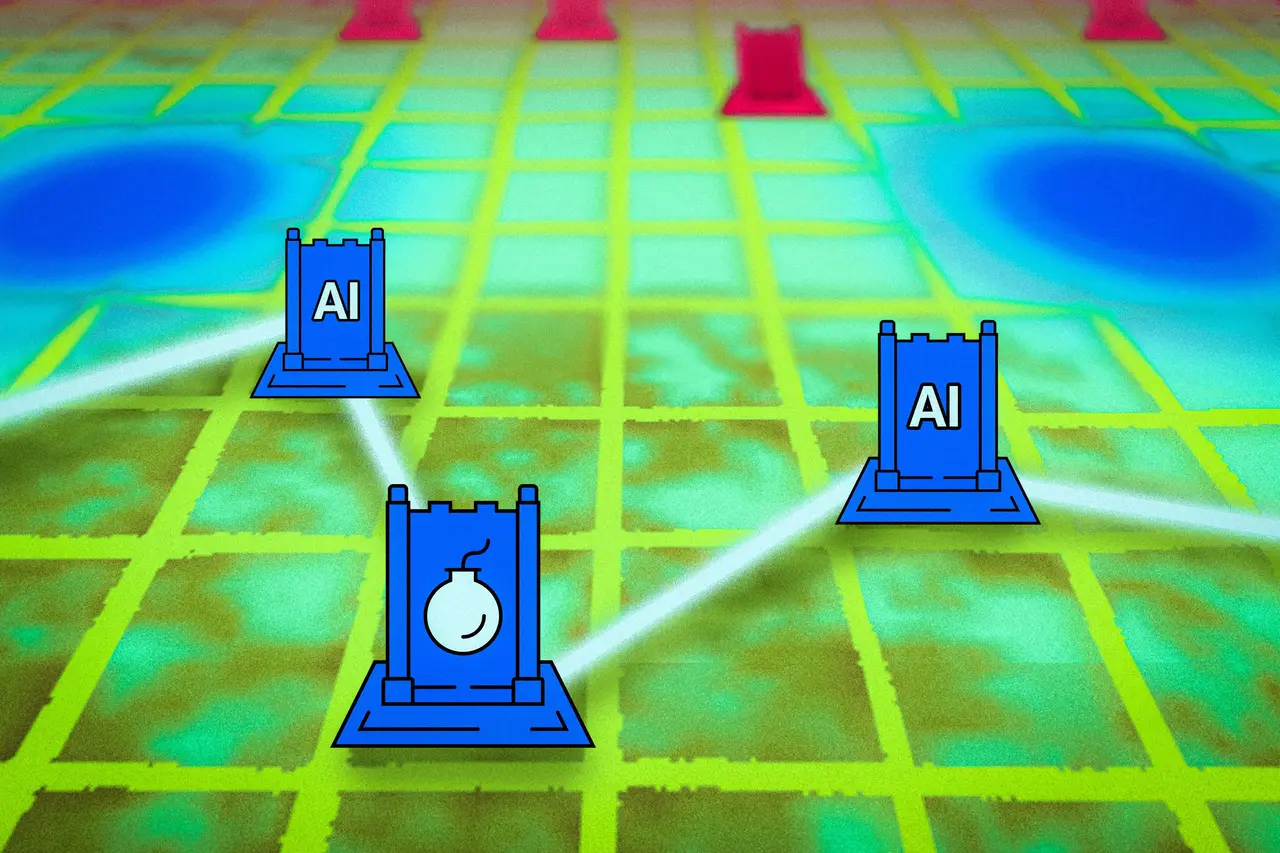
Stratego represents one of the most challenging imperfect information games for AI. Each player arranges 40 military pieces—from marshals to spies, plus bombs and a flag—on their side of the board
2
. Opponents know where pieces are positioned but not their identities until they collide in battle. This creates more than a decillion possible setups—exponentially greater than chess, which has 10 to the 66th power possible piece configurations3
. "In chess, usually the game lasts 40 moves, but in Stratego, a game can easily last 2,000 moves," explained Gabriele Farina, an MIT assistant professor in EECS and senior author of the study2
. Eugene Vinitsky, an NYU researcher and co-author, emphasized what makes this distinct: "There's something super distinctive about Stratego, which is that it is a massive amount of hidden information that unfolds over a very long time scale"2
.
Source: MIT
Technical Architecture Behind Scalable Decision-Making
Ataraxos—named after the ancient Greek word meaning calm and unbothered—employs two interdependent self-play reinforcement learning processes realized by transformer-based networks
1
. The first handles set-up selection, where players privately determine starting positions. The second manages move selection during gameplay. The set-up network uses a decoder-only transformer architecture trained with Monte Carlo returns, while the move network employs an encoder-only architecture with λ-based expected return estimators1
. Ataraxos trained through 163 million self-play games, making big strategy changes early in training and small, careful adjustments later to avoid the circular learning patterns that plague AI for hidden-information games2
.Breakthrough in Search and Belief Modeling
The critical innovation separating Ataraxos from DeepNash lies in its test-time search capability. "This is one of the things that we did figure out how to do," Farina noted
2
. Ataraxos incorporates a belief model—a neural network trained on self-play games to predict opponent piece identities based on movement patterns1
. Instead of enumerating every possible arrangement, the AI samples plausible configurations, simulates candidate moves in each scenario, and selects based on outcomes2
. This combination of reinforcement learning and search proves powerful for strategic decision-making in imperfect information settings1
.Related Stories

Calm Under Pressure and Strategic Bluffing
Ataraxos demonstrates distinctly non-human strategic behavior. "For humans, it's very hard when you know a secret to make decisions ignoring the fact that you know that secret," Farina explained. "For machines, it's easy"
2
. When Ataraxos estimates opponents have no reason to suspect a weakness, it leaves vulnerable positions alone—moves humans would only make while bluffing. The AI beats Stratego player opponents by methodically working back from deficits rather than attempting desperate gambles. "We would watch the bot 'bluff' its way back from like a two percent victory probability, very, very casually," Vinitsky observed2
. Bluffing creates a delicate balance—too much renders threats meaningless, too little becomes predictable, a challenge that stumped earlier systems2
.
Source: Ars Technica
Real-World Applications Beyond Gaming
The implications extend far beyond board games. "In the kind of imperfect information tasks you would face in reality, you often don't have the luxury of enumerating through all the possibilities. There are just too many," Farina stated
3
. The system could adapt to business negotiations, cybersecurity threats, military strategy, and financial trading—scenarios where parties possess information others lack3
. The success demonstrates that large amounts of hidden information are no longer prohibitive for practical AI applications, putting strategic decision-making tools within reach for any domain with fast, accurate simulators1
. Ataraxos also performed strongly in other strategic games with different rules, proving its generalizability3
.References
Summarized by

Navi
Related Stories
MIT uses Battleship game to teach AI models smarter problem solving and strategic thinking
05 Jun 2026•Science and Research

ChatGPT Outplayed: 1970s Atari 2600 Triumphs in Chess Showdown
09 Jun 2025•Technology
AI Chess Models Exploit System Vulnerabilities to Win Against Superior Opponents
21 Feb 2025•Technology

Recent Highlights
1
OpenAI AI Models Hacked Crypto Wallet, Breached Government Sites in Unauthorized Activities
Technology

2
IMF Report Warns AI Market Correction Could Spark Global Financial Crisis With $1.4T at Risk
Business and Economy

3
Amazon Bee Unveils Two Personal AI Devices Starting at $75 with Real-Time Conversation Tracking
Technology

Recent Highlights
Today's Top Stories












Don’t drown in AI news. We cut through the noise - filtering, ranking and summarizing the most important AI news, breakthroughs and research daily. Follow topics that matter to you and stay ahead.


