MIT's tiny superconducting sandwich could give cold computers the memory they lack


2 Sources
[1]
MIT builds superconducting device to power computers of future
Researchers at the MIT Plasma Science and Fusion Center (PSFC) have developed a tiny superconducting device. It could serve as a low-energy memory cell and signal router for future superconducting and quantum computing systems. Senior research scientist Jagadeesh Moodera and postdoctoral
[2]
Tiny superconducting sandwich could help computers use less energy
Scientists at the MIT Plasma Science and Fusion Center (PSFC) have created a tiny superconducting device that could help future computers store and process information using far less energy. Today's computers, supercomputers and data centers need more of everything to keep up with demand: more
Share
Copy Link
Researchers at MIT's Plasma Science and Fusion Center have built an ultrathin superconducting device that can store data as memory and, at lower temperatures, route electrical signals, a combination aimed at the missing parts of future superconducting and quantum computers
1
2
.A sandwich that switches
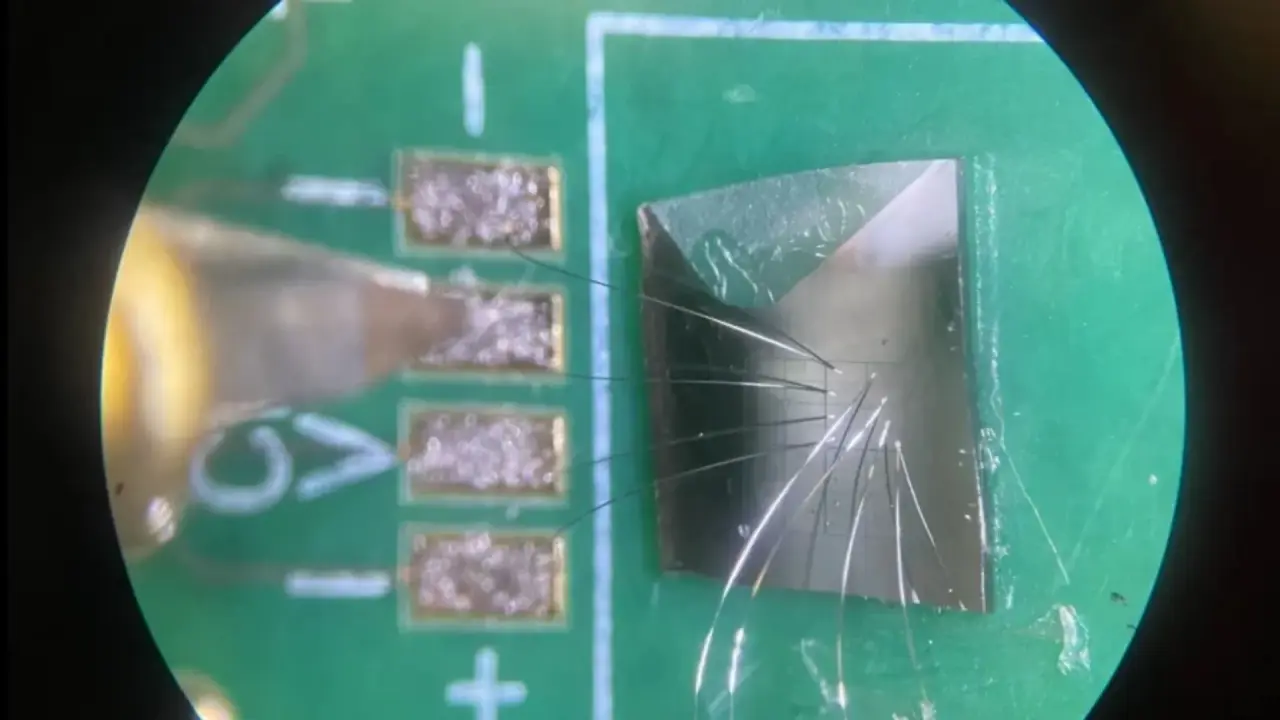
The device is a superconducting film a few atoms thin, squeezed between two magnetic layers. Flip the layers' magnetic alignment and the film's superconductivity turns on or off, which the computer reads as a 0 or a 1
1
2
.
Source: Interesting Engineering
Writing a bit takes a brief electrical pulse that gently heats the chosen cell, plus a small magnetic field to set its alignment. Once set, the cell holds its state without power, and its neighbors stay undisturbed. That last part matters: usable memory arrays are built from individually switchable, power-free bits
1
2
."Any useful memory must have the ability to change one bit without disturbing all the information around it," said Josep Ingla-Aynés, a postdoctoral researcher and first author on the paper. "Showing that we could switch a single cell without losing the neighbor's memory state was an important step toward bringing this superconducting layered device closer to a practical memory technology"
1
.Writing a bit takes less energy in these cells than in a traditional semiconductor cell, the researchers claim, though they give no figures
2
.Why cold computers need this
Superconducting computers run extremely cold, with no electrical resistance and almost no wasted heat, but they have long lacked one part: fast, high-capacity memory that works at those temperatures. Conventional RAM loses its data without power, while nonvolatile options such as flash write slowly and wear out with use
1
2
. That gap is the one the MIT team says its device could address.At still lower temperatures, the same structure does a second job. Within a certain current range it acts as a superconducting diode, passing current without resistance in one direction and resisting in the other. Changing the magnetic alignment reverses that direction or blocks current entirely. One structure that can both remember and route raises the possibility of putting both functions on a single superconducting chip
1
2
.The cells store ordinary bits, not qubits, but they could sit inside a quantum computer's cryogenic chamber handling memory and signal control for the supporting electronics. That keeps heat and electromagnetic interference away from the fragile qubits
1
2
."Integrating these devices can lead to processors operating at high speed and low energy," said Jagadeesh Moodera, the senior research scientist who led the work. "This development addresses the current lack of suitable cryogenic memory and control components, allowing for the advancement of cryogenic electronics technologies, including quantum computing and networking"
1
.The findings appear in Physical Review Letters, in a paper titled Magnetic Exchange-Coupled Superconducting Devices with Broken Symmetry for Cryogenic Memory
2
.The researchers say shrinking and linking the cells into dense arrays, and measuring how much energy a whole system would actually save, must happen before any commercial use. Until then, the sandwich stays a laboratory result
1
2
.Related Stories

References
Summarized by

Navi
[1]
Related Stories
Scientists Develop Ultrafast Magnetic-Field Pulses to Slash Computer Memory Energy Use by 100x
07 Sept 2026•Science and Research

Microsoft tests superconductors to shrink data centers and tackle AI power demands
10 Feb 2026•Technology

SK hynix and TetraMem unveil in-memory computing chip that processes AI directly inside memory
09 Jul 2026•Technology
Recent Highlights



Recent Highlights
Today's Top Stories





Don’t drown in AI news. We cut through the noise - filtering, ranking and summarizing the most important AI news, breakthroughs and research daily. Follow topics that matter to you and stay ahead.


