Nanit and Rivals Push AI Baby Monitors Beyond Sleep Tracking, Sparking Data Privacy Debate


2 Sources
[1]
Nanit and Other Baby-Tracking Start-Ups Eye Collecting Even More Data
For all but a few nights of my first child's life, her sleep has been recorded and analyzed by the Nanit Smart Baby Monitor System. A sleek white camera, bolted to the wall, points straight down at her body. High-definition footage is beamed to a server, where machine-learning algorithms log her
[2]
Aw, it's baby's first AI surveillance system
Nanit and other start-ups want to track your children through the night - and soon, for much longer than that. The downsides of this rush are manifest. For all but a few nights of my first child's life, her sleep has been recorded and analysed by the Nanit Smart Baby Monitor System. A sleek white
Share
Copy Link
Nanit's AI baby monitor uses machine-learning algorithms to track infant sleep patterns, generating daily sleep efficiency scores. With one million daily users and $100M+ revenue, the company just raised $50M to expand AI surveillance into speech development and motor skills tracking through early adolescence.
AI Baby Monitor Market Explodes as Nanit Leads $100M Industry
Nanit, the AI baby monitor that has captured one million daily users, is expanding its data collection ambitions far beyond sleep tracking
1
. The company recently secured $50 million in funding to develop AI-powered baby-tracking technology that monitors speech and language development, motor skills, and other developmental metrics through early adolescence1
. With annual revenue exceeding $100 million, Nanit has transformed from a simple video monitor into a comprehensive AI surveillance system that analyzes every movement and moment of a child's night1
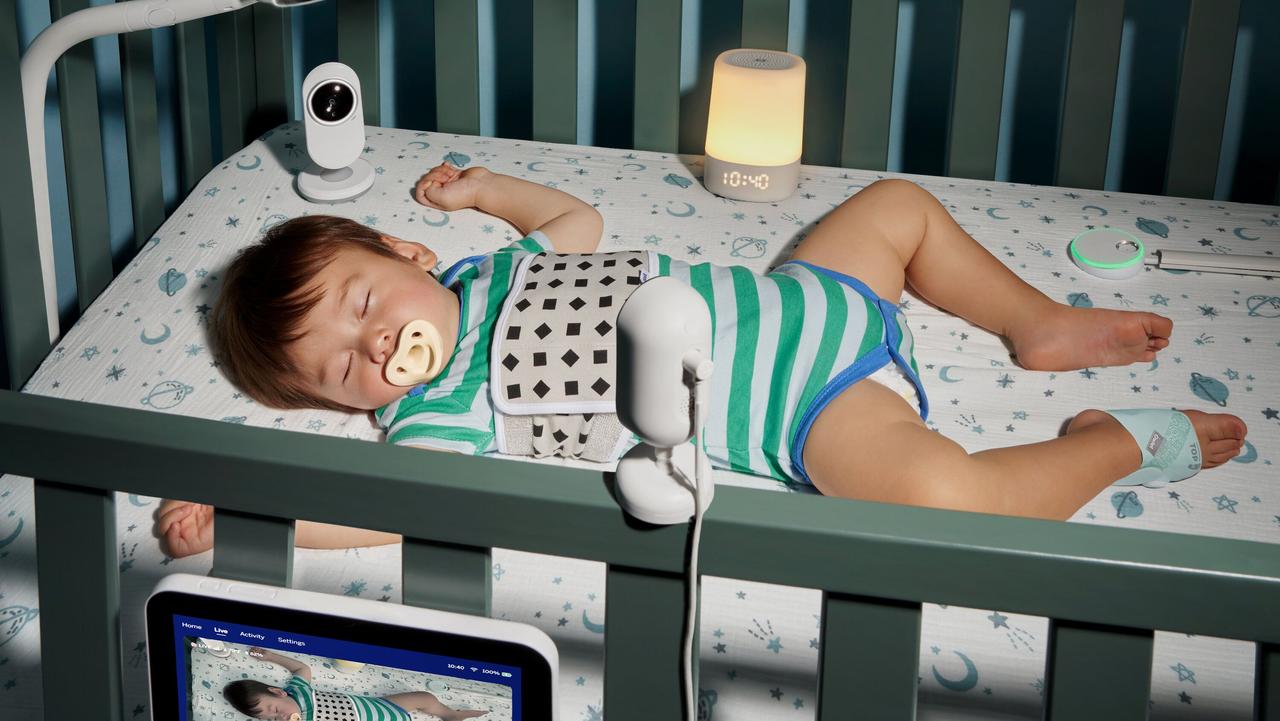
.The Nanit Smart Baby Monitor System uses machine-learning algorithms to process high-definition footage beamed to servers, logging precise moments when babies' eyes open and close
1
2
. Parents receive daily sleep efficiency scores from zero to 100, minutes until sleep onset, and detailed charts tracking infant sleep patterns throughout the night1
. The most expensive kit costs $474 plus roughly $100 annually in subscription fees1
.Machine-Learning Algorithms Drive Growing Babytech Ecosystem
Nanit faces competition from rivals offering increasingly sophisticated AI-powered baby-tracking technology. Owlet markets a $300 pulse oximetry tracker that attaches to babies' feet through a sock
1
. Huckleberry provides a free app for tracking feedings and diaper changes, with a $120 upgrade membership offering optimized nap predictions and access to an AI chatbot delivering personalized guidance1
. CuboAi's $359 Smart Baby Monitor 3 features AI-scheduled lullabies and sends alerts when a baby's face is covered1
.Founded in 2014 by Assaf Glazer, who completed a Ph.D. in machine learning and computer vision at the Technion-Israel Institute of Technology, Nanit emerged from a sleep-deprived new father's vision to create sophisticated sleep analysis beyond rudimentary baby monitors
1
. The company's $20 Breathing Band uses pixel movement analysis to quantify every rise and fall of a baby's chest, sending danger alerts to parents' phones1
.Data Collection Practices Raise Parental Autonomy Questions
The rapid adoption of AI baby monitors by millennial parents and Gen Z parents reflects broader cultural shifts toward health data optimization, with nearly half of Americans now owning wearable devices
1
. Companies manufacturing smart rings and wristbands have achieved valuations exceeding $10 billion, signaling investor confidence in continuous health monitoring1
.However, ethical concerns are mounting about how easily parents outsource daily parenting decisions to technology
1
. The downsides include sneakily high costs, erosion of parental autonomy and self-confidence, and surrendering sensitive data to corporations1
2
. A branding consultancy that helped create Nanit's visual identity acknowledged the central challenge: introducing novel technology while transcending negative connotations of surveillance1
.Related Stories

Speech Development Tracking Signals Expansion Beyond Infancy
Nanit's ambitions extend well beyond monitoring infant sleep patterns. The company plans to use its camera technology to track speech development, language acquisition, and motor skills while maintaining presence in children's bedrooms into early adolescence
1
. This expansion positions Nanit and competitors to own 24/7 health tracking for children under four feet tall1
. As children become aware of the constant monitoring—one 4-year-old now refers to "the Nanit" by name—questions emerge about long-term impacts of growing up under perpetual AI surveillance systems1
2
.References
Summarized by

Navi
[2]
Related Stories
AI and childhood face critical crossroads as expert warns human connection could become a luxury
14 Jul 2026•Entertainment and Society

Tech Dad's AI Voice Model for Bedtime Stories Sparks Fierce Parenting Debate
09 Oct 2026•Entertainment and Society

Andreessen Horowitz Bets on AI-Powered Parenting Tools
09 Nov 2024•Technology

Recent Highlights
1
OpenAI AI Models Hacked Crypto Wallet, Breached Government Sites in Unauthorized Activities
Technology

2
IMF Report Warns AI Market Correction Could Spark Global Financial Crisis With $1.4T at Risk
Business and Economy

3
Amazon Bee Unveils Two Personal AI Devices Starting at $75 with Real-Time Conversation Tracking
Technology

Recent Highlights
Today's Top Stories










Don’t drown in AI news. We cut through the noise - filtering, ranking and summarizing the most important AI news, breakthroughs and research daily. Follow topics that matter to you and stay ahead.


