3 Sources
[1]
'The Trojan Teddy Bear': The promise and peril of childhood in the age of AI
In A.I. Artificial Intelligence, Monica introduces Teddy to David. The seemingly ordinary teddy bear quickly reveals himself to be an intelligent companion capable of conversation and emotional support. Warner Bros. Pictures hide caption Back in 2001, Steven Spielberg released an underrated scifi movie named A.I. Artificial Intelligence (yes, the title is a bit redundant). The movie, which loosely borrows from Pinocchio, tells the story of a family who adopts a robotic boy programmed for love, and that robot's heartbreaking quest to become a real boy. Much of the technology in A.I. remains elusive. We're probably not anywhere close to building androids that can convincingly pass as Haley Joel Osment -- or Jude Law, for that matter. But some of the AI products imagined in the movie are starting to look surprisingly plausible. Take Teddy, an animatronic teddy bear. Teddy can walk, talk, make decisions, and respond to the needs and emotions of people around him. He's more than just a toy. He's an intelligent companion and protector for children. Today, a slew of technology companies are developing AI companions that sort of resemble Teddy. The most intelligent AI chatbots still live on digital screens, but a wave of startups is giving them bodies -- creating dolls, action figures, and robots that can serve as companions for kids. What happens when kids grow up with AI? AI is already a part of childhood. Recommendation algorithms curate what many kids watch and listen to. Chatbots stand ready to answer questions like, "Are monsters real?" or "Why is the sky blue?" They can help with homework, tell bedtime stories, or even feel like a friend. And companies are racing to embed AI into toys, nurseries, classrooms, and eventually robots that live alongside families. In a new book, Human Raised: Nurturing Connection, Curiosity & Lifelong Learning in the Age of AI, author Dana Suskind grapples with what the rising tide of artificial intelligence means for raising kids. On the one hand, she acknowledges that the technology offers promise as, for example, a productivity enhancer and time saver for parents, a monitoring and research tool that can give parents and scientists valuable data on child development, and an interactive tutor that might help some kids learn. But Suskind worries about what happens if AI begins replacing the kinds of human interactions that young brains evolved to learn from. In fact, Suskind says, her original, working title for the book was, "The Trojan Teddy Bear," a warning that AI companions may seem cute and cuddly -- but they carry hidden risks for child development. She ultimately went with Human Raised because she wanted to emphasize the positive -- and irreplaceable -- role that parents, teachers, and caregivers play in molding young ones. "If we want children to be able to continue to connect with each other and with other human beings, to be able to think critically, to be able to navigate the human world, we're gonna need to make sure that kids have a distinctly human-raised early childhood," Suskind says. Suskind is a professor of surgery and pediatrics at the University of Chicago Medical Center, where she directs a program aimed at giving kids hearing with cochlear implants. After she began doing this incredible work -- literally helping children hear -- she noticed that some kids who had the procedure went on to understand spoken language and talk with relative ease, while others had a much harder time. Hearing alone wasn't enough. And that led her to dive into neuroscience and social science to understand why. The brain development of young kids, Suskind learned, is heavily influenced by the back-and-forth interactions they have with their parents and caregivers during the first several years of their life. And she grew concerned that there is a big population of kids who aren't getting the enriching communication their brains need. And so she founded the TMW Initiative, a research center that helps parents create the kinds of brain-enriching environments that children need to reach their full potential. (You can read more about Suskind's biography and previous work in a Planet Money newsletter from 2022). Why Dana Suskind is sounding the alarm With the explosion of AI, Suskind has grown alarmed by a rush to introduce an unprecedented technology into kids' lives without careful reflection and rigorous scientific study about its effects on young minds. She is especially concerned about AI companions and other systems that interact socially with children, which she fears many people will use to substitute for the human interactions that children need most. Since the dawn of civilization, humans have used technology to make raising children a little easier. In Human Raised, Suskind traces that history back to prehistoric times, when mothers used woven slings to carry infants while they worked. Over the centuries, new technologies -- like television and tablets -- have eased the burdens of caregiving or helped keep children occupied. Many of these technologies have also been greeted with fears that they would rot kids' brains. But Suskind argues AI may mark a fundamental shift. Interacting with a chatbot or intelligent teddy bear is more than just a kid glued to a television or an iPad watching Sesame Street or Paw Patrol. AI systems carry on conversations that can feel strikingly human. They respond to kids' questions, emotions, and fears. They create a kind of synthetic social relationship -- one that, Suskind argues, may shape developing minds in ways that, until recently, only humans could. Suskind cites the research of renowned University of Washington developmental psychologist Patricia K. Kuhl. Kuhl proposed what's known as the "social gate" hypothesis -- the idea that children's brains are biologically primed to learn through social interaction. Studies have shown, for example, that babies learn language much better from a live person than from a screen. Neuroscientists and psychologists suggest that's because social interactions engage the brain in ways passive media does not. The sing-song way adults naturally speak to babies, smiles and other facial expressions, gentle touch, eye contact, and back-and-forth exchanges all appear to help open that social gate and facilitate learning and healthy brain development. While artificial intelligence is no match for human educators and caregivers, Suskind argues, it is capable of opening the social gate in young children in ways that previous technologies could not. That makes AI a potentially extraordinary educational tool -- but also a potentially dangerous one. Companies design AI systems with their own goals, which could include maximizing your kids' engagement, keeping their attention, collecting data, and making money. They don't have the same priorities as parents. And while those systems may imitate human interaction, Suskind argues they cannot recreate everything that makes human relationships developmentally valuable. "Eye contact, shared laughter, patient answers to 'why' questions activate ancient neural circuits designed for connection," Suskind writes. "These exchanges provide a form of nourishment no algorithm, however sophisticated, can match." Human relationships are also messy and filled with emotions. Parents misunderstand their children. Kids get frustrated. Families argue, reconnect, and then smooth things over. Suskind argues that those imperfect interactions -- and "the productive struggle" they create -- are how children learn resilience, emotional regulation, flexibility, and how to navigate real relationships. Unlike most humans, AI systems can be endlessly engaging, infinitely patient, and relentlessly affirming. Interactions with them often feel frictionless. Suskind worries giving young kids considerable exposure to them may make them less prepared for the messy, unpredictable nature of real human relationships. AI as junk food for the young mind Suskind compares AI relationships to ultra-processed food. " If all you eat is fruit snacks, which is a synthetic version of fruit, when you actually eat the real fruit, you're gonna be like, "Hmm, it's not quite as sweet," she says. AI could eventually be programmed to try and mimic real parents and caregivers even more closely. But Suskind argues that the problem isn't simply that today's AI falls short of human relationships. It's that AI represents a fundamentally new kind of social experience for children -- one that already raises concerns based on what we know about child development and whose long-term effects remain deeply uncertain. Suskind uses an analogy from the 19th century, when a German chemist named Justus von Liebig created one of the first infant formulas, hoping to replicate the nourishment of human milk. But when a French physician tested the formula on four newborns, all of them died within days, and the episode sparked a fierce controversy. The lesson, Suskind suggests, is that we should be cautious about engineering substitutes for something as biologically, emotionally, and socially complex as human caregiving before we understand how those substitutes shape children's development. Given so much uncertainty about this rapidly evolving technology and its potential effects on kids, Suskind spends a lot of the book offering parents a practical guide for safely navigating child-rearing in the age of AI. She emphasizes that it's especially important to shield kids from AI during their first years of life. "Older children and adults encounter AI with already-built neural scaffolding, but young children are still wiring the very circuits that shape future learning and relationships," she writes. "Introducing AI during this sensitive period presents a fundamentally different challenge with greater potential for harm." Suskind is open to the idea of using AI to enhance education for some kids -- but only as a tool that enhances, rather than replaces, humans. She argues that human caregivers are the best way to cultivate what she calls "the Human Edge," a set of social, emotional, and cognitive skills like "critical thinking, interpersonal connection, genuine creativity, empathy, and resilience." But, like time-crunched parents who rely on screens to buy themselves some time today, there may be growing temptations to outsource parts of child-rearing to AI, especially considering the fact that childcare is incredibly expensive. Suskind worries that, over time, a fully human-raised childhood could become a kind of luxury good -- much the way fresh, healthy food often is today. Families with the time and resources would provide rich human interaction to their kids. Everyone else might increasingly rely on cheaper, more convenient AI substitutes. And children raised largely by AI might not only lag socially, emotionally, and cognitively, but, ironically, they could also be less prepared for an AI-driven economy. Suskind points to a recent essay by the University of Chicago economist Alex Imas. Imas argues that as AI automates more cognitive work, human jobs may be increasingly concentrated in what he calls "the relational sector" -- occupations where humans are valued for qualities that make them distinctly human, from education to health care to hospitality, the arts, and therapy. If that's true, then the traits children develop through a human-raised childhood won't just matter for their social lives. They may also become an economic advantage. In a world increasingly shaped by artificial intelligence, the most valuable skills may be the ones that are the most deeply human.
[2]
Human attention is childhood's next digital divide
Why it matters: Human attention could become a privilege, Dana Suskind -- a University of Chicago pediatric surgeon and early childhood researcher -- warns in a new book. The big picture: Suskind argues that young children need low-tech childhoods because early human relationships help wire the brain. * But parents working multiple jobs or lacking child care, time or money don't always have the luxury of offering an idyllic screen-free childhood or a life without AI. Driving the news: Suskind's book "Human Raised: Nurturing Connection, Curiosity & Lifelong Learning in the Age of AI" comes out July 14. * Suskind compares the risks of AI toys and tutors to the risk of processed food: a cheap, convenient substitute that can crowd out what children actually need. * Suskind worries that AI tools marketed as educational "will become that sort of ultra-processed alternative for certain populations, widening opportunity gaps in ways that we can't even imagine." Context: Suskind outlines various categories of AI toys and tools, such as dolls that can chat with kids, make up stories, or remember their favorite things. * AI tutors are already promised as a solution to the global teacher shortage, even for the youngest children. * Robotics companies are piloting elder care robots with the ability to provide companionship, surveillance and emergency alerts. Suskind writes that similar robots could one day care for children. Zoom in: Suskind warns of a future in which human connection itself becomes a luxury good where a certain class of parents will have the time to ensure that their children get a low-tech childhood. * "And others will get the artificial replacement," she tells Axios. By the numbers: In a Common Sense Media poll last year, nearly 30% of parents of kids age 0 to 8 said their children had used AI learning tools, even though the major general-purpose chatbots have age limits that exclude young kids. * Nearly half of kids ages 7 to 11 said "talking to a digital companion feels like talking to a character or a friend," according to AI safety tool Aura's 2026 State of the Youth Report. The impact of AI on kids could be fundamentally different than the impact of TV, the internet, iPads and social media, Suskind argues. * "The algorithms are going to become much more sophisticated and keep kids engaged even longer," she says. * Suskind also points to research showing that young kids are more likely to anthropomorphize AI and to trust AI chatbots. Zoom out: AI is rapidly moving into homes and schools with little oversight or regulation. * Right now, there is no federal law regulating AI toys. In Congress, one proposed House bill would ban AI chatbot-enabled toys, and lawmakers have introduced similar bills in New York and California. Between the lines: OpenAI CEO Sam Altman has said that he's going to wait as long as possible to expose his child and future children to AI. * "I don't know when I would let him talk to AI," Altman said in April on the Mostly Human podcast with Laurie Segall. * "I'd rather be on the late end of what's reasonable," Altman said. "I think it's great that he'll grow up in a world where computers are smarter than him and do anything he wants." * "But you know, I want him to play in the dirt for now," Altman added. Flashback: Bill Gates and Steve Jobs both also reportedly limited their kids' use of the technology their companies built. * Follow the people who are creating this technology, Suskind says. And be suspicious "if the bridge makers are not wanting to cross their own bridge." Suskind is not calling for parents to bar their kids from using AI entirely, just not alone and unsupervised. Used well, she writes, it can "ease parents' burdens and enrich children's learning."
[3]
How AI is Shaping Childhood
Dr. Dana Suskind is a professor of surgery and pediatrics at the University of Chicago and the author of "Human Raised." For years I dreamed of silence. Between a home with three young children and a pediatric clinic crowded with restless kids, the noise at times felt relentless. A family and a meaningful career were all I ever wanted, but sometimes I yearned for quiet. Just a moment of peace. I don't wish for that anymore. In Rachel Carson's Silent Spring, the revolutionary book that sparked the modern environmental movement, the birds that no longer sang weren't the tragedy. They were the signal. A warning that something essential was dying. I hear a similar warning now in a different kind of silence: the eerie, algorithm‑induced quiet of children transfixed by technology. We are social creatures. We chat and complain, debate and tell stories. We embrace, bump fists, communicate nuanced emotions wordlessly -- an eye roll, a smile, a shrug. We call out to each other in stadium crowds, console crying babies on airplanes. This is what we do. And these lively, sometimes irritating, often messy, but always essential noises are the product of our species connecting and caring for one another. The volume of this beautiful, chaotic music is slowly being turned down. Technologies that once lived squarely in the realm of science fiction are now entering nurseries, classrooms, and family life at extraordinary speed, capturing the attention of adults and children alike. Companies are developing versions of popular AI chatbots specifically for kids. Entertaining AI dolls and action figures are core to the strategic vision of major toy brands. Virtual AI tutors are being promoted as the future of education around the world. AI has also moved into our lives in subtler ways. When you scroll social media or look for your next watch on Netflix, intelligent algorithms select or suggest the content for you. These AI‑powered recommendation engines are designed to predict what will hold your attention and keep you glued to the screen. If your little ones are watching YouTube, they too are under the sway of the technology as it works silently in the background to hold them close and shape their experience. The very content they consume might have been created by AI, including a flood of supposedly educational AI‑generated videos. These low‑quality, error‑filled abominations known as AI slop don't just fail to teach. They actively misinform. They embed misspellings, peddle nonsense, and model unsafe behaviors for children too young to know the difference. And the companies developing these technologies are racing ahead of the rules as they're being written. Policymakers are struggling to understand what they are regulating. The rest of us are struggling to understand how our world is changing. Perhaps one day these gaps will close, but childhood will not wait. I believe that the relationship between child development and artificial intelligence is one of the most critical and overlooked challenges of our time, one that has the potential to transform childhood, family structures, and ultimately nothing less than our future as a species. And it's up to us as parents and caregivers to decide how these intelligent tools will shape our children's lives. Not companies. Not governments. We are the ones who will take the lead on deciding what these technologies replace, what they enhance, and what they should never touch. And we are uniquely equipped to do so, as we possess something critical that machines are missing. The helpless infant paradox Nobel laureate Geoffrey Hinton, known as the Godfather of Artificial Intelligence for the pivotal role he played in creating the AI systems now remaking our world, left Google in 2023 to warn humanity about what he'd helped build. He spoke of existential risks, of systems that might one day surpass us. But when asked once what we might do to make artificial intelligence safe, he gave a surprising answer. He suggested we embed maternal instincts in these systems. Not better algorithms. Not more guardrails. Not elaborate structures of rules and constraints. Maternal instincts. The primal, inexplicable forces that make any parent -- mothers and fathers -- go to the ends of the earth to protect and care for their child without calculating the expected return. I have spent years studying the evolutionary origins of these parental instincts and their profound importance in building children's brains. Human babies are born powerless, weak, and extremely needy. Yet these tiny, vulnerable creatures somehow commandeer the lives of adults many times their size and strength. I call this the helpless infant paradox. There is no other example I can think of in nature of such complete power held by such powerless entities. Yet this is the very source of our success as a species. The instinct to nurture is wired so deeply into parents that it feels less like a choice than a biological imperative. These past few decades, I've watched our culture focus on trying to make humans more like machines. More efficient, more optimized, more productive. We have quantified and data‑fied childhood, turned parenting into a performance metric, measured our worth in developmental milestones met and cognitive outputs achieved. And now one of the scientists at the very frontier of machine intelligence is asking the opposite question: How do we make machines more like humans? The missing instinct The biggest missing piece in all of artificial intelligence, roboticist Matthias Scheutz told me, is that "none of our machines care." But can we fix that? Is Hinton's hope even possible? Can we code parental instinct? Can we engineer caring? When I posed these questions to Scheutz, a philosopher turned roboticist who has spent decades thinking about human and machine minds, his answer cut to the heart of what separates us from even the most sophisticated AI. He pointed me to a philosophical concept: original intentionality. Our thoughts, he explained, don't just process information -- they reach toward what matters to us. Our cognition isn't mere information processing. It's grounded in something deeper. A scientist who devotes their life to understanding children's brain development is driven by passion and concern. Parental instincts, Scheutz mused, are subconscious, visceral. Love coming from biological intentionality. The product of millions of years of evolution rather than countless lines of code, refined by the brutal simplicity of survival. In short, children needed loving caregivers to live. The survivors then raised their own children with the same fierce attention. And so it continued, an unbroken chain of caring, until it reached you. You have the quality the machines are missing. The love no code can copy. What makes us human? Is it reason? Language? Creativity? Tool use? Artificial intelligence is eroding our supposed superiority in each area one by one. It produces outputs indistinguishable from reasoning. It generates language with fluency that surpasses most humans. AI turns out art, music, poetry, software. It uses existing tools and builds new ones. But AI does not care. No algorithm lies awake at night worrying about whether a struggling child finally learned to read. No chatbot feels the weight of unrealized human potential. No system, however sophisticated, has thoughts that are genuinely about your child, that one‑of‑a‑kind combination of genes and experiences. These technologies act on patterns shaped by everyone else's data, targeted at producing responses that look like caring. True caring -- our capacity to have heartfelt thoughts about another being, rooted in concern for their flourishing, irrational in their intensity -- is what makes us unique. It is the irreducible human core. Excerpted from HUMAN RAISED: Nurturing Connection, Curiosity, & Lifelong Learning in the Age of AI with permission from Dutton, an imprint of Penguin Random House.
Share
Copy Link
Dana Suskind, a University of Chicago pediatric surgeon, warns in her new book 'Human Raised' that AI companions and toys could replace crucial human interactions children need for brain development. She compares AI tools to ultra-processed food—cheap substitutes that crowd out what kids actually need—and fears human attention itself could become a privilege in an age where nearly 30% of young children already use AI learning tools.
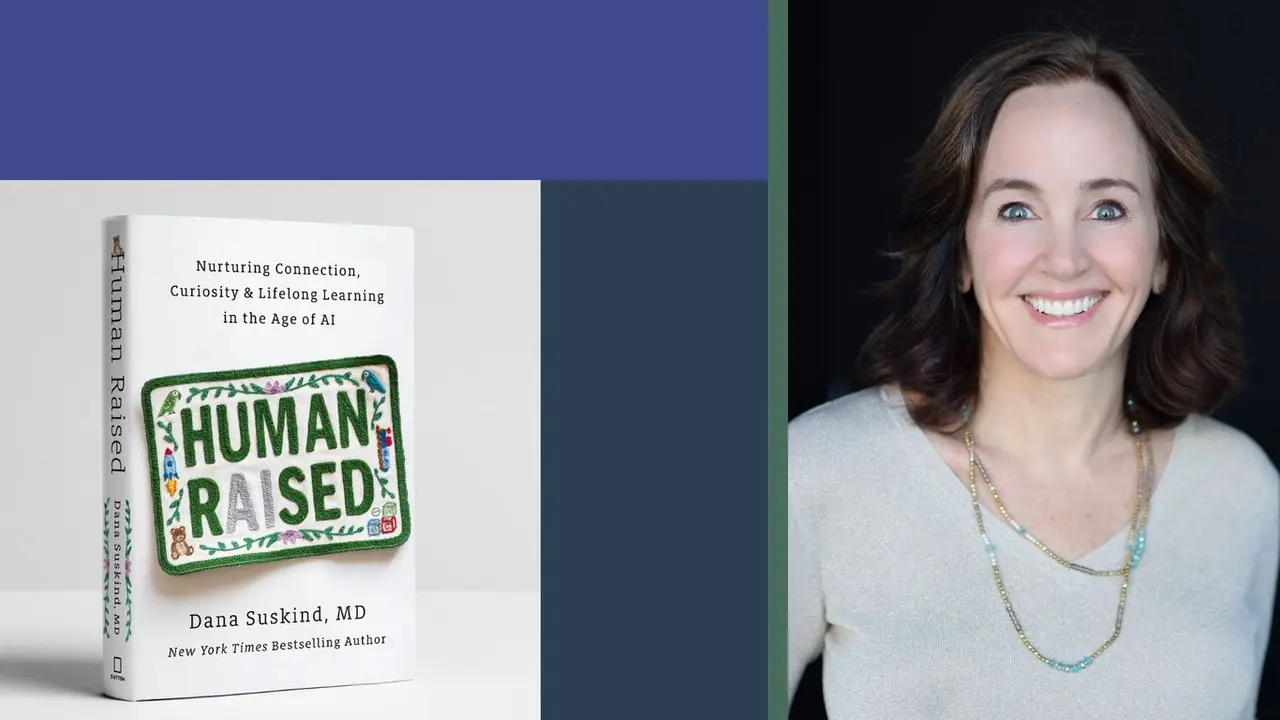
A wave of AI companions for kids is entering homes and classrooms with little oversight, raising urgent questions about childhood development in an algorithmic age. Dana Suskind, a pediatric surgeon and professor at the University of Chicago Medical Center, has emerged as a leading voice of caution with her new book Human Raised: Nurturing Connection, Curiosity & Lifelong Learning in the Age of AI, released July 14
2
.
Source: Axios
The book examines how AI shaping children's lives could fundamentally alter brain development and create a troubling digital divide where human attention becomes a luxury good
2
.Suskind's original working title captured her core concern: "The Trojan Teddy Bear," a reference to AI companions that may seem cute and cuddly but carry hidden risks of AI in childhood
1
. Companies are developing AI dolls, action figures, and chatbots that can tell bedtime stories, help with homework, and even feel like friends to children. Nearly 30% of parents of kids age 0 to 8 said their children had used AI learning tools, according to a Common Sense Media poll, despite major chatbots having age limits that exclude young kids2
. More striking still, nearly half of kids ages 7 to 11 reported that talking to a digital companion feels like talking to a character or friend, according to AI safety tool Aura's 2026 State of the Youth Report2
.
Source: NPR
Suskind's expertise in childhood development stems from her work directing a program that gives children hearing through cochlear implants. After performing this transformative procedure, she noticed some children developed spoken language easily while others struggled
1
. Hearing alone wasn't enough. This led her to study neuroscience and discover that brain development in young children is heavily influenced by back-and-forth interactions with parents and caregivers during the first several years of life1
."If we want children to be able to continue to connect with each other and with other human beings, to be able to think critically, to be able to navigate the human world, we're gonna need to make sure that kids have a distinctly human-raised early childhood," Suskind says
1
. She founded the TMW Initiative, a research center helping parents create brain-enriching environments that children need to reach their full potential1
.Suskind compares AI toys and tutors to processed food—cheap, convenient substitutes that can crowd out what children actually need
2
. She worries that AI tools marketed as educational "will become that sort of ultra-processed alternative for certain populations, widening opportunity gaps in ways that we can't even imagine"2
. The concern extends beyond chatbots to AI dolls that remember children's favorite things, AI tutors promoted as solutions to global teacher shortages, and even robots being piloted for elder care that could one day care for children2
.Parents working multiple jobs or lacking child care, time, or money don't always have the luxury of offering a screen-free childhood or life without AI
2
. This creates what Suskind warns could be a future where human connection itself becomes a luxury good, with certain parents having time to ensure low-tech childhoods while "others will get the artificial replacement"2
.AI is rapidly moving into homes and schools with minimal regulation. Right now, there is no federal law regulating AI technologies for children
2
. One proposed House bill would ban AI chatbot-enabled toys, with similar bills introduced in New York and California2
. Meanwhile, AI-generated slop—low-quality, error-filled videos supposedly educational—floods platforms like YouTube, embedding misspellings, peddling nonsense, and modeling unsafe behaviors for children too young to know the difference3
."Policymakers are struggling to understand what they are regulating," Suskind writes
3
. "The rest of us are struggling to understand how our world is changing. Perhaps one day these gaps will close, but childhood will not wait." The impact of AI on kids could be fundamentally different than TV, the internet, iPads, and social media, she argues, because algorithms will become much more sophisticated at keeping kids engaged, and research shows young children are more likely to anthropomorphize AI and trust AI chatbots2
.Related Stories
Suskind emphasizes that parents and caregivers—not companies or governments—must decide how these intelligent tools shape children's lives, determining what technologies replace, what they enhance, and what they should never touch
3
. She points to a telling pattern: OpenAI CEO Sam Altman said he's going to wait as long as possible to expose his child to AI, stating "I want him to play in the dirt for now"2
. Bill Gates and Steve Jobs also reportedly limited their kids' use of the technology their companies built2
. "Follow the people who are creating this technology," Suskind says, "and be suspicious if the bridge makers are not wanting to cross their own bridge"2
.Geoffrey Hinton, the Nobel laureate known as the Godfather of Artificial Intelligence who left Google in 2023 to warn about existential risks, offered a surprising suggestion for making AI safe: embed maternal instincts in these systems
3
. Not better algorithms or more guardrails, but the primal forces that make parents protect and care for children without calculating expected returns3
.
Source: TIME
Suskind is not calling for parents to bar children from using AI entirely, just not alone and unsupervised. Used well, she writes, it can "ease parents' burdens and enrich children's learning"
2
. But she warns of an "eerie, algorithm-induced quiet of children transfixed by technology"—a modern version of Rachel Carson's Silent Spring, where the silence itself signals something essential dying3
. The societal implications extend beyond individual families to questions about what it means to raise the next generation in an age where machines increasingly mediate human connection.Summarized by
Navi
[3]
29 Jun 2025•Technology

08 Mar 2026•Policy and Regulation

03 Jun 2026•Entertainment and Society

1
Technology

2
Policy and Regulation

3
Business and Economy