North Korean Hackers Exploit ChatGPT to Create Deepfake Military ID for Phishing Attack


9 Sources
[1]
This North Korean Phishing Attack Used ChatGPT's Image Generation
Don't miss out on our latest stories. Add PCMag as a preferred source on Google. A North Korean hacking group appears to have used the technology behind OpenAI's ChatGPT to help them develop a phishing attack. The scheme was traced to the Kimsuky group, which has been known to engage in cyber
[2]
Nork snoops whip up fake military ID with help from ChatGPT
Kimsuky gang proves that with the right wording, you can turn generative AI into a counterfeit factory North Korean spies used ChatGPT to generate a fake military ID for use in an espionage campaign against a South Korean defense-related institution, according to new research. Kimsuky, a
[3]
North Korean Hackers Used ChatGPT to Help Forge Deepfake ID
A suspected North Korean state-sponsored hacking group used ChatGPT to create a deepfake of a military ID document to attack a target in South Korea, according to cybersecurity researchers. Attackers used the artificial intelligence tool to craft a fake draft of a South Korean military
[4]
North Korean hackers used ChatGPT to help forge deepfake ID
A suspected North Korean state-sponsored hacking group used ChatGPT to create a deepfake of a military ID document to attack a target in South Korea, according to cybersecurity researchers. Attackers used the artificial intelligence tool to craft a fake draft of a South Korean military
[5]

North Korean hackers used ChatGPT to help forge deepfake ID | Fortune
Attackers used the artificial intelligence tool to craft a fake draft of a South Korean military identification card in order to create a realistic-looking image meant to make a phishing attempt seem more credible, according to research published Sunday by Genians, a South Korean cybersecurity
[6]

North Korean hackers used ChatGPT to help forge deepfake - The Economic Times
A North Korea-linked hacking group used ChatGPT to create a fake South Korean military ID in a phishing attack, researchers at cybersecurity firm Genians revealed. The deepfake aimed to deceive targets, including journalists and activists. AI tools were also used to craft malware and fake
[7]

North Korean hackers used ChatGPT to help forge deepfake ID
A suspected North Korean state-sponsored hacking group used ChatGPT to create a deepfake of a military ID document to attack a target in South Korea, according to cybersecurity researchers. Attackers used the artificial intelligence tool to craft a fake draft of a South Korean military
[8]

N. Korea-backed hacking group uses AI deepfake to target S. Korean institutions: report - The Korea Times
A North Korea-linked hacking group has carried out a cyberattack on South Korean organizations, including a defense-related institution, using artificial intelligence (AI)-generated deepfake images, a report showed Monday. Kimsuky group, a hacking unit believed to be sponsored by the North Korean
[9]

ChatGPT exploited by North Korea-linked group to target South Korean journalists and activists
Hackers even spoofed official South Korean military email addresses to enhance phishing credibility. In a recent phishing campaign, a hacker group with ties to North Korea is allegedly creating fake South Korean military ID cards using OpenAI's well-known AI chatbot, ChatGPT, according to new
Share
Copy Link
A North Korean hacking group, Kimsuky, used OpenAI's ChatGPT to generate a fake South Korean military ID for a sophisticated phishing attack. This incident highlights the growing use of AI tools by state-sponsored hackers for cyber espionage.
North Korean Hackers Leverage ChatGPT for Sophisticated Phishing Attack
In a concerning development at the intersection of artificial intelligence and cybersecurity, a North Korean hacking group known as Kimsuky has been found using OpenAI's ChatGPT to create deepfake military identification cards for a targeted phishing attack against South Korean defense institutions
1
2
3
. This incident, discovered by South Korean cybersecurity firm Genians, highlights the evolving tactics of state-sponsored hackers and the potential misuse of AI technologies in cyber espionage.The Attack: Methodology and Targets
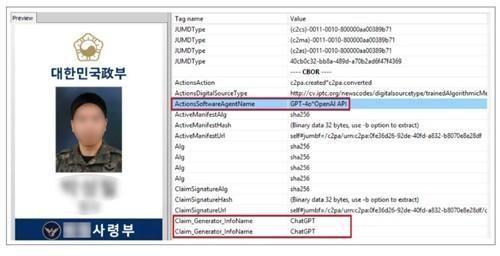
The phishing campaign, detected in July 2025, involved emails impersonating a South Korean defense-related institution responsible for issuing IDs to military-affiliated officials
1
. The attackers used a domain mimicking an official South Korean military institution and included a malicious .zip file attachment1
. This file contained a fake government military ID image, which was later found to be generated using OpenAI's GPT-4o model1
2
.
Source: Korea Times
The targets of this sophisticated attack included South Korean journalists, researchers, and human rights activists focused on North Korea
4
. The phishing emails were sent from an address ending in .mil.kr, cleverly impersonating a legitimate South Korean military address4
5
.AI-Generated Deepfakes: A New Frontier in Cyber Attacks
The use of ChatGPT to create a convincing deepfake military ID marks a significant escalation in the capabilities of cybercriminals. Genians' analysis revealed that the fake ID image had a 98% probability of being AI-generated
1
. This development is particularly noteworthy because OpenAI has implemented safeguards to prevent the generation of government IDs1
2
.However, the Kimsuky group appears to have found a workaround, possibly by framing their requests as creating mock-ups or sample designs for legitimate purposes
1
2
. This technique, known as prompt engineering, allowed the attackers to bypass ChatGPT's built-in restrictions2
4
.Broader Implications and Growing Trends
This incident is not isolated but part of a broader trend of North Korean operatives leveraging AI for intelligence gathering and cyber attacks. In August 2025, Anthropic reported that North Korean hackers had used the Claude Code tool to create elaborate fake identities, pass coding assessments, and even secure remote work positions at U.S. Fortune 500 tech companies
3
4
5
.
Source: ET
Related Stories

Security Concerns and Preventive Measures
The successful use of AI in creating convincing fake documents raises significant security concerns. It demonstrates that attackers can leverage emerging AI technologies throughout the hacking process, from attack planning to malware development and social engineering
4
5
.In response to these threats, AI companies like OpenAI have taken steps to ban suspected North Korean accounts and prevent the misuse of their technologies
3
5
. However, the Kimsuky incident shows that determined attackers can still find ways to exploit these powerful AI tools.
Source: Fortune
Conclusion
As AI technologies continue to advance, the cybersecurity landscape faces new challenges. The use of ChatGPT by North Korean hackers to create deepfake military IDs serves as a stark reminder of the need for enhanced security measures and ongoing vigilance in the face of evolving cyber threats. It also underscores the importance of responsible AI development and the need for robust safeguards to prevent the misuse of these powerful tools in cyber warfare and espionage.
References
Summarized by

Navi
[2]
[4]
Related Stories
North Korean Hackers Build Offline AI Stack to Automate Cyberattacks and Evade Detection
10 Aug 2026•Technology

OpenAI Confirms ChatGPT Abuse by Hackers for Malware and Election Interference
10 Oct 2024•Technology

OpenAI Uncovers Global AI Misuse in Cyber Operations and Influence Campaigns
06 Jun 2025•Technology

Recent Highlights



Recent Highlights
Today's Top Stories



Don’t drown in AI news. We cut through the noise - filtering, ranking and summarizing the most important AI news, breakthroughs and research daily. Follow topics that matter to you and stay ahead.


