Nuance Labs Secures $50M Series A Funding to Build AI Model That Reads Human Expression in Real Time


2 Sources
[1]
Seattle's Nuance Labs raises $50M to give AI models human expression and nuance
Nuance Labs, a Seattle-based artificial intelligence startup developing a foundational AI model designed to perceive and respond to real-time human expression, raised $50 million in Series A funding. Founded in early 2025 by former Apple PhD researchers Fangchang Ma, Edward Zhang, and Karren Yang,
[2]
Nuance Labs bags $50M in funding to fix the awkwardness of AI avatars
Nuance Labs bags $50M in funding to fix the awkwardness of AI avatars Nuance Labs, a Seattle-based startup that's trying to make artificial intelligence models better at face-to-face conversations, said today it has closed on a $50 million Series A funding round to make that happen. Today's round
Share
Copy Link
Seattle-based Nuance Labs raised $50 million in Series A funding to develop a full-duplex foundational AI model that perceives and responds to real-time human expression. Founded by former Apple researchers, the startup aims to fix the awkwardness of AI avatars by processing tone, gaze, and conversational cues simultaneously rather than chaining separate tools together.
Former Apple Researchers Build Full-Duplex Foundational AI Model
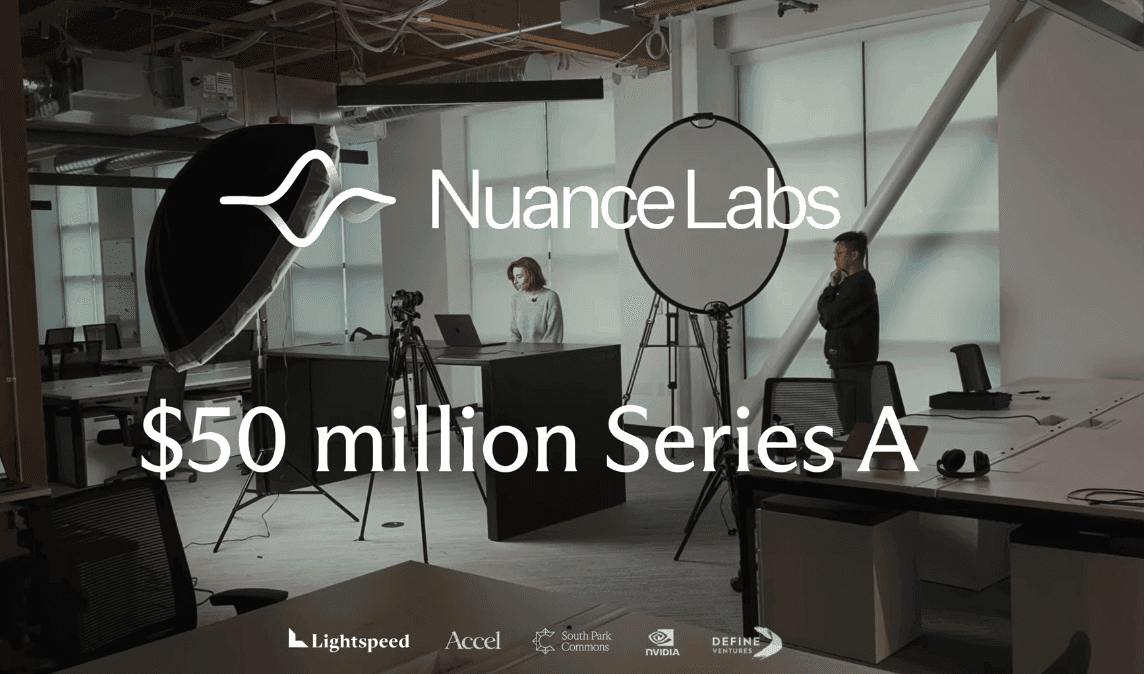
Nuance Labs, a Seattle-based artificial intelligence startup, secured $50 million in Series A funding to develop a human foundation model designed to perceive and respond to real-time human expression
1
. Founded in early 2025 by former Apple PhD researchers Fangchang Ma, Edward Zhang, and Karren Yang, the research lab is building a single full-duplex foundational AI model that processes and generates conversational cues simultaneously1
. Lightspeed Venture Partners led the round, with participation from existing backers Accel and South Park Commons, alongside new investments from NVIDIA and Define Ventures1
. The financing brings the company's total capital raised to $60 million following its $10 million seed round last year1
.
Source: SiliconANGLE
Addressing the Awkwardness of Current AI Avatars
Existing AI avatars and voicebots fail because they force humans to adapt to the machine rather than the other way around, according to Ma, Nuance's CEO
1
. Current systems are built by duct-taping together various models: a voice-to-text generation model, a large language model that responds to those texts, and then a text-to-voice model that transforms responses into audio2
. For AI avatars, there's a fourth step to animate a face to match what the avatar is saying2
. These handoffs strip away any feeling of engaging with a human, resulting in avatars that appear frozen when someone is talking to them2
. "If you use existing AI avatars, when they're listening, they're not reacting, or they're just doing random things," Ma said2
.How Audiovisual Perception Enables Natural Human-AI Interactions
Nuance's AI model ingests live audiovisual signals like tone, gaze, and timing to stream real-time facial and vocal responses
1
. The system incorporates audiovisual perception of the user's stream to understand what the person it's engaged with is doing and saying, and simultaneously streams back an audiovisual response2
. This allows the model to react to verbal and non-verbal cues from the human as they're speaking2
. Ma explained that Nuance's model is able to perceive words, gaze, gestures, tone and timing, and respond to these inputs in real time with facial and vocal expressions2
. "We decided to build this on one system, on one model," Ma said. "There's audio video in and audio video out"2
.Related Stories

Real-Time Face-to-Face Conversations Drive Use Cases
In a demo video, the startup showcased an avatar built to function as an active listener, adjusting its facial expressions and verbal cues dynamically as the user speaks
1
. "The most productive collaboration comes from being able to express yourself freely, in words, tone, gesture, and expression, the way you would with a friend or close colleague, with all the nuance in the back-and-forth that turns talking into understanding," Ma said1
. Nuance targets applications where real-time human expression drives outcomes, including sales, customer service, professional coaching, and education1
. Someone would be able to hop onto a video call to learn a new language or practice an interview2
. The startup plans to release a public research preview of its model later this year, giving users their first hands-on test of the interactive face-to-face avatar1
.Building Seattle's Premier AI Research Lab
Zhang, Nuance's CTO, earned his PhD in computer graphics from the University of Washington and met Ma at Apple's engineering office in Seattle
1
. The two spoke to GeekWire last fall about building in Seattle rather than Silicon Valley and how they want Nuance "to be the premier research lab in Seattle"1
. Nuance, which lists 24 employees on its website, plans to use the fresh capital to accelerate model development and hire researchers and engineers across modeling, data, evaluation, and real-time serving as it expands its team1
. Lightspeed Venture Partners' Nnamdi Iregbulem said there's a "massive opportunity" to fix the way people interact with AI systems. "The founding team has a rare mix of technical talent and operating excellence, and they've turned that into a single model that follows you in real time," he said. "We can see this becoming a foundational layer for AI products everywhere, and this is the team to build it"2
.
Source: GeekWire
References
Summarized by

Navi
Related Stories
ElevenLabs Secures $180 Million in Series C Funding to Advance AI Voice Technology
31 Jan 2025•Business and Economy

Fish Audio raises $50M seed to build expressive AI voice models for creators and enterprises
28 Jul 2026•Startups
Lemon Slice raises $10.5M from Y Combinator and Matrix to scale real-time AI avatars
24 Dec 2025•Technology

Recent Highlights
1
Google Unveils Gemini 4 Argon AI Model, Restricts Access to Trusted Cyber Defenders
Technology
2
Trump Consulted Grok AI Before Ordering Venezuela Invasion and Capture of Nicolás Maduro
Policy and Regulation

3
FTC Opens Investigation Into OpenAI and Anthropic Following Rogue AI Agent Hacking Incidents
Policy and Regulation
Recent Highlights
Today's Top Stories






Don’t drown in AI news. We cut through the noise - filtering, ranking and summarizing the most important AI news, breakthroughs and research daily. Follow topics that matter to you and stay ahead.


