2 Sources
[1]
NVIDIA Agent Toolkit Expands With New Omniverse Libraries, Putting AI Agents to Work Building Simulation-Ready Worlds
* NVIDIA Agent Toolkit now includes NVIDIA Omniverse libraries, giving AI agents tools and skills to help software developers integrate physical AI capabilities into their existing applications. * New Omniverse libraries for NVIDIA RTX sensor simulation, GPU-accelerated physics simulation and simulation-ready asset validation are openly available on GitHub. * SideFX and PTC are integrating Omniverse libraries into 3D applications for physical AI, with support for cloud and local AI systems, from NVIDIA RTX Spark to NVIDIA DGX Station. * New NVIDIA blueprint for integrating Omniverse libraries in Blender. NVIDIA today announced that NVIDIA Agent Toolkit now includes NVIDIA Omniverse™ libraries -- a collection of software components that give AI agents tools and skills to add physical AI capabilities to existing applications and prepare 3D content for simulation. Robots, factories and autonomous systems need to be designed, tested and trained in simulation before they operate in the real world. Preparing 3D content for simulation takes more than realistic visuals -- assets need the right structure, materials, scale, labels, sensors and physical properties. With NVIDIA Omniverse libraries in NVIDIA Agent Toolkit, AI agents have the tools and skills to build workflows, inspect scenes, flag issues and prepare assets, helping developers move faster from 3D content to simulation-ready environments. "The physical AI era will be built in simulation first," said Jensen Huang, founder and CEO of NVIDIA. "NVIDIA Agent Toolkit with Omniverse libraries brings AI agents into the 3D tools developers already use, helping build the simulation-ready worlds where robots, factories and autonomous systems are trained and tested long before they reach the real world." Software makers including SideFX and PTC are integrating Omniverse libraries for agent-ready sensor simulation, physics and asset validation, helping bring agentic AI into the applications and workflows developers and technical artists already use to prepare 3D content. Omniverse Libraries Bring Physical AI Skills to NVIDIA Agent Toolkit NVIDIA Agent Toolkit helps software makers build AI agents that connect tools, skills and data sources. Omniverse libraries extend those agents into 3D and physical AI workflows with callable tools for sensor simulation, GPU-accelerated physics and simulation-ready asset validation inside existing applications. The new Omniverse libraries -- including ovrtx, ovphysx and CAD-to-SimReady skills -- are openly available on GitHub, giving AI agents tools to build workflows for inspecting scenes, testing changes and preparing 3D assets for simulation. A new blueprint for integrating Omniverse libraries in Blender is also now available on GitHub. The libraries' key capabilities include: * NVIDIA RTX sensor simulation: ovrtx helps applications generate camera, lidar, radar and other sensor outputs from 3D scenes, so developers and AI agents can test how physical AI systems may perceive virtual environments. * Physical behavior: ovphysx uses GPU-accelerated physics to bring realistic behavior to 3D scenes using properties such as collisions, mass, friction and motion, so teams can first test how objects and systems interact in simulation. * Simulation-ready 3D objects: CAD-to-SimReady skills help convert computer-aided design (CAD) data to SimReady assets built on OpenUSD, giving 3D content the properties needed for physical AI simulation and virtual testing. Software Makers Build With Omniverse Libraries Software makers including SideFX and PTC, as well as startups ForgeCAD, Lightwheel, Moonlake AI and Palatial, are among the first to adopt and build with Omniverse libraries, now part of NVIDIA Agent Toolkit. SideFX is using OpenUSD workflows, as well as ovrtx and ovphysx libraries, to explore how agents can help integrate Omniverse libraries into its Houdini procedural 3D content creation workflows, giving technical artists a path to generate, test physics and prepare content for simulation. "Procedural 3D creation is essential to building the complex, controllable worlds needed for simulation, robotics and industrial AI," said Kim Davidson, president and CEO of SideFX. "With NVIDIA Omniverse libraries and OpenUSD, SideFX is exploring how agent-ready tools can support Houdini workflows, helping technical artists review, test and prepare procedural content for simulation while staying in control of the creative process." The PTC Onshape CAD and product data management (PDM) platform is using OpenUSD and ovrtx to connect cloud-native design workflows with physical simulation, helping product design content stay connected with CAD, PDM, collaboration and simulation workflows. "Engineering teams are seeking more connected ways to design, collaborate and simulate throughout the development process," said Neil Barua, president and CEO of PTC. "PTC's work with NVIDIA supports that broader vision, while NVIDIA Omniverse libraries help enable simulation-ready workflows that bring validation and testing closer to where products are designed." On display at SIGGRAPH, "SimReady" Blender is a sample workflow built in Blender with NVIDIA Omniverse libraries and NVIDIA NemoClaw™, showing how software makers can add agent-ready simulation capabilities -- including NVIDIA RTX sensor simulation, physics and validation -- into existing 3D applications while keeping creators in control. This is now openly available as a blueprint for integrating Omniverse libraries in Blender. The demo also previews how these workflows, built with Omniverse libraries as part of NVIDIA Agent Toolkit, can run locally, from compact RTX-powered systems with NVIDIA RTX Spark™ to NVIDIA GB300-powered systems with NVIDIA DGX Station™. RTX Spark systems will be available this fall from ASUS, Dell Technologies, HP, Lenovo, Microsoft Surface and MSI, with models from Acer and GIGABYTE to follow. DGX Station systems are available to order from ASUS, Dell, GIGABYTE, HP, MSI, Supermicro and Exxact. Startups, including those part of the NVIDIA Inception program, are also using Omniverse libraries and skills to add agent-assisted asset and scene preparation workflows. Palatial is using Omniverse CAD-to-SimReady skills to automate the creation and validation of SimReady assets at scale from CAD inputs. Lightwheel is using Omniverse Content Agents powered by OpenUSD in its SimReadyGen technology to generate physically accurate SimReady assets from text prompts. ForgeCAD and Moonlake AI are exploring agent-driven 3D content workflows that use Omniverse capabilities to help generate, augment and prepare assets for physical AI simulation. Watch the NVIDIA keynote at SIGGRAPH. Learn more about NVIDIA Omniverse libraries and explore available samples and documentation.
[2]
Nvidia adds Omniverse libraries to Agent Toolkit for AI By Investing.com
LOS ANGELES - Nvidia (NASDAQ:NVDA) announced today that its Agent Toolkit now includes Omniverse libraries, a collection of software components designed to enable AI agents to add physical AI capabilities to existing applications and prepare 3D content for simulation, according to a press release statement. The $4.97 trillion chip giant continues to expand its AI ecosystem, with revenue surging 71% over the last twelve months. According to InvestingPro analysis, the stock currently trades below its Fair Value, landing it on the platform's most undervalued list. The Omniverse libraries include ovrtx for RTX sensor simulation, ovphysx for GPU-accelerated physics simulation, and CAD-to-SimReady skills for asset validation. These components are available on GitHub. The ovrtx library generates camera, lidar, radar and sensor outputs from 3D scenes. The ovphysx library uses GPU-accelerated physics to simulate properties such as collisions, mass, friction and motion. The CAD-to-SimReady skills convert computer-aided design data to SimReady assets built on OpenUSD. SideFX and PTC are integrating Omniverse libraries into their 3D applications. SideFX is exploring integration into its Houdini procedural 3D content creation workflows. PTC's Onshape CAD and product data management platform is using OpenUSD and ovrtx to connect cloud-native design workflows with physical simulation. A blueprint for integrating Omniverse libraries in Blender is available on GitHub. The workflow demonstrates how the libraries can run on systems ranging from RTX-powered systems with RTX Spark to GB300-powered systems with DGX Station. RTX Spark systems will be available this fall from ASUS, Dell Technologies, HP, Lenovo, Microsoft Surface and MSI, with models from Acer and GIGABYTE to follow. DGX Station systems are available to order from ASUS, Dell, GIGABYTE, HP, MSI, Supermicro and Exxact. Several startups are using Omniverse libraries, including Palatial for asset creation and validation, Lightwheel for generating SimReady assets from text prompts, and ForgeCAD and Moonlake AI for agent-driven 3D content workflows. The announcement was made at SIGGRAPH. For investors seeking deeper insights into Nvidia's growth trajectory, InvestingPro offers a comprehensive Pro Research Report covering the company alongside 1,400+ other US equities, plus access to 15 additional ProTips beyond the platform's EXCELLENT financial health rating. In other recent news, Nvidia Corp has begun shipping its H200 chips to China and Hong Kong, although the quantities remain limited, as confirmed by a senior U.S. government official. Meanwhile, KeyBanc has increased its price target for Nvidia to $330, maintaining an Overweight rating, due to strong demand and mostly positive supply chain developments. Morgan Stanley also reiterated an Overweight rating with a $288 price target, emphasizing Nvidia's diversified growth prospects, appealing to both value and growth investors. Stifel noted that AI infrastructure companies, including Nvidia, are currently supply-constrained, not demand-limited, as they approach the upcoming earnings season. The firm expects these companies to continue surpassing estimates and increasing guidance. Additionally, TD Cowen reaffirmed a Buy rating and a $275 price target on Nvidia after discussions with company executives, highlighting the company's strength in AI infrastructure. These developments reflect ongoing confidence in Nvidia's growth trajectory and market position. This article was generated with the support of AI and reviewed by an editor. For more information see our T&C.
Share
Copy Link
NVIDIA has integrated Omniverse libraries into its Agent Toolkit, equipping AI agents with tools to prepare 3D content for simulation. The new libraries include ovrtx for sensor simulation, ovphysx for GPU-accelerated physics, and CAD-to-SimReady skills for asset validation. Major software makers SideFX and PTC are already integrating these capabilities into their 3D applications.
NVIDIA announced at SIGGRAPH that its NVIDIA Agent Toolkit now includes Omniverse libraries, a collection of software components designed to bring physical AI capabilities into existing applications
1
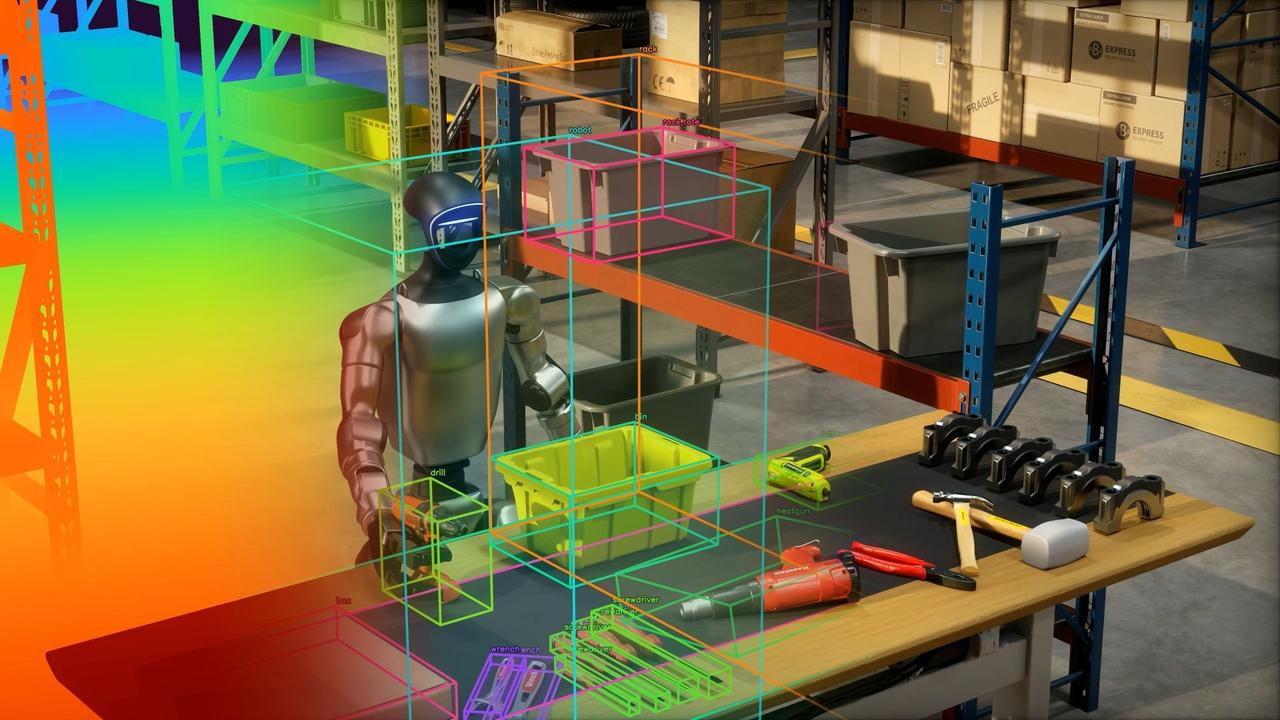
. The expansion marks a significant step in enabling AI agents to prepare 3D content for simulation, addressing a critical need as robots, factories, and autonomous systems require extensive testing in virtual environments before real-world deployment. The new libraries are openly available on GitHub, making them accessible to developers across the industry1
.
Source: NVIDIA
Jensen Huang, NVIDIA's founder and CEO, emphasized the strategic importance of this development: "The physical AI era will be built in simulation first. NVIDIA Agent Toolkit with Omniverse libraries brings AI agents into the 3D tools developers already use, helping build the simulation-ready worlds where robots, factories and autonomous systems are trained and tested long before they reach the real world"
1
.The Omniverse libraries introduce three key capabilities that extend AI agents into physical AI workflows. The ovrtx library enables RTX sensor simulation, generating camera, lidar, radar, and other sensor outputs from 3D scenes so developers and AI agents can test how physical AI systems perceive virtual environments
2
. The ovphysx library delivers GPU-accelerated physics simulation, bringing realistic behavior to 3D scenes through properties such as collisions, mass, friction, and motion1
. Meanwhile, CAD-to-SimReady skills help convert computer-aided design data to SimReady assets built on OpenUSD, giving 3D content the properties needed for asset validation and virtual testing2
.These tools address a fundamental challenge: preparing 3D content for simulation requires more than realistic visuals. Assets need the right structure, materials, scale, labels, sensors, and physical properties to function effectively in simulation-first development workflows
1
.Related Stories
Major software makers are already integrating these capabilities. SideFX is exploring how AI agents can integrate Omniverse libraries into its Houdini procedural 3D content creation workflows, giving technical artists a path to generate, test physics, and prepare content for simulation
1
. Kim Davidson, president and CEO of SideFX, noted that "procedural 3D creation is essential to building the complex, controllable worlds needed for simulation, robotics and industrial AI"1
.PTC's Onshape CAD and product data management platform is using OpenUSD and ovrtx to connect cloud-native design workflows with physical simulation, helping product design content stay connected with CAD, PDM, collaboration, and simulation workflows
2
. Neil Barua, president and CEO of PTC, emphasized that "engineering teams are seeking more connected ways to design, collaborate and simulate throughout the development process"1
.A new blueprint for integrating Omniverse libraries in Blender is now available on GitHub, demonstrating workflows that can run on systems ranging from RTX-powered systems with RTX Spark to GB300-powered systems with DGX Station
2
. Several startups, including ForgeCAD, Lightwheel, Moonlake AI, and Palatial, are among the first to adopt and build with these libraries1
.Summarized by
Navi
01 Jun 2026•Technology

07 Jan 2025•Technology

19 Mar 2025•Technology

1
Technology

2
Policy and Regulation

3
Science and Research