NVIDIA Expands Omniverse with Generative AI for Physical AI Applications


4 Sources
[1]
NVIDIA Expands Omniverse With Generative Physical AI
* New Models, Including Cosmos World Foundation Models, and Omniverse Mega Factory and Robotic Digital Twin Blueprint Lay the Foundation for Industrial AI * Leading Developers Accenture, Altair, Ansys, Cadence, Microsoft and Siemens Among First to Adopt Platform Libraries CES -- NVIDIA today
[2]
Nvidia uses GenAI to integrate Omniverse virtual creations into physical AI apps
Join our daily and weekly newsletters for the latest updates and exclusive content on industry-leading AI coverage. Learn More Nvidia unveiled generative AI models and blueprints that expand Nvidia Omniverse integration further into physical AI applications such as robotics, autonomous vehicles
[3]
Nvidia announces early access for Omniverse Sensor RTX for smarter autonomous machines
Join our daily and weekly newsletters for the latest updates and exclusive content on industry-leading AI coverage. Learn More Nvidia announced early access for Omniverse Cloud Sensor RTX software to enable smarter autonomous machines with generative AI. Generative AI and foundation models let
[4]
Building Smarter Autonomous Machines: NVIDIA Announces Early Access for Omniverse Sensor RTX
Organizations including Accenture and Foretellix are accelerating the development of next-generation self-driving cars and robots with high-fidelity, scalable sensor simulation. Generative AI and foundation models let autonomous machines generalize beyond the operational design domains on which
Share
Copy Link
NVIDIA announces new generative AI models and blueprints for Omniverse, expanding its integration into physical AI applications like robotics and autonomous vehicles. The company also introduces early access to Omniverse Cloud Sensor RTX for smarter autonomous machines.

NVIDIA Unveils Generative AI Models for Omniverse
NVIDIA has announced a significant expansion of its Omniverse platform with new generative AI models and blueprints, aimed at revolutionizing physical AI applications such as robotics, autonomous vehicles, and vision AI
1
. This development, revealed at CES 2025, marks a major step towards integrating virtual creations into real-world AI applications.Expanding Omniverse Integration
The expansion includes the introduction of NVIDIA Cosmos world foundation models, which create a synthetic data multiplication engine. This allows developers to easily generate massive amounts of controllable, photoreal synthetic data for physical AI training
2
. The company also announced the general availability of USD Code and USD Search NVIDIA NIM microservices, enabling developers to use text prompts to generate or search for OpenUSD assets1
.New Blueprints for Industrial and Robotic Workflows
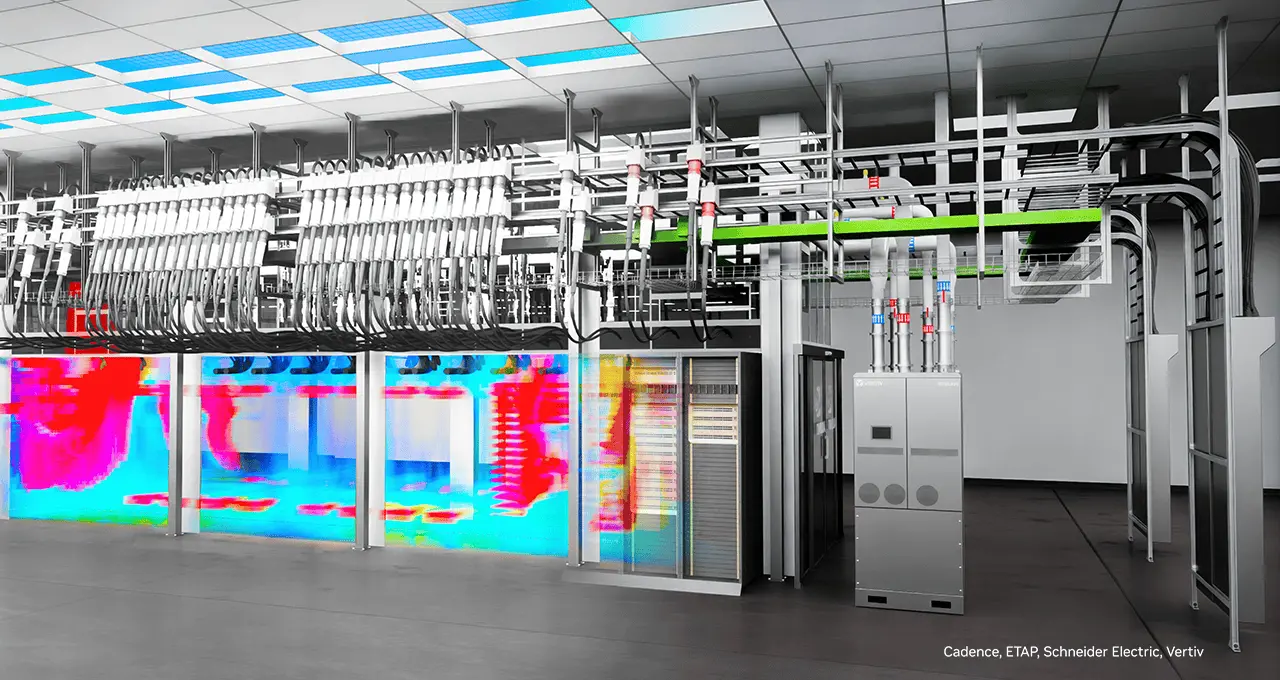
NVIDIA introduced four new blueprints to simplify the development of Universal Scene Description (OpenUSD)-based Omniverse digital twins for physical AI
1
. These blueprints are designed to accelerate industrial and robotic workflows, making it easier for developers to create complex simulations and environments.Omniverse Cloud Sensor RTX for Autonomous Machines
In a related announcement, NVIDIA revealed early access to Omniverse Cloud Sensor RTX software, aimed at enabling smarter autonomous machines with generative AI
3
. This technology addresses the challenge of collecting diverse data for training, fine-tuning, and validating autonomous systems, especially in rare or hazardous scenarios4
.Industry Adoption and Collaboration
Several industry leaders are already integrating Omniverse into their products and services:
- Siemens announced the Teamcenter Digital Reality Viewer, powered by NVIDIA Omniverse libraries
1
. - Cadence is further integrating Omniverse into Allegro, its electronic computer-aided design application
2
. - Altair and Ansys are adopting Omniverse for real-time CAE digital twins and computational fluid dynamics
2
. - Accenture is using the Mega blueprint to help KION Group build next-generation autonomous warehouses
2
.
Related Stories
Impact on Manufacturing and Logistics
Jensen Huang, NVIDIA's founder and CEO, emphasized the transformative potential of physical AI: "Physical AI will revolutionize the $50 trillion manufacturing and logistics industries. Everything that moves -- from cars and trucks to factories and warehouses -- will be robotic and embodied by AI"
1
. This vision underscores the significant impact NVIDIA's technologies are expected to have on various industries.Advancing Autonomous Vehicle Development
The Omniverse Blueprint for AV simulation, which uses Omniverse Sensor RTX APIs, is being adopted by companies like Foretellix to enhance autonomous vehicle development and validation
4
. This technology enables the generation of physically accurate sensor data, crucial for training and testing autonomous vehicles at scale.As these technologies continue to evolve, they promise to accelerate the development and deployment of advanced autonomous systems across multiple industries, potentially reshaping the future of manufacturing, logistics, and transportation.
References
Summarized by

Navi
[3]
Related Stories
NVIDIA Expands Omniverse Platform to Revolutionize AI Factory Design and Industrial Robotics
19 Mar 2025•Technology

NVIDIA Unveils Cosmos Reason and Advanced AI Models for Robotics and Physical AI Applications
12 Aug 2025•Technology

NVIDIA launches Physical AI Data Factory Blueprint to accelerate robotics and autonomous vehicles
17 Mar 2026•Technology
Recent Highlights
1
Microsoft and Nvidia Launch Surface Laptop Ultra: A $2,599 AI-Ready PC With RTX Spark Chip
Technology

2
Trump Consulted Grok AI Before Ordering Venezuela Invasion and Capture of Nicolás Maduro
Policy and Regulation

3
Scientists Build AI Model That Reconstructs Images From Brain Scans in Record Time
Science and Research

Recent Highlights
Today's Top Stories






Don’t drown in AI news. We cut through the noise - filtering, ranking and summarizing the most important AI news, breakthroughs and research daily. Follow topics that matter to you and stay ahead.


