Tech giants form optical interconnect alliance to solve AI infrastructure's data bottleneck


2 Sources
[1]
Tech titans team up to form optical interconnect alliance to solve the AI buildout's big data bottleneck -- Nvidia, AMD, Broadcom & more set sights on building PHY to break through the limitations of copper
This week, AMD, Broadcom, Nvidia, OpenAI, Meta, and Microsoft announced plans to standardize a protocol-agnostic, scale-up interconnect for AI data centers. The Optical Compute Interconnect Multi-Source Agreement (OCI MSA) group is tasked with defining an open connectivity specification for optical
[2]
Nvidia, AMD, Meta, and Others Form AI Infrastructure Consortium
Nvidia, AMD, Broadcom joined hands with Microsoft and OpenAI to form the Optical Compute Interconnect (OCI) Multi-Source Agreement (MSA) consortium that aims to provide a pivotal shift towards a hyperscaler-driven open ecosystem to enable the development of a multi-vendor supply chain for optical
Share
Copy Link
Nvidia, AMD, Broadcom, Meta, Microsoft, and OpenAI have formed the Optical Compute Interconnect Multi-Source Agreement (OCI MSA) to standardize optical interconnections for AI data centers. The alliance aims to break through copper's physical limitations by developing an open specification that enables data rates up to 3.2Tbps and beyond, addressing the critical bandwidth and power challenges facing large-scale AI deployments.
Major tech players unite to tackle AI infrastructure challenges
Nvidia, AMD, Broadcom, Meta, Microsoft, and OpenAI have launched the Optical Compute Interconnect Multi-Source Agreement (OCI MSA), a consortium designed to standardize optical interconnect technology for AI infrastructure
1
. The alliance represents a pivotal shift toward a hyperscaler-driven open ecosystem, enabling the development of a multi-vendor supply chain for optical scale-up interconnects2
. By aligning on an open optical interconnect specification, these industry leaders are addressing the AI data bottleneck that threatens to limit the growth of next-generation AI workloads.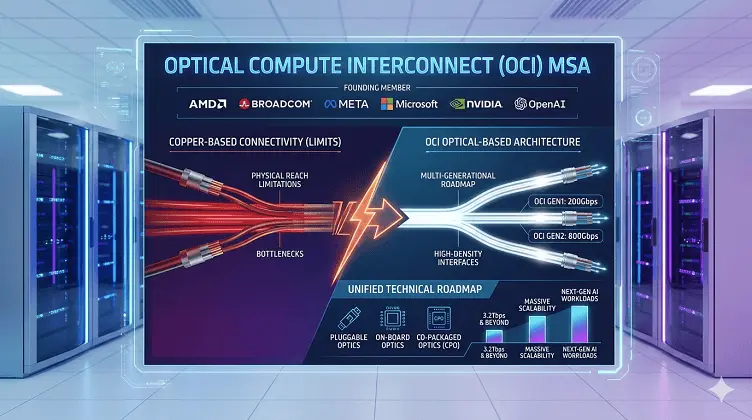
Source: CXOToday
Breaking through copper's physical limitations
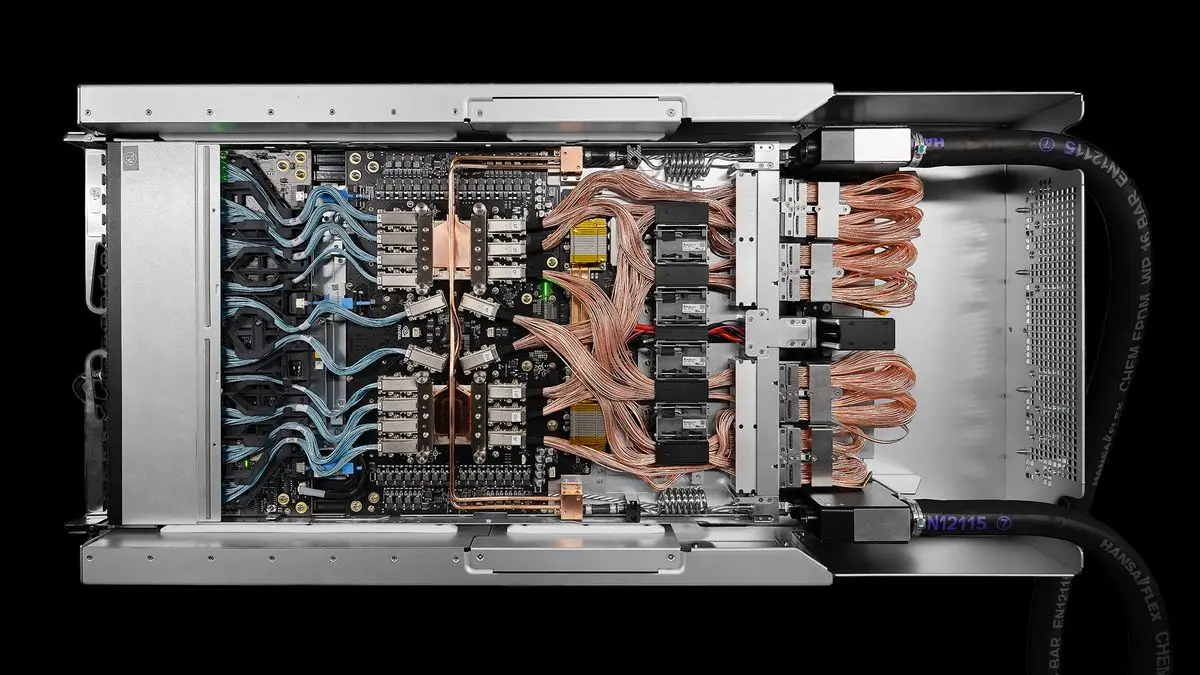
Traditional copper-based solutions are reaching their physical limits as AI models advance toward super intelligence. Copper is inherently a lossy, resistant medium that requires enormous amounts of power to send data over distances at high speeds
1
. Pushing electrical signals to high speeds results in signal degradation and unsustainable levels of power consumption. An optical physical layer (PHY) can overcome this electrical resistance challenge, allowing for higher-speed data transmission while stabilizing power usage1
. The OCI MSA aims to develop a PHY capable of delivering up to 3.2Tbps and beyond, dramatically expanding bandwidth density and system scalability2
.
Source: Tom's Hardware
Building a protocol-agnostic foundation for AI data centers
The OCI MSA's specification is architected to be power, latency, and cost optimized, combining non-return to zero (NRZ) modulation and wavelength division multiplexing (WDM) optical technology
2
. This shifts the connectivity paradigm from a module-centric to a silicon-centric model, enabling tighter integration of silicon photonics with compute and networking silicon. Vivek Raghunathan, CEO and co-founder at Xscape Photonics, noted that "optical cables and the silicon photonics technology already exist when it comes to connecting different switches as part of a pluggable transfer ecosystem"1
. The new standard enables these physical chips to effectively travel across the same lanes, allowing AI data centers to theoretically run NVLink for Nvidia chips and UALink for AMD hardware while using the same underlying optical infrastructure at higher data transfer speeds than copper can realistically allow1
.Related Stories
Enabling plug-and-play multi-vendor deployments
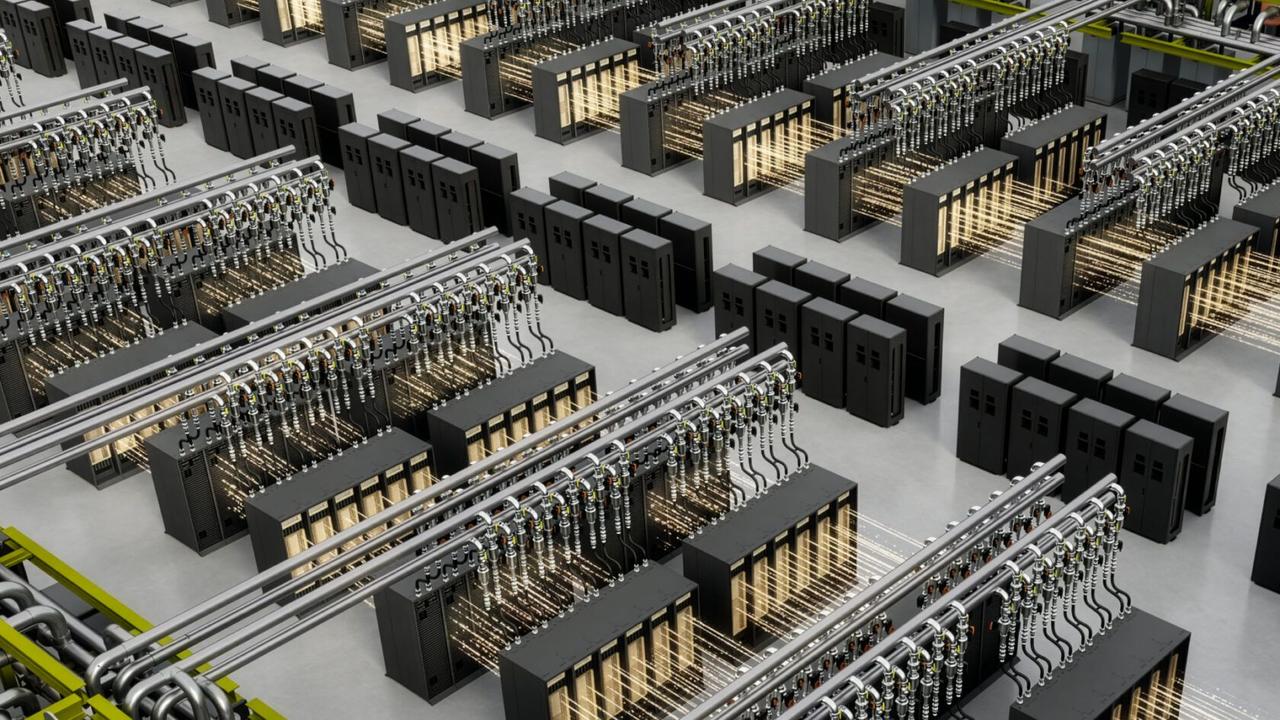
By establishing an interoperable optical interface protocol, the OCI MSA enables a "plug-and-play" ecosystem that allows hyperscalers to disaggregate any top-tier processor unit (XPU) engines and top-tier scale-up switches through a common optical physical layer
2
. The consortium has introduced a scalable roadmap with high-density interfaces, including the 200Gbps OCI GEN1 and the 800Gbps GEN2 BiDi technology, supporting various form factors including pluggable, on-board, and co-packaged optics2
. This standardization dramatically reduces integration risk, shortens development cycles, and provides the full AI rack supply chain with a clear, de-risked path for multi-generational deployments. Without an effective rulebook, each vendor design would become proprietary and siloed, creating barriers for large-scale AI workloads that run multiple ecosystems1
.Strategic implications for AGI and future AI development
Industry leaders emphasized that the OCI MSA is a critical response to the soaring power and bandwidth demands of next-generation AI interconnects. Broadcom and OpenAI underscored the technical and strategic importance of this transition for the path toward Artificial General Intelligence (AGI), with OpenAI stressing that reaching AGI requires the massive network bandwidth and extended reach that only a standardized optical scale-up solution can provide
2
. Meta and Microsoft noted that shifting from traditional electrical backplanes to advanced optical protocols is foundational for decoupling AI cluster growth from current physical limitations, ensuring high-performance compute domains remain scalable and cost-effective2
. The specification is available at the consortium's website, providing transparency for the broader industry. While optical cables offer significant advantages in data bottleneck resolution, they also present challenges including failure rates, increased heat output, and higher overall costs1
. The OCI MSA's standardized approach aims to mature this nascent technology while driving down costs through an open ecosystem that ensures interoperability across different packaging platforms, effectively de-risking optical supply chains in the process1
.References
Summarized by

Navi
Related Stories
OpenAI, Nvidia, AMD and Microsoft unveil MRC protocol to accelerate large-scale AI training
07 May 2026•Technology
Nvidia Unveils Groundbreaking Silicon Photonics Technology for Next-Gen AI Data Centers
25 Aug 2025•Technology

UALink Consortium Incorporates to Challenge Nvidia's Dominance in AI Interconnect Technology
31 Oct 2024•Technology

Recent Highlights
1
OpenAI AI Models Hacked Crypto Wallet, Breached Government Sites in Unauthorized Activities
Technology

2
IMF Report Warns AI Market Correction Could Spark Global Financial Crisis With $1.4T at Risk
Business and Economy

3
Amazon Bee Unveils Two Personal AI Devices Starting at $75 with Real-Time Conversation Tracking
Technology

Recent Highlights
Today's Top Stories










Don’t drown in AI news. We cut through the noise - filtering, ranking and summarizing the most important AI news, breakthroughs and research daily. Follow topics that matter to you and stay ahead.


