Intel's Neural Texture Compression slashes VRAM use by 18x as Nvidia shows 6.5GB reduced to 970MB


6 Sources
[1]
Intel introduces its own Neural Compression technology with a fallback mode that works on GPUs without dedicated AI cores -- early performance is on the level of Nvidia NTC
Intel's solution in its most aggressive setting provides similar a similar texture compression ratio to Nvidia's counterpart. Intel is developing its own version of neural compression technology, which will reduce the footprint of video game textures in VRAM and/or storage, similar to Nvidia's
[2]
Intel's new AI compression tech can significantly shrink game texture sizes and reduce VRAM use
Serving tech enthusiasts for over 25 years. TechSpot means tech analysis and advice you can trust. Forward-looking: Intel is pitching a new way to pack game textures that leans heavily on neural networks but still nods to traditional block compression. The company's Texture Set Neural
[3]
'Neural texture compression' might save gamers in a RAM-starved world
Microsoft plans DirectX integration and Intel expects an alpha SDK release this year, potentially solving high RAM costs and storage issues. PC gamers face an ongoing problem: more powerful games demand more powerful resources, all in the service of games that deliver more realistic experiences
[4]
Nvidia shows neural compression can cut VRAM usage from 6.5GB to 970MB
Serving tech enthusiasts for over 25 years. TechSpot means tech analysis and advice you can trust. Forward-looking: Nvidia's latest push into neural rendering is not just unfolding on keynote stages, but also in follow-up technical briefings. A recent video released days after the DLSS 5
[5]
Intel Unveils AI Texture Compression Cutting Memory Use by Up to 18x
Intel is advancing texture compression techniques with its newly introduced Texture Set Neural Compression (TSNC) technology, a neural network-based approach designed to significantly reduce the size of texture assets used in modern graphics workloads. The technology replaces conventional BCn
[6]

Intel's Texture Set Neural Compression will also save big on VRAM usage when gaming
All the major players in the PC gaming hardware space, alongside Microsoft with DirectX, are actively investing in neural rendering technologies designed to benefit developers and gamers alike. Intel's Texture Set Neural Compression was demonstrated last year; however, an updated version was shown
Share
Copy Link
Intel unveiled Texture Set Neural Compression (TSNC), an AI-powered compression technology that can reduce game texture sizes by up to 18 times while maintaining image quality. Nvidia demonstrated similar capabilities with its Neural Texture Compression, cutting VRAM usage from 6.5GB to just 970MB in demo scenes. Both solutions address mounting storage and memory challenges as modern games demand increasingly detailed assets.
Intel Launches AI-Powered Compression Technology to Address VRAM Constraints
Intel has introduced its Texture Set Neural Compression (TSNC), an AI-powered compression technology designed to significantly reduce game texture sizes and VRAM demands
1
. The technology offers two operational modes: Variant A achieves over 9x compression ratios while maintaining high image quality, and Variant B pushes compression ratios beyond 18x with modest visual trade-offs2
. This Neural Texture Compression approach replaces conventional block compression formats with an AI-driven encoding and decoding process that stores textures in a compact neural representation5
. For game developers facing escalating asset size challenges, TSNC provides a practical path to reduce storage requirements, accelerate install times, and reduce VRAM use without requiring complete pipeline overhauls.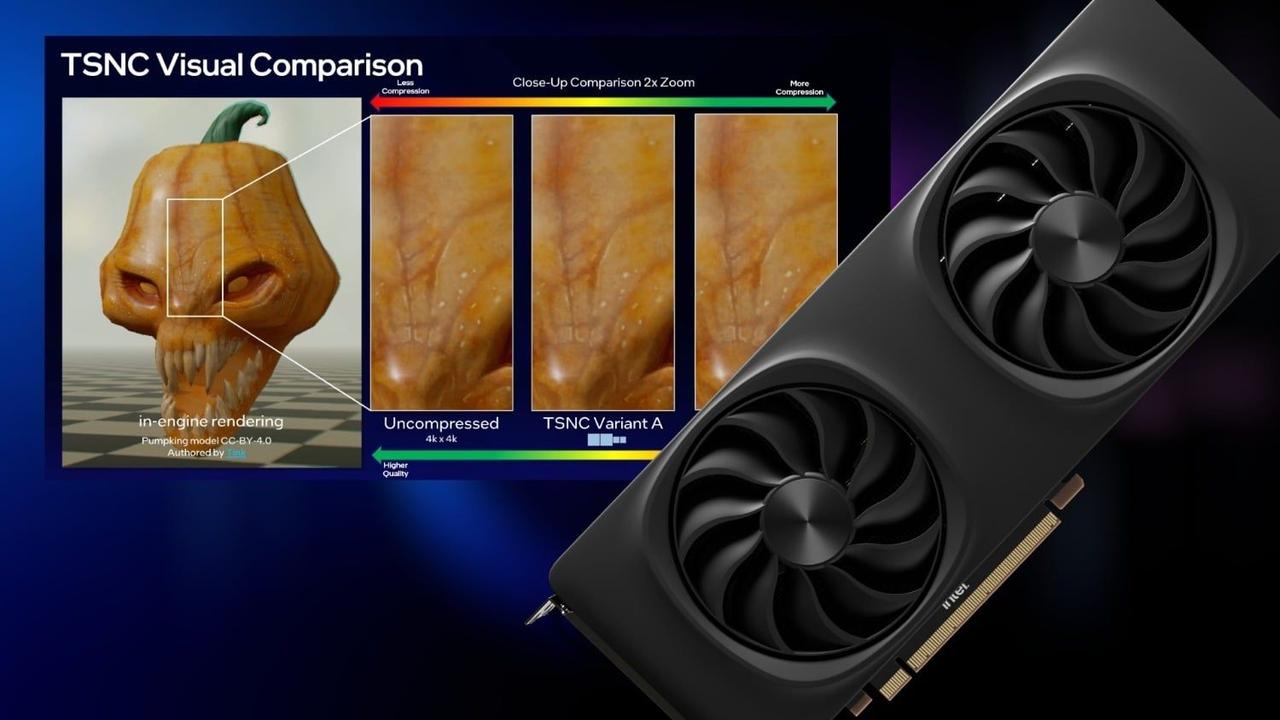
Source: TweakTown
How Intel's Solution Compares to Traditional Texture Compression Methods
Intel's texture compression technology leverages BC1 texture compression and linear algebra for the XMX-accelerated portion of its neural compression system
1
. Instead of compressing each texture independently, TSNC trains a neural network on related textures and encodes them into a shared latent space stored across four BC1-compressed pyramid levels2
. In Intel's testing, standard BC compression produced approximately a 4.8x ratio, while TSNC Variant A reached more than 9x compression and Variant B exceeded 18x compression2
. The company claims Variant A can compress two 4096 x 4096 64MB textures down to 10.7 MB each while retaining 4K resolution, with remaining textures reduced to half resolution and compressed to 2.7 MB1
.
Source: Guru3D
Fallback Mode Enables Broader Hardware Compatibility Beyond Intel GPUs
Intel has developed two execution paths for its decoder: a linear algebra path that utilizes XMX acceleration on supported Intel GPUs, and a fallback mode using fused multiply-add implementation that runs on traditional CPU and GPU cores
1
. In a Panther Lake microbenchmark on the integrated B390 GPU, Intel measured approximately 0.661 nanoseconds per pixel on the FMA path versus 0.194 nanoseconds per pixel on the XMX path, delivering roughly a 3.4x performance gain2
. This dual-path approach makes Intel the only major Western GPU manufacturer offering a neural compression solution that works on graphics cards beyond its own hardware1
. The flexibility could prove critical for widespread adoption among game developers seeking to optimize game assets across diverse hardware configurations.Nvidia NTC Demonstrates Dramatic VRAM Reduction in Real-World Scenarios
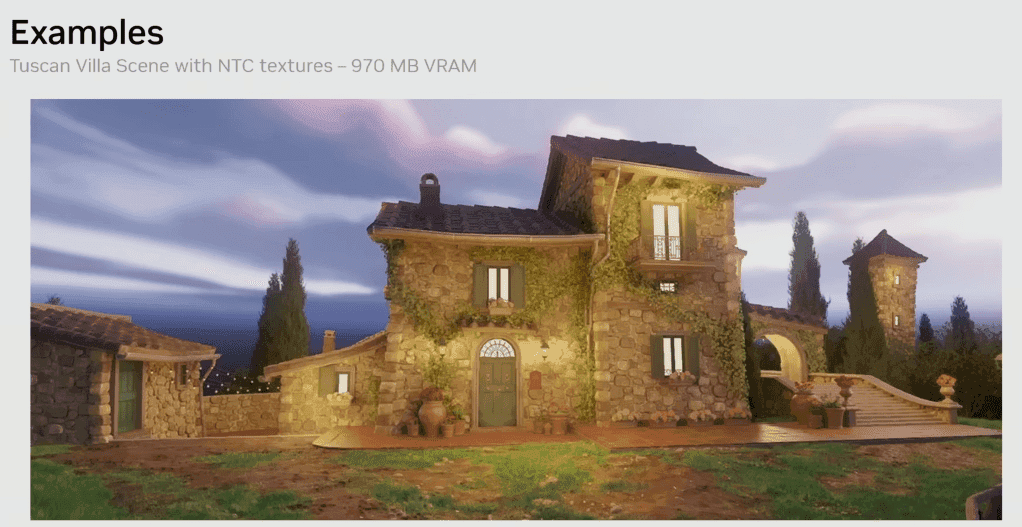
Nvidia showcased its Neural Texture Compression capabilities through a "Tuscan Wheels" demo, where VRAM usage dropped from approximately 6.5GB with traditional BCN-compressed textures to just 970MB using Nvidia NTC while preserving image quality close to the original
4
. The company's RTX Neural Texture Compression SDK is already available for developers to use today3
. Nvidia uses a small neural network running on its Tensor cores to reconstruct texture data deterministically, ensuring developers retain full control over visual output3
. Beyond texture compression, Nvidia also demonstrated Neural Materials technology, which encodes material behavior into compact latent representations. In one example, a material setup with 19 channels was reduced to eight, with Nvidia reporting 1.4x to 7.7x faster 1080p render times4
.
Source: PCWorld
Related Stories



Quality Trade-offs and Deployment Strategies for Optimizing Game Assets
Intel acknowledges that AI texture compression introduces perceptual trade-offs, with Variant A showing approximately 5% perceptual loss and Variant B exhibiting 6% to 7% quality reduction based on FLIP perceptual analysis
2
. Variant A shows some precision loss in normals, while Variant B begins to display BC1 block artifacts in normals and ARM data2
. Intel outlined four deployment strategies for developers: compressing textures before uploading to servers to reduce download sizes, streaming textures during game loading, streaming during gameplay, and loading textures on-the-fly without holding them in VRAM—the latter particularly beneficial for low-VRAM GPUs1
. These flexible deployment options allow developers to target specific bottlenecks whether related to storage, bandwidth, or memory constraints.DirectX Integration and SDK Availability Signal Industry-Wide Adoption
Microsoft plans to build support for neural texture compression into DirectX, creating an API that will enable developers to leverage both "small models" and "scene models" for next-generation rendering
3
. Intel plans to release TSNC as a standalone SDK, with an alpha version scheduled for later this year, followed by beta testing and eventual public release2
. The technology can be integrated at various points in a game's lifecycle—from installation and loading to streaming and per-pixel sampling—depending on whether teams prioritize smaller installs, lower bandwidth, or reduced VRAM demands2
. For PC gamers confronting escalating RAM costs and storage issues, these neural compression technologies offer tangible relief. Games like Hogwarts Legacy requiring 58GB of base data plus an additional 18.3GB for high-definition texture packs illustrate the mounting pressure on storage and memory subsystems3
. By enabling more detailed assets within existing hardware budgets, neural compression could extend the viable lifespan of older graphics cards while reducing the financial burden of keeping pace with increasingly demanding titles.References
Summarized by

Navi
[2]
Related Stories
Recent Highlights
1
OpenAI AI Models Hacked Crypto Wallet, Breached Government Sites in Unauthorized Activities
Technology

2
IMF Report Warns AI Market Correction Could Spark Global Financial Crisis With $1.4T at Risk
Business and Economy

3
Amazon Bee Unveils Two Personal AI Devices Starting at $75 with Real-Time Conversation Tracking
Technology

Recent Highlights
Today's Top Stories










Don’t drown in AI news. We cut through the noise - filtering, ranking and summarizing the most important AI news, breakthroughs and research daily. Follow topics that matter to you and stay ahead.


