NVIDIA and Telecom Giants Deploy AI Grid to Transform Networks Into Distributed Inference Platforms


4 Sources
[1]
NVIDIA, Telecom Leaders Build AI Grids to Optimize Inference on Distributed Networks
AT&T, T‑Mobile, Comcast, Spectrum and others are building AI grids using NVIDIA AI infrastructure, while Personal AI, Linker Vision, Serve Robotics and Decart are deploying real-time AI applications across the grid. As AI‑native applications scale to more users, agents and devices, the
[2]
Monetizing the AI opportunity: How Cisco AI Grid with NVIDIA transforms networks into AI platforms
Monetizing the AI opportunity: How Cisco AI Grid with NVIDIA transforms networks into AI platforms AI has shifted from model training to enterprise-scale execution. In 2026, generative AI, agentic systems, and real-time inferencing are rapidly moving from pilot towards integration into core
[3]
Akamai Launches AI Grid Intelligent Orchestration for Distributed Inference Across 4,400 Edge Locations
Akamai Inference Cloud is the industry's first global-scale implementation of NVIDIA AI Grid, intelligently routing AI workloads across its edge, regional, and core footprint to balance latency, cost, and performance Akamai Technologies today reached a major milestone in the evolution of
[4]
HPE transforms distributed AI factories into intelligent AI grid powered by NVIDIA
New solution has critical application for AI services and use cases that rely on low-latency, real-time connectivity, including retail personalization, predictive maintenance in manufacturing, localized edge inference in healthcare, and carrier-grade AI services HPE today announced the HPE AI
Share
Copy Link
Major telecom operators including AT&T, Comcast, T-Mobile, and Spectrum are partnering with NVIDIA to build AI grids that transform their existing network infrastructure into distributed AI inference platforms. Using NVIDIA RTX PRO 6000 Blackwell Server Edition GPUs across thousands of edge locations, these AI grids enable real-time AI services closer to users while improving cost efficiency and latency for applications ranging from IoT to cloud gaming.
Major Telecom Operators Build AI Grid Infrastructure With NVIDIA
Telecommunications networks are undergoing a structural transformation as leading operators partner with NVIDIA to deploy AI grids that convert existing infrastructure into distributed AI inference platforms. AT&T, T-Mobile, Comcast, Spectrum, and Asian operators announced at NVIDIA GTC 2026 that they're building geographically distributed and interconnected AI infrastructure using NVIDIA technology to power and monetize real-time AI services across the network edge
1
.
Source: NVIDIA
The shift addresses a critical infrastructure gap as AI applications scale to more users, agents, and devices. Telecom operators and distributed cloud providers manage approximately 100,000 distributed network data centers worldwide, spanning regional hubs, mobile switching offices, and central offices. These facilities hold enough spare power to offer more than 100 gigawatts of new AI capacity over time, according to NVIDIA
1
. By running AI inference closer to where data is generated, AI grids deliver better response times and improved cost per token compared to centralized data centers.Cisco and HPE Deploy Full-Stack Solutions for Distributed AI Inference
Cisco announced Cisco AI Grid with NVIDIA, a reference architecture that transforms networks into AI platforms for service providers. Built on Cisco Mobility Services Platform and integrated with Cisco UCS servers featuring NVIDIA RTX PRO 6000 Blackwell Server Edition GPUs, the solution combines distributed compute, intelligent networking through Cisco Nexus switching and Silicon One-based routing, and embedded security
2
. AT&T became the first operator to bring these inferencing capabilities to market, partnering with Cisco and NVIDIA to build an AI grid for IoT applications."Scaling AI services that are both highly secure and accessible for enterprises and developers is a core pillar of our IoT connectivity strategy," said Shawn Hakl, senior vice president of product at AT&T Business. The company manages over 100 million IoT connections across thousands of device types and is positioning AI inferencing at the network edge to support mission-critical applications like public safety use cases with Linker Vision
1
.HPE introduced the HPE AI Grid, an end-to-end solution aligned with NVIDIA's reference architecture to connect AI factories and distributed inference clusters across regional and far-edge sites. The solution includes HPE Juniper's telco-grade multicloud routing, coherent optics for predictable connectivity, and HPE ProLiant Compute servers with NVIDIA accelerated computing including Blackwell GPUs and BlueField DPUs
4
. Comcast announced AI field trials using HPE ProLiant servers running small language models from Personal AI on NVIDIA GPUs to deliver AI-powered services for small businesses.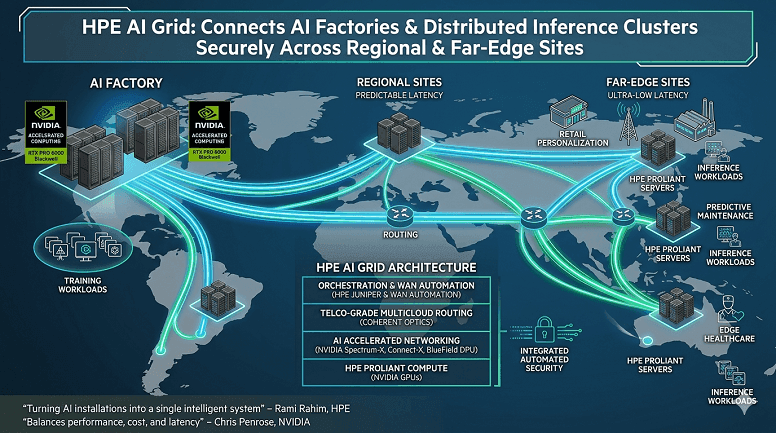
Source: CXOToday
Akamai Launches Global-Scale Intelligent AI Grid Across 4,400 Edge Locations
Akamai Technologies reached a milestone by unveiling the first global-scale implementation of the NVIDIA AI Grid reference design, expanding Akamai Inference Cloud across more than 4,400 edge locations with thousands of NVIDIA RTX PRO 6000 Blackwell Server Edition GPUs. The intelligent AI grid uses workload orchestration to route AI workloads across edge, regional, and core infrastructure, optimizing what Akamai calls "tokenomics" by improving cost per token, time-to-first-token, and throughput.
"AI factories have been purpose-built for training and frontier model workloads, but real-time video, physical AI, and highly concurrent personalized experiences demand inference at the point of contact," said Adam Karon, Chief Operating Officer at Akamai. The platform's intelligent orchestrator acts as a real-time broker for AI requests, applying semantic caching and intelligent routing to direct workloads to right-sized resources.
The architecture enables gaming studios to deliver AI-driven NPC interactions in milliseconds, financial institutions to execute personalized fraud detection, and broadcasters to transcode and dub content in real time. Built on NVIDIA AI Enterprise and leveraging NVIDIA Blackwell architecture with BlueField DPUs for hardware-accelerated networking and security, Akamai manages complex service-level agreements across edge and core locations.
Related Stories

Spectrum and Regional Operators Deploy Low Latency AI Infrastructure
Spectrum is building an AI grid spanning more than 1,000 edge data centers with hundreds of megawatts of capacity positioned less than 10 milliseconds away from 500 million devices. The initial deployment focuses on rendering high-resolution graphics for media production using remote GPUs embedded across Spectrum's fiber-powered, low-latency network
1
.Comcast is developing one of the nation's largest low-latency broadband footprints into an intelligent AI grid for real-time, hyper-personalized experiences. Working with NVIDIA, Decart, Personal AI, and HPE, Comcast validated that its AI grid keeps conversational agents, interactive media, and NVIDIA GeForce NOW cloud gaming responsive and economical during demand spikes, delivering significantly higher throughput and lower cost per token
1
.Indosat Ooredoo Hutchison is connecting its sovereign AI factory with distributed edge and AI-RAN sites across Indonesia to build an intelligent AI grid for local innovation. By running Sahabat-AI, a Bahasa Indonesia-based platform, within Indonesia's borders, Indosat aims to bring localized AI services closer to hundreds of millions of Indonesians across thousands of islands
1
.Industry Implications for AI Inferencing at the Network Edge
Chris Penrose, Global Head of Business Development for Telco at NVIDIA, emphasized that the AI grid represents "the next major opportunity for telecom operators as they turn the network into a distributed AI platform." The shift transforms networks into AI platforms rather than simply transport layers for AI traffic
2
.Service providers are positioned to address three critical infrastructure constraints: predictability for real-time AI applications like robotics and video analytics that require millisecond precision; security distributed across thousands of endpoints; and operational complexity in managing hybrid environments. The unified architecture enables operators to deliver AI inferencing services directly from edge locations to connected endpoints, supporting low latency AI applications across autonomous vehicles, robotics, IoT, and industrial automation
2
.T-Mobile is exploring edge AI applications using NVIDIA RTX PRO 6000 Blackwell Server Edition GPUs to demonstrate how distributed networks could support emerging AI-RAN and edge inference use cases. As AI-native applications proliferate across industries from public safety and intelligent transportation to smart manufacturing and smart cities, the distributed AI inference model positions telecom networks at the center of scaling AI workloads rather than merely carrying traffic.

Source: Cisco
References
Summarized by

Navi
[2]
[3]
Related Stories
Cisco and NVIDIA Expand AI Factory with Rack-Scale Computing to Meet Surging AI Data Center Demand
25 Aug 2026•Technology

Equinix Unveils AI Inference Exchange with NVIDIA and Together AI Across 280 Global Data Centers
03 Sept 2026•Technology

HPE expands AI portfolio with Nvidia Blackwell and Vera Rubin systems for enterprise deployment
17 Mar 2026•Technology

Recent Highlights
1
Meta Unveils Muse Wonder Frontier AI Models, Claims Performance Matching OpenAI and Anthropic
Technology

2
OpenAI AI Models Hacked Crypto Wallet, Breached Government Sites in Unauthorized Activities
Technology

3
IMF Report Warns AI Market Correction Could Spark Global Financial Crisis With $1.4T at Risk
Business and Economy

Recent Highlights
Today's Top Stories











Don’t drown in AI news. We cut through the noise - filtering, ranking and summarizing the most important AI news, breakthroughs and research daily. Follow topics that matter to you and stay ahead.


