14 Sources
[1]
New Cisco Secure AI Factory with NVIDIA: Built for Rack-Scale Era
Earlier this week, we announced that we're expanding the Cisco Secure AI Factory with NVIDIA with new rack scale and high-density compute options, including support for NVIDIA Vera Rubin NVL72 and NVIDIA HGX Rubin NVL8 and featuring Cisco AI Networking spanning both Cisco Silicon One and NVIDIA Spectrum-X Ethernet silicon. Through a partnership with Supermicro, our expanded compute portfolio enables the Cisco Secure AI Factory with NVIDIA to add rack-to-fabric liquid and air-cooled compute and switching, serving more types of customers and more use cases, with security and observability built in. If we're learning anything right now about the pace of deployment in AI, speed only counts if it also comes with the ability to secure and control data, manage token costs, and deliver real returns on investment. That's simply not possible without the right infrastructure, delivered as an integrated solution that's easy to deploy and secure from day one. That's why Cisco and NVIDIA are enabling enterprises to own their AI by building customized models and agents around their data, workflows, and expertise while keeping that advantage secure and under their control. NVIDIA's enterprise AI platform, including Nemotron open frontier models, gives organizations a powerful starting point to create, improve, and run custom AI. Combined with the Cisco Secure AI Factory with NVIDIA and the full Vera Rubin platform, enterprises gain a full-stack, enterprise-ready foundation to scale AI reliably across the entire lifecycle. The Cisco Secure AI Factory with NVIDIA helps both enterprise as well as sovereign and neocloud customers plan AI investments with confidence. Customer benefits include: * Less risk: Cisco and Supermicro each bring industry-leading global supply chain expertise to help mitigate delivery timeline challenges. * Faster time to value: With Cisco Secure AI Factory solutions based on NVIDIA reference architectures, customers can have confidence that their infrastructure is pressure-tested for modern workloads, with security and resiliency built in through Cisco Hybrid Mesh Firewall on NVIDIA BlueField. * Simplified operations: With NVIDIA AI Enterprise software and AgenticOps through Cisco Cloud Control, customers will use tools they already know, making AI deployment feel like an expansion rather than an overhaul. This is especially important for neoclouds, sovereign clouds, and large enterprises, because when you're standing up capital-intensive AI capacity, the time between a rack landing on the floor and when it's up and running securely is a massive cost in and of itself. Every week spent proving infrastructure works as designed is a week of capacity earning nothing. There are two more parts I want to call out: Finally, instead of a patchwork of parts that needs to be integrated, this is a full-stack offer that will all be delivered and validated as one system tying together compute, networking, security, storage, software, and AgenticOps with Cisco Cloud Control as the unified management platform. The world of AI is moving at incredible speed. We all need to move just as fast, and that means validated designs, integrated solutions, security built-in, and management that gives you simplicity of deployment without sacrificing speed or sophistication. For more details about our partnership with Supermicro and how we're expanding Cisco Secure AI Factory with NVIDIA, read Jeremy Foster and Will Eatherton's blog, More Than Rack-Scale Compute: Operationalizing AI at Scale.
[2]
Exclusive: Cisco expands Nvidia partnership for AI data center boom
Why it matters: Cisco is leaning into its AI infrastructure business, betting that compute demand is not slowing any time soon. Driving the news: Cisco is working with Supermicro to add high-density, liquid- and air-cooled computing systems to its Secure AI Factory with Nvidia, the company told Axios. * The systems will support Nvidia's next-generation platforms and are expected to become available in October. * Cisco will sell the compute alongside its networking, security and observability products as a pre-validated system designed to make massive GPU clusters easier to deploy. What they're saying: "Think about us as being the critical infrastructure for the AI era, and we will go support every architectural variance that there is," Cisco President and Chief Product Officer Jeetu Patel told Axios. * Cisco's bet is that as long as demand for AI infrastructure is there, it doesn't matter where AI ultimately runs. * "We literally don't have a preference," Patel said, arguing Cisco can supply infrastructure whether customers use frontier models powered by hyperscalers, or use open-weight models or even build on-prem or run AI locally. Follow the money: Cisco has largely escaped the "SaaSpocalypse" that hammered software stocks this year, as investors increasingly view the company as a beneficiary of the physical AI buildout. * That's in part because the company has leaned into hardware versus software, though Patel said both feed off of and into one another. * The stock is up nearly 45% year-to-date. Yes, but: The expansion pushes Cisco deeper into a market where partners like other hyperscalers and even Nvidia itself are also formidable competitors. * Patel downplayed that tension, saying the areas where the companies compete remain small relative to where they complement each other. The bottom line: Cisco is betting the AI infrastructure boom will benefit the networking and hardware parts of its business.
[3]
More Than Rack-Scale Compute: Operationalizing AI at Scale
The AI infrastructure that provides the lowest cost per token is the AI infrastructure waiting to be used. We've spent a lot of time over the last two years in rooms where the same thing happens. A team shows a genuinely impressive AI pilot. Everyone nods. Then someone asks what it takes to run this for real, at scale, under the security and compliance rules the business actually lives with. The room goes quiet. That gap between a working AI model and a production environment is where time, money and momentum disappear. Because the hard part of AI isn't just training a model or buying the compute. It's standing up compute, networking, storage, software, power, cooling, security, observability and operations management as one system that a real team can actually run. As AI infrastructure gets larger and denser, organizations can't afford months of integration and validation before those investments start producing value. And at rack scale, operationalizing that infrastructure becomes even more critical. That's the idea behind Cisco Secure AI Factory with NVIDIA: give customers a pre-validated path to production AI instead of leaving every organization to figure it out themselves. And now, we're partnering with Supermicro to deliver NVIDIA Cloud Partner Reference Architecture (NCP RA)-compliant rack-scale AI infrastructure, including liquid and air-cooled systems for high-density training, inference, and agentic workflows. The result is that we're giving customers a more predictable path from design to deployment to validation, taking uncertainty out at each step, from the edge to the enterprise, to the neocloud and sovereign cloud organizations that serve the enterprise. Design it. Deploy it. Prove it. Every AI build starts with the same deceptively simple question: What should we build? NCP RA compliance answers a big part of that question before a rack ever ships. It gives customers a known architectural foundation for how rack-scale compute, frontend and backend AI fabrics, power, cooling and management should fit together. Cisco is the only NVIDIA technology partner to utilize its own networking switches and network operating system in an NVIDIA Cloud Partner (NCP) compliant solution. But a certification is the starting line, not the outcome. You still have to translate it into a specific customer environment, deploy it correctly and prove that what got built actually performs the way it was designed to. That's where Cisco Validated Infrastructure Services, or CVIS, comes in. CVIS carries the architecture into the customer environment, from detailed design and deployment through post installation compliance verification, and performance validation of the completed cluster using Cisco tooling. Every CVIS cluster is handed over with a complete evidence package, an end-of-test report documenting the as-built configuration, test results, and conformance to the reference architecture, so the cluster is not just deployed, but provably compliant and support-ready from day one. In other words, NCP RA helps define what to build; CVIS helps turn that blueprint into a deployed, validated system. The prize isn't a certified bill of materials, but a more predictable path from design to first token, and from first token to business value. Operationalizing AI at scale Of course, the blueprint and deployment process only matter if you've got the right technology underneath them. Cisco Secure AI Factory with NVIDIA brings accelerated Cisco compute together with Cisco networking, security and observability as one architecture. Beginning in October, Cisco will expand this to rack-scale, offering Supermicro liquid-cooled and air-cooled systems on the Cisco Global Price List, giving customers access to a broader range of dense infrastructure directly from Cisco. That includes NVIDIA HGX and NVIDIA MGX-based platforms and NVIDIA G300 NVL72 systems, with Vera Rubin NVL72 planned to follow. This brings the rack-scale engineering, cooling expertise, and manufacturing scale needed to extend Cisco's portfolio into the most demanding AI environments. But this is about more than adding rack-scale compute. It's about turning that compute into infrastructure customers can actually operate in production. Cisco Nexus One provides a high-performance AI networking fabric with a choice of NX-OS or SONiC, built on Cisco Silicon One and NVIDIA Spectrum-X Ethernet switch silicon. Cisco AI Defense, Hybrid Mesh Firewall, Live Protect and Isovalent Runtime Security help build security into the architecture from the start rather than adding it later. And the system has to remain manageable after deployment. Cisco Cloud Control with AgenticOps brings signals across GPUs, NICs and the network together so teams can see what's happening across the infrastructure and identify problems before they become stalled jobs. Cisco engineering, support and lifecycle services extend that operating model into Day 2 and beyond. That's what operationalizing AI at rack scale means. The point is to bring the pieces production AI depends on together as a system, instead of leaving customers to integrate and operate them after the fact. As Sharon AI co-founder and CEO James Manning put it, "with Cisco Secure AI Factory with NVIDIA, we no longer have to choose between performance, reliability or ease of management. NCP RA validation gives us the confidence that our infrastructure is optimized from day one, while rack-scale capabilities provide a seamless path to scale our AI operations as our business grows." One architecture, different AI needs Not every AI workload needs the same infrastructure. What customers do need is an architecture that can adapt as those requirements change. At distributed sites, Cisco Unified Edge brings compute, networking, security and cloud management together to run AI closer to where data is created. In the data center, Cisco UCS, available standalone or in full-stack solutions like Cisco AI PODs continue to support enterprise AI and traditional workloads. And for the highest-density AI environments -- including neocloud and sovereign AI deployments -- rack-scale systems add the performance, density and cooling required to operate at much greater scale, helping these providers deliver production AI infrastructure to the enterprise customers they serve. The infrastructure can change with the workload. The operating model doesn't have to. Ultimately, the value should be measured by how quickly customers can put it to work. For more on the announcement and what Cisco is bringing to market, read the full press release. Want more? Check out the FAQ.
[4]
Nvidia's next multibillion-dollar market: Breaking the AI factory out of the data center
Nvidia's next multibillion-dollar market: Breaking the AI factory out of the data center Nvidia's first AI infrastructure boom concentrated enormous amounts of compute. The next opportunity will be distributing it through high-speed network fabrics. Everyone knows that I love stories that connect Silicon Valley to Wall Street. Well two important things were happening today in Palo Alto and on Wall Street - the HotChips elite semiconductor conference and Nvidia earnings a monster blowout. The narrative surrounding AI infrastructure has reached a fever pitch. NVIDIA's latest earnings prove that the world's appetite for AI compute remains insatiable. With data center revenue surging and hyperscalers dropping massive capital expenditure into monolithic, liquid-cooled mega-clusters, CEO Jensen Huang made it clear: "Compute is revenue, and demand is accelerating." Today Nvidia posted $96.2 billion in revenue for the quarter ended July 26, and guided for $108 billion in the current period. "AI has reached its inflection point. It's doing useful work. Its tokens are productive and profitable. Now, compute is revenue," chief executive Jensen Huang said in a statement. "The AI infrastructure buildout is at full steam. Vera Rubin, now in full production, was built to power exactly this moment." Yet underneath the headline numbers lies a stark physical reality. Modern NVLink-scale architectures require up to 140 kW (or more) of power density inside a single physical rack. For massive centralized facilities built from the ground up, that is a manageable engineering task. But as AI expands outward from centralized training to distributed inference, autonomous systems, and enterprise operations, it hits a hard physical wall: the existing edge cannot handle the physical weight, cooling, or power density of a modern AI rack. How does Nvidia keep the revenue and profit machine cranking to create the next billions of dollars? The answer is the distributed edge or AI at the Edge. This next multi-billion-dollar market isn't just about building larger AI factories in the desert. It is about taking the AI scale-up domain and extending it into places where conventional rack-scale systems physically cannot fit. The Edge Paradox: 30 Gigawatts Stuck in 30 Kilowatt Racks Across telecom central offices, industrial campuses, regional facilities, and enterprise datacenters sits a vast, installed infrastructure footprint representing roughly 30 GW of aggregated power capacity (my estimate from the past year conversations and data gathering). The problem? It is fragmented. A typical telco site or enterprise facility is thermally and electrically capped at roughly 30 kW to 50 kW per rack. Attempting to drop a 140 kW monolithic AI factory unit into these environments breaks power delivery, overloads liquid cooling capabilities, and violates physical building limits. This creates a structural impasse. The industry has plenty of power at the edge in the aggregate, but it cannot absorb the monolithic density required by top-tier scale-up fabrics. The Paradigm Shift: Breaking the Physical Chassis To solve this density mismatch, forward-thinking infrastructure architects are turning to a simple yet radical proposition: Stop treating the physical rack as the computer. This is a stark change from today's rack scale system need for big AI clouds (neoclouds). Instead of trying to jam a 140 kW footprint into a single cabinet, architects are taking that exact compute envelope, disaggregating it across four or five 30 kW physical racks, and interconnecting them with a high speed networking scale-up fabric. Because optical interconnects provide massive bandwidth without the strict distance-and-power penalties of copper links, these geographically adjacent physical nodes behave logically as one unified, low-latency AI system. This transforms the entire deployment paradigm. You do not ask the customer to tear down a facility or spend millions retrofitting a building's electrical system. You adapt the compute topology to fit the facility. Disruption via Market Creation In classic disruption theory, disruptive architectures rarely win by attacking the incumbent head-on in high-end environments. They enter where the incumbent physically cannot go, establish a beachhead, and scale upward. High speed networking disaggregation creates a market expansion strategy: By disaggregating physical hardware over optical or superfast ethernet switching layers, operators do not need to displace existing hyperscale infrastructure. They enable net-new enterprise and distributed deployments that would otherwise be impossible. The Strategic Verticals: Monetizing Power, Telcos, and Enterprise "AI Outposts" This architectural breakthrough unlocks three massive market shifts: 1. The Telco Pivot: From Transport to Intelligent Services Telcos have spent a decade attempting to monetize 5G investments beyond simple data caps and bandwidth plans. By injecting disaggregated AI compute into regional central offices, operators can aggregate fragmented local capacity into a distributed AI factory. The edge transforms from a passive transport pipe into an active, programmable inference platform handling real-time model routing, security, and context processing close to the end user. 2. Workload Orchestration: Compute Moves to Power Historically, data centers brought power to where the compute was racked. In a distributed scale across (optical/photonic) topology, intelligent orchestration software shifts AI workloads across geographically separated nodes based on real-time variables: power availability, cooling efficiency, local energy pricing, latency, and data proximity. The resource being virtualized is no longer just compute -- it is compute, network, power, cooling, and geography managed as a unified pool. This drives the research around of System of Intelligence and Systems of Execution we've recently published. 3. Enterprise "AI Outposts" Pioneered conceptually by AWS Outposts for general cloud compute which brought cloud to the enterprise. The enterprise AI model is adopting an outpost design optimized for real-time inference and scale-up which bring intelligence to the physical world. Enterprises adopt this AI Outpost model for three critical reasons: Robotics: The Leading Indicator for Physical AI and Edge AI If you want to know when edge AI has truly arrived at scale, watch the robotics and autonomous systems sector or as many call the physical AI sector. Robots, automated factory floors, smart warehouses, and autonomous vehicles generate continuous streams of sensor data that demand real-time inference. They cannot tolerate a 50-100-millisecond round-trip to a distant centralized cloud. However, a manufacturing facility does not need a $3 million hyperscale rack sitting next to an assembly line. It needs small, modular, distributed AI nodes networked across the campus -- looking far more like campus networking infrastructure than a miniature data center. The Evolution: AI Infrastructure Moves to the Swarm Just as enterprise networking evolved from monolithic mainframe connections into distributed campus switches, AI compute is following the exact same evolutionary path. The future of the next billions of dollars for Nvidia in AI infrastructure is not bound by the just the big AI Factories or the small AI Factories requirements. These new smaller footprints of power, land, and shell as it is called are bound to the physical dimensions of a 19-inch server rack or a 140 kW power delivery system. Where's the money? By decoupling the physical cabinet from the logical compute domain via high speed networking scale-up fabrics, the industry is entering an era where the rack stops being a physical chassis and becomes a logical scope. Compute can finally go wherever power, cooling, and latency dictate -- turning every node at the edge into part of one massive, distributed AI computer. AI Infrastructure is not a bubble and the above is what we've been seeing and documenting at theCUBE and NYSE Wired. NVIDIA's first AI infrastructure boom was about concentrating enormous amounts of compute. The next one may be about distributing it. Tell me where I'm wrong.
[5]
The network becomes the computer as Cisco and Nvidia accelerate AI factory rack-scale
The network becomes the computer as Cisco and Nvidia accelerate AI factory rack-scale The first phase of the generative artificial intelligence infrastructure boom was defined by a race for graphics processing units. The next phase will be defined by what happens after those GPUs arrive. As the AI infrastructure buildout continues to advance rapidly the building and deploying massive accelerated-computing systems, and the challenge is shifting from acquiring silicon to turning thousands, and eventually hundreds of thousands, of GPUs, switches, storage systems and software components into a single productive machine. It's this mainstream shift that puts conventional networking into the center of the AI infrastructure story. In exclusive interviews with theCUBE, senior Nvidia Corp. and Cisco Systems Inc. networking executives laid out the architecture and economics behind an expanded Cisco Secure AI Factory with Nvidia. The companies, working with the ecosystem, are pushing the system to liquid-cooled rack scale while combining Nvidia's accelerated-computing and Spectrum-X architecture with Cisco networking, software, management and enterprise operating expertise. The Cisco-Nvidia announcement Tuesday is important, but the bigger story is that it signals that the AI infrastructure is moving from a GPU acquisition cycle into an AI production cycle, and Nvidia is increasingly defining the architecture of the entire AI infrastructure factories. From GPU scarcity to token production The first AI infrastructure wave was largely measured in GPUs. The emerging production era requires a different set of metrics: time to first token, tokens per second, tokens per watt, tokens per dollar invested, availability and ultimately continuous token production. AI factories are not simply data centers filled with accelerators. They are massive distributed computers whose components have to operate as a coordinated system. That's where networking changes roles. Historically, networks connected computers. In the AI factory, the network increasingly helps create the computer. Thousands of GPUs participating in distributed training, post-training and inference have to communicate with one another, storage, models, agents, tools and enterprise data with increasingly deterministic performance. That makes networking part of the AI production architecture itself. Spectrum-X meets the Cisco operating model Nvidia's Gilad Shainer captured one of the most strategically important elements of the partnership: Cisco isn't simply connecting to Nvidia infrastructure. The companies are bringing Nvidia's AI-optimized networking technology into an environment enterprises already know how to operate. "Spectrum-X inside the Cisco systems means that now there is an AI-optimized fabric that comes with the operating model that the enterprise world already runs on." That combination matters because Nvidia has developed Spectrum-X as an Ethernet architecture purpose-built for AI workloads. Cisco brings an enormous enterprise networking footprint, operating systems, management infrastructure and decades of experience connecting enterprise applications and data. The result potentially bridges two computing eras: the traditional enterprise network and the emerging AI factory. That's particularly significant as AI moves from training toward inference. Enterprise AI needs access to proprietary data sitting inside databases, storage systems, ERP environments, applications and existing networks. Intelligence cannot remain isolated inside the GPU cluster. It has to connect to the enterprise. The strategic opportunity for Cisco therefore goes beyond selling networking equipment into AI clusters. Cisco can become an important bridge connecting Nvidia's accelerated-computing architecture to the enterprise infrastructure and data surrounding it. For Nvidia, the relationship potentially extends the reach of the AI factory architecture deep into mainstream enterprise computing. The AI factory is a five-layer system Nvidia's Marc Hamilton provides another important piece of the story. An AI factory cannot be optimized by treating compute, networking and storage as independent purchasing decisions. Hamilton describes the AI factory as a "five-layer cake" spanning the physical data center, chips, AI infrastructure, models and applications. "If you don't build that whole thing end-to-end and have a place where you can test every application, every model, every network architecture, it's nearly impossible to optimize it." This is why Nvidia's reference architecture becomes strategically important. The traditional enterprise model where server teams buy servers, network teams buy networks and storage teams procure storage doesn't map cleanly onto AI factories. The system has to operate end-to-end. For instance, a workload running across thousands of GPUs may communicate through multiple networking domains. Nvidia's Collective Communication Library software could coordinate GPUs connected within systems, through NVLink, across Spectrum-X scale-out networking and ultimately into front-end networks accessing agents, tools or enterprise data. The individual application doesn't care where those boundaries are. It cares whether the system performs. That means the infrastructure increasingly needs to be designed, tested, validated and operated as one giant distributed computer. Nvidia's Cloud Partner Reference Architecture and Cisco's validated designs and services are intended to make that architecture repeatable rather than forcing every customer to engineer a bespoke AI supercomputer. Cisco takes the AI factory to rack scale The third major development is physical scale. Cisco's Will Eatherton said the company is broadening the solution beyond networking and into full rack-scale compute through its partnership with Supermicro. "We are going broader with compute. So we have partnered with Supermicro. And what we're bringing is the full rack scale, so that is liquid cooled, starting with Blackwell, moving to Vera Rubin, on the HGX and MGX form factors." Eatherton said the full solution will be orderable in September. "The Secure AI Factory is going rack scale." That statement is more significant than it initially sounds. Rack-scale architecture represents the transition from thinking about servers as the fundamental building block toward treating entire racks, and ultimately clusters of racks, as computing systems. Cisco can surround those systems with networking, software, support, validated infrastructure and management while Nvidia supplies the underlying accelerated-computing architecture. The result is an attempt to turn what has historically looked like bespoke supercomputing engineering into something closer to repeatable industrial infrastructure. Scale up, scale out, scale across There is a useful way to frame and understand where this architecture is heading. Scale up creates increasingly powerful computing domains inside the rack. Scale out connects those racks and GPUs into massive AI supercomputers. But the next frontier is scale across where connecting AI factories to storage, enterprise networks, other data centers, neoclouds, agents, applications and ultimately the proprietary data makes enterprise AI valuable. That is where the Cisco-Nvidia relationship gets particularly interesting. Cisco Silicon One, Nvidia Spectrum-X, NX-OS and SONiC, Nexus One and Cisco Cloud Control create different pieces of an architecture stretching from the AI backend toward the enterprise front end. The goal isn't simply moving packets faster. It's making an enormously complicated distributed AI system behave operationally like one infrastructure platform. First token isn't enough Another underappreciated aspect of the AI infrastructure race emerges after deployment. Getting to the first token matters. But AI factories are living systems. Models change. Software changes. Firmware changes. Workloads change. Clusters expand. Failures occur. Performance has to be continuously optimized. This creates a new operational battleground around monitoring, availability, upgrades and lifecycle management. Cisco brings decades of experience operating enterprise networks into that problem, while Nvidia brings the software and reference architecture surrounding the accelerated-computing system. That suggests another important economic distinction where the time to first token wins the deployment race. Continuous token production determines the return on the investment. A billion dollar AI factory operating significantly below its potential utilization represents an enormous amount of stranded production capacity. Networking, observability and operations therefore become directly connected to AI economics. The bigger Nvidia story For Nvidia, this announcement illustrates something larger than another ecosystem partnership. Nvidia won the first phase of generative AI by establishing accelerated computing as the foundation of modern AI. Its next opportunity is broader. As AI infrastructure evolves into factories, Nvidia can increasingly define how the entire production system fits together from accelerated compute and NVLink to Spectrum-X, software, reference architectures, models and the ecosystem surrounding them. Cisco gives that architecture something particularly valuable. They provide a bridge into the installed enterprise. That means the next competitive question may not simply be who has the fastest GPU. Instead, it may be who defines the architecture that turns millions of GPUs into reliable, continuously operating AI production systems. Cisco and Nvidia are making the case that networking is central to the answer. For decades, the network connected computers. In the AI factory era, the network is becoming part of the computer itself. And that could make networking one of the most consequential and valuable layers of the next phase of the AI infrastructure buildout. Bottom line: Conventional networking meets AI networking. Here's an exclusive video interview with Cisco and Nvidia senior technology executives:
[6]
Cisco expands rack-scale secure AI factory infrastructure for neocloud and sovereign clouds
Cisco expands rack-scale secure AI factory infrastructure for neocloud and sovereign clouds Cisco Systems Inc. today introduced an expansion to its current lineup of rack-scale artificial intelligence solutions for massive AI workloads in secure AI factories, addressing growing needs for massive inference and training compute. Through a partnership with Super Micro Computer Inc., Cisco announced an expanded portfolio of Secure AI Factory solutions with Nvidia Cloud Partner-compliant solutions for hyperscale, neocloud, and sovereign clouds. It features the company's Silicon One-based switches for the front end and builds on the company's Nvidia Spectrum-X-based switches on the back end, unified by Nexus One, Cisco's networking management platform. "We are at the beginning of one of the largest datacenter buildouts in history," President and Chief Product Officer Jeetu Patel said. "Every organization is racing to scale AI -- but speed only counts if it comes with control of data, managed token costs, and real return on investment." The company said it has also expanded its Enterprise Reference Architectures to include the latest generation for enterprise deployments. This will allow small deployments and large datacenter projects to rapidly spin up and prototype networking and rack-scale build-outs using Nvidia AI deployments with very little risk by tapping into well-known expertise and best practices. As is already fundamental to large-scale AI factories and high-throughput compute, liquid cooling dovetails nicely with Cisco's hardware. Modern rack-scale systems, such as Nvidia Vera Rubin NVL72, can exceed 200 kilowatts per rack - the company said its Cisco N9000 Series Switches are liquid-cooled and interoperate with Supermicro rack-scale, liquid-cooled compute to deliver rack-to-fabric speeds at AI factory throughput. As the race to bring trillion-parameter training and high-throughput inference use cases to the enterprise burns bright, heat exchange will remain a major data center bottleneck. Platforms including the aforementioned NVL72 and Nvidia HGX Rubin NVL8 will continue to work at the front lines, requiring combined cooling systems alongside networking. "With Cisco Secure AI Factory with Nvidia, we no longer have to choose between performance, reliability or ease of management," said co-founder and Chief Executive of Sharon AI James Manning. "NCP validation gives us the confidence that our infrastructure is optimized from day one." By combining effort between Cisco and Supermicro, the partnership offers solutions for compute and networking infrastructure that are pressure-tested for service-ready enterprise environments. The company added that, once delivered, new Cisco Validated Services will help customers certify infrastructure to make certain it is built, designed, and aligned to reference architecture. This way, datacenter compute, networking, security and resilience retain the standards and best practices outlined in deployment guidelines. During operations, Nvidia AI Enterprise software and AgentOps delivered through the Cisco Cloud Control backend will allow customers to use their own tooling and utilities. The company said it expects this will allow most customers to enjoy using the hardware and software delivered by an AI Factory as if it were a robust expansion, instead of a complete overhaul. "The AI Factory is a new concept - generating tokens and generating revenue. But that AI Factory needs to sit within your existing enterprise infrastructure," Vice President of Solution Architecture and Engineering at Nvidia Inc. Marc Hamilton said on theCUBE, SiliconANGLE Media's livestreaming broadcast. "The lifeblood of AI is data. When you go use ChatGPT or Gemini, those are great models, but they are trained on public data. Cisco networking has access to enterprise data that is not accessible on the internet." Hamilton added that it's more than just a rack-scale solution, providing factory-wide access for graphics processing units to vast amounts of data. That connectivity could open compute and networking for hundreds of thousands of GPUs at scale to handle the traffic volume for the AI inference needed in the agentic AI era. The Supermicro compute solutions will roll out as part of the Cisco Secure AI Factory with Nvidia beginning October this year. Watch the complete video of theCUBE's deep dive on Cisco Secure AI Factory with Nvidia here:
[7]
Nvidia AI Chips Are Driving the Liquid Cooling Boom - Cisco Systems (NASDAQ:CSCO), NVIDIA (NASDAQ:NVDA)
Nvidia's AI Chips Are Making Liquid Cooling the New Standard as Cisco Expands Its AI Bet Nvidia Corp's (NASDAQ:NVDA) next AI breakthrough may not be inside its chips -- it could be in how they're cooled. Cisco Systems, Inc's (NASDAQ:CSCO) latest expansion of its AI infrastructure partnership with Nvidia highlights a growing industry shift toward liquid cooling. It reinforces forecasts that the technology is rapidly becoming the new standard for powering increasingly dense AI data centers. Cisco's Latest Nvidia Bet Highlights a Bigger AI Infrastructure Shift Cisco on Tuesday expanded its Secure AI Factory with Nvidia through a partnership with Super Micro Computer, Inc. (NASDAQ:SMCI), adding high-density liquid- and air-cooled GPU systems to its AI infrastructure portfolio. The offering includes rack-to-fabric liquid cooling, pairing Cisco's liquid-cooled networking systems with Supermicro's liquid-cooled servers to support Nvidia's next-generation Vera Rubin NVL72 and HGX Rubin NVL8 platforms. Cisco framed the move as a response to the changing economics of AI infrastructure. "Power and cooling dictate where infrastructure can be built," the company said, adding that the next generation of AI infrastructure must deliver not only compute but also architectures capable of running efficiently at scale. The announcement reflects a broader trend across the AI ecosystem. As GPU clusters become more powerful, managing heat is emerging as one of the industry's biggest engineering challenges. Top Stories EXCLUSIVE: This Off-The-Radar Company Is Fixing The AI Problem Nvidia And Vertiv Can't Hyliion CEO Thomas Healy tells Benzinga why power generation -- not chips or cooling -- is the next major AI infrastructure opportunity. 3 min read Read this article Liquid Cooling Is Moving From Optional to Essential That shift is already showing up in industry forecasts. Market research firm TrendForce expects liquid cooling penetration among AI chips to rise from 33% in 2025 to 53% in 2026, before reaching 60% in 2027. The firm attributes the rapid adoption to increasingly power-hungry processors from Nvidia, Advanced Micro Devices, Inc. (NASDAQ:AMD) and Alphabet Inc's (NASDAQ:GOOGL) (NASDAQ:GOOG) Google, whose higher thermal requirements are pushing traditional air-cooling systems to their practical limits. Rather than simply installing more GPUs, AI infrastructure providers are increasingly redesigning entire racks around cooling, networking and power delivery. Cisco's latest announcement illustrates that evolution, with liquid cooling integrated into a full-stack AI infrastructure offering rather than treated as a standalone feature. Investment Takeaway For investors, the AI infrastructure story is expanding beyond semiconductors. Nvidia's increasingly powerful AI platforms are driving demand not only for GPUs but also for the networking, power management and cooling technologies needed to operate them efficiently. Cisco's latest move suggests liquid cooling is no longer a niche capability reserved for specialized deployments -- it is becoming a foundational part of next-generation AI data centers, creating new opportunities across the broader AI infrastructure supply chain. Tech Nvidia Says AI's Water Problem May Already Be Solved Nvidia claims its latest AI infrastructure can reduce cooling-related water consumption to nearly zero in some locations. Elon Musk responded "True". 3 min read Read this article Market News and Data brought to you by Benzinga APIs To add Benzinga News as your preferred source on Google, click here.
[8]
AI factories enter the execution era as Cisco and NVIDIA push rack-scale systems into production - SiliconANGLE AI infrastructure enters the execution era
AI factories enter the execution era as Cisco and NVIDIA push rack-scale systems into production The artificial intelligence infrastructure market is crossing an important threshold. The conversation is shifting from acquiring graphics processing units to building complete AI factories that can generate tokens reliably, efficiently and at scale. This is the next bottleneck. GPUs may be the engine, but an AI factory is a system. Compute, networking, storage, cooling, software and operations must work together from Day 0 through continuous production. If one component fails to perform, expensive capacity sits idle and revenue slips away. In a series of exclusive interviews on theCUBE, I spoke with Cisco's Will Eatherton, senior vice president and head of networking engineering, and NVIDIA's Gilad Shainer, SVP of networking, and Marc Hamilton, VP of solutions architecture and engineering, about how the companies are tackling that execution challenge as neoclouds, sovereign AI programs and enterprises move infrastructure into production. We explored the engineering, operational and financial requirements behind building AI factories at rack scale. That is the strategic context behind the expansion of the Cisco Secure AI Factory with NVIDIA to rack-scale systems. Cisco Systems Inc., and NVIDIA Corp. are bringing together liquid-cooled compute, AI-optimized networking, validated designs and unified operations in an effort to compress the path between ordering infrastructure and producing the first token. The full rack-scale Secure AI Factory solution will be orderable through Cisco in September. The market has entered the execution era. The winners will be determined by how quickly they turn capital expenditures into productive capacity. Time to first token becomes the new infrastructure metric Neoclouds illustrate the urgency. Many have customers lined up before the GPUs arrive, which means deployment delays translate directly into deferred revenue. Enterprises face a similar issue as the cost of consuming models through external application programming interfaces grows. Sovereign AI programs add another layer of pressure because they must balance performance, data control and national infrastructure requirements. These different markets are converging around the same question: How quickly can an organization move from a purchase order to a production-ready AI factory? "When we work with neoclouds, from the moment that they put in the PO for the GPU, they already have their end customers lined up," said Will Eatherton, senior vice president and head of networking engineering at Cisco. "And one of the challenges is just the speed, the expectation that from the moment that is all the project planned, that the GPUs have to come back, that then has to go through all of the final deployment aspects of software and then a bring up and hand over to their income." The important shift is economic. Traditional enterprise infrastructure was frequently viewed as a cost center to be optimized downward. An AI factory is designed to manufacture a digital product: tokens. Those tokens power applications, agents and business processes, giving infrastructure a direct connection to revenue. That changes the scoreboard. Utilization, availability, tokens per second and tokens per watt become business metrics, not simply engineering measurements. "The real cost savings in an AI factory is not about cost savings, but it is about token generation and how do you drive that revenue -- so having a repeatable way to do it," said Marc Hamilton, vice president of solutions architecture and engineering at NVIDIA. A rack of components is not an AI factory The industry cannot approach this buildout using the old data center playbook. An AI factory operates as one enormous computing system assembled from thousands, and potentially hundreds of thousands, of components. GPUs, network interface cards, switches, cables, storage systems, models and software libraries must operate in concert. That makes architecture critical. NVIDIA describes the AI factory as a five-layer cake encompassing the data center's land, power and shell; chips; infrastructure; models; and applications. Performance depends on optimizing across every layer. "Building an a factory, it's not connecting components and hoping for the best," said Gilad Shainer, senior vice president of networking at NVIDIA. "Building an AI factory means that you need to build a supercomputer and a supercomputer that needs to be built quickly, needs to be built fast and needs to provide the highest numbers of tokens per second, the highest numbers of tokens per power, and so forth." Cisco's expanded solution brings rack-scale systems and liquid cooling into an architecture supporting HGX and MGX form factors, including NVIDIA NVL72 systems and a path toward the Vera Rubin platform. Cisco wraps those systems with networking, software, sales and support. The networking architecture combines NVIDIA Spectrum-X Ethernet with Cisco technology. Spectrum-X provides the adaptive routing, congestion control, remote direct memory access and lossless capabilities required for distributed AI computing. Cisco Silicon One supports front-end, storage and data center interconnect requirements, while NX-OS or SONiC provides a familiar operating model. This is where the partnership gets interesting. NVIDIA brings infrastructure purpose-built for AI. Cisco brings the networking reach, enterprise operating model and installed experience required to connect AI factories with the data that already runs through the business. Reference architectures reduce financial and operational risk Reference architectures can sometimes be dismissed as technical checklists. That view misses their role in the AI factory market. An NVIDIA Cloud Partner reference architecture establishes how the entire system should be constructed, tested and operated. Cisco Validated Designs and Cisco Validated Infrastructure Services adapt those requirements to Cisco networking and management technologies. The goal is repeatability: Customers should not have to reinvent the system every time they deploy a cluster. The certification also has financial implications. Infrastructure lenders want confidence that the assets they finance will deliver the utilization, performance and availability required to support the investment. Following an established reference architecture can therefore affect financing terms, as well as technical performance. "We've actually had some of the largest finance lenders in the world say that they will only finance at preferred rates customers that are following that NCP reference architecture," Hamilton said. "So, this is now a huge selling point for any Cisco customer, any Cisco sales rep." Availability is where the risk becomes visible. A multibillion-dollar AI factory running at 50% or 60% availability because of cabling, firmware or software issues destroys the underlying economics. The first token matters, but the billionth token matters more. Validated infrastructure reduces the number of variables. It gives deployment teams a tested architecture, benchmarking tools and a common escalation path across Cisco and NVIDIA. In my view, that operational discipline will become one of the most valuable layers of the AI infrastructure stack. Day 2 operations will separate the winners Getting an AI factory online is only the beginning. Models change rapidly, inference software improves and organizations continually introduce new workloads. The system must be upgraded and optimized without sacrificing availability. "If you look at the Blackwell generation of GPUs, over the lifetime, or over the lifetime of that product, we've driven down the inference costs by x factors," Hamilton said. "Not 1 or 2x, but 10x, 20x, 30x by going through and doing software optimization. So, being able to continuously upgrade that AI factory once you install it is super important." Cisco is positioning Nexus One and Cisco Cloud Control as a common management layer across routing, front-end networking, storage networks and the Spectrum-X backend. The addition of AgenticOps creates an opportunity to apply AI-assisted monitoring and lifecycle management across the infrastructure. "A lot of the industry focus is up to the point that you light up the cluster and you get your first token out," Eatherton said. "That's been a big focus. That's great. But the Day 2 two aspects around monitoring and health and availability and software upgrades, and these are things that from a Cisco standpoint, we've put a lot of focus on here over the years." This becomes even more important as inference moves across on-premises systems, neoclouds and the edge. Enterprises want access to external capacity without creating a completely different operating environment. Neoclouds want to support multiple customers, departments and development environments with increasingly granular security and accounting controls. A common architecture can make those boundaries less visible. An enterprise should be able to run sensitive inference locally, burst into a neocloud and extend intelligence to factories, hospitals, telecommunications networks and other edge environments. The long-term opportunity is bigger than selling racks. It is about creating a repeatable operating model for intelligence. The AI infrastructure buildout may be one of the largest capital deployment cycles in computing history, but capital alone will not decide the outcome. Execution will. The market is moving from GPU scarcity to systems engineering, where networking, software and operations determine how much useful intelligence an organization produces from every dollar and watt. Time to first token gets an AI factory into the race. Continuous optimization, availability and scale are what win it. Here's the complete interview playlist, part of SiliconANGLE's and theCUBE's exclusive coverage of the "Cisco Secure AI Factory With NVIDIA Expands to Rack Scale" event:
[9]
Cisco Expands Rack-Scale AI Computing With Nvidia, Supermicro - Cisco Systems (NASDAQ:CSCO)
Cisco Systems, Inc. (NASDAQ:CSCO) announced Tuesday an expansion of its Secure AI Factory offering with Nvidia Corp. (NASDAQ:NVDA) through a new partnership with Super Micro Computer, Inc. (NASDAQ:SMCI). The collaboration introduces end-to-end, rack-scale AI computing solutions that incorporate high-density server systems. By scaling the architecture from trillion-parameter model training to edge inference, Cisco aims to help enterprise, neocloud, and sovereign cloud clients simplify deployment, boost efficiency, and retain data control. The NVIDIA Cloud Partner-compliant architecture combines Cisco AI networking with Supermicro compute hardware. Cisco expects to begin offering the integrated Supermicro solutions within its Secure AI Factory starting October 2026. CSCO Technical Outlook At $112, Cisco is trading 3.3% below its 20-day SMA ($115.85) and 3.5% below its 50-day SMA ($116.00), which frames the recent pullback as a near-term cooling phase rather than a broken long-term trend. The stock is still 3.2% above its 100-day SMA ($108.56) and 20.3% above its 200-day SMA ($93.12), keeping the bigger-picture uptrend intact after a strong 12-month run of 64.18%. The 20-day SMA sitting below the 50-day SMA is a bearish short-term crossover that often shows rallies are having trouble following through. By contrast, the 50-day SMA remains above the 200-day SMA, a classic bullish long-term alignment that tends to matter more for longer-horizon trend followers. Tech Cisco, Nvidia, Amazon and Nokia: The Customer List Behind Fabrinet's AI Boom Fabrinet's latest earnings showed Cisco, Nvidia, Amazon and Nokia as its largest customers, highlighting the company's expanding role in AI infrastructure. 3 min read Read this article Momentum-wise, MACD is below its signal line and the histogram is negative, which points to fading upside pressure versus the prior upswing. In plain terms, when MACD is below the signal line, it often means buyers need a fresh push to reassert control rather than assuming the prior trend immediately resumes. * Key Resistance: $121.50 -- a nearby ceiling that lines up with a prior pivot-style area above current price where rebounds can stall * Key Support: $111.50 -- a tight, nearby floor just under current price that can act as a first "line in the sand" if sellers press Trending Get a 1% Match on Your First Deposit of $1,000+ CSCO Earnings Preview And Analyst Price Targets Looking further out, the next major catalyst for the stock arrives with the November 11, 2026 (estimated) earnings report. * EPS Estimate: $1.25 (Up from $1.00 YoY) * Revenue Estimate: $18.11 Billion (Up from $14.88 Billion YoY) * Valuation: P/E of 33.1x (Indicates premium valuation relative to peers) Analyst Consensus & Recent Actions: The stock carries a Buy rating with an average price forecast of $134.31. Recent analyst moves include: * HSBC: Downgraded to Hold (Lowers Target to $120.00) (Aug. 14) * UBS: Buy (Raises Target to $138.00) (Aug. 13) * Truist Securities: Buy (Raises Target to $140.00) (Aug. 13) How Cisco Ranks On Momentum, Quality, Value And Growth Below is the Benzinga Edge scorecard for Cisco, highlighting its strengths and weaknesses compared to the broader market: * Momentum: Bullish (Score: 88.41) -- The stock's longer-run trend remains strong, even as near-term momentum has cooled. * Quality: Bullish (Score: 85.31) -- The score suggests Cisco screens well on durability-style factors versus the broader market. * Value: Weak (Score: 16.23) -- The market is pricing the shares at a premium, leaving less room for error if growth expectations slip. * Growth: Weak (Score: 10.79) -- Growth scoring is lagging, which can matter if investors rotate toward faster-growing large-cap tech peers. The Verdict: Cisco's Benzinga Edge signal reveals a momentum-and-quality-led profile with a clear premium-valuation tradeoff. For longer-term bulls, the setup argues for respecting the uptrend, but using the $111.50 support area as a practical risk line if the pullback deepens. CSCO ETF Exposure: Funds With The Biggest Weights * First Trust NASDAQ Cybersecurity ETF (NASDAQ:CIBR): 7.39% Weight * First Trust Dow Jones Internet Index Fund (NYSE:FDN): 8.14% Weight * Amplify Cybersecurity ETF (NYSE:HACK): 5.45% Weight Significance: Because CSCO carries such a heavy weight in these funds, any significant inflows or outflows for these ETFs will likely force automatic buying or selling of the stock. CSCO Stock Price Activity: Cisco Systems shares were trading at $112.01 during premarket trading on Tuesday, according to Benzinga Pro data. Markets Kalshi's Nvidia Compute Markets Hit $4.4M: Is AI Compute the 'New Oil'? Kalshi's Nvidia GPU markets hit $4.4 million in volume as CME prepares compute futures. Could AI compute become Wall Street's new oil? 2 min read Read this article Photo via Shutterstock Market News and Data brought to you by Benzinga APIs To add Benzinga News as your preferred source on Google, click here.
[10]
Cisco just broke its biggest hardware rule to chase the AI boom
Cisco Systems Inc. (CSCO) has built its reputation on the routers and switches that move data between machines, not the machines themselves. This week the company crossed that line. It is now selling AI server hardware directly, through a new partnership with Super Micro Computer Inc. (SMCI), a move that pulls Cisco deeper into a business it has traditionally left to others. The announcement came Tuesday, August 25, when Cisco said it is expanding its Secure AI Factory with Nvidia architecture to include Supermicro's liquid and air cooled server systems. Those systems will now be sold and validated as part of Cisco's own AI infrastructure portfolio, not bolted on as a third party option. The combined stack becomes compliant with Nvidia's Cloud Partner program, the credential neoclouds and sovereign cloud operators look for before signing large contracts. Cisco framed the timing around the scale of AI data center construction underway. Cisco President and Chief Product Officer Jeetu Patel said the industry is at the state of "one of the largest datacenter buildouts in history." That framing matters because Cisco is betting its growth on selling into that buildout as more than a networking vendor Why Cisco needed a hardware partner Cisco's own hardware has always been networking gear, not the dense GPU servers that actually run AI workloads. Supermicro fills that gap with rack-scale systems built for Nvidia's newest platforms, including the Vera Rubin NVL72, a rack that can draw more than 200 kilowatts of power, according to SiliconANGLE. That power draw is the real constraint driving this deal. Air cooling alone cannot keep up with racks that dense, which is why the partnership centers on liquid cooling that links Cisco's networking gear directly to Supermicro's compute hardware. Cisco says it is the only Nvidia technology partner building an NCP compliant architecture on its own networking silicon, according to the company's technical FAQ. That distinction matters commercially. It lets Cisco sell a fuller slice of the data center stack instead of competing purely on switches, where margins are thinner and rivals like Arista have been gaining ground. Jason marz / Getty Images Wall Street buys the growth story A Dow Jones 30 member, Cisco (CSCO) shares rose roughly 1% Tuesday following the news. Wall Street's broader view on Cisco is more bullish than that modest move suggests. Also read: DJIA Master List: What companies make up the Dow Jones Industrial Index in 2026? Twenty six analysts polled by S&P Global rate the stock a consensus Buy with an average price target near $133, implying meaningful upside from current levels, according to Stockanalysis.com. That bullish consensus is clearly reflected at Morgan Stanley. In an August 24 report shared with TheStreet, analyst Meta A. Marshall reiterated an Overweight rating and a $135 price target for Cisco, noting the company is entering a "more durable growth phase." Crucially for this hardware pivot, Marshall pointed to upcoming "scale-across AI deployments" as a primary driver. With industry supply still tightly constrained, Morgan Stanley highlighted that Cisco's massive balance sheet and direct procurement relationship with TSMC give it a distinct advantage in securing the components needed to actually execute on these dense server builds. Supermicro's high-growth, thin-margin reality Supermicro's reaction was sharper. SMCI jumped about 9% Tuesday, a move 247wallst attributed partly to the Cisco news and partly to unrelated legal clarity after Taiwanese prosecutors charged former associates without implicating the company itself. Analyst sentiment remains more guarded than the stock pop implies. Nineteen analysts covering Supermicro rate it a consensus Hold, with an average price target near $42, according to Stockanalysis.com. That caution sits awkwardly next to Supermicro's actual numbers. The company's fiscal fourth quarter revenue reached $11.1 billion, up from $5.8 billion a year earlier, while gross margin recovered to 17.5% from 9.5%, according to Supermicro's earnings release. Supermicro also guided fiscal 2027 revenue to a range of $65 billion to $72 billion, more than 75% above this year at the midpoint. Analysts are still pricing in the risk that fast growth and thin margins have coexisted at Supermicro before, and could again. The race for full-stack dominance * Cisco disclosed no committed order volume or pricing under the new arrangement, leaving the actual revenue impact unquantified for now. * The combined architecture unifies Cisco's Silicon One and Nvidia's Spectrum-X switch silicon under a single Cisco Nexus One design, a rare instance of a vendor supporting a rival's networking chips inside its own reference architecture. * Supermicro's systems become available through Cisco's channel starting in October 2026, giving both companies a concrete date to show whether the partnership converts into actual orders. This deal fits a pattern spreading across enterprise tech. Dell, HPE, and now Cisco are all racing to become full-stack AI infrastructure sellers rather than component vendors, because the AI buildout rewards companies that can offer compute, networking, cooling, and support as one purchase. For Cisco, that shift is a bigger strategic pivot than the headline suggests. The company that once defined itself by staying out of the server business is now betting its next growth cycle on getting into it, and October will be the first real test of whether customers are buying. The Arena Media Brands, LLC THESTREET is a registered trademark of TheStreet, Inc. This story was originally published August 26, 2026 at 10:33 AM.
[11]
Rack-scale AI: Cisco, Nvidia expand secure AI factory
Nvidia and Cisco push the enterprise AI factory into the rack-scale era The Cisco Secure AI Factory with Nvidia has been extended into the rack-scale era, offering enterprises greater full-stack operational capabilities as a result. Designed to give customers a framework for deploying artificial intelligence across their entire infrastructure, Secure AI Factory with Nvidia from Cisco Systems Inc. now integrates rack-to-fabric liquid cooling supporting systems beyond 200 kilowatts per rack for reasoning, agentic AI and trillion-parameter training. The latest enhancements include Nvidia Spectrum-X switch silicon paired with a Cisco operating system, enabling customers to leverage both Nvidia Cloud Partner-compliant reference architectures and Cisco Silicon One-based architectures. "From a networking standpoint, on the scale-out portion connecting GPUs, we have a stack from Cisco where we're taking the Nvidia Spectrum silicon [and] we're putting our NX-OS or SONiC on it," said Will Eatherton (pictured, left), senior vice president and head of networking engineering at Cisco. "Then we use that to connect the GPUs on the front end. We use Cisco Silicon One with a similar, same software -- NX-OS, SONiC -- and then we have an option where, for instance, the customer is doing high-performance networking with storage." Eatherton spoke with John Furrier at the "Cisco Secure AI Factory With Nvidia Expands to Rack Scale" event, during an exclusive broadcast on theCUBE, SiliconANGLE Media's livestreaming studio. He was joined by Marc Hamilton (right), vice president of solutions architecture and engineering at Nvidia Corp., and they discussed how the two companies were addressing the deployment gap between acquiring GPUs and operating production-ready AI factories. (* Disclosure below.) Rack-scale architecture for the AI factory As AI moves from the research lab into manufacturing floors and shopping aisles, enterprises are looking for full-stack architecture that can implement autonomous technology across high-value production environments. This is a central feature of the AI factory, and Cisco, in partnership with Nvidia, is positioning its portfolio to supply the operational foundation that can drive this model. "It's much more than even a rack-scale solution, this is really an AI factory-wide solution," Hamilton explained. "As you get into the GenAI world, you may have to call out to your agent sitting in a sandbox or doing some tool calling that is sitting on your front-end network. Now you're running this and something slows down. Where on earth do you even know how to go in and look and debug this and optimize this across this stack? That really is the power of the reference architecture that Cisco is fully adopting and bringing to their customers." The application of this reference architecture has involved the integration of a number of Cisco's previously developed tools and services. These include Cisco Nexus One, an open, unified networking management plane that integrates silicon, systems, software and operating models with embedded security and observability, and the Cisco Cloud Control operations platform for agentic IT. "It's a network OS layer from Cisco that we're bringing in and then we do have a common management layer," Eatherton told theCUBE. "We have our Nexus One, which is how we do our day-to-day operations and management and monitoring. Then we have Cisco Cloud Control which is where we bring in AgenticOps across the whole solution. We're bringing in software, sales and support for this whole cluster. That's really been key in the partnership with Nvidia because they're looking for outcomes for customers that are parallel to the stack that they've put together with all the right technology components." Here's the complete video interview, part of SiliconANGLE's and theCUBE's coverage of the "Cisco Secure AI Factory With Nvidia Expands to Rack Scale" event: (* Disclosure: TheCUBE is a paid media partner for the "Cisco Secure AI Factory With Nvidia Expands to Rack Scale" event. Neither Cisco, the sponsor of theCUBE's event coverage, nor other sponsors have editorial control over content on theCUBE or SiliconANGLE.)
[12]
Cisco partners with Supermicro to expand AI infrastructure By Investing.com
SAN JOSE, Calif. - Cisco Systems Inc. (NASDAQ:CSCO) announced Monday a partnership with Supermicro to add rack-scale AI computing solutions to its Secure AI Factory with NVIDIA portfolio. The partnership will enable Cisco to offer Supermicro's liquid- and air-cooled server systems as part of its AI infrastructure architecture, according to a press release statement. The expanded offering targets enterprise, neocloud and sovereign cloud customers. The solution includes NVIDIA Cloud Partner compliant architecture featuring Cisco AI networking systems. Cisco will utilize Silicon One-based switches for front-end operations and NVIDIA Spectrum-X based switches for back-end operations, unified through Cisco Nexus One. The infrastructure supports platforms including NVIDIA Vera Rubin NVL72 and NVIDIA HGX Rubin NVL8 for AI training and inference workloads. Cisco stated it is the only NVIDIA technology partner to use its own networking switches and network operating system in an NCP compliant solution. "We are at the beginning of one of the largest datacenter buildouts in history," said Jeetu Patel, President and Chief Product Officer at Cisco. "Every organization is racing to scale AI - but speed only counts if it comes with control of data, managed token costs, and real ROI." The company will introduce Cisco Validated Infrastructure Services (CVIS), aligned with NVIDIA Infrastructure Services, to certify infrastructure deployment. Cisco plans to establish a dedicated large-scale AI Lab to develop testing tools and software for CVIS. The solution will integrate NVIDIA AI Enterprise software with Cisco Cloud Control for infrastructure management and observability across compute, network interface cards, optics and network performance metrics. Cisco will begin offering Supermicro compute solutions as part of the Secure AI Factory with NVIDIA in October 2026. This article was generated with the support of AI and reviewed by an editor. For more information see our T&C.
[13]
Cisco and Nvidia take AI factories from rack to runtime
AI factories are moving from ambitious plans toward production, but the path from graphics processing unit acquisition to usable systems remains a race against time. Neoclouds already have customers waiting for capacity, enterprises are looking to bring inference workloads closer to home and sovereign AI programs are being built now. Those distinct buyer motions are converging around a common need: getting AI systems into production quickly enough to support the business, according to Will Eatherton (pictured, left), senior vice president of Cisco Systems Inc. "Enterprises, many of them ... are spending a large amount on tokens right now," he said. "The rush and the pressure is getting these systems up so they can start offloading what has been an [application programming interface] into using local inference. I think it's all converging on common architectures [and] common systems, but I think speed is either what's broken or the challenge." Eatherton, along with Gilad Shainer (center), senior vice president of networking at Nvidia Corp., and Marc Hamilton (right), vice president of solutions architecture and engineering at Nvidia, spoke with theCUBE Research's John Furrier at the "Cisco Secure AI Factory With Nvidia Expands to Rack Scale" event during an exclusive broadcast on theCUBE, SiliconANGLE Media's livestreaming studio. They discussed the rise of AI factories, rack-scale compute, Nvidia's reference architecture, networking and the challenge of moving from the first token to sustained operations. (* Disclosure below.) AI factories move toward a unified deployment model Cisco is expanding its Secure AI Factory beyond its networking foundation to include full rack-scale compute. The offering brings liquid-cooled systems into a broader solution, according to Eatherton. "What we're announcing today is that across the sovereign, enterprise and neocloud markets, we need to go big," he said. "We are going broader with compute: We have partnered with Supermicro, bringing in the full rack scale. That is liquid-cooled, starting with Blackwell and moving to Vera Rubin. That gives us a breadth of compute systems that we can then wrap around from a Cisco standpoint, from a sales support and a software standpoint." To make the rack-scale expansion deployable, Cisco and Nvidia are building around Cisco Validated Designs that comply with the Nvidia Cloud Partner reference architecture. The framework is intended to reduce late-stage integration problems as customers bring complex AI systems into production, according to Hamilton. "Traditional enterprises had server teams and networking teams ... and the two didn't come together until very late," he said. "In an AI factory, because it's a five-layer cake, everything has to work together. There are so many mistakes when customers try to go to one vendor and order networking [and] another vendor to order servers." Getting an AI factory to its first token is only the beginning. Cisco is also focused on monitoring, availability, software upgrades and lifecycle management as customers operate these systems over time, according to Eatherton. "A lot of the industry focus is up to the point that you light up the cluster and you get your first token out," he said. "That's been a big focus. But the day-two aspects around monitoring, health, availability and software upgrades ... are things that, from a Cisco standpoint, we've put a lot of focus on here over the years." The partnership also leaves room for flexibility within the networking stack. For AI factories, that flexibility gives customers room to customize the technology without abandoning familiar operating tools. The open interfaces in Nvidia Spectrum-X allow customers to run their own technologies on top of the platform, while Spectrum-X licensing allows Cisco Silicon One switches to connect to the access network, according to Shainer. "That's the reason that we build the reference architecture: to make sure that [customers] can get the full performance of Nvidia components," he said. "That guarantee is now coming with the Cisco AI Factory. That's how both of us guarantee that they're getting the best performance out of their investment." Here's the complete video interview, part of SiliconANGLE's and theCUBE's coverage of the "Cisco Secure AI Factory With Nvidia Expands to Rack Scale" event: (* Disclosure: TheCUBE is a paid media partner for the "Cisco Secure AI Factory With Nvidia Expands to Rack Scale" event. Neither Cisco, the sponsor of theCUBE's event coverage, nor other sponsors have editorial control over content on theCUBE or SiliconANGLE.)
[14]
Cisco Partners with Super Micro on Nvidia-Equipped Computing Systems
Cisco Systems is partnering with Super Micro Computer to put more processing power into its flagship AI architecture that is equipped with Nvidia's chips. The company said Tuesday that it would start using Super Micro's liquid-cooled hardware to help customers run massive AI models. Doing so can reduce deployment risk and help customers run workloads with greater efficiency and more control over their data, Cisco said. "Every organization is racing to scale AI--but speed only counts if it comes with control of data, managed token costs, and real ROI," said Cisco Chief Product Officer Jeetu Patel. Cisco is also supplying built-in setup and monitoring services so companies can use the new hardware without any technical issues. The pre-tested hardware packages will start to roll out in October, Cisco said.
Share
Copy Link
Cisco is expanding its Secure AI Factory with NVIDIA through a partnership with Supermicro, adding high-density, liquid and air-cooled computing systems. The move positions Cisco to capitalize on the AI infrastructure boom, with its stock up nearly 45% year-to-date as investors view the company as a key beneficiary of the physical AI buildout.
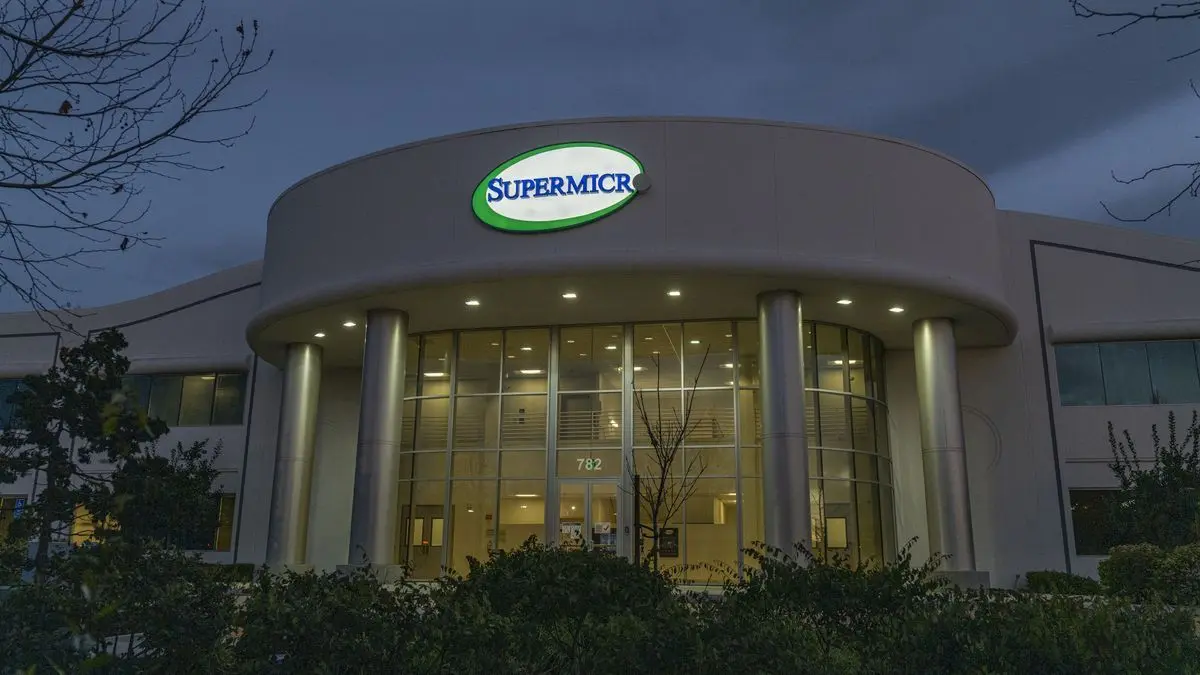
Cisco is expanding the Cisco Secure AI Factory with NVIDIA by partnering with Supermicro to deliver rack-scale AI infrastructure, including liquid and air-cooled systems designed for high-density training, inference, and agentic workflows
1
. The systems will support NVIDIA's next-generation platforms, including NVIDIA Vera Rubin NVL72 and NVIDIA HGX Rubin NVL8, and are expected to become available in October2
. Cisco will sell the compute alongside its networking, security and observability products as a pre-validated system designed to make massive GPU clusters easier to deploy2
.
Source: SiliconANGLE
The expanded Cisco Secure AI Factory with NVIDIA addresses a critical gap between AI pilots and production environments. Through Cisco Validated Infrastructure Services (CVIS), customers receive a complete evidence package and end-of-test report documenting the as-built configuration, test results, and conformance to NVIDIA Cloud Partner Reference Architecture (NCP RA)
3
. Cisco is the only NVIDIA technology partner to utilize its own networking switches and network operating system in an NCP-compliant solution, featuring Cisco Nexus One built on Cisco Silicon One and NVIDIA Spectrum-X Ethernet switch silicon3
. The architecture integrates Cisco AI Defense, Hybrid Mesh Firewall, and Cisco Cloud Control with AgenticOps to provide security and unified management from day one1
.Cisco President and Chief Product Officer Jeetu Patel told Axios that the company is positioning itself as "the critical infrastructure for the AI era," supporting every architectural variance whether customers use frontier models powered by hyperscalers, open-weight models, or build on-premises
2
. The strategy has paid off for investors. Cisco has largely escaped the "SaaSpocalypse" that hammered software stocks, with the company's stock up nearly 45% year-to-date as investors increasingly view Cisco as a beneficiary of the physical AI buildout2
. The expansion pushes Cisco deeper into a market where partners like hyperscalers and even NVIDIA itself are formidable competitors, though Patel downplayed that tension, saying competitive areas remain small relative to where the companies complement each other2
.
Source: Axios
Related Stories
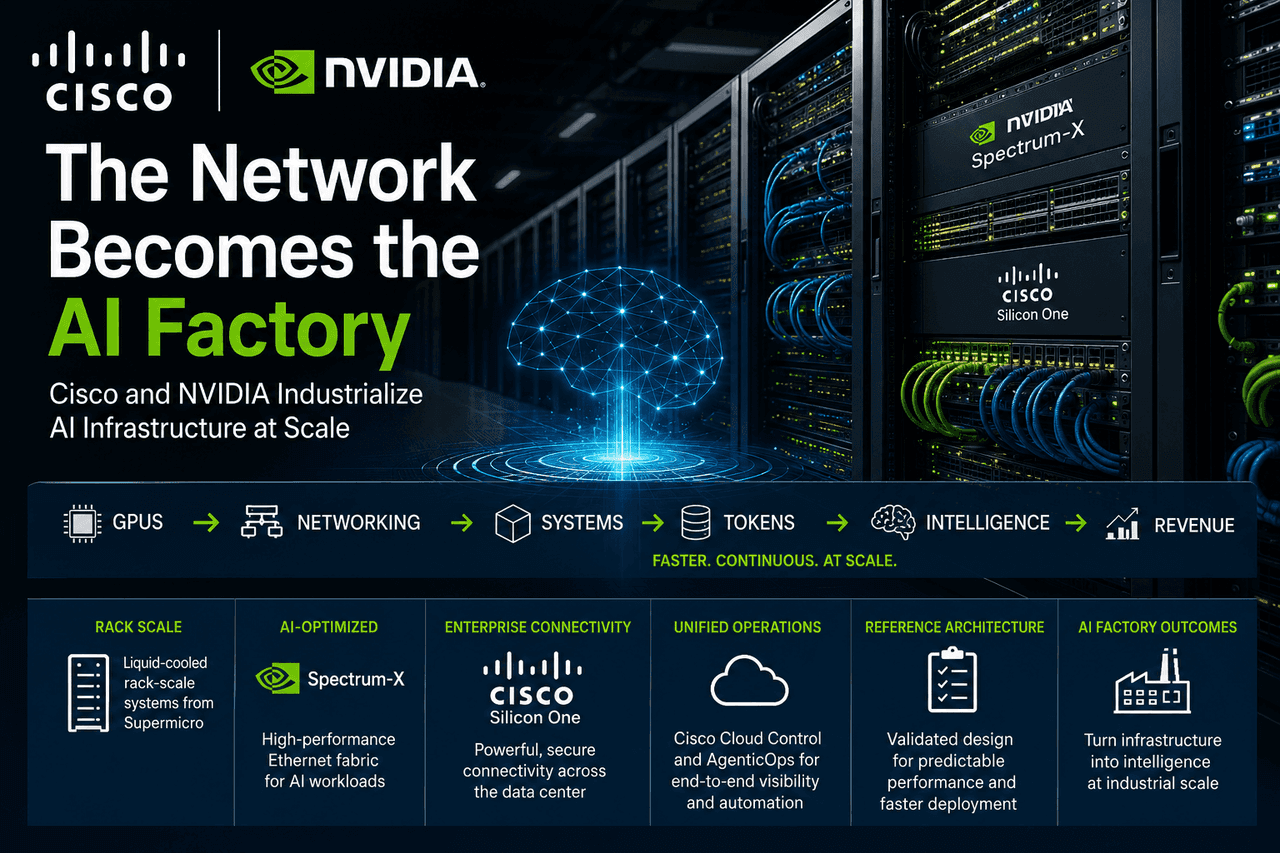
The AI infrastructure landscape is shifting from a GPU acquisition cycle to an AI production cycle, where success is measured by time to first token, tokens per second, tokens per watt, and continuous token production
5
. NVIDIA's Marc Hamilton describes the AI factory as a "five-layer cake" spanning the physical data center, chips, AI infrastructure, models and applications, emphasizing that the entire system must be built and tested end-to-end for optimization5
. NVIDIA's Gilad Shainer highlighted that Spectrum-X inside Cisco systems delivers an AI-optimized fabric with the operating model that enterprise networking already runs on5
.
Source: SiliconANGLE
A critical challenge facing AI infrastructure expansion is the Edge Paradox: approximately 30 gigawatts of aggregated power capacity sits fragmented across telecom central offices, industrial campuses, and enterprise data centers, but typical facilities are thermally and electrically capped at roughly 30 kW to 50 kW per rack
4
. Modern NVLink-scale architectures require up to 140 kW or more of power density inside a single physical rack, creating a structural impasse4
. The solution involves disaggregating that compute envelope across four or five 30 kW physical racks and interconnecting them with high-speed networking scale-up fabric using optical interconnects4
. This approach enables net-new enterprise and distributed deployments that would otherwise be impossible, particularly for sovereign clouds, neoclouds, and large enterprises standing up capital-intensive AI capacity1
.Summarized by
Navi
[4]
1
Technology

2
Policy and Regulation

3
Technology