16 Sources
16 Sources
[1]
I Watched Nvidia's Controversial DLSS 5 Turn 'Potato Faces' Into Photorealistic Characters
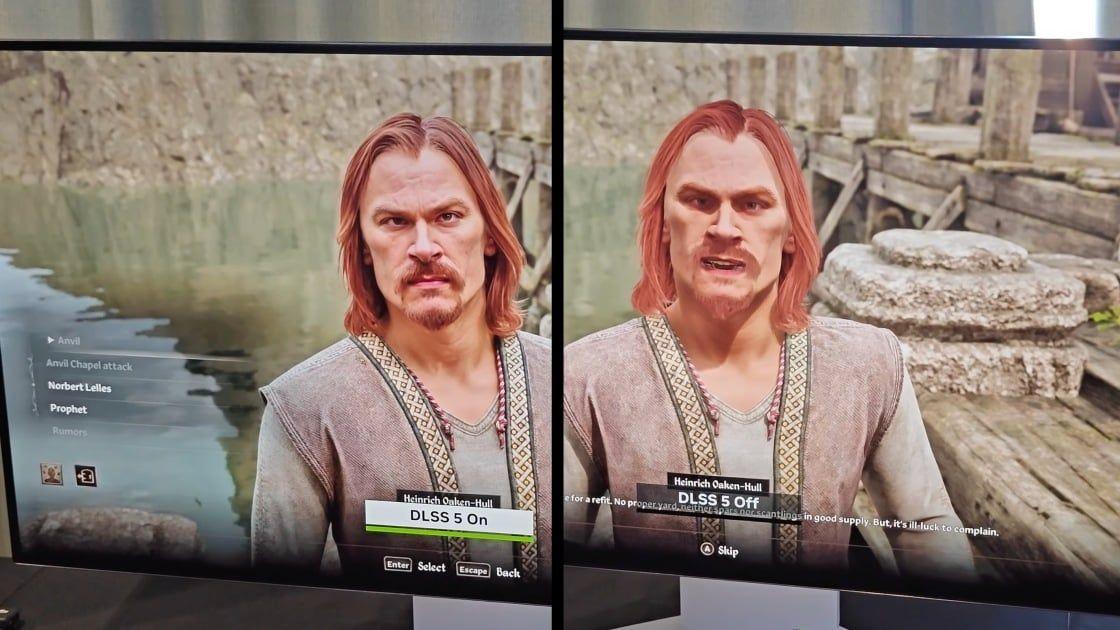
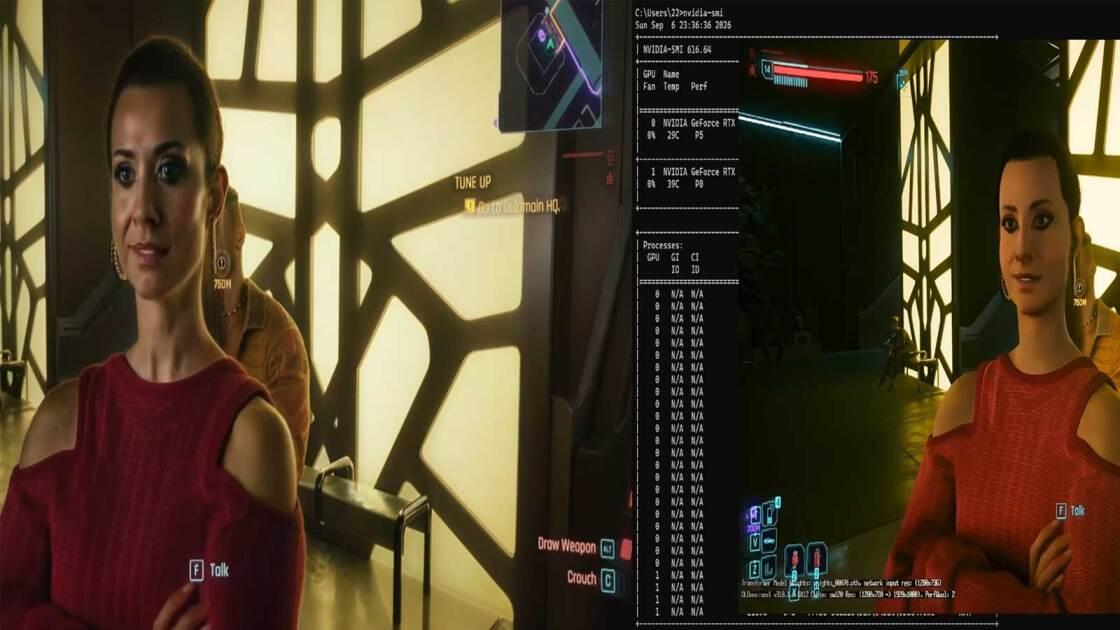
DLSS 5 on and off for the game The Elder Scrolls IV: Oblivion Remastered. (Credit: PCMag) Big leaps in game graphics used to be obvious -- the kind you'd notice instantly, no squinty side-by-side comparisons required. Lately? Not so much. Gains have been real, but incremental, easy to miss unless you're looking for them. Nvidia thinks it can change that tempo. Its recently announced DLSS 5 isn't just another iteration -- it's a swing at delivering a within-generation visual jump on a scale we haven't seen in ages. But, in this age of AI hype and hypersensitivity, that ambition is already sparking debate. (Indeed, CEO Jensen Huang had to step in early to defend the latest twist in the DLSS story.) It's easy to see why: DLSS 5 pushes well beyond simple upscaling and even the frame-generation tricks of recent versions. At Nvidia's GTC event in mid-March, I got a short, early look at DLSS 5 in action. It's raw, unoptimized, and nowhere near ready for the kinds of everyday hardware that we mortals run. But even in this state, it managed to surprise me more than once -- and it left me wondering whether this could be the next real turning point for gaming graphics. DLSS 5: The Promise, and the Controversy DLSS is best known for using AI models to increase a PC game's frame rate for smoother gameplay, whether via upscaling (rendering a game at a lower resolution, then upticking it to a higher one) or frame generation (using AI to splice in additional frames between classically rendered ones). But last week, Nvidia introduced DLSS 5, which uses a "neural rendering" model to add photorealistic effects. It's a whole new layer to the DLSS game. The company has been quietly developing the technology for over three years. The result can make game characters feel startlingly alive by injecting even more shadows, textures, and definition over faces, clothes, and environments, creating a new sense of depth. But despite the improvements, Nvidia's DLSS 5 announcement has already drawn some backlash over concerns that the GPU maker is merely adding an Instagram-like image filter to game characters' faces. Another criticism is that DLSS 5 is acting like an AI slop generator and allegedly forcing AI imagery on top of carefully crafted characters created by game developers. Those worries were on my mind as Nvidia gave me a closer look at DLSS 5 at GTC. But as I saw the technology in action, it also became clear to me that DLSS 5 could take computer graphics to a whole new level. Eyes On With the Next DLSS One thing is clear: DLSS 5 is no simple face filter. Video-game rocks and stones suddenly looked like rocks from real-life. The same was true of trees, water, a medieval castle, the interior of Hogwarts School, and even an espresso machine: DLSS 5 added a new level of photorealism that traditional game rendering had struggled to achieve. Another "wow" moment came when DLSS 5 was activated during a demo of The Elder Scrolls IV: Oblivion Remastered. Characters originally modeled two decades ago instantly began to look more like real people; their distinctly odd "potato faces" had vanished, replaced by fully fleshed-out visages with photorealistic hair, skin, eyes, and clothes. Sure, I was not seeing the crude-but-charming facial models from before. But in return, DLSS 5 unlocked a new level of immersion. In Assassin's Creed Shadows, DLSS 5 turned the game's lush forests into something that seemed organic. The effects added even more variety to the light and texture of the dense foliage and rocks, making the depicted landscape indistinguishable from real-world photography. Crucially, the experience didn't feel fake or forced. Nor did it act like a conventional AI image filter, which can alter a person's face, but in a clumsy, heavy-handed way that masks over the original. Nvidia points out that DLSS 5's neural rendering is designed to understand 3D characters and objects, including colors, hair, fabric, skin, and movement, as well as the surrounding environment. In other words, the technology is supposed to preserve game models before enhancing them. The Power Question: What Will It Take to Run DLSS 5? That all said, DLSS 5 remains a work-in-progress. In fact, Nvidia demoed the technology using not one but two GeForce RTX 5090 graphics cards -- each starting at $1,999, though actual pricing has since risen far higher due to the ongoing memory shortage. The goal is to optimize DLSS 5 so it can run on a single GPU. But in the demo I saw at GTC, one RTX 5090 card was used to render the game, while the other added neural rendering effects. That suggests DLSS 5 will need major tweaks to make it practical for the company's graphics cards. Nvidia will need to move quickly on its optimizations, since it plans to launch the technology this fall. We wouldn't be surprised if the initial launch is limited in scope. Other big unknowns include whether DLSS 5 will introduce a major performance hit -- a potential irony, considering that DLSS was developed to boost frame rates on sometimes underpowered hardware. How DLSS performs over an entire game is another major question. I was only able to briefly try out the feature in both Hogwarts Legacy and Oblivion, and my hands-on session was limited to walking around a single scene, rather than battling enemies or throwing magic spells. Understandably, some gamers may be skeptical or even alarmed, given the ethical issues and legal battles surrounding generative AI. At the same time, the PC market is reeling from an AI-driven memory shortage that risks undercutting DLSS 5 by inflating the cost of admission to buy Nvidia GPUs. But putting all that aside, I have to say DLSS 5 displayed the most realistic gaming graphics I've ever seen -- and I'm looking forward to experiencing more. Once you see DLSS 5 in action, it's hard to deny the potential it holds. In the meantime, Nvidia is already responding to some of the backlash, explaining that game developers will have full artistic control over DLSS 5 and can fine-tune the model to their liking. Some major developers, including Bethesda, Capcom, and Ubisoft, are already on board and preparing to support the technology in their own games.
[2]
Nvidia's new AI tool is giving female game characters a makeover - and gamers are pushing back
Last week leading chipmaker Nvidia announced DLSS-5 (Deep Learning Super Sampling), a new artificial intelligence (AI) rendering tool it describes as a "breakthrough in visual fidelity for games". The software takes low-resolution images and uses AI to upscale them, adding what Nvidia calls "photoreal lighting and materials". The tool is designed to make video games look more photorealistic, but the examples Nvidia chose to show off the technology revealed something unexpected: the AI doesn't just makes images sharper and glossier, it also makes characters significantly more conventionally attractive. The growing backlash is about more than makeup. It points to a broader anxiety about what happens when AI is given control over creative decisions - and whose idea of "better" gets encoded in the algorithms. A 'beauty filter' for games? Nvidia showcased the technology using Grace Ashcroft, the protagonist of the recently released Resident Evil Requiem. Before-and-after comparisons showed the software changing her hair colour, adding defined eyebrows, lip tint, and facial contouring. Some gamers quickly labelled it a "beauty filter", criticising the way it applies what looks like heavy makeup and reshapes her face to be more conventionally attractive. The choice of Grace to showcase the technology is worth examining. Resident Evil Requiem features all kinds of monsters and gritty characters, and Nvidia could have used any of them. The decision to highlight a young, conventionally attractive female character and then make her more glamorous feels pointed. Representation of women in games has been a flashpoint issue for years. Female characters in games are poorly treated Historically, female characters in games were depicted as either helpless and weak, or as sexualised objects secondary to a male lead. The 2000s brought more varied female characters, but attempts at greater diversity triggered a fierce backlash in 2014 during the Gamergate harassment campaign. Women and minorities in and around gaming were targeted with abuse, doxxing, and threats of rape and death. The debate has continued since. Some players were furious at the muscular depiction of Abby Anderson in The Last of Us: Part 2, claiming her physique was unrealistic and demanding she be made more conventionally attractive. DLSS-5 adds a new dimension to this debate. Rather than designers making deliberate choices about how characters look, an algorithm can quietly override those choices in a particular direction. Looksmaxxing game characters The specific changes DLSS-5 made to Grace's face also echo the manosphere's looksmaxxing trend. Originating in incel communities, looksmaxxing is built on the idea that certain facial features are biologically more sexually desirable to women, prompting some men to pursue techniques that alter their own faces to increase their "sexual market value". Seeing a piece of software automatically apply similar logic to a female game character raises uncomfortable questions. Gamers have noticed, and many are responding with humour. The software has been mocked as "yassifying" characters, with one widely shared meme applying the same treatment to God of War's hulking protagonist Kratos, complete with blue eyeshadow, pink blush, and plump lips. The joke lands because it makes the gendered absurdity obvious. This reaction mirrors how some gamers once responded to criticism of Aloy, the protagonist of 2017's Horizon Zero Dawn. After complaints that Aloy was "woke" for not wearing heavy makeup or conforming to conventional beauty standards, some gamers sarcastically created "unwokified" versions of the character to make the same point in reverse. Bad news for game designers, too A second, distinct complaint about DLSS-5 is that it undermines the artistic choices of developers. Rather than simply sharpening what is already there, the software uses algorithms to alter textures and lighting. The results can have that familiar AI aesthetic: glossy, smooth, bright and generic. A dark, gritty game like Resident Evil Requiem can end up looking like a luxury skincare ad. In at least one case, in EA Sports FC, the filter changed a real-life player's likeness so dramatically they became completely unrecognisable. The future of game visuals - and who controls it It is worth noting that DLSS-5 can genuinely improve visual quality in many games, enriching environments and bringing older character models to life. Nvidia has also pushed back against critics, with chief executive Jensen Huang insisting DLSS-5 is not a filter and that developers retain control over how it is applied. But the backlash reveals a real tension. Many players objected to Nvidia selecting a young female character and using AI to make her more conventionally attractive and sexualised. Many others objected to AI overriding the deliberate creative choices of game developers. Both concerns push against the same force: tech companies' drive to deploy AI as broadly as possible, and to define "better" visuals on their own terms.
[3]
I defended DLSS for years, but DLSS 5's AI slop crosses a line that shouldn't exist
Gaming has been Samarveer's greatest passion, and the Literature graduate in him takes immense joy in dissecting games for their themes, messages, and impact. Samarveer holds a deep appreciation of gaming, and considers the platform to be the most immersive and impactful across all media. He can be found engaging with gaming communities online, always ready to debate the finer points of ray tracing or itching to write an 8-page collegiate thesis on any game that impacts him emotionally. I've spent the better part of the last few years defending technologies like DLSS. I think I just might continue doing that, because when it works, it really works. It turns otherwise unplayable games into smooth, responsive experiences without completely butchering image quality. It felt like a smart compromise instead of a shortcut. DLSS 5, though, feels like something else entirely. Sadly, it's not about performance anymore, and now, DLSS is changing how games look, feel, and present themselves. The more I've seen of DLSS 5, the harder it has been to ignore the uncomfortable realization that DLSS enhancement has now become more about replacement. It's sloppy (pun very well intended), and at worst, it looks like the countless AI-generated "art" that plagues the internet today. DLSS 5 is further proof that rasterization's days are numbered For better or worse, rasterization continues to be buried, and it won't be long until games are unrecognizable Posts 62 By Ty Sherback People aren't thrilled about DLSS 5 Why isn't Nvidia's upscaler upscaling anymore? We must not forget that DLSS started life as a clever workaround for extracting more performance from games. It renders at a lower resolution, upscales using AI, and claws back more performance without sacrificing too much visual clarity. Over time, it has certainly evolved into something far more ambitious, with frame generation and increasingly convincing reconstruction techniques. But through all of that, the goal never changed, which was to approximate the original image as closely as possible. At GTC 2026, however, Nvidia just unveiled DLSS 5, which breaks that philosophy completely. Instead of reconstructing what's already there, DLSS now actively reinterprets scenes in real time. When you look at it, you see lighting getting rebalanced, materials being altered, and faces can end up looking... different. Of course, that shift didn't go unnoticed, because how could it? Across forums, videos, developer circles, and threads, the reaction has been uneasy, to say the very least. Words like "AI slop" get thrown around a lot, but beneath the hyperbole is a real concern. If the final image isn't even what the game actually rendered, then what exactly are we looking at, folks? It feels like the soap opera effect, but worse DLSS is now rewriting instead of smoothing It's been rather tempting to compare DLSS 5 to motion smoothing, that infamous "soap opera effect" that TVs force on you out of the box. Sure, there's a shared vibe here because both of these "technologies" make things feel unnaturally processed, overly clean, and just a little off. I'm aware that comparison doesn't go all that far, considering how motion-smoothing interpolates frames without fundamentally changing the image, since you can always turn it off and get the original content intact under all that artificial fluidity. On the other hand, DLSS 5 doesn't really give you that safety net. For starters, we've already seen that not only does it currently take two RTX 5090 GPUs, but it's also terrible at capturing motion with the "AI slop, Instagram filter" unlocked. So, not only is it changing the underlying visual information, but it also fails to make motion smoother, with shadows shifting around and highlights blooming differently. Oh, and the characters themselves take on a god-awful, strangely polished look that wasn't there before. I'll be the first to admit that the environments and lighting look significantly better with DLSS 5 on, but that's not the elephant in the room. Resident Evil Requiem Like Survival Horror Action Adventure Shooter Systems OpenCritic Reviews Top Critic Avg: 89/100 Critics Rec: 95% Released February 27, 2026 ESRB Mature 17+ / Intense Violence, Blood and Gore, Strong Language, In-Game Purchases Developer(s) Capcom Publisher(s) Capcom 7 Images Where to play Close WHERE TO PLAY DIGITAL PHYSICAL Genre(s) Survival Horror, Action, Adventure, Shooter Powered by Expand Collapse I love my RTX 5090, but its built-in screen is the most pointless GPU feature ever made Part of your price premium is for an extra screen you'll never look at. Posts 1 By Adam Conway This AI look threatens every game's individuality Passing through the same neural filter would make everything look the same Anyone who has ever played even a halfway-respectable amount of games would know and agree that art direction far supersedes sheer visual fidelity. When games have their own unique visual identity and style, they manage to set themselves apart. However, if you spend enough time looking at DLSS 5 footage, you'll see that the "AI look" is completely rampant here, with perfect faces, and an oddly uniform sheen on skins. Now, Nvidia CEO Jensen Huang himself has clarified that developers will exercise a degree of control over their games' DLSS 5 look, but that's still control after the fact, not authorship at the source. Those are two very different things. If different art styles, from gritty shooters and moody horror games to stylized RPGs and quirky racers, all start drifting toward the same visual baseline, the imperfections that gave a game its identity begin to disappear. 4 PS4 exclusives that proved that art style always trump graphical fidelity It's never just about the polygon count. Heart and soul in a game's visual design can immortalize it. Posts 1 By Samarveer Singh There's a very dangerous future lurking here DLSS was not supposed to decide how games look By actively altering lighting, materials, and even character detail, DLSS is starting to step into territory that traditionally belonged to artists and developers. The final image on your screen should always just be the result of the game engine and artists. It shouldn't be a "collaboration" between the devs' intent and Nvidia's model. That's enough to make anyone uncomfortable, because then, who gets the final say? Once a technology begins to override artistic decisions (even if it does that subtly), it stops being a tool and starts becoming an influence. Developers might design a scene with a specific mood in mind, only for DLSS 5 to reinterpret it into something cleaner, brighter, or more "appealing." Subscribe to our newsletter for DLSS 5 analysis Explore the implications of DLSS 5 by subscribing to our newsletter for in-depth analysis, developer perspectives, and clear explainers on how AI-driven upscaling may reshape art direction, visual identity, and authorship in games. Get Updates By subscribing, you agree to receive newsletter and marketing emails, and accept our Terms of Use and Privacy Policy. You can unsubscribe anytime. We've already seen how games launch in rough shape, with performance all over the place, and then the solution boils down to "just turning on DLSS." There's no denying that the rise in upscaling tech has presented a lot of cases where developers optimized their major AAA games lazily, knowing that DLSS or FSR would do the heavy lifting. DLSS 5 can make that precedent even more dangerous, because if AI can not only improve performance but also "enhance" visuals, then the incentive to optimize games, and fine-tune lighting systems will start to fade. After all, why do all that when an AI layer can smooth things over afterward? We have reached the GPU ceiling, and AI tricks like DLSS are how companies pretend we haven't Silicon alone can only do so much without software bearing the load Posts 8 By Samarveer Singh At what point did enhancement stop meaning improvement? If DLSS 5 takes us toward a future where almost every game looks the same, that's not progress. With each new DLSS iteration, we expect massive improvements in the upscaled image quality, with perhaps a couple of new features here and there that only serve to enhance the user experience with more performance. DLSS 5, technically, is a step forward in rendering tech, but it's more a shift in philosophy. It seems to be trying to take the visuals of any game and put them into the hands of algorithms instead of the artists, and that comes with trade-offs that are impossible to ignore. I'm not trying to be a Luddite here who rejects new technology outright. However, when a tool starts changing the thing it was meant to support, voices have to be raised. If the end results no longer reflect the original vision, and it slowly takes us toward a future where almost every game looks the same, then that's not progress at all.
[4]
"Why make game art at all?" New Blood publisher fears DLSS 5 is replacing artistry with AI
Serving tech enthusiasts for over 25 years. TechSpot means tech analysis and advice you can trust. Big quote: Developers are no longer arguing about whether DLSS 5 is a good idea so much as what to do about it. While major studios like Capcom and Bethesda have publicly backed the generative upscaling tech, independent creators are treating it as a flashpoint in a wider fight over artistic control, hardware costs, and the creeping normalization of AI-driven graphics systems. Nvidia says that DLSS 5, due later this year, is designed to sit on top of existing assets, taking a 2D frame plus motion vectors and inferring more photorealistic lighting and materials in real time. The company pitches it as a leap toward more lifelike visuals, but critics see it as an AI filter mimicking social-media aesthetics instead of reflecting what artists actually created. "This is fundamentally changing the way video games look based on artificial intelligence that's been trained on Instagram models and Epstein memes," Dave Oshry, co-founder of indie publisher New Blood Interactive, told PC Gamer. For Oshry, the concern is less about one feature toggle and more about a pattern of executives chasing cost savings and hype over craft. "We as developers and players need to push back against this bullshit just like we did with NFTs and crypto games and try in vain to do with predatory microtransactions, loot boxes and battle passes," he says. DLSS 5 doesn't generate new assets, but its ability to repaint a frame has him asking why studios should invest in bespoke art pipelines if an AI layer can be dropped on top. "At this rate, why make game art at all? Why not just draw some shapes and colors and let AI generate what it thinks it should look like?" he says. The hardware requirements in Nvidia's own demo have only sharpened that criticism. The showcase used two RTX 5090 cards, one to run the game and another to handle DLSS 5, with Nvidia later saying release builds will run on a single GPU. Oshry jokes that where players once had to hack together clumsy mods to get this kind of "cinematic" look, Nvidia is now offering a turnkey version that still effectively demands several thousand dollars' worth of hardware to use. He also argues the most effective response now is economic: "The only thing we can do besides calling them out on it and making them feel bad is voting with our wallets. Cripple their sales, tank their stock price. Stop collaborating with them as developers. Then maybe they'll think about going back to giving us what we want." Oshry stresses that New Blood itself is not tightly bound to Nvidia's roadmap. The studio focuses on retro-style shooters, and only Amid Evil shipped with DLSS and RTX support, which he said arguably made the game look worse and did not generate extra sales. However, he credits Nvidia for repeatedly pushing experimental features like 3D Vision, Shield, and PhysX. Developer David Szymanski, known for Dusk, Iron Lung, and Gloomwood, backs Oshry's view and narrows in on what DLSS 5 does to the image itself. Even setting aside concerns about AI training data and art direction, he says the lighting and contrast it adds makes scenes look less realistic and believable. Szymanski notes that it is particularly frustrating to see DLSS 5 showcased in Resident Evil: Requiem, a project he sees as a showcase of care and craft in big-budget game development, and that running characters like Grace and Leon through what he views as a "slop filter" turns the demo into a kind of victory lap that feels both dismissive and damaging to the underlying work. Szymanski also rejects the idea that DLSS 5's impact can be waved away because the feature is technically optional. In his view, once a technology is built into the assumptions of a AAA pipeline, toggling it off stops being a real choice. He argues DLSS, TAA, and ray tracing have delivered visual gains at the cost of clarity, accessibility, and playability, and remains unconvinced they solve problems that did not already have workable answers. The pushback is far from universal. Jean Pierre Kellams, a lead producer at Epic Games, has called the belief that DLSS 5 looks bad or undermines art direction "absolutely insane," arguing that if the same footage had been presented as a next-gen hardware reveal rather than as AI, "you guys would be going nuts." Kellams believes that DLSS 5 actually improves how Grace Ashcroft looks in Resident Evil: Requiem, pointing to more convincing skin shading and finer detail in her lips. Behind the technical debate, Szymanski sees a broader frustration with what he calls lateral movements in rendering that ask for ever-higher GPU budgets and deliver ambiguous benefits to players. He says that no one wants an AI system acting like autocorrect for visuals, overriding the work of human artists with a machine-generated pass. In his view, players are looking for something much simpler: stable frame rates, clear resolution, strong art direction, and coherent lighting on reasonably priced hardware, without leaning on technology that makes the platform costs or environmental impact feel apocalyptic. For now, neither Oshry nor Szymanski can say whether DLSS 5 will stick, but both argue that public criticism and consumer choices still matter. "I don't know if DLSS 5 is going to be here to stay or not, but it's heartening to at least see so many of us in agreement," Szymanski says. "Hopefully if we're all loud and insistent enough, and we throw the weight of our wallets around, companies like Nvidia will eventually get the message." If that does not happen, he adds, DLSS 5 may simply become one more big-budget feature that indie and AA developers ignore as they continue building games with a wide range of visual styles that do not require thousands of dollars' worth of hardware to run.
[5]
NVIDIA's DLSS 5 distracted everyone from the feature that actually matters
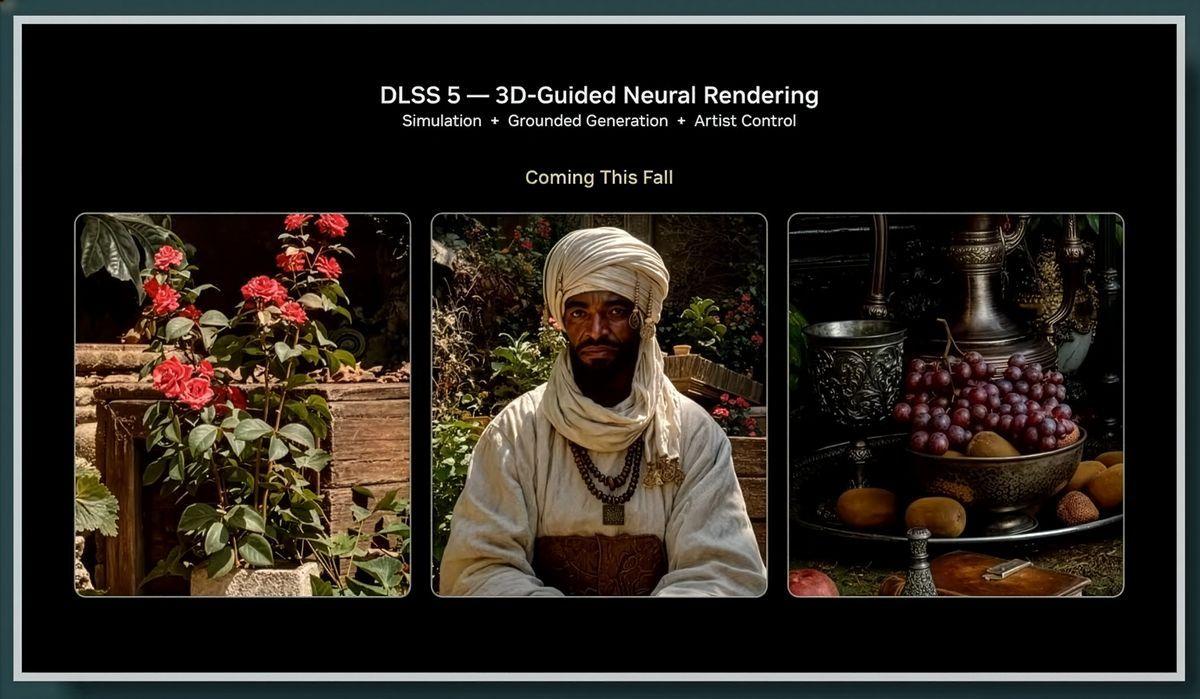
Monica J. White is a journalist with over a decade of experience in covering technology. She built her first PC nearly 20 years ago, and she has since built and tested dozens of PCs. PC hardware is her main beat, and graphics cards and the GPU market at large are her main area of interest, but she has written thousands of articles covering everything related to PCs, laptops, handhelds, and peripherals. From GPUs and CPUs to headsets and software, Monica's always willing to geek out over all things related to computing. Outside of her work with How-To Geek, Monica contributes to TechRadar, PC Gamer, Tom's Guide, Laptop Mag, SlashGear, Whop, and Digital Trends, among others. Her ultimate goal is to make PC gaming and computing approachable and fun to any audience. Monica spends a lot of time elbow-deep in her PC case, as she's always making upgrades, testing something, or plotting out her next build. She's the go-to tech support person in her immediate circle, so she's never out of things to do. Whenever she has spare time, you'll find her gaming until the early hours and hanging out with her dog. Nvidia's recent DLSS 5 announcement caused quite the stir in various tech and gaming spaces, and that's not necessarily a good thing. Any press is good press, one might say, but in this case, most of the conversation on social media has been centered around what DLSS 5 does to in-game assets. Most importantly, the faces of various characters. The "AI slop" label has been plastered all over DLSS 5, and I'm not here to debate whether that should be the case or not. I'm only here to remind you that if you're focusing on that aspect of DLSS, you're missing out on the part that actually matters. DLSS 5 stole the headlines And not in a good way Don't you just love it when the PC gaming/hardware enthusiast community has a meltdown about something or other? It happens regularly, which isn't unexpected, given that we all care about the matter at hand and hardware tends to be expensive. Don't even get me started on GPU prices. With that in mind, I wasn't surprised when Nvidia's DLSS 5 announcement absolutely dominated the headlines. And, given the contents of the update, I also wasn't too shocked when the general public responded negatively. After all, DLSS 5 is controversial. It departs from Nvidia's usual goal for the software stack, which is performance improvement, in a major way. And it gives games an AI-powered facelift that many gamers never asked for. Officially, Nvidia is pitching DLSS 5 as a much bigger shift than another round of upscaling tweaks. The company says DLSS 5 uses a real-time neural rendering model that takes a game's color and motion-vector data and then adds more photorealistic lighting and material detail, with specific callouts for things like skin, hair, fabric, and more complex light interactions. Nvidia also says developers get control over intensity, color grading, and masking, and that DLSS 5 itself is scheduled to arrive this fall rather than right away. DLSS 5 comes with some important caveats The over-the-top faces aren't its only problem Technical details aside, DLSS 5 serves up what many refer to as "AI slop." It turns in-game assets, chiefly characters' faces, into a completely different version of what the devs had there to start with. Everything is different, and it's not just the fact that frames are changing; the lighting is off, too. While DLSS 5 sounds impressive on paper, the public reaction hasn't been great. Nvidia's own preview video is currently flooded with comments made by people who are making fun of the tech or mourning the loss of originality in games. This was brought on by footage from games like Resident Evil Requiem and Starfield, where faces looked unnaturally polished, overly homogenized, or just plain uncanny, which is where the whole "AI slop" criticism really took off. The negative reaction was strong enough that Nvidia stepped in, saying in the comments: "Important to note with this technology advance - game developers have full, detailed artistic control over DLSS 5's effects to ensure they maintain their game's unique aesthetic." There are also some practical caveats here beyond the uncanny valley-esque faces. For one thing, DLSS 5 is a visual fidelity feature and not a straightforward performance tool. It runs in real time at up to 4K, but it's almost guaranteed to have a performance overhead as a result. Early reporting suggests this isn't exactly a lightweight effect, and no surprise. This is a neural-rendering step that adds lighting and material changes on top of the existing frame rather than just chasing higher fps the way many people expect from DLSS. It's also locked to the RTX 50-series, so many people won't have to try hard to avoid it; they simply won't have access to it in the first place. Dynamic multi-frame gen is what truly matters Surprisingly, it's not even part of DLSS 5 All the talk around DLSS 5 has drowned out the fact that, at its most basic level, it doesn't really fit with the rest of Nvidia's software stack. It's hard to compare it to the other iterations, and Nvidia's had a lot of success with DLSS the way we've grown to expect it to be: a performance-related tool. Announced at CES 2026, DLSS 4.5 delivers Dynamic Multi-Frame Generation and 6x MFG. And if that announcement came bundled with the updates provided by DLSS 5, maybe the reaction would've been more accepting. Dynamic frame gen is a pretty fantastic addition. It's designed to react to changing workloads and balance frame rate, image quality, and responsiveness on the fly. DLSS 4.5 in and of itself may not boost frame rates by much (although some have noted gains of up to 10% in certain titles), but it lets you crank up the quality-related settings in DLSS and still maintain good performance. Then, there's 6x multi-frame generation. The benefits here are obvious, and will be even more pronounced than the previous iterations of DLSS. Nvidia accidentally proved what gamers really want from AI It's not the face filters, apparently DLSS 5 is, in a way, groundbreaking. We've all grown accustomed to AI-generated videos and images, and the quality of both is now so good that it's sometimes hard to tell the difference between reality and AI. But to apply that to gaming in real time, and with the results Nvidia showed off, is huge. And yet, it's not really what gamers want. I think there's probably a level of uncanny valley and realism that gamers want from their gaming, or at least that is the case for me. I don't need my in-game characters to look like real people (or better). I want them to look cohesive, to fit into the game worlds they were created to fit into, and to have their own, aesthetically pleasing visuals. And that can truly mean anything from Stardew Valley graphics to Cyberpunk 2077 on RT Overdrive settings. It just needs to work together. Is DLSS 5 as bad as it seems? It's too early to say how good, or bad, DLSS 5 is going to be. It's possible for it to be both groundbreaking and disappointing all at once, but so far, I think that the main focus should be the immediate gains of DLSS 4.5. For DLSS 5, it's all still very early days; by the time it's actually out, we might be happier with the end result. Let's hope. ASUS TUF Gaming GeForce RTX 5070 12GB Graphics RAM Size 12GB Brand ASUS Architecture NVIDIA Blackwell If you want to give DLSS 5 a try, you'll need an RTX 50-series graphics card, and it needs to be one that can handle the compute tax. The RTX 5070 is a midrange GPU that bridges the gap between "too weak" and "too expensive." $762 at Amazon $800 at ASUS $800 at Best Buy $980 at Newegg Expand Collapse
[6]
Broken Nvidia CEO Says He Can't Stand AI Slop Either
Can't-miss innovations from the bleeding edge of science and tech The overwhelming backlash against Nvidia's new DLSS 5 feature that uses AI to yassify video games has clearly rattled CEO Jensen Huang, who's now insisting that he actually hates AI's horrible and homogenous aesthetic as much as gamers do. "I think their perspective makes sense and I can see where they're coming from, because I don't love AI slop myself," Huang said during an interview in a new episode of the Lex Fridman podcast, as quoted by Kotaku. "You know, all of the AI-generated content increasingly looks similar and they're all beautiful and so I'm empathetic towards what they're thinking." It's kind of an astonishing line for Huang to take, sincerely or not, given that his company ballooned to a near $5 trillion valuation off providing the hardware for the generative AI boom -- and the tidal wave of slop that's come with it. Here comes that inevitable conjunction, though: "But that's not what DLSS 5 is trying to do," Huang insisted. After DLSS 5 was unveiled with a video demo last week, gamers and developers from every corner of the internet retaliated by calling it "slop" and accusing it of undermining artistic intent. It was relentlessly mocked in memes and nicknamed "sloptracing," a play on Nvidia's raytracing tech for realistically simulating light. It was the rare example of gamer outrage being warranted: the feature used a generative AI model to plaster a familiar hyperreal AI sheen onto the games' graphics, making character faces look Facetuned to conform to trendy beauty standards. It even produced classic AI hallucinations, with one character given a grotesque "giga-nostril" after the feature appeared to misinterpret a facial shadow as part of his nose. Huang days later questionably struck back by calling gamers "completely wrong" -- the thrust of all ironclad arguments -- claiming that DLSS 5 doesn't take away from "artistic control." The long and short of his jargon laden defense was that the generative AI feature wasn't a post-processing filter, but anchored to the game's geometry and lighting data, which developers could fine-tune to keep in line with their aesthetic vision. His defense was seemingly undermined when Nvidia employee Jacob Freeman revealed to PC gaming YouTuber Daniel Owen that DLSS 5 only works off of 2D frame data -- not 3D lighting and geometry. Still, Huang stuck to his guns on the podcast appearance. DLSS 5 is "ground truth structure data guided," he insisted. "And so the artist determined the geometry we are completely truthful to. The geometry maintains in every single frame." "DLSS is integrated with the artist, and so it's about giving the artist the tool of AI, the tool of generative AI," Huang added. "They could decide not to use it, you know?" That they could.
[7]
'Cripple their sales, tank their stock price. Stop collaborating with them as developers': New Blood CEO on fighting against DLSS 5
DLSS 5 is contentious, to put it lightly. Though execs from the likes of Capcom and Bethesda seem on board with the new generative AI rendering tool, some of its employees didn't even know it was going to be announced (admittedly, the logistics of informing all employees does make my head spin, not to mention a legal minefield of NDAs). Then, alongside this, the announcement drew ire from many developers, with some calling it "slop" or "disrespectful to the intentional art direction of devs". I recently had the chance to pick the brains of Dave Oshry, the co-founder of indie publisher New Blood Interactive, and David Szymanski, the developer behind Dusk, Iron Lung, and Gloomwood, to get their reactions to the tech. Oshry tells me, "We as developers and players need to push back against this bullshit just like we did with NFTs and crypto games and try in vain to do with predatory micro transactions, loot boxes and battle passes." Generative AI is already a hot topic among game developers. Some fear for the ethics of models that can technically scrape whatever work they like, and others fear that their output could contribute to the mass firing of many. A lot of game developers worry that executives making decisions might not favour the quality of handmade work over the benefits of getting artificial intelligence to create assets quickly and cheaply. DLSS 5 is not making assets and instead working with premade assets to make them more photorealistic, but that fear still exists. Oshry argues, "This is fundamentally changing the way video games look based on artificial intelligence that's been trained on Instagram models and Epstein memes." "You used to have to spend hours poorly modding your games to make them look this 'cinematic', and now Nvidia is going to let you do it for free! Just kidding, it'll cost like $5,000." What Oshry is referring to here is the two RTX 5090's required to render the DLSS 5 demo that Nvidia showed off last week. Nvidia has said it will be able to run off just one GPU, but one can assume that will be a high-end one, so a rather expensive setup will likely be needed for the launch of DLSS 5 later this year. He goes on to argue, "At this rate, why make game art at all? Why not just draw some shapes and colours and let AI generate what it thinks it should look like?" Last week, Oshry tweeted, alongside other critiques of DLSS 5, "We need to push back harder against it", so I asked what that looks like for developers and gamers. "The only thing we can do besides calling them out on it and making them feel bad is voting with our wallets. Cripple their sales, tank their stock price. Stop collaborating with them as developers. Then maybe they'll think about going back to giving us what we want." Oshry does clarify that he has "no dog in this fight other than being a PC gamer". He notes that New Blood makes retro indie games, and Amid Evil is the only game it has put DLSS and RTX in and "it was a huge pain in the ass, arguably made the game look worse, and didn't get us any extra sales. But it was a fun experiment and Nvidia sent us some free GPUs for our trouble. Yippie." Oshry notes Nvidia's constant role on the cutting edge and how products 3DVision and Nvidia Shield weren't massive hits in the industry. He calls PhysX (which is only sort of supported on RTX 50-series graphics) "costly but it sure was cool as hell watching concrete pillars dynamically explode into pieces during shootouts in Mafia 2." As far as newer tech is concerned, he says RTX and Path Tracing are very costly bits of tech, though they make Cyberpunk 2077 look good. He does argue, though, that the jury's still out on frame generation. Catching up with Szymanski, he tells me he agrees with everything said by Dave (including how cool PhysX was) but notes that, "even if we set aside all (relevant and valid) concerns about artistic intent and generative AI itself, the lighting and contrast it adds (or removes, in some parts) makes scenes look less realistic and believable." "It especially sucks seeing it showcased in Resident Evil: Requiem," he notes, "a game that exemplifies quality and passion in AAA game design. Seeing Grace and Leon getting run through the slop filter as a 'victory lap' definitely feels like insult and injury combined into one." A common refutation of criticism of DLSS 5 is that it's optional, but Szymanski argues it's not actually that optional. "You mean optional like upscaling? You mean optional like temporal AA? Optional like realtime GI? Optional like any number of 'optional' features that anyone who has played a AAA game in the past half decade can tell you aren't really optional, because games are now built to lean on those technologies." Szymanski tells me that DLSS, TAA, and ray tracing are paying off, but at the cost of clarity, accessibility, and playability."While I'm not a graphics tech expert, I'm still not convinced that they've solved many problems that didn't already have solutions" The debate around DLSS 5 is currently being had by game developers, with Jean Pierre Kellams, a lead producer over at Epic Games, saying, "If that was shown as a next-gen hardware reveal and not AI you guys would be going nuts." Kellams argues that Grace Ashcroft from Resident Evil Requiem looks better with DLSS 5: "Her skin shader has much better subsurface scattering (she doesn't have the Japanese game character perfect skin). Her lips actually have creases now. Her ear stud is now catching light properly." Even Kingdom Come: Deliverance 2's director has recently argued, "This is just a little uncanny beginning. No way haters will stop this. It's way more than a soap opera effect every TV has when you turn motion smoothing on." DLSS 5 seems to be less smart than we initially thought, too. Jacob Freeman, GeForce Evangelist, describes it as taking a "2D frame plus motion vectors as input", which makes it pretty similar to applying an AI filter over the top of the game. It running in real-time is still impressive, but it brings into question the developer's ability to play with said tools. Szymanski feels gamers have been paying more and more for "lateral movements in rendering", and DLSS 5 represents a boiling point for it. "Nobody wants a fucking glorified autocorrect painting over the work of actual human beings making actual art." He tells me that all he (and most gamers) want are games at a consistent frame rate with a good resolution, strong art design and consistent lighting "on hardware that doesn't require us to remortgage our house, using technology that doesn't necessitate turning the world into a Mad Max wasteland." Importantly, both Oshry and Szymanski feel the public element of the criticism against Nvidia is important. Szymanski says, "I don't know if DLSS5 is going to be here to stay or not, but it's heartening to at least see so many of us in agreement" "Hopefully if we're all loud and insistent enough, and we throw the weight of our wallets around, companies like Nvidia will eventually get the message." "That or this will simply be the newest in a long line of features that indie developers don't have to use, and the indie and AA scenes will continue to provide a wild variety of visual styles that don't require thousands of dollars in hardware to render."
[8]
Kingdom Come: Deliverance 2 director defends DLSS 5, says 'No way haters will stop this'
NVIDIA's recent DLSS 5 announcement was met with widespread controversy and backlash over how its AI model was built to deliver photorealistic lighting, producing visuals that look transformative, albeit with characters that cross into the uncanny valley. In response to the feedback, NVIDIA has reiterated that DLSS 5 doesn't alter in-game geometry and that it provides developers with the tools they need to fine-tune the effect to ensure it fits a particular game's art direction or artistic vision. However, even though DLSS 5's technology is impressive from a purely technical level, that hasn't stopped the media and the PC gaming community alike from comparing the effects to an Instagram-like AI filter. Specifically, in the NVIDIA demos showcasing characters from games like Resident Evil: Requiem and Hogwarts Legacy, where characters look completely different. And with that, there aren't many positive comments surrounding DLSS 5, which makes this social media post from Kingdom Come: Deliverance 2 notable. Daniel Vavra, who was the game director on the critically acclaimed 2025 story-driven action RPG set in 15th-century Medieval Europe, has taken a more pragmatic approach to DLSS 5's debut. Although he doesn't outright praise the DLSS 5 demos, he's optimistic about what it means for the future of gaming and how it might "replace" expensive ray tracing. Adding, "No way haters will stop this." "I can imagine in the future devs will be able to train this tech for (a) particular art style or specific people(s) faces, and it might replace expensive raytracing etc," the post on X reads. "This is just a little uncanny beginning. No way haters will stop this. It's way more than a soap opera effect every TV has when you turn motion smoothing on." Daniel Vavra is known for holding controversial opinions on a wide range of topics, so this defence of DLSS 5 is not out of character. However, it rightfully highlights that what we've seen so far is an early version of a new AI rendering technology that could be a game-changer for how expensive path-traced lighting is presented in games. Right now, DLSS 5 runs on a single catch-all model, similar to other DLSS technologies, so the note about training the model on a specific game's art and presentation could be key to living up to its promise of maintaining a game's unique or individual look.
[9]
Kingdom Come: Deliverance 2 director defends DLSS 5: 'No way haters will stop this'
Nvidia's DLSS 5 hit the gaming public to much controversy -- including from us here at PC Gamer. In one corner, you've got folks who are just seeing it as a very fancy filter analogous to AI upscaling, in the other, you've got Instagram filter Grace Ashcroft trotted out as a proud advancement of technology rather than an uncanny kneecap to creative intent. The latest defender of the tech, Daniel Vávra, also happens to've been the director of Kingdom Come: Deliverance 2 -- though he's now currently taking a step back from development studio Warhorse to focus on a film. The former creative director wrote on X (thanks, PCGamesN): "I can imagine in the future devs will be able to train this tech for [a] particular art style or specific people faces, and it might replace expensive raytracing etc. This is just a little uncanny beginning. No way haters will stop this. It's way more than a soap opera effect every TV has when you turn motion smoothing on." Vávra's a controversial figure, having been vocally in support of Gamergate back in 2015, rallying against "social justice warriors", and making some tasteless jokes about the first game's mostly-white cast. That's in contrast to KCD2, which seemed purposefully adverse to culture war nonsense. It featured gay romance and a more diverse setting with proportionate representation -- exhaustion that Vávra, to his credit, echoes with appropriate disdain. But he's also pro-Musk and called Canada an Orwellian country recently. So, er. Basically, given his propensity for opinionated posting, it doesn't surprise me that he's hiked up his gambeson to wade into this topic, and has, in fact, talked with a sort of resigned acceptance about AI before. As I noted in our group opinion piece on the stuff, I'm deeply cynical of the tech -- partially just because of pattern recognition, most every AI promise has fallen flat, why not this one -- but also because that garish, ghoulish, uncanny trailer was put forward by Nvidia. And as much as the company wants you to believe it's not into AI slop, its out-of-touch understanding as to what is and isn't acceptable to its audiences strikes me more than enough cause for scepticism. I can see a small window where it might be useful -- I'm certainly not complaining about AI upscaling. But DLSS 5 is clearly more than that, and I just can't see a future in which this tech becomes widely adopted and is, as Vávra implies, fine-tuned by devs to avoid overriding the artstyle. It's just naive -- executives will try to use this tech to cut important corners, as they have with almost every other piece of AI technology before now. That's if it even can be used that way: Our hardware writer, Dave James, was one of the tech's initial defenders amongst our crew -- but as he's observed last week, DLSS 5 seems increasingly like something developers can't even theoretically fine-tune: "The more we hear about Nvidia's DLSS 5 feature, the worse it seems to get."
[10]
Indie Devs Call For Gamers To Cripple Nvidia Over DLSS 5
Dave Oshry isn't ready to let the blowback to DLSS 5 simply blow over. The CEO of boomer shooter publisher New Blood Interactive called for people to boycott Nvidia over what many have accused of being a generative AI slop filter. "Cripple their sales, tank their stock price," he recently told PC Gamer. "Stop collaborating with them as developers. Then maybe they'll think about going back to giving us what we want." After spending a week defending DLSS 5 as generative upscaling at the "geometry layer" rather than just post-processing, Nvidia has moved on from the controversy. But those who still have the yassified face of Resident Evil Requiem's Grace seared into their memory haven't been so quick to forget. Oshry and Dusk developer David Szymanski have been pushing for the furor to go beyond online outrage and upvoted dunks and spark a boycott of Nvidia that will actually pressure it to back off of bringing the generative AI arms race to gaming. "We as developers and players need to push back against this bullshit just like we did with NFTs and crypto games and try in vain to do with predatory micro transactions, loot boxes and battle passes," Oshry said this week in remarks that were later posted in full on X. "This is more than just experimental bullshit. This is fundamentally changing the way video games look based on artificial intelligence that's been trained on Instagram models and Epstein memes." Nvidia has so far declined to disclose what actual data DLSS 5 was trained on. He continued, "You used to have to spend hours poorly modding your games to make them look this 'cinematic', and now Nvidia is going to let you do it for free! Just kidding, it'll cost like $5,000." Oshry noted that only one of New Blood's games uses DLSS, which was a "huge pain in the ass," so he has no "dog in this fight" beyond being a concerned PC gamer like everyone else. For Szymanski, the backlash to DLSS 5 is part of a broader frustration with "lateral" improvements in rendering tech, even as graphics cards themselves get astronomically more expensive. "It especially sucks seeing it showcased in Resident Evil Requiem," he told PC Gamer, "a game that exemplifies quality and passion in AAA game design. Seeing Grace and Leon getting run through the slop filter as a 'victory lap' definitely feels like insult and injury combined into one." Szymanski continued, "Nobody wants a fucking glorified autocorrect painting over the work of actual human beings making actual art." The assault on the artists behind the games and their creative intentions is what takes the DLSS 5 controversy beyond the usual calls for gamer boycotts. "At this rate, why make game art at all?" Oshry asked. "Why not just draw some shapes and colors and let AI generate what it thinks it should look like?"
[11]
"Nobody wants their games to look like Italian brainrot" - Indie publisher New Blood CEO urges devs to push back against DLSS 5 just like they did with NFTs and crypto games
I'm not remotely surprised that more Indie developers are pushing back against DLSS 5 and Nvidia's gen AI graphics card tools. However, New Blood, a publisher with a focus on retro-style games, is urging devs to push back on the tech while comparing the situation to the rise (and fall) of NFTs and crypto, all while providing player insights that I wholeheartedly agree with. In a conversation with PC Gamer, New Blood's CEO Dave Oshry and David Szymanski, the developer behind Dusk, Gloomwood, and Iron Lung, delve into their concerns with DLSS 5. The full, unedited comments have since been shared via Bluesky, but I feel like kicking things off with "first of all, who asked for this?!" really sets the stage. "This isn't even DLSS! Please tell me what generative AI has to do with Deep Learning Super Sampling," Oshry exclaims before suggesting that using phrase "Nvidia Generative Upscaling" would result in instant backlash. At the same time, the CEO says that even if the tech does use DLSS 5 branding, "we all have working eyes and can see exactly what we think it is." Oshry admits the more effective way to tackle DLSS 5 besides calling Nvidia out is "voting with our wallets" and "stop collaborating with them as developers." The Indie boss believes this might prompt the GPU maker to "go back to giving us what we want," before rhyming off a wishlist of more power and GPUs that should be "getting cheaper with every innovation, not somehow more expensive while we get less value." These are pretty common concerns in the GPU scene right now, and when it comes to graphics card pricing, external forces have affected costs in the past. The CEO isn't shy when it comes to drawing comparisons, stating developers and players need to push back "just like we did with NFTs and crypto games and try in vain to do with predatory microtransactions, loot boxes, and battle passes." These are naturally strong comments, but Oshry undertsands the separation between DLSS 5 and previous iterations. While they get a quick jab in at historic failed technologies like Nvidia 3DVision and the shield, he also admits that while elements like RTX and Path Tracing are expensive, "I'll be damned if they don't make Cyberpunk 2077 look good." The "jury is still out" on Frame Generation, though. One element PC players might not consider is how much it'll cost developers to actually even use DLSS 5. Oshry jokes about how it sounds like you'll inject your games with realistic graphics for free, when really "it'll cost something like $5,000." Even if it didn't require premium GPUs like the RTX 5090, though, the CEO sarcastically asks the question, "At this rate, why make game art at all? Why not just draw some shapes and colours and let AI generate what it thinks it should look like?" Developer David Szymanski confirms that he agrees with the New Blood CEO while criticizing the idea of DLSS 5 being optional: "Optional like realtime GI? Optional, like any number of "optional" features that anyone who has played an AA game in the past half decade can tell you aren't really optional, because games are now built to lean on those technologies." Explains Szymanski. The dev also points out that while embracing features like DLSS and raytracing is starting to pay off, "It's been at an immense cost to the clarity, accessibility, and playability of the games that use them for years." Szymanski's concerns largely tie back to the idea of players getting features they don't really need when the industry is crying out for "games that run at a consistent framerate and sharp resolution, with consistent lighting and art design, on hardware that doesn't require us to remortage out house, using technology that doesn't necessitate turning the world into a Mad Max wasteland." I couldn't have put it better myself. As amusing as the above plea and Szymanski's comments about how "nobody wants their games to look like Italian brainrot" sound, the core point rings tremendously true. I've had the displeasure of working within the GPU scene during a time where decent midrange performance is locked behind what we used to call premium, and access to good, playable native performance is being swapped out for AI features that are drifting further away from an ordinary gaming experience. The current PC gaming tech trajectory is pretty unclear, but from where I'm standing as a hardware reviewer, we're charging towards a future where simply running games on a console or rig will be a thing of the past. Between Nvidia pushing for a generative AI future where a model dreams up graphics, and even the idea of streaming everything from the cloud lingering in the shadows, it's easy to see why publishers like New Blood are urging everyone to push back in an attempt to course-correct. * Graphics cards at Amazon * Desktop PCs at Amazon Putting together a new rig? Swing by the best RAM for gaming and best CPU for vital components. Alternatively, check out the best gaming handheld options and escape outside with your Steam library.
[12]
'I don't love AI slop myself' says Nvidia chief Jensen Huang: 'I'm empathetic towards what [gamers] are thinking. That's just not what DLSS 5 is trying to do'
After all the furore surrounding Nvidia's DLSS 5 announcement, which was met with a mixture of curiosity around its AI capabilities and outright objection to the aesthetic changes it appears to make to existing games, CEO Jensen Huang has pushed back against the critique. Despite stating that the DLSS 5 backlash was "completely wrong" late last week, the Nvidia chief has since taken a more thoughtful tone in an appearance on the Lex Fridman podcast. When asked to explain the drama around DLSS 5, Huang said: "I think their [gamers] perspective makes sense, and I can see where they're coming from, because I don't love AI slop myself. All of the AI generated content increasingly looks similar, and they're all beautiful... so I'm empathetic towards what they're thinking. "That's just not what DLSS 5 is trying to do," Huang continued. "I showed several examples of it, but DLSS 5 is 3D conditioned, 3D guided, it's ground truth structure data guided, so the artists determine the geometry. We are completely truthful to the geometry... in every single frame. "It's conditioned by the textures, the artistry of the artists, and so every single frame it enhances, but it doesn't change anything." Hmm. One of the problems with DLSS 5's announcement has been the mixed messaging around exactly how it operates, and I'm not sure Huang's words make things clearer. Certainly, a splitting of hairs between the terms "enhance" and "change" is debatable -- and from the demos shown to date, it seems the latter is perhaps more appropriate to describe the infamous "yassified Grace." "Because the system is open, you could train your own models to determine and you could even, in the future, prompt it," Huang continues. "So you can give it even an example, and it would generate in the style of that, all consistent with the artistry... and so all of that is done for the artist so that they can create something that is more beautiful, but still in the style that they want. "I think that they [gamers] got the impression that the games are going to come out, the way games are shipped, and then we're going to post process it. That's not what DLSS is intended to do. DLSS is integrated with the artists. It's about giving the artist the tool of AI, the tool of generative AI. They could decide not to use it, you know?" I think one of the interesting things to pull out of Huang's words is the use of future tense. You could train your own models. You could, in the future, prompt it. But, as was revealed in a recent Q&A session with GeForce Evangelist Jacob Freeman, what DLSS 5 appears to be doing in the demos shown to date is essentially applying an adjustable AI filter to already-rendered 2D frames, with some motion vector data thrown into the soup. This is all really, really messy. What strikes me at this point is that the version of DLSS 5 shown to the public, and the messaging around how it operates, is still a muddle of AI terminology and odd process descriptions that, at points, seem to directly contradict each other. And while Huang seems more empathetic towards the gamers' concerns, it does seem like what we've been shown to date is a very early version of something that, on a conceptual level, doesn't seem to have clearly defined parameters. I guess all there is to do now is to wait for more demonstrations, technical deep dives, and really anything that gives us a clearer bead on what our AI-enhanced gaming future will actually look like. May you live in interesting times, as the old proverb goes.
[13]
Kingdom Come Deliverance Lead Stans For DLSS 5's Slop Filter
Daniel Vávra leaps to the defense of the despised Nvidia tech, says it's just the 'uncanny beginning' As the broader games industry comes together in condemnation of Nvidia's DLSS 5 AI-slopificator technology, one man is brave enough to step forward and say something against the grain, to puff out his chest and speak up for the little billionaires. And that man is Daniel Vávra, one-time GamerGater and co-founder of Kingdom Come: Deliverance 2 studio Warhorse. He sees this leap forward for technology as a replacement for the expense of raytracingâ€"you know, once it gets over its initial struggles. Because sometimes you just have to believe. "I can imagine in the future devs will be able to train this tech for particular art style or specific people faces and it might replace expensive raytracing etc.," says the Czech game director. That really ought to be genAI's catchphraseâ€""I can imagine in the future"â€"given its purported benefits haven't yet trickled down into the present. Vávra suggests this is the case for DLSS 5, too, despite Nvidia CEO Jensen Huang recently declaring the new version of its upscaling tech could already allow developers to maintain bespoke designs and artistic intent. He was adamant it wasn't simply redrawing a 2D view of a game's assets as if being passed through a TikTok beauty filter. That framing was later undercut by the company's own messaging. But what if that wasn't the case? What if DLSS 5 was something different and better and good?! Just imagine that future. According to Vávra, the tech is just having "a little uncanny beginning," much like how the generic, clumsily plagiarized writing of ChatGPT, or the sheen-faced, weird-eyed, object-impermanence of any number of genAI video engines, are just simply working through their difficult toddler years. It's all about to be incredible, and what a time that will be to live through. Although I'll tell you what: try telling that to the haters! The ones trying to stop us from being able to live in this AI-crafted nirvana. What about them? "No way haters will stop this," says Vávra. Phew! "It's way more than a soap opera effect every tv has when you turn motion smoothing on." God, yes, that! He's right! Well, he's wrong, as in he says the opposite of what's true, but it's correct about the awful soap opera effect, isn't it? When something shot on celluloid at 24 frames per second is interpolated by your TV, rendering it looking like it was shot on camcorder on the set of Days of Our Lives. It's a peculiar instinct to want to aggressively stan for something everyone else has already reasonably been grossed out by. Especially when DLSS was one of those rare moments when AI tech provides a functional use that allows people to play games at higher fidelity on less powerful machines without this ridiculous update. It seems reasonably likely that level-headed ongoing development of DLSS could see such code continue to incrementally improve, allowing developers to create ever-more impressive-looking games without a massive hardware cost for players, and all without the need for genAI drivel redrawing the frames to make every game look like a Facebook ad. Vávra joins the esteemed company of Mike Ybarra, who recently told Crimson Desert developers Pearl Abyss to "man up" after the studio apologized for having littered the game with crappy genAI art, in what will presumably soon become a super-team of avoidable games developers standing up for the billionaires who've gambled their entire companies on technology that cannot and will not ever achieve its idiotic claims. Presumably they'll also be there to wipe away the tears when the bubble bursts in the next few years, as investors start to demand returns that cannot be created.
[14]
"No Way Haters Will Stop This", Says Kingdom Come Deliverance Director of NVIDIA DLSS 5
Daniel Vávra, founder and creative director at Warhorse Studios on Kingdom Come: Deliverance, and Kingdom Come: Deliverance II, and previously credited for his work on Hidden & Dangerous and Mafia I and II at Illusion Softworks/2K Czech, has shared his opinion on the controversial reveal of NVIDIA DLSS 5 at GTC 2026. In a tweet posted on X, he opined that while the beginning might look a little uncanny, in the future, DLSS 5 could be trained to a particular art style or face and replace computationally expensive ray tracing. Moreover, he doesn't believe haters will be able to stop the technology. I can imagine in the future devs will be able to train this tech for a particular art style or specific people's faces, and it might replace expensive raytracing, etc. This is just a little uncanny beginning. No way haters will stop this. It's way more than a soap opera effect every TV has when you turn motion smoothing on. The part about training the technology for a non-photorealistic style has already been answered by NVIDIA CEO Jensen Huang, who revealed the tech during the GTC 2026 keynote. In the same Lex Fridman interview in which he mentioned hating AI slop (while also stressing how DLSS 5 does not fall into that category), he said: DLSS 5 also lets, because the system is open, you could train your own models to determine, and you could even, in the future, prompt it. You know, I want it to be a toon shader. I want it to look like this kinda, you know, so you can give it even an example. And it would generate in the style of that, all consistent with the artistry. All of that is done for the artist, so that they can create something that is more beautiful, but still in the style that they want. They want the generative models to generate the opposite of photo-realistic. Yeah, it'll do that too. And so it's just yet another tool. DLSS 5 is definitely not just for photorealism, then. Even so, some developers and modders are against it. As I discussed in my op-ed article, there is no doubt that NVIDIA made some big mistakes during the tech's reveal, which harmed the technology's first impressions. However, it would be an even bigger mistake to abandon the whole project rather than refine it to improve edge cases and expand developer control. As for Vávra, the outspoken director is apparently going to focus on adapting the Kingdom Come: Deliverance IP to live action film and/or TV, according to recent news confirmed by Warhorse.
[15]
"No way haters will stop this": Kingdom Come: Deliverance 2 lead says AI tech like Nvidia DLSS 5 will "replace expensive raytracing" someday, and "this is just a little uncanny beginning"
Nvidia recently unveiled its upcoming DLSS 5 technology with a controversial showcase of the AI-powered "breakthrough" (as the company calls it) in visuals, and it seems Kingdom Come: Deliverance 2 lead Daniel Vávra has hope in the image-enhancing tool. Vávra, co-founder of Warhorse Studios and Kingdom Come: Deliverance director, shares his thoughts on the tech in a new online post. "I can imagine in the future devs will be able to train this tech for [a] particular art style or specific people['s] faces," he writes, "and it might replace expensive raytracing, etc." Attached is a clip of DLSS 5 in action in Starfield, shown at Nvidia's recent AI conference, with before-and-after transitions from the game. "This is just a little uncanny beginning," continues Vávra. "No way haters will stop this. It's way more than a soap opera effect every TV has when you turn motion smoothing on." Well, that's... certainly a take. The Kingdom Come: Deliverance 2 head, who is working to turn his RPG into a TV show or movie now, doesn't exactly echo the more popular sentiment across the industry here, though. Many developers have spoken out against the AI tech. From Baldur's Gate 3 to Palworld devs, folks across the industry have said "we need to push back harder" against what they dub Nvidia's "AI slop" filter. Quite a few players themselves agree, and this can be seen under Vávra's own post here. "Actually, it's exactly that; even motion smoothing got improved over the years. It's still distracting, and it never won't be," reads one such comment, arguing that the tech won't ever improve enough. "I personally don't believe that computer-generated imagery will ever pass the sniff test of the uncanny valley." Vávra, unsurprisingly, disagrees - and he responds saying as much: "You are funny. It already did." Well, I'm not sure I think so myself... but everyone's entitled to their own opinions, I suppose. DLSS 5 is likely set to launch sometime in the fall, so we've got a good few months to go yet before we see how it truly plays out. I'm not holding my breath, though. I think I've seen enough - the strange Instagram-ification of Grace from Resident Evil Requiem has been seared permanently into my brain... as have the somehow more horrifying Oblivion Remastered NPCs' faces.
[16]
DLSS 5 Isn't Anywhere Near As Impressive As V-Rally 3 on the Game Boy Advance
There's scarcely little more magical than two nerdy French guys achieving the impossible. A classic Nintendo handheld turned 25 this week amidst an ongoing bust-up about the very future of graphics tech, an anniversary that reminds us how hollow the pursuit of ever increasing graphical fidelity is when all the post-processed path tracing in the world can't make the driving in Cyberpunk 2077 feel as good as V-Rally 3 on the Game Boy Advance. Look at it. Squeezing every bit of horsepower out of the GBA's dinky 16MHz processor, a system explicitly designed to run sprite-based 2D games, V-Rally 3 represents an incredible feat of software engineering: a fully 3D racer conjured from textured polygons, clever art direction, and three entire volts of copper-topped power. This was damn close to PS1 quality gaming you could enjoy on a bus (at a time when the PS1 was still very much a going concern), making the GBA a very early taste of what would be possible decades later, where any lingering distinction between a handheld game and a home console or PC game has been utterly obliterated. Sure, harsh compromises have to be made, for example, to get The Witcher 3 running on the original Switch, which makes it objectively the worst possible version of that game, but plenty of you loved it all the same and it sold gangbusters. For many of us, having the game running on affordable hardware that you can take to the dunny is more valuable than how sharp it looks. Which rather suggests that anyone willing to sacrifice the concept of art direction on the twin-gpu'd altar of slightly wonky photorealism probably isn't that in touch with the average game enjoyer. A suggestion that, as it happens, we have a case study for: the almost total rejection of DLSS 5's Yassify filter after its controversial unveiling last week. Aside from the usual marks who use Grok as a soothsayer, most people seem distinctly unimpressed with what DLSS 5 has thus far been shown to be capable of. Which mostly seems to be cultural vandalism. For those of you who have so far remained mercifully out of the loop on this, DLSS 5 is Nvidia's upcoming technology that seeks to enhance video game graphics by replacing each frame with an AI generated image, using similar technology to that which allows your iPhone to put a hat on the poo emoji, or that bad actors on Facebook are currently using to radicalise your nan against the concept of time. The same kind of technology, as it happens, that's so comically unprofitable it just got unceremoniously ripped out of ChatGPT. The goal of DLSS 5 is to brute-force true photorealism into gaming, which as we all know is the end goal of all computer graphics tech, by slamming it bow-first into the uncanny valley and then somehow dragging it up the other side. Essentially, imagine Werner Herzog was an elaborate Instagram filter. Except don't imagine that because it would be a grave insult to the man. One wonders what on earth DLSS 5's image processing algorithms would even make of V-Rally 3 on the Game Boy Advance. There will no doubt be some way to test it, but the results would scarcely be worth the bother. If you want to play a racing game that strives for photorealism, it's not like there aren't thousands of options. It's of limited academic interest: DLSS 5 is designed to enhance - and I use that word very charitably - graphics that are already of a decent high quality. Something as primitive as V-Rally 3 on the Game Boy Advance probably wouldn't give it enough clues to adequately guess from. And yet, to the human art enjoyer, its basic, blocky forms coalesce into something beautiful: a proper sense of speed. The knotted stomach of a downhill rush. The rumble of Subaru tyres on Finnish gravel. V-Rally 3 on the Game Boy Advance is achieved via V3D, a custom game engine developed by coders Fernando Velez, sadly no longer with us, and Guillaume Dubail. These guys made a career out of getting Game Boys to do things they shouldn't have been able to, and during V-Rally 3's development it was generally believed that pulling off true 3D graphics on the Advance was more or less impossible. As it turned out, plenty of studios found a way to squeeze or cheat 3D gaming onto it, often employing pseudo-3D techniques as made famous by the original Doom and Duke Nukem 3D, both of which were ported to the system. But V-Rally 3 was the real deal. No tricks. No Mode 7 scaling or ray projection. These were real 3D tracks with height and depth, not a direct port of the PS2 game it's based on but something approaching its complexity on a device that shouldn't have been able to get anywhere near it. Velez and Dubail would go on to do versions of three other PS2 games for the GBA: Asterix & Obelix XXL, Stuntman, and Driver 3. And they're all technically impressive showcases of the impossible things that the GBA could be made to do in the hands of wizards. But V-Rally 3 is their crowning achievement: a thrilling arcade rally game with simple, unfussy controls, and clean PS1 style presentation. It's not realistic looking in any sense, but like any good piece of art, it transcends that. It's about nailing a feeling. In modern parlance, the vibes. And in the case of DLSS 5, the vibes are distinctly off. Even people willing to give it the benefit of the doubt have a tendency to damn it with faint praise. Some have noted that the model being used is capable of 'remarkable consistency between frames' - which is a bit like praising a cat for shitting in the tray. It is morbidly impressive that this thing is processing a live frame buffer and pumping out the "improved" visuals locally, on device, on the fly. But it's a system that right now requires two of the most expensive GPUs on the market running at once, costing almost six grand more than is necessary to, say, run Starfield on a normal PC that a real person might own. A game you can run perfectly reasonably on a £300 GPU, in a manner where consistency between frames won't even occur as an issue. Has there ever been a more damning example of diminishing returns than this wretched "slop filter" that nobody wants? It's a digital folly: a technology that requires more power to make a game look like it has path-tracing than it takes to do actual path-tracing. Which pulls into sharp focus how misbranded it is as a DLSS feature. DLSS, along with its copycat technologies such as AMD's FSR and PlayStation's PSSR, has always had its detractors. But to be clear, I have never counted myself among them: I've always found it quite marvellous. To have real-time raytracing, long considered a holy grail in computer graphics, become achievable by sacrificing small amounts of overall image quality is an incredible trade-off. In a world where Moore's Law is effectively over, and technological advancement is butting up against the hard laws of physics, intelligent upscaling represents a clever solution for achieving more within those limits. In short, it makes cutting-edge visuals a lot less expensive in terms of clock cycles and quids. DLSS 5 is completely antithetical to that purpose. The cost of achieving it, literally and figuratively, is astronomical: and for no discernable benefit. Using it doesn't unlock something previously unobtainable, like real-time path tracing. It merely makes a mockery of everything fed into it, making questionable decisions about lighting and colour composition that make the heartswelling, mist-draped landscapes of Assassin's Creed: Shadows look like drone footage, that make every NPC character inexplicably edge-lit, ring-lit, and Instagram ready at all times. When its most evident effect is to make a game look like it's running through Vivid mode on your mum's telly, considering it an improvement to the source material should count as a mark against you in the Turing test. DLSS tech and its derivatives are already widely believed to have jeopardised the art of video game optimisation: the worry is that they provide a shortcut for quick-fix performance gains that a developer would previously have had to work a lot harder to achieve at the cost of image quality. Stealing valour with fuzzy edges and fake frames. In reality, this has been happening in some form for years. The Xbox 360 had a built-in scaling chip that gave it a huge performance advantage over PS3 in the early days, but that's a whole different article That enthusiast gamers are so passionate about as dry a topic as "game optimisation" speaks to how much we value the handcrafted nature of the medium. That may sound ignorant to the fact it is a medium so directly tied to the development of ever more sophisticated machines, but video games are a deeply human magic: from within the machines, human experiences and human ideas are conjured to be passed among us. And I put it to you that there's scarcely little more magical than two nerdy French guys coaxing V-Rally 3 onto the Game Boy Advance. But hey, maybe I'm wrong, maybe this thing looks great and you wanna tell me why. If so, do down below!
Share
Share
Copy Link
Nvidia unveiled DLSS 5, an AI-powered neural rendering tool that promises photorealistic game graphics. But the announcement triggered fierce criticism from gamers and developers who say it applies beauty filter effects to characters and undermines artistic intent. The controversy highlights tensions over AI's role in creative industries.
Nvidia announced DLSS 5 at its GTC event in mid-March, marking a dramatic departure from the technology's original purpose. While previous DLSS versions focused on upscaling lower-resolution images and generating additional frames to improve frame rates, DLSS 5 introduces neural rendering that actively transforms how games look
1
. The AI rendering tool uses real-time neural models to add what Nvidia calls "photoreal lighting and materials" to game scenes, fundamentally changing textures, shadows, and character appearances2
.The technology has been in development for over three years and represents Nvidia's attempt to deliver a within-generation visual jump on a scale not seen in recent gaming history
1
. Early demonstrations showed DLSS 5 transforming The Elder Scrolls IV: Oblivion Remastered characters, replacing their notorious "potato faces" with photorealistic characters featuring detailed hair, skin, and eyes. In Assassin's Creed Shadows, the technology turned forests into scenes indistinguishable from real-world photography1
.
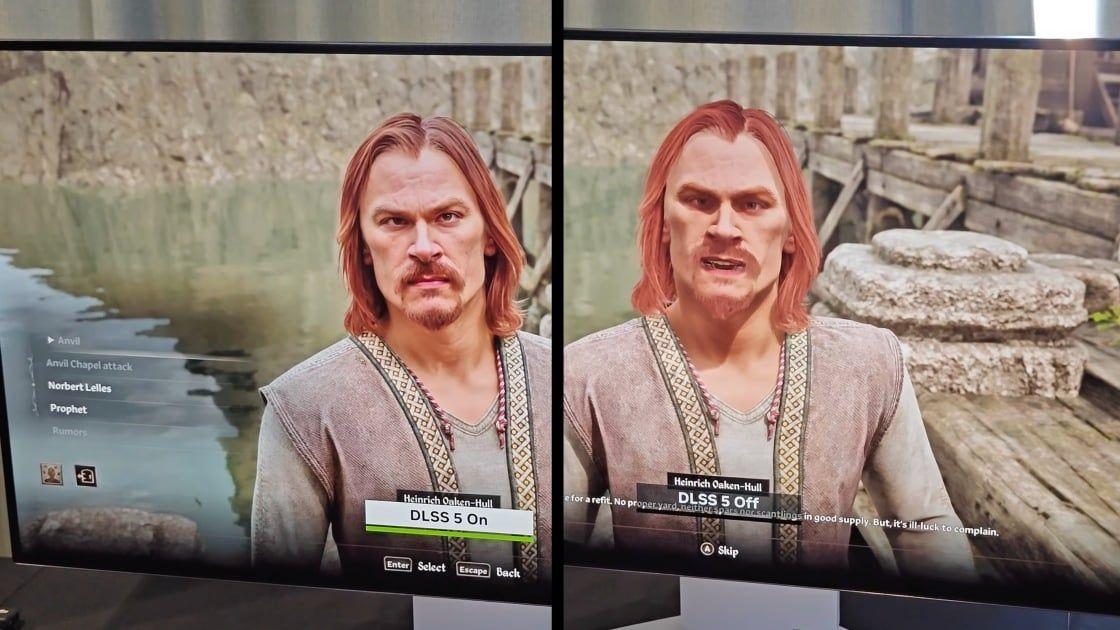
Source: PC Magazine
The strongest criticism emerged when Nvidia showcased DLSS 5 using Grace Ashcroft from Resident Evil Requiem. Before-and-after comparisons revealed the software changing her hair color, adding defined eyebrows, lip tint, and facial contouring
2
. Gamers quickly labeled it a beauty filter, criticizing how it applies what appears to be heavy makeup and reshapes faces to conform to conventional beauty standards. The backlash intensified because Nvidia chose to highlight a young female character rather than the game's monsters or other characters, a decision many saw as pointed given the industry's troubled history with female representation2
.
Source: The Conversation
The controversy echoes broader debates about gendered beauty standards in gaming. Some observers noted the changes mirror the manosphere's "looksmaxxing" trend, where certain facial features are considered biologically superior
2
. Gamers responded with humor, creating memes that applied similar treatment to God of War's Kratos, complete with blue eyeshadow and pink blush, to highlight the gendered absurdity2
. The term "AI slop" became widely used to describe the results, with critics arguing the technology produces generic, overly polished visuals that lack authenticity3
.Independent game developers expressed alarm that DLSS 5 undermines artistic intent by overriding carefully crafted visuals. Dave Oshry, co-founder of New Blood Interactive, told PC Gamer: "This is fundamentally changing the way video games look based on artificial intelligence that's been trained on Instagram models"
4
. He questioned why studios should invest in bespoke art pipelines if an AI layer can simply be dropped on top, asking: "At this rate, why make game art at all?"4
.Developer David Szymanski, known for Dusk and Iron Lung, argued that the lighting and contrast DLSS 5 adds actually makes scenes look less realistic. He found it particularly frustrating to see the technology showcased in Resident Evil Requiem, viewing the demo as dismissive of the underlying craft
4
. Szymanski also rejected claims that DLSS 5's impact is minimal because it's optional, arguing that once a technology is built into AAA pipeline assumptions, toggling it off stops being a real choice4
.The concern extends beyond individual preferences. Many developers worry that DLSS 5 applies a neural filter that homogenizes visuals across games, threatening each game's individuality and unique art direction
3
. Dark, gritty games like Resident Evil Requiem can end up looking like luxury skincare advertisements, fundamentally altering the intended atmosphere2
.DLSS 5 faces significant technical hurdles before its planned fall launch. Nvidia demonstrated the technology using two GeForce RTX 5090 graphics cards—each starting at $1,999—with one card rendering the game and another handling neural rendering effects
1
. The company plans to optimize DLSS 5 to run on a single GPU, but the current hardware demands suggest major tweaks are needed1
.

Source: How-To Geek
The technology is locked to the RTX 50-series, meaning many gamers won't have access regardless of their interest
5
. Unlike previous DLSS versions that improved performance, DLSS 5 is a visual fidelity feature almost guaranteed to carry a performance overhead5
. This represents a potential irony: a feature designed to enhance game graphics may actually reduce performance1
.Related Stories
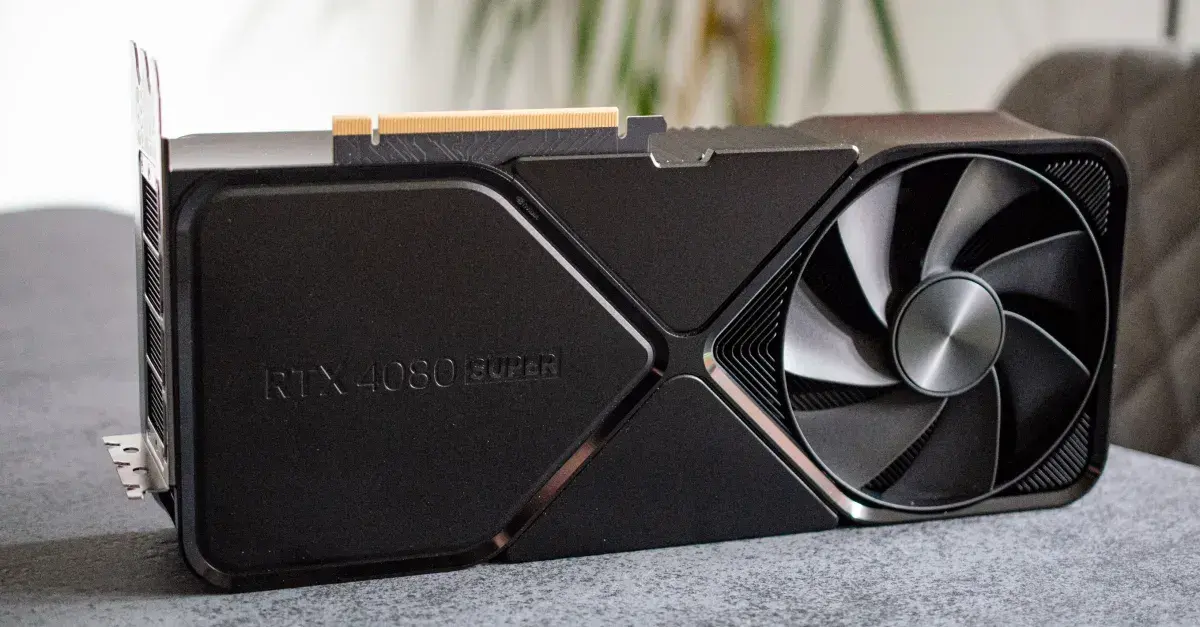
Nvidia CEO Jensen Huang stepped in early to defend DLSS 5 against mounting criticism, insisting the technology is not simply a filter
2
. The company stated in comments that "game developers have full, detailed artistic control over DLSS 5's effects to ensure they maintain their game's unique aesthetic"5
. Nvidia emphasizes that the neural rendering is designed to understand 3D characters and objects, including colors, hair, fabric, skin, and movement, with the goal of preserving game models before enhancing them1
.Not all responses have been negative. Jean Pierre Kellams, a lead producer at Epic Games, called criticism "absolutely insane," arguing that if the same footage had been presented as a next-gen hardware reveal rather than as AI, reception would be enthusiastic
4
. Major studios like Capcom and Bethesda have publicly backed the technology4
.The DLSS 5 controversy reveals deeper tensions about AI's expanding role in creative industries. Oshry urged the community to push back "just like we did with NFTs and crypto games," advocating for economic pressure through reduced sales and refusing collaboration
4
. The debate centers not just on whether DLSS 5 looks good, but on who controls creative decisions and whose idea of "better" gets encoded in algorithms2
.As the technology approaches its fall release, questions remain about performance impacts, optimization progress, and whether developers will embrace or resist the tool. The initial launch may be limited in scope given the current technical constraints
1
. For now, DLSS 5 represents a flashpoint in ongoing debates over artistic control, hardware costs, and the normalization of AI-driven graphics systems4
. Whether it becomes a turning point for gaming graphics or a cautionary tale about AI overreach will depend on how Nvidia addresses these concerns and whether the gaming community accepts this new direction.Summarized by
Navi
[1]
[2]
[3]
[4]
17 Mar 2026•Technology

31 Jan 2025•Technology

24 Jan 2025•Technology

1
Policy and Regulation

2
Policy and Regulation

3
Technology