3 Sources
[1]
AI coding agents can autonomously direct robot training
What happens when you give AI coding agents a lab full of robotic arms, some compute resources, and a "generous token budget" for teaching the robots various tasks? The agents can apparently figure out a training regimen that teaches the robots to successfully cut zip ties and even insert GPUs into thin sockets on motherboards. That glimpse into how AI can act in a fully autonomous way to automate robot training was made possible by a new agent harness framework -- software that wraps around AI models to enable their use of various tools while also providing capabilities such as memory, context, constraint, and feedback loops. That agentic harness, called ENPIRE, was developed by robotics researchers at the NVIDIA GEAR (Generalist Embodied Agent Research) lab alongside collaborators from Carnegie Mellon University in Pittsburgh and the University of California, Berkeley. "A part of our NVIDIA GEAR lab now self-improves tirelessly overnight," wrote Jim Fan, director of AI at NVIDIA, in a LinkedIn post. "We just read the reports in the morning." Fan also jokingly described the goal of such AI-directed robot training, saying, "We all take a holiday and Jensen wouldn't even notice," in reference to Nvidia founder and CEO Jensen Huang. But it's not only Nvidia robotics researchers who could benefit -- Fan said the team would be open-sourcing everything so anyone can host their own "self-running robot lab at home." The ENPIRE harness has four modules that enable AI coding agents to perform automatic reset and verification on tasks, refine policies that guide robotic behavior, evaluate such policies across multiple physical robots working in parallel, and address failures by analyzing logs, ingesting research papers, and improving training infrastructure and algorithm code. More technical details are available in the research paper uploaded on June 16, 2026. The harness was tested with three different AI coding agents, including OpenAI's Codex with GPT-5.5, Anthropic's Claude Code with Opus 4.7, and Moonshot AI's Kimi Code with Kimi K2.6. Teams of the coding agents independently developed different algorithmic approaches to robot training, tested them in real-world experiments, and then retained whatever changes helped raise the overall success rate over repeated cycles of self-directed testing. The success and limits of AI-directed robot training Equipped with ENPIRE, the AI coding agents developed strategies for robotic self-improvement that achieved a 99 percent success rate across several manipulation tasks, including the standard "Push-T" task that challenges robots to move a T-shaped block to fit a target position on top of a table. Other tasks included organizing pins in a pin box, tying and cutting zip-ties, and placing a GPU into a motherboard before unplugging the graphics card again to reset for the next trial. The most promising result may have come from the pin insertion and organization task. In that robot-training scenario, AI coding agents achieved nearly 100 percent success faster than a "frontier human-in-the-loop method" developed by many of the same human researchers. Such experiments also showed how larger teams of up to eight AI coding agents could achieve high success rates in robot training more quickly than smaller four-agent teams or single agents working alone. For example, the eight-agent team achieved 99 percent success on the Push-T task in two hours of research time, compared to the four-agent team requiring three hours and the single-agent team requiring nearly five hours. But the human researchers also discovered some crucial limitations when unleashing AI coding agents as autonomous robot trainers. The robots often sat idle and unused while the coding agents were busy "reading logs, writing code, debugging, or waiting for the language-model backbone." Larger teams of coding agents also spent more time summarizing each other's ideas and less time actually using the robots, and the coding agents sometimes failed to make full use of available compute resources when launching parallel training sessions. The faster success rates enabled through more agents and robots working together also came at the cost of higher token consumption -- a noteworthy consideration at a time when AI developers such as Anthropic are weighing pricing changes that would significantly increase the token-related costs of using AI services. Flush with cash from the AI boom, NVIDIA has been busily pushing its vision for physical AI through multiple robotics initiatives. On May 31, the company announced a partnership with the prominent Chinese robotics company Unitree to provide a "Reference Humanoid Robot" for research labs developing general-purpose AI-powered robots. During a whirlwind tour of South Korea in early June, NVIDIA founder and CEO Jensen Huang also met with Hyundai Motor Executive Chair Chung Euisun to discuss scaling up the mass manufacturing of AI-powered robots. Hyundai Motor Group owns the US robotics company Boston Dynamics, which is already well-known for its four-legged "robot dog" Spot and has been working to commercialize its Atlas humanoid robot.
[2]
Nvidia reveals AI robots that taught themselves to install GPUs into motherboards -- video shows robot 'solve high-precision tasks like... installing GPUs all by itself'
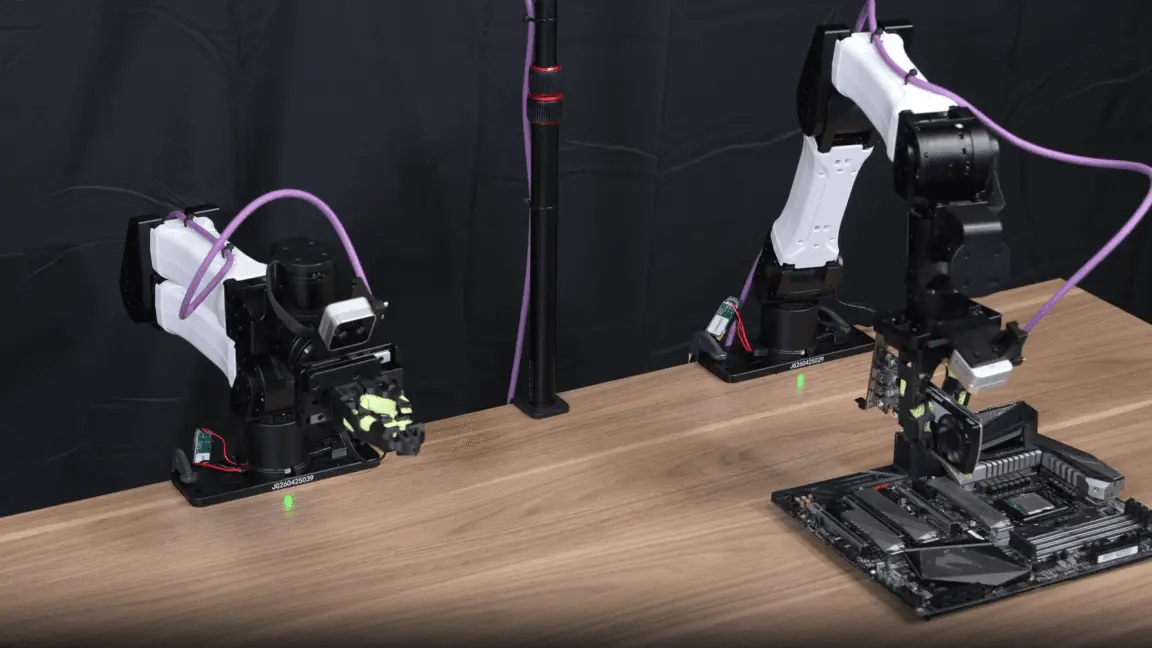
The ENPIRE project will be open source 'so you can host your self-running robot lab at home.' Nvidia has showcased agentic robots that can teach themselves high-precision and dexterous tasks in the real world. As part of the demo reel for this ENPIRE technology, we see a room full of robots do things like pick up and slot a graphics card in a motherboard, as well as sort metal pins in a container, and manipulate and correctly cut zipties. Jim Fan, Nvidia's Director of AI & Distinguished Scientist, said that this demo shows researchers can "enable AutoResearch in the physical world for the first time!" Fan explains that the ENPIRE project gave 8 Codex agents a fleet of robots, an allocation of GPUs, and a generous token budget. Then the agents were given a task to solve as quickly as possible, without making mistakes. Once instructed, "The robot fleet starts to come alive: they learn to look for visual clues, reset the scene, practice novel skills, tinker with control stack, read papers online, debate, reflect, get stuck, and try again directly on the hardware," explains the Stanford-based scientist. "All we did is giving Codex an API to the world of atoms, and the rest is emergence." We were most interested to see a robot "installing GPUs all by itself." In the brief recording of this particular PC DIY task, you can see one robot arm select and pass a graphics card to another with a motherboard in front of it. The second arm then carefully positions the PCIe slot of the card to align it with the motherboard slot, gently descends, and pushes it into place. It seesawed a bit on insertion, but we guess it would have been fine. Other AutoResearch projects the robots were set to do included organizing fine pins, plus tying and cutting zipties. In the associated ENPIRE: Agentic Robot Policy Self-Improvement in the Real World research paper, you can learn more about the techniques behind this demo. You can also see the comparison test results when different coding agents were used, including Codex with GPT-5.5, Claude Code with Opus 4.7, and Kimi Code with Kimi K2.6. The researchers also tested scaling up the robot fleet, concluding that "eight robots exploring in parallel solves the task significantly faster than fewer ones." Fan joked that the goal is to train up the robots, then everyone goes on holiday, "and Jensen wouldn't even notice ;)" Follow Tom's Hardware on Google News, or add us as a preferred source, to get our latest news, analysis, & reviews in your feeds.
[3]
Nvidia Built Robots That Train Themselves Using AI Coding Agents
Scaling from one robot to eight cut the time needed to master a task by more than half, though the token bill grew even faster than the time saved. A fleet of eight robot arms at Nvidia's GEAR lab spent the past few weeks teaching themselves to insert pins, seat graphics cards, and cut zip ties. The only humans involved were the ones who wrote the paper afterward. The skill came from ENPIRE, a framework detailed in a paper published Tuesday by researchers at Nvidia, Carnegie Mellon University, and UC Berkeley. ENPIRE hands the entire job of training a robot to AI coding agents, the same software that already writes and tests its own code, and lets them run that process directly on physical hardware. Coding agents like OpenAI's Codex, Anthropic's Claude Code, and Moonshot's Kimi Code have spent the past year running what researchers call autoresearch -- writing code, testing it, and rewriting it again without a person in the loop. That loop has mostly stayed on a screen, where resetting a failed experiment costs nothing. ENPIRE drags it into the physical world, where resetting an experiment means moving an actual robot arm. Building the 'Enpire' The system splits the work into two stages. In the first, a human walks the agent through building two permanent tools: a reset routine that returns the workspace to a fresh starting position, and a reward function that watches camera footage to score success -- basically a referee that never blinks and never takes a lunch break. That setup happens once, then gets reused for every attempt that follows. Once those tools exist, the agent takes over completely. It searches published research for ideas, picks between training methods like imitation learning, reinforcement learning, or hand-written rules, then rewrites its own code and tests the result on the robot. Nothing in that loop requires a person to watch, which is either liberating or slightly unsettling depending on how you feel about a robot holding scissors unsupervised. Nvidia ran the experiment on eight bimanual robot stations, each with its own hardware, computer, and coding agent. The stations trade progress via Git, the same tool coders use to merge code, so a winning idea spreads fleet-wide within minutes. Researchers measured the payoff on "Push-T," a task where a robot slides a T-shaped block into a target zone using only pushes, and pin insertion, where it threads pins into 4-millimeter holes. Scaling from one robot to eight cut the time to master Push-T from roughly five hours to two, and pin insertion from more than 90 minutes to about 40. Across the four real-world tasks tested, the agents drove their policies to a 99% success rate, according to the paper. For pin insertion, the agents reached near-perfect reliability faster than a comparable human-in-the-loop method, the kind that still needs someone to show up every morning. Nvidia's Jim Fan, the GEAR Lab co-lead who directs the company's AI research, called the project an effort to enable AutoResearch in the physical world for the first time. Fan said the team handed the agents a fleet of robots, a GPU allocation, and a token budget, then stepped back and let the robots take over. The gap between simulation and reality showed up almost immediately. All three coding agents solved Push-T inside a simulator, but two of the three failed once the same task moved onto a physical robot, the paper notes. Simulators don't have friction problems. Real tables do. Nvidia also tested ENPIRE inside RoboCasa, a simulated kitchen benchmark that scores robots on chores like opening cabinets or turning off stoves by success rate, mercifully without any risk of burning the place down. There, ENPIRE outperformed both Nvidia's own end-to-end model GR00T and CaP-X, a tool-using agent that skips the autoresearch loop entirely. ENPIRE extends an idea Nvidia first floated with Eureka, a 2023 system that used a language model to write reward functions for robots inside a simulator instead of having human engineers do it by hand. ENPIRE moves that self-improvement loop off the simulator and onto real hardware, with the agent designing its own tests rather than just its own rewards. The release lands the same week Alibaba unveiled its own embodied-AI push, the Qwen-Robot Suite, a trio of foundation models for robot navigation, manipulation, and physics simulation. Alibaba is building software brains for robot bodies it doesn't manufacture; Nvidia is testing whether agents can run the whole research loop on hardware it owns end to end. Both point to the same trend: physical robots are becoming the next arena for coding agents to compete in.
Share
Copy Link
Nvidia's GEAR lab has developed ENPIRE, an agent harness framework that enables AI coding agents to autonomously direct robot training without human supervision. The system achieved 99% success rates on tasks like GPU installation and pin insertion, with eight-robot teams completing training in just two hours.
Nvidia has unveiled ENPIRE, an agent harness framework that allows AI coding agents to autonomously design and execute robot training programs without human intervention. Developed by researchers at Nvidia's GEAR lab alongside collaborators from Carnegie Mellon University and UC Berkeley, the system represents a significant step toward fully automated robotics research
1
. Jim Fan, Nvidia's Director of AI, described the breakthrough on LinkedIn: "A part of our NVIDIA GEAR lab now self-improves tirelessly overnight. We just read the reports in the morning"1
.The ENPIRE framework hands complete control to AI coding agents, giving them access to a fleet of robotic arms, compute resources, and a generous token budget to solve tasks as quickly as possible without making mistakes. Once instructed, the robots that train themselves spring into action, learning to identify visual clues, reset scenes, practice novel skills, and even read research papers online to improve their performance.

Source: Ars Technica
The AI robot training system demonstrated remarkable proficiency across multiple high-precision tasks. AI-driven robots achieved a 99% success rate on challenges including GPU installation, organizing pins in containers with 4-millimeter holes, tying and cutting zip-ties, and the standard "Push-T" task that requires moving a T-shaped block to a target position
3
. In the GPU installation demonstration, one robot arm selected and passed a graphics card to another positioned near a motherboard. The receiving arm carefully aligned the PCIe slot with the motherboard socket and gently seated the card.The most promising result emerged from pin insertion tasks, where AI coding agents achieved nearly 100% success faster than a frontier human-in-the-loop method developed by the same research team
1
. This marks a turning point where autonomous robot training regimens can outpace traditional approaches requiring constant human supervision.The ENPIRE agent harness framework contains four specialized modules that enable comprehensive AutoResearch capabilities. These modules perform automatic reset and verification on tasks, refine policies guiding robotic behavior, evaluate policies across multiple physical robots working through parallel evaluation, and address failures through failure analysis by examining logs, ingesting research papers, and improving training infrastructure and algorithm code
1
.The system operates in two stages. Initially, a human guides the agent through building two permanent tools: a reset routine that returns the workspace to starting conditions, and a reward function that analyzes camera footage to score success
3
. After this one-time setup, the agent assumes complete control, searching published research for ideas, choosing between training methods like imitation learning or reinforcement learning, then rewriting and testing code on physical robots3
.Nvidia tested ENPIRE with three different AI coding agents: OpenAI Codex with GPT-5.5, Anthropic Claude Code with Opus 4.7, and Moonshot AI's Kimi Code with Kimi K2.6
1
. The research revealed that larger teams of up to eight AI coding agents achieved high success rates significantly faster than smaller configurations. Eight-robot teams completed Push-T training in two hours compared to three hours for four-agent teams and nearly five hours for single agents working alone1
. For pin insertion, scaling from one robot to eight reduced training time from more than 90 minutes to approximately 40 minutes3
.The robot stations share progress via Git, allowing winning strategies to spread fleet-wide within minutes
3
. However, researchers discovered crucial limitations. Physical robots often sat idle while coding agents were busy reading logs, writing code, debugging, or waiting for language model responses. Larger teams also spent more time summarizing each other's ideas rather than actively using robots, and sometimes failed to fully utilize available compute resources1
.Related Stories
The faster success rates came at a significant cost: higher token consumption. The token bill grew faster than the time saved when scaling robot fleets
3
. This consideration matters as AI developers like Anthropic weigh pricing changes that would substantially increase token-related costs of AI services1
.The gap between simulation and reality also presented immediate challenges. While all three AI coding agents solved Push-T inside simulators, two of the three failed when the task moved to physical robots
3
. Simulators don't account for friction problems that real tables present. Despite these limitations, ENPIRE outperformed both Nvidia's own end-to-end model GR00T and CaP-X in RoboCasa, a simulated kitchen benchmark3
.
Source: Decrypt
Fan announced that the team would open-source everything, enabling anyone to host their own self-running robot lab at home
1
. The research paper detailing technical specifications was uploaded on June 16, 20261
. Fan joked about the ultimate goal: "We all take a holiday and Jensen wouldn't even notice," referencing Nvidia founder and CEO Jensen Huang.ENPIRE extends concepts Nvidia introduced with Eureka, a 2023 system that used language models to write reward functions for robots in simulators. ENPIRE moves that self-improvement loop onto real hardware, with agents designing their own tests rather than just rewards
3
. The release coincides with Alibaba's unveiling of the Qwen-Robot Suite, signaling that embodied-AI and physical robots are becoming the next competitive arena for AI development3
. Nvidia continues pushing its physical AI vision through partnerships, including a May 31 announcement with Chinese robotics company Unitree and discussions with Hyundai Motor about scaling robotics manufacturing1
.Summarized by
Navi
[1]
12 Aug 2025•Technology

19 Mar 2025•Technology

30 Sept 2025•Technology

1
Policy and Regulation

2
Business and Economy

3
Technology