Nvidia's DGX Station brings trillion-parameter AI models to your desk with GB300 Superchip


6 Sources
[1]
Nvidia launches DGX Station with its bleeding-edge GB300 Grace Blackwell Superchip -- now available to order and will begin shipping in the coming months
DGX Station serves as the middle-ground between the DGX Spark and full-blown GB300-powered servers. Nvidia has officially released its DGX Station workstation PC that the company unveiled last year during GTC 2025. The new system is targeted at software developers, researchers, data scientists,
[2]
Nvidia Opens Orders for DGX Station, Ready to Run Giant AI Models at Your Desk
Following a delay, Nvidia is ready to release the DGX Station, a desktop-like computer that can run AI models locally, bringing AI data center-like performance to your home or office. At the company's annual GTC event, Nvidia revealed that PC manufacturers are starting to accept orders for their
[3]
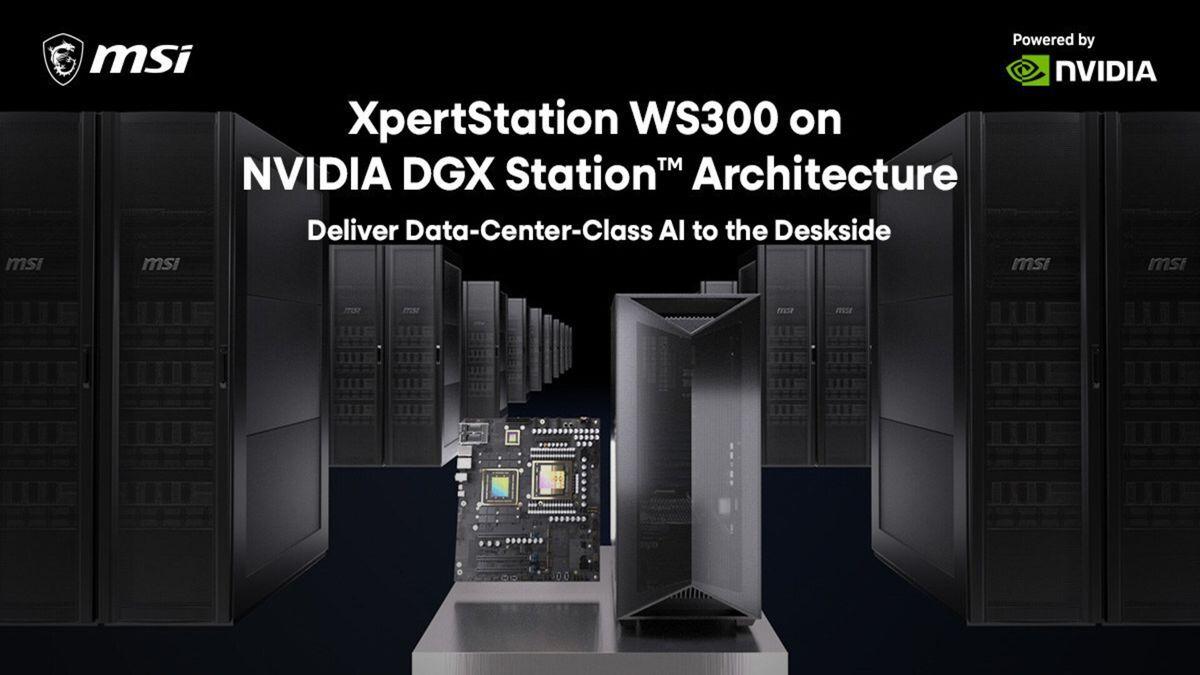
MSI's XpertStation WS300 brings data-center-class AI to desktops
Data center class performance delivered directly to the desktop * XpertStation WS300 supports trillion-parameter models without relying on cloud infrastructure * Dual 400GbE LAN ports enable high-speed distributed multi-node AI workloads * Unified HBM3e GPU and LPDDR5X CPU memory maximizes
[4]
Nvidia's DGX Station is a desktop supercomputer that runs trillion-parameter AI models without the cloud
Nvidia on Monday unveiled a deskside supercomputer powerful enough to run AI models with up to one trillion parameters -- roughly the scale of GPT-4 -- without touching the cloud. The machine, called the DGX Station, packs 748 gigabytes of coherent memory and 20 petaflops of compute into a box that
[5]

NVIDIA DGX Station GB300 Superchip Specifications and 748GB Unified Memory
NVIDIA has officially opened orders for its DGX Station, a desktop-class AI system built around the new GB300 Superchip. Announced during the company's GPU Technology Conference keynote, the system is positioned as a local AI development platform that brings data center-class performance into a
[6]

NVIDIA DGX Station Upgraded With GB300 Blackwell Ultra Desktop Superchip: 748 GB Memory, 20 PFLOPs AI Compute & AI Ready
NVIDIA has introduced its updated DGX Station AI Supercomputer powered by the GB300 Blackwell Ultra Desktop Superchip. NVIDIA & Its Partners Introduce GB300 "Blackwell Ultra" Powered DGX Station: A Powerful AI Workstation With Meaty Specs Last year, NVIDIA introduced its DGX Station powered by
Share
Copy Link
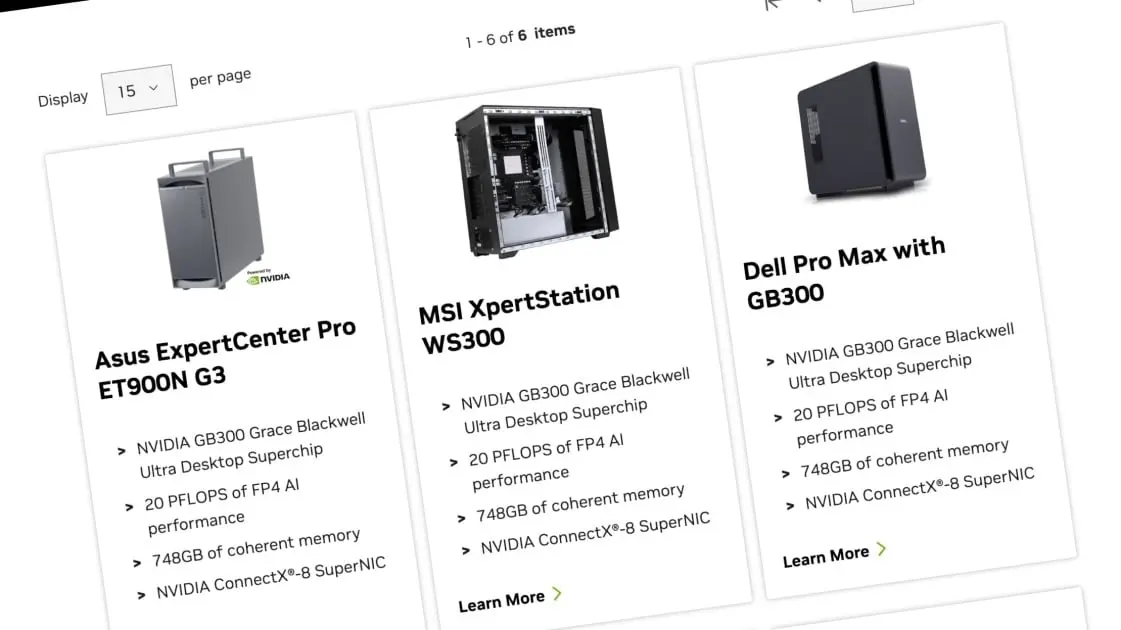
Nvidia officially opened orders for the DGX Station, a desktop supercomputer powered by the GB300 Grace Blackwell Ultra Superchip. The system delivers 20 petaflops of compute and 748GB of unified memory, enabling AI professionals to run trillion-parameter models locally without cloud infrastructure. Available from Asus, Dell, Gigabyte, MSI, Supermicro, and HP, the workstation targets researchers and developers building autonomous AI agents.
Nvidia Opens Orders for Desktop Supercomputer Targeting AI Professionals
Nvidia has officially opened orders for its DGX Station, a desktop AI system that brings data-center-class AI performance directly to workstations
1
. Announced at the company's annual GTC conference, the system is now available through six manufacturers: Asus, Dell, HP, Gigabyte, MSI, and Supermicro2
. Systems will begin shipping within weeks to months, though pricing remains undisclosed by most vendors. MSI's XpertStation WS300 variant carries a price tag of $84,999.99, signaling the premium positioning of these desktop supercomputer units3
.
Source: TechRadar
The DGX Station represents a significant evolution from Nvidia's $4,000 DGX Spark mini PC, which features a smaller GB10 chip and 128GB of RAM capable of running AI models with up to 200 billion parameters
2
. This new workstation targets software developers, researchers, data scientists, and anyone requiring substantial local AI development capabilities beyond what cloud infrastructure or smaller systems can provide1
.GB300 Superchip Delivers 20 Petaflops of Compute Power
At the core of the DGX Station sits Nvidia's GB300 Grace Blackwell Ultra Desktop Superchip, which integrates a 72-core Grace CPU with a Blackwell Ultra GPU featuring 20,480 CUDA cores
5
. The processors connect through a 900 GB/s NVLink C2C interface, delivering 1.8 terabytes per second of coherent bandwidth between the CPU and GPU—seven times faster than PCIe Gen 64
. This architecture enables the system to deliver up to 20 petaflops of performance using FP4 precision with sparsity5
.
Source: Guru3D
To put this in perspective, 20 petaflops—20 quadrillion operations per second—would have ranked among the world's top supercomputers less than a decade ago. The Summit system at Oak Ridge National Laboratory, which held the global number one spot in 2018, delivered roughly ten times that performance but occupied a room the size of two basketball courts
4
. Nvidia is now packaging a meaningful fraction of that capability into a system that plugs into a standard wall outlet and fits beside a monitor.Unified Memory Architecture Enables Trillion-Parameter Models
The DGX Station features 748GB of unified memory, consisting of 252GB of HBM3e memory on the GPU rated at 7.1 TB/s bandwidth and 496GB of LPDDR5X memory on the CPU rated at 396GB/s bandwidth
1
. Both memory pools are unified through the NVLink interconnect, allowing the CPU and GPU to share each other's memory seamlessly5
.This unified memory configuration is crucial for running trillion-parameter models—neural networks roughly the scale of GPT-4—which must be loaded entirely into memory to function
4
. Without sufficient memory, no amount of processing speed matters because the model simply won't fit. The coherent architecture eliminates the latency penalties typically associated with shuttling data between separate CPU and GPU memory pools, significantly reducing bottlenecks that cripple desktop AI work4
.Designed for Always-On Autonomous AI Agents
Nvidia designed the DGX Station explicitly for what it identifies as the next phase of AI: autonomous AI agent systems that reason, plan, write code, and execute tasks continuously rather than simply responding to prompts
4
. The system pairs with NemoClaw, a new open-source stack that bundles Nvidia's Nemotron models with OpenShell, a secure runtime that enforces policy-based security, network, and privacy guardrails for autonomous agents2
.Nvidia CEO Jensen Huang called OpenClaw—the broader agent platform NemoClaw supports—"the operating system for personal AI," comparing it directly to Mac and Windows and stating it's "as big of a deal as HTML, as big of a deal as Linux"
2
. The argument centers on architectural fit: cloud instances spin up and down on demand, but always-on agents require persistent compute, persistent memory, and persistent state. A workstation running 24/7 with local data and models inside a security sandbox is better suited to that workload than rented GPU capacity in someone else's data center4
.Related Stories
Extensive Connectivity and Expansion Options
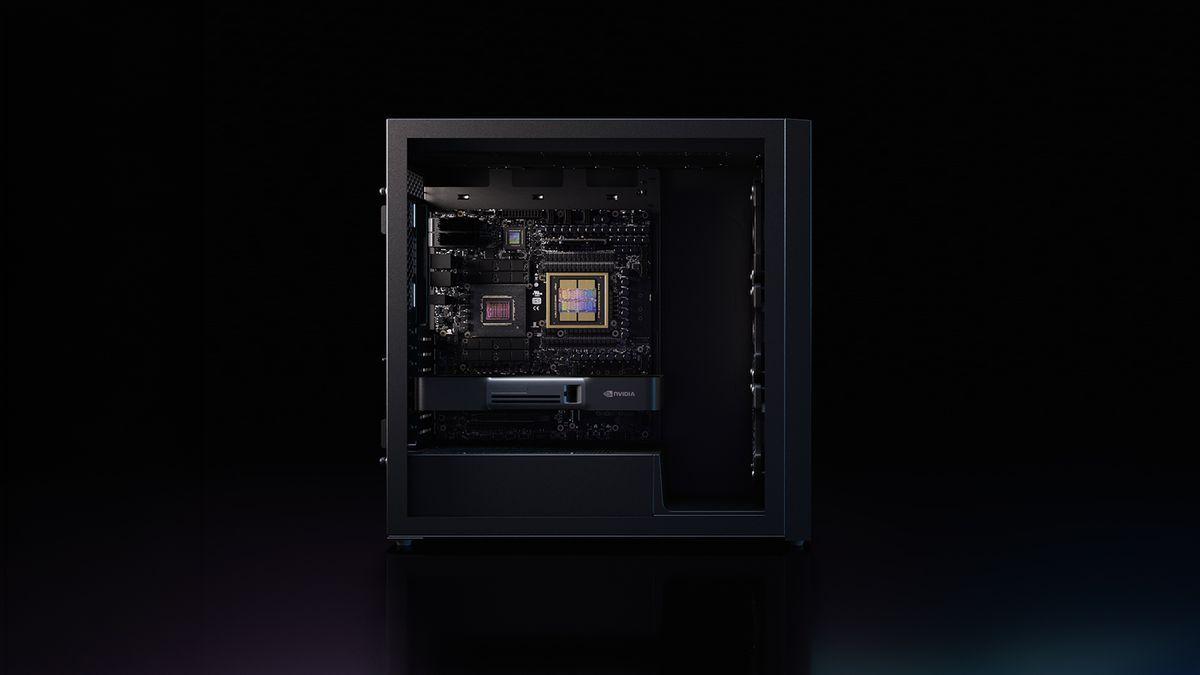
The DGX Station includes three PCIe Gen 5 x16 slots—one wired with 16 lanes and eight lanes for the other two—officially supporting discrete GPU options for additional tasks such as simulation and ray-traced visualization
1
. Supported GPUs include the RTX Pro 6000 Workstation Edition, RTX Pro 6000 Blackwell Max-Q Workstation Edition, RTX Pro 4000 Blackwell SFF Edition, and RTX Pro 2000 Blackwell graphics cards1
.For networking, the system uses Nvidia's ConnectX-8 SuperNIC, supporting speeds up to 800 Gb/s through two QSFP112 ports, with dual 400GbE LAN ports enabling high-speed distributed multi-node AI workloads
3
. The design allows connecting up to two DGX Station units together to scale model capacity and performance1
. Storage options include four M.2 slots for high-speed NVMe drives, accelerating dataset ingestion and AI pipelines3
.Power delivery comes through a single 24-pin ATX power connector, a single 8-pin EPS connector, and three 12V-2x6 power connectors for the GPU, feeding the system's 1,600W official power rating
1
.
Source: PC Magazine
Seamless Path from Desk Prototype to Data Center Production
One strategic advantage of the DGX Station is architectural continuity with Nvidia's GB300 NVL72 data center systems—72-GPU racks designed for hyperscale AI factories
4
. Applications built on the workstation migrate seamlessly to these data center configurations without rearchitecting code, creating a vertically integrated pipeline where developers can prototype at their desk and scale to cloud infrastructure when ready4
.This matters because the biggest hidden cost in AI development today isn't compute—it's the engineering time lost rewriting code for different hardware configurations. Models fine-tuned on local GPU clusters often require substantial rework to deploy on cloud infrastructure with different memory architectures, networking stacks, and software dependencies
4
. The DGX Station runs the same Nvidia AI software stack that powers every tier of Nvidia's infrastructure, eliminating that friction5
.The system supports the full AI lifecycle, including large-scale model training, data-intensive analytics, and real-time inference
3
. It can function as a personal supercomputer for solo developers or as a shared compute node for teams, with support for air-gapped configurations in classified or regulated environments where data cannot leave the building4
. Organizations maintain control over their data and intellectual property while conducting collaborative fine-tuning and on-demand deployment for generative AI applications3
.References
Summarized by

Navi
[1]
[4]
Related Stories
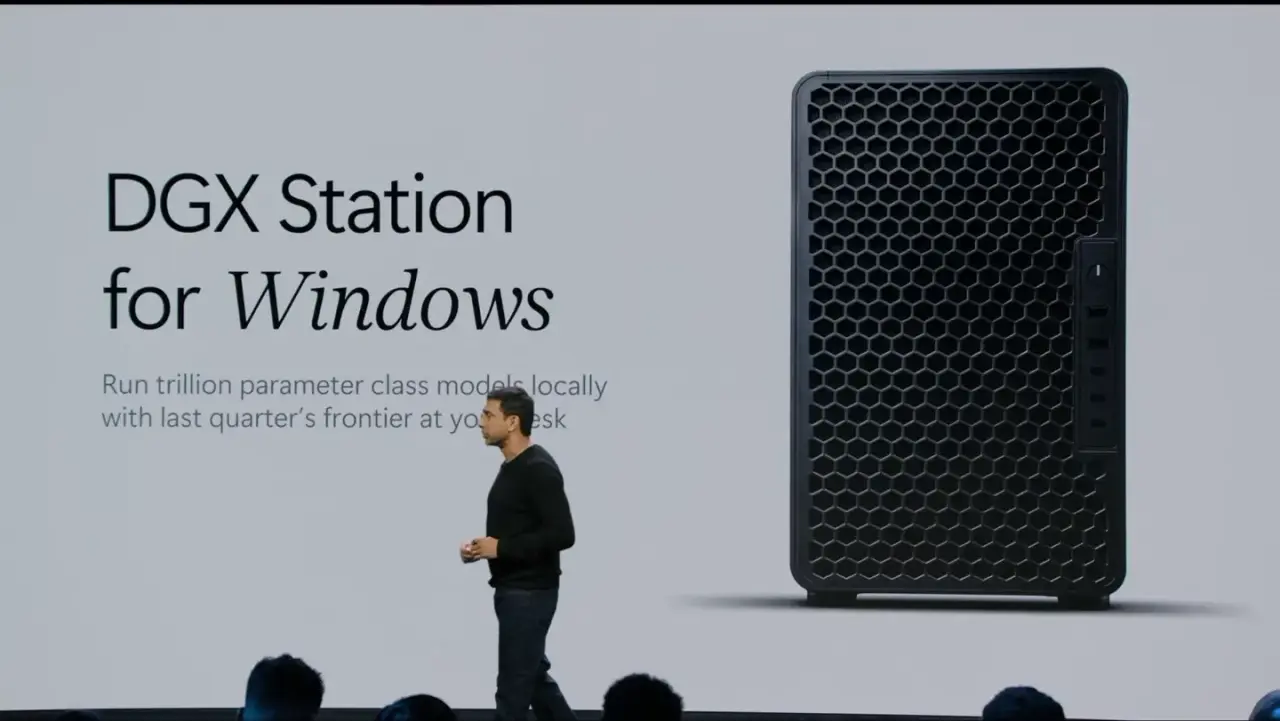
Nvidia squeezes trillion-parameter AI supercomputer into desktop workstations for Windows
01 Jun 2026•Technology
NVIDIA DGX Station for Windows Delivers 748GB Memory for Local AI Model Execution
08 Oct 2026•Technology
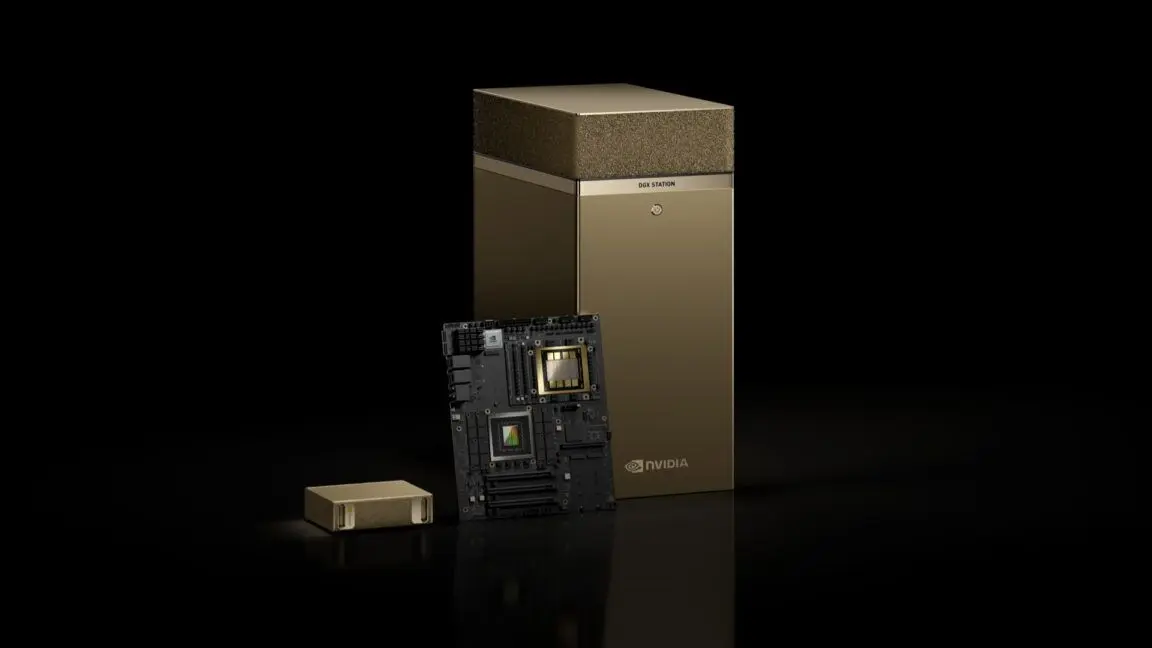
Nvidia Unveils DGX Spark and DGX Station: Personal AI Supercomputers for the Desktop
19 Mar 2025•Technology
Recent Highlights



Recent Highlights
Today's Top Stories



Don’t drown in AI news. We cut through the noise - filtering, ranking and summarizing the most important AI news, breakthroughs and research daily. Follow topics that matter to you and stay ahead.


