2 Sources
[1]
NVIDIA DGX Station for Windows Puts a Trillion-Parameter AI Supercomputer on Every Enterprise Desk
* NVIDIA announces DGX Station for Windows -- the world's most powerful deskside AI supercomputer for developing and running agents on Windows -- built on the NVIDIA GB300 Grace Blackwell Ultra Desktop Superchip, coming in Q4 this year. * DGX Station brings frontier AI agents to Windows -- enabling enterprise developers, researchers, engineers, designers and data scientists to build and deploy AI across the workflows and applications their business runs on. * DGX Station will support NVIDIA OpenShell on Windows, built on new Windows security and containment primitives. NVIDIA GTC Taipei -- NVIDIA today announced NVIDIA DGX Station⢠for Windows, the world's most powerful deskside AI supercomputer designed to build, run and connect always-on AI agents to Windows applications and workflows, capable of running frontier AI models of up to 1 trillion parameters locally. Historically, heavy-duty enterprise AI workloads -- training, fine-tuning, large-scale inference and multi-agent development -- have required powerful AI systems in the data center that run on Linux, while the vast majority of Fortune 500 companies use Windows for everyday productivity, creative, design and engineering applications. Building on the NVIDIA DGX Station system design, DGX Station for Windows bridges this gap as the first deskside AI supercomputer to bring NVIDIA GB300 Grace Blackwell-class AI infrastructure directly into the Windows ecosystem -- providing the compute needed to build, run and connect powerful AI agents to the applications and infrastructure Windows users already harness. "As enterprises scale AI agents across their organizations, they need AI infrastructure that can connect directly to the applications and workflows that power their business," said Chris Marriott, vice president of enterprise platforms at NVIDIA. "DGX Station delivers supercomputing-class AI directly into Windows, where millions already design, engineer, research and create every day." "For decades, Microsoft and NVIDIA have partnered to advance the most powerful computing platforms in the world," said Pavan Davuluri, executive vice president of Windows + Devices at Microsoft. "Today, we're taking that collaboration to the next level, scaling the full power of Windows from thin-and-light PCs to data-center-class workstations with DGX Station powered by GB300. This unlocks a new class of AI performance on Windows, the platform enterprises trust for security, manageability and compatibility." Introducing DGX Station for Windows The DGX Station state-of-the-art design is powered by the NVIDIA GB300 Grace Blackwell Ultra Desktop Superchip, connecting a powerful NVIDIA Blackwell Ultra GPU to a high-performance 72-core NVIDIA Grace⢠CPU via the NVIDIA NVLinkā¢-C2C interconnect for best-in-class system communication and performance. It features up to 748GB of coherent memory and up to 20 petaflops of FP4 performance, and can be paired with an NVIDIA RTX PRO⢠6000 Blackwell Workstation GPU for frontier AI compute with ray-traced visualization and simulation. In addition, DGX Station for Windows features the NVIDIA ConnectX-8 SuperNICā¢, optimized to supercharge hyperscale AI computing workloads. With support for networking at up to 800Gb/s, the ConnectX-8 SuperNIC enables extremely fast network data transfers for AI workloads and high-speed connectivity of multiple DGX Station systems for even larger workloads. A Window Into the World of Always-On AI Agents Enterprise AI is evolving from simple chatbot interactions to agentic inference that operate continuously, reason in real time and connect directly to enterprise applications and workflows. Developed in collaboration with Microsoft, DGX Station for Windows serves as dedicated agent infrastructure -- enabling enterprises to build and run agents with frontier intelligence locally, supporting AI models of up to 1 trillion parameters. DGX Station can also run agents at scale, with hundreds of agents executing on tasks simultaneously. Powerful AI agents can be built and connected to 3D design and engineering applications, giving developers, designers and engineers intelligent assistants that understand their tools and processes to automate repetitive tasks and accelerate productivity. For enterprise IT teams, DGX Station for Windows brings a secure, managed platform to GB300 deployments -- extending the same Windows security, compliance and fleet management infrastructure organizations already rely on. AI agents deploy and operate within this managed environment, governed through familiar Microsoft tools. Linux workloads get the same level of manageability support through Windows Subsystem for Linux. Enterprise-grade features -- including deployment and system updates -- help organizations maintain security, compliance and operational readiness across their fleets. NVIDIA and Microsoft's collaboration to deliver agents in the Windows experience extends from frontier to personal agents with NVIDIA RTX Spark⢠-- bringing the full spectrum of NVIDIA AI to slim laptops and small desktop PCs. Secure Agent Development and Deployment With NVIDIA OpenShell Autonomous agents need to be developed and deployed in a secure runtime that governs how they act, how they operate tools and how they interact with the rest of the system. DGX Station is an ideal platform for Windows users to build and run always-on, autonomous agents locally and securely before scaling to data center AI factories. NVIDIA OpenShell⢠is an open source, secure-by-design runtime for autonomous agents. Building on the new Windows security and containment primitives, it creates an individual, isolated sandbox for each agent and separates application-layer operations from infrastructure-layer policy enforcement. This means security and privacy policies are out of the agent's reach and applied at the system level. Instead of relying on behavioral system prompts, OpenShell uses the new Windows security and containment primitives with the aim to enforce constraints on the environment the agent runs in, so it cannot override policies, or leak credentials or private data. DGX Station for Windows Workflows DGX Station for Windows is built for the full spectrum of enterprise AI workflows -- from autonomous agent deployment and frontier model development to high-throughput inference, data science and physical AI, all with the full Microsoft and Windows enterprise manageability stack. * AI Agents: Build and run multiple frontier agents in parallel, and connect them directly to enterprise applications and workflows. * AI Development: Pretrain, fine-tune and iterate on large AI models within a Windows environment, with access to Linux AI toolchains via Windows Subsystem for Linux. * Data Science: Ingest large datasets into up to 748GB of coherent memory, eliminating data movement bottlenecks and accelerating every step from data preparation to machine learning and analytics. * AI Inference: Run high-throughput inference on AI models, and run large AI models of up to 1 trillion parameters. * Physical AI: Pair the GB300 Superchip with an additional NVIDIA RTX PRO Blackwell Workstation GPU to combine frontier AI compute with ray-traced visualization and simulation in a single deskside system -- delivering the performance needed for agents to perceive, simulate and interact in virtual-to-physical environments. DGX Station for Windows can serve as a dedicated AI supercomputer for a single developer or a shared local compute node for entire teams -- with workloads scaling seamlessly to GB300 in the data center or cloud. Global Ecosystem and Availability DGX Station for Windows is expected to be available from ASUS, Dell Technologies, GIGABYTE, HP, MSI and Supermicro, coming in Q4 this year. Watch NVIDIA founder and CEO Jensen Huang's keynote and learn more at NVIDIA GTC Taipei.
[2]
With DGX Station for Windows, Nvidia squeezes 1 trillion-parameter AI supercomputer into a deskside form factor
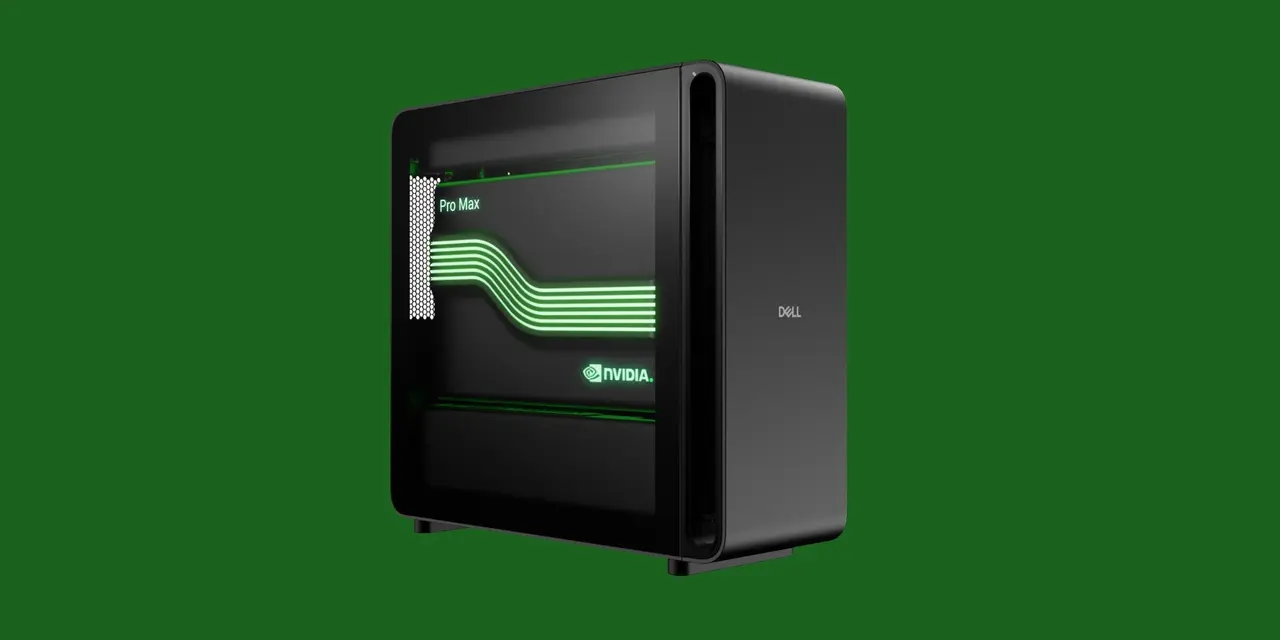
With DGX Station for Windows, Nvidia squeezes 1 trillion-parameter AI supercomputer into a deskside form factor Nvidia Corp. says it's uprooting supercomputers from the vast, sprawling data center complexes they normally live inside and squeezing them into compact, desktop-sized workstations that can sit on or aside the desks of individual developers, researchers and data scientists. That's the idea behind the new Nvidia DGX Station for Windows, which is said to be the world's first "deskside AI supercomputer." Announced today at GTC Taipei concurrent with the Computex conference, it's slated to launch in the fourth quarter, and specifically designed for building and running powerful, always on AI agents that can automate workflows within Windows ecosystems. The system was developed in close collaboration with Microsoft Corp. and delivers data center-grade AI infrastructure into the desktop or deskside form factor for the first time. It supports Nvidia OpenShell on Windows, a secure, open-source agentic runtime that integrates Microsoft's security and container technology to ensure agents can run safely within isolated sandbox environments. Nvidia says it's addressing a major friction point for enterprise developer teams. Traditionally, the heaviest-duty AI workloads, such as model training, fine-tuning and large-scale inference have been run in Linux-based cloud data centers that have the necessary infrastructure to support them. However, the bulk of the Fortune 500 runs much of its everyday business operations and engineering workflows locally on Windows-based systems. By bringing its latest architecture to the Windows ecosystem, the DGX Station eliminates the need for teams to push early-stage AI workloads to the cloud, so they can instead build and deploy powerful AI agents locally while leveraging the tools and security infrastructure they trust. Nvidia Vice President of Enterprise Platforms Chris Marriott said enterprises require specialized infrastructure that allows them to connect AI agents directly to the applications and workflows that drive their business. "DGX Station delivers supercomputing-class AI directly into Windows, where millions already design, engineer, research and create every day." The DGX Station for Windows is powered by Nvidia's GB300 Grace Blackwell Ultra Desktop Superchip, which is a customized version of the Grace Blackwell platform for rack-scale data centers. It packages a Blackwell Ultra graphics processing unit with an Nvidia Grace central processing unit that's connected via NVLink-C2C interconnect. All told, the system provides 20 petaflops of FP4 performance and up to 748 gigabytes of memory. With such immense computing power, the DGX Station for Windows can run frontier models of up to 1 trillion parameters locally, or support hundreds of parallel AI agents running simultaneously on the same platform. But that's just the basic setup. For customers that need to run intensive simulations or visualization workflows, DGX Station for Windows can be paired with an additional Nvidia RTX Pro 6000 Blackwell Workstation GPU, enabling "physical AI workflows" that combine powerful compute with ray-tracing capabilities. This supports the creation of AI agents that can not only perceive, but interact with virtual environments that support lifelike physics. For even more power, customers can link multiple DGX Station for Windows systems over Nvidia ConnectX-8 SuperNIC to create their very own integrated clusters of desktop supercomputers and run much larger workloads, Nvidia said. Because every agent runs in Nvidia's OpenShell runtime environment, they can be set up to run within tight boundaries and with strict security guardrails in place. Instead relying on easily bypassed behavioral system prompts, OpenShell leans on Windows' security primitives to create isolated sandbox environments for each agent. When users do this, their agents' security and privacy policies will be enforced at the system level, preventing them from overriding corporate policy or leaking credentials and sensitive information. OpenShell also makes it possible for administrators to manage their agents using Microsoft's fleet management tools. Meanwhile, the Windows Subsystem for Linux ensure compatibility with Linux toolchains. Microsoft's Pavan Davuluri, executive vice president of Windows + Devices, said the launch of DGX Station for Windows builds on a decades-long partnership between the two companies. "Today we're taking that collaboration to the next level, scaling the full power of Windows from thin-and-light PCs to data center-class workstations," he said. "This unlocks a new class of AI performance on Windows." Nvidia said the DGX Station for Windows will become available before the end of the year. It will come in a range of flavors, with systems made by partners including Dell Technologies Inc., HP Inc., ASUSTeK Computer Inc., Micro-Star International Co. Ltd., Super Micro Computer Inc. and others.
Share
Copy Link
NVIDIA announced DGX Station for Windows, a deskside AI supercomputer powered by the GB300 Grace Blackwell Ultra Desktop Superchip. Developed with Microsoft, the system brings data center-grade AI infrastructure to Windows environments, enabling enterprise developers to build and run AI agents with up to 1 trillion parameters locally. The system launches in Q4 2026.
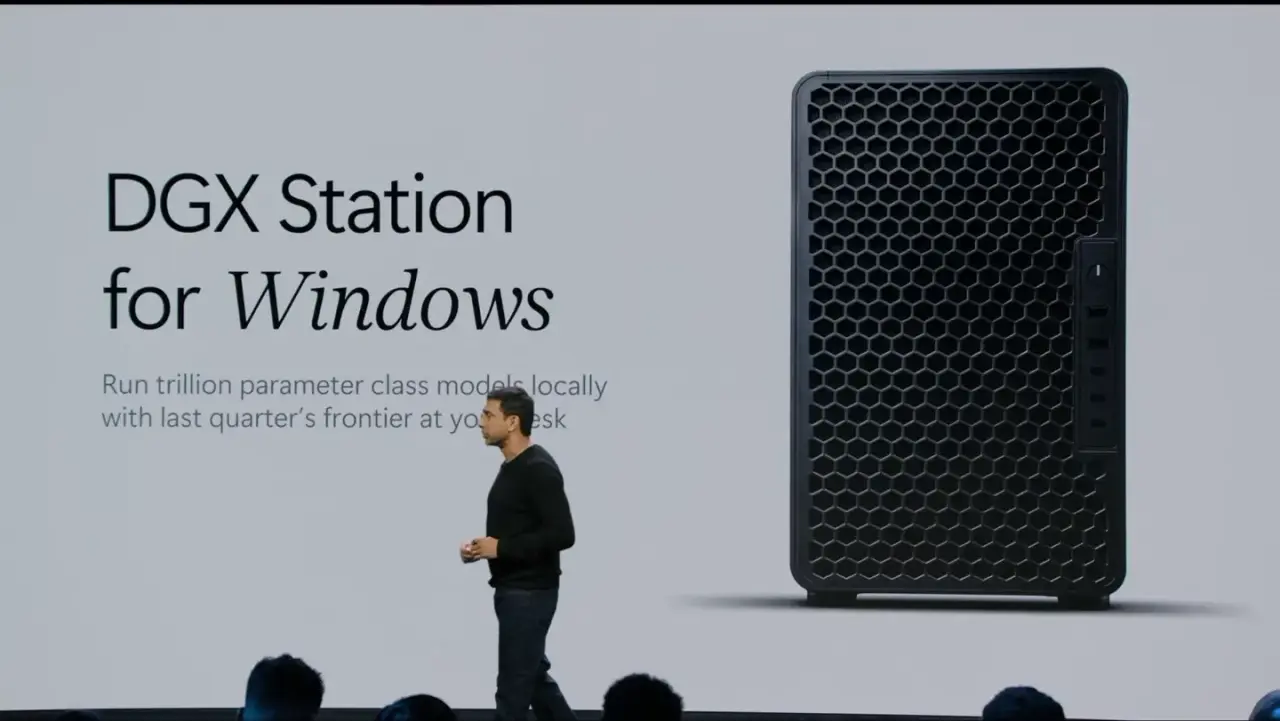
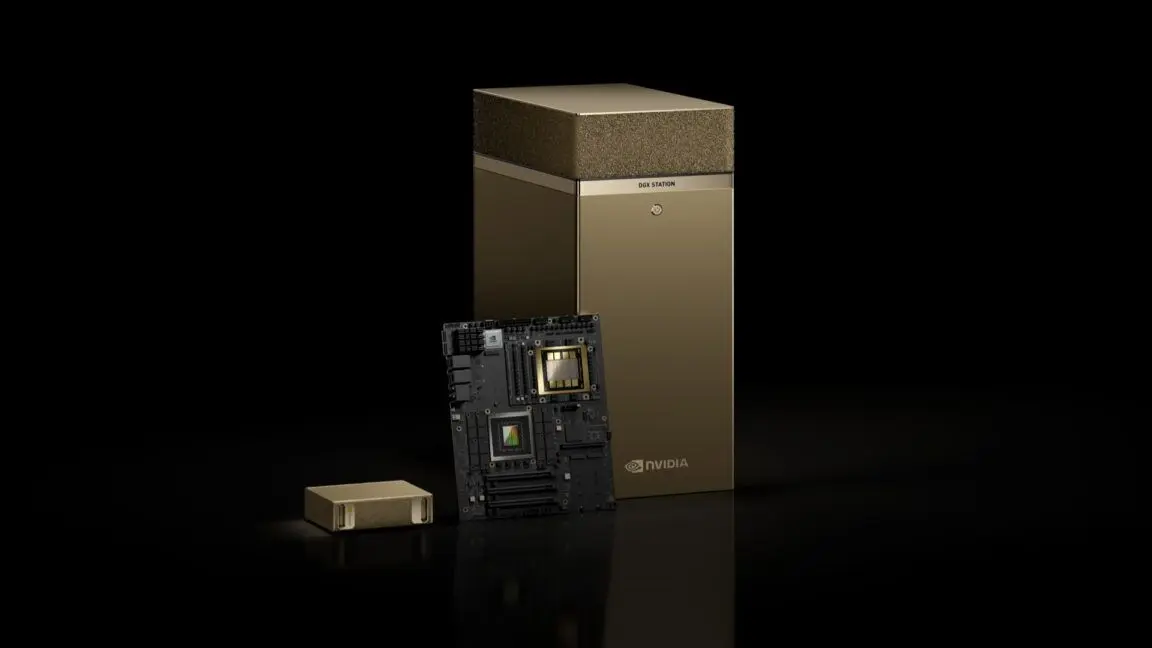
NVIDIA DGX Station for Windows represents a shift in how enterprises access powerful AI infrastructure. Announced at GTC Taipei, the system delivers what NVIDIA calls the world's most powerful deskside AI supercomputer, capable of running 1 trillion-parameter AI models directly on enterprise desks
1
. Set to launch in Q4 2026, the system addresses a longstanding friction point: while heavy-duty AI workloads have traditionally required Linux-based data centers, the majority of Fortune 500 companies run their everyday operations on Windows2
.
Source: NVIDIA
Developed in collaboration with Microsoft, the NVIDIA DGX Station bridges this gap by bringing data center-grade AI infrastructure into the Windows ecosystem where enterprise developers, researchers, engineers, designers and data scientists already work
1
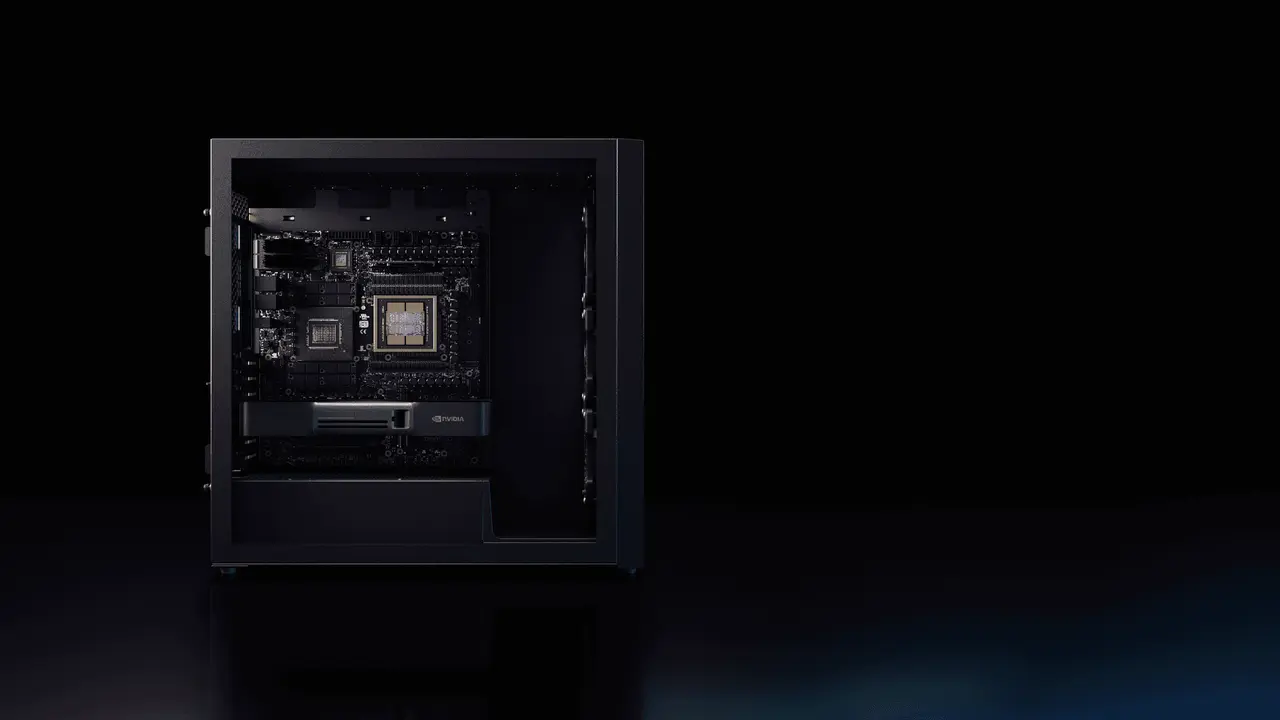
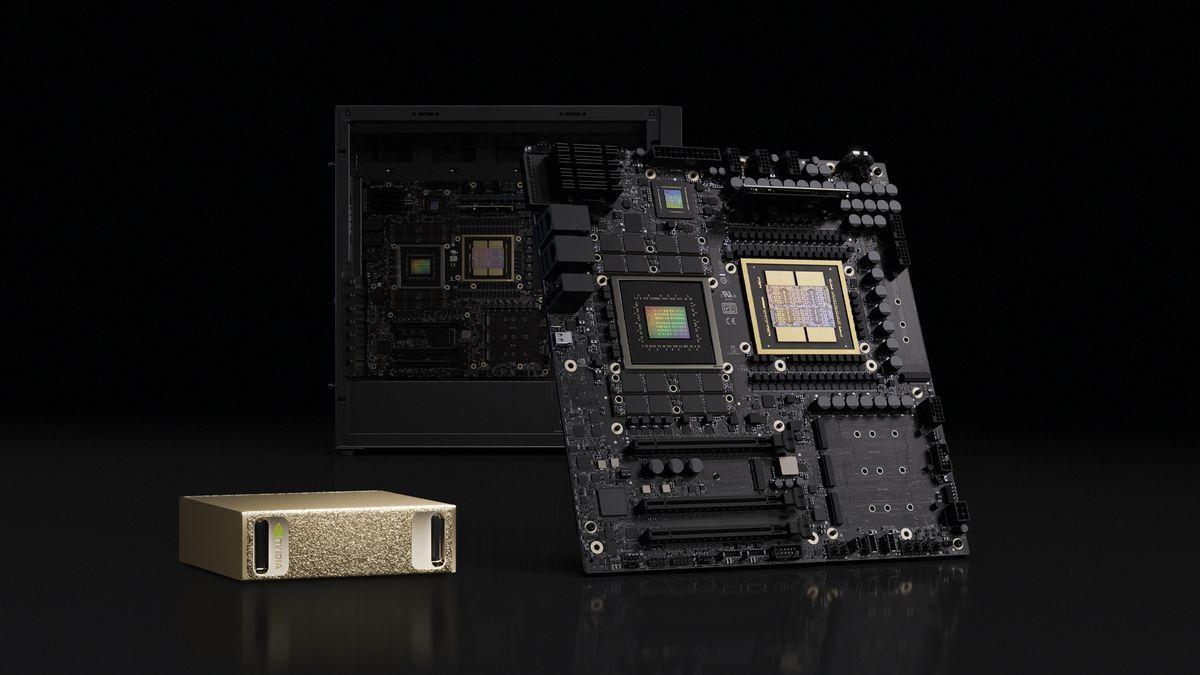
. This enables teams to build and deploy AI agents for Windows locally, eliminating the need to push early-stage workloads to cloud environments.At the heart of the NVIDIA DGX Station sits the NVIDIA GB300 Grace Blackwell Ultra Desktop Superchip, connecting a Blackwell Ultra GPU to a 72-core NVIDIA Grace CPU via NVLink-C2C interconnect
1
. The system delivers up to 20 petaflops of FP4 performance and up to 748GB of coherent memory, providing the compute power necessary to run frontier AI models locally2
.For users requiring visualization and simulation capabilities, the system can be paired with an NVIDIA RTX PRO 6000 Blackwell Workstation GPU, enabling what NVIDIA describes as "physical AI workflows" that combine frontier AI compute with ray-traced visualization
1
. The deskside form factor makes this level of computing accessible without requiring dedicated data center space.The NVIDIA DGX Station serves as dedicated agent infrastructure, supporting hundreds of AI agents executing tasks simultaneously
1
. Chris Marriott, vice president of enterprise platforms at NVIDIA, explained that "as enterprises scale AI agents across their organizations, they need AI infrastructure that can connect directly to the applications and workflows that power their business"1
.The system supports NVIDIA OpenShell on Windows, built on Windows security and containment primitives to ensure agents operate within isolated sandbox environments
1
. Unlike behavioral system prompts that can be bypassed, OpenShell leverages Windows' security primitives to enforce policies at the system level, preventing agents from overriding corporate policy or leaking sensitive information2
.Related Stories
For organizations requiring even greater compute power, multiple DGX Station systems can be linked via the NVIDIA ConnectX-8 SuperNIC, which supports networking at up to 800Gb/s
1
. This enables enterprises to create integrated clusters of desktop supercomputers for larger workloads2
.For enterprise IT teams, Windows AI capabilities extend to familiar management tools. The system brings the same Windows security, compliance and fleet management infrastructure organizations already rely on to GB300 deployments
1
. Linux workloads receive equivalent support through Windows Subsystem for Linux, ensuring compatibility with existing Linux toolchains2
.Pavan Davuluri, executive vice president of Windows + Devices at Microsoft, noted that the collaboration "scales the full power of Windows from thin-and-light PCs to data center-class workstations," unlocking "a new class of AI performance on Windows, the platform enterprises trust for security, manageability and compatibility"
1
. Partners including Dell Technologies, HP, ASUS, MSI, and Super Micro Computer will manufacture systems2
.Summarized by
Navi
[1]
17 Mar 2026ā¢Technology

19 May 2025ā¢Technology

19 Mar 2025ā¢Technology

1
Business and Economy

2
Policy and Regulation

3
Technology