Nvidia launches humanoid robot platform with Unitree amid US-China tech competition tensions


8 Sources
[1]
The Humanoid Robot of the Future Is a 6-Foot-Tall Beefcake With a Chinese Body and an American Brain
The humanoid robot of the future is a hulking specimen with a body that's made in China and a brain that runs on American silicon. This week, Jensen Huang, the CEO of Nvidia, announced a blueprint for the bot, which combines a few different things: a 6-foot, 150-pound robot called H2 Plus from
[2]
Nvidia to work with US, European humanoid robot makers in addition to China's Unitree
SAN FRANCISCO, June 1 (Reuters) - Nvidia (NVDA.O), opens new tab plans to work with humanoid robot makers in the U.S., Europe and South Korea in addition to China's Unitree to build robots for researchers, according to the AI chip company's executives. After CEO Jensen Huang's keynote address in
[3]
NVIDIA's Isaac Gr00t platform gives researchers access to frontier humanoid robotics - Engadget
It uses a nearly 6-foot tall humanoid chassis and tactile five finger hands. As part of his AI-palooza Computex keynote, NVIDIA's Jensen Huang dove into the most relatable form of artificial intelligence: robots. The company announced the new Isaac Gr00t reference design humanoid robot platform
[4]
Nvidia picks Unitree for humanoid robot platform as Chinese startup eyes IPO
Nvidia has selected Chinese humanoid robot maker Unitree for the first robotics system the U.S. chipmaker is selling to researchers from Stanford to ETH Zurich, the company announced Monday. The system combines Unitree's nearly 6-foot-tall H2 humanoid robot with Nvidia's Jetson Thor hardware,
[5]

NVIDIA launches Unitree-based humanoid robot system for research
NVIDIA has introduced what it calls the first open humanoid robot reference design built on its Isaac GR00T development platform, giving researchers access to an integrated hardware and software ecosystem for developing next-generation humanoid robots. The new platform combines a human-scale robot
[6]

'Robots that can perform real work': Nvidia, Unitree, and Sharpa are forming a super-group to make the most capable humanoid robots yet -- with Jensen Huang promising a 'meaningful step' towards frighteningly capable robots
* Nvidia, Unitree, and Sharpa have a new robotics deal * The companies will produce a cutting-edge humanoid robot blueprint * These robots are going to be better equipped for 'real work' There are some very impressive humanoid robot demos out there, but questions remain about just how capable
[7]

NVIDIA Announces NVIDIA Isaac GR00T Reference Humanoid Robot for Academic Research
* NVIDIA announces an open humanoid robot reference design built on the NVIDIA Isaac GR00T platform, combining a Unitree H2 Plus humanoid robot, Sharpa five-fingered hands for dexterous manipulation, NVIDIA Jetson Thor onboard compute for advanced reasoning and control, and NVIDIA Isaac GR00T open
[8]

Nvidia to work with US, European humanoid robot makers in addition to China's Unitree
After CEO Jensen Huang's keynote address in Taiwan on Monday ahead of the Computex trade show, Nvidia announced that the company is working with China's Unitree, a leading maker of humanoid robots, to provide a standardized version of Unitree's H2 robot that can be used by academic
Share
Copy Link
Nvidia CEO Jensen Huang unveiled a new humanoid robot platform combining Unitree's 6-foot H2 Plus robot, Nvidia's Jetson Thor chip, and Sharpa's dexterous hands. The Isaac Gr00t platform aims to accelerate robotics research at institutions like Stanford and ETH Zurich, but the partnership with Chinese humanoid robot maker Unitree raises security questions as US lawmakers consider banning the company's robots from federally-funded research.
Nvidia Unveils Integrated Humanoid Robot Platform for Academic Research
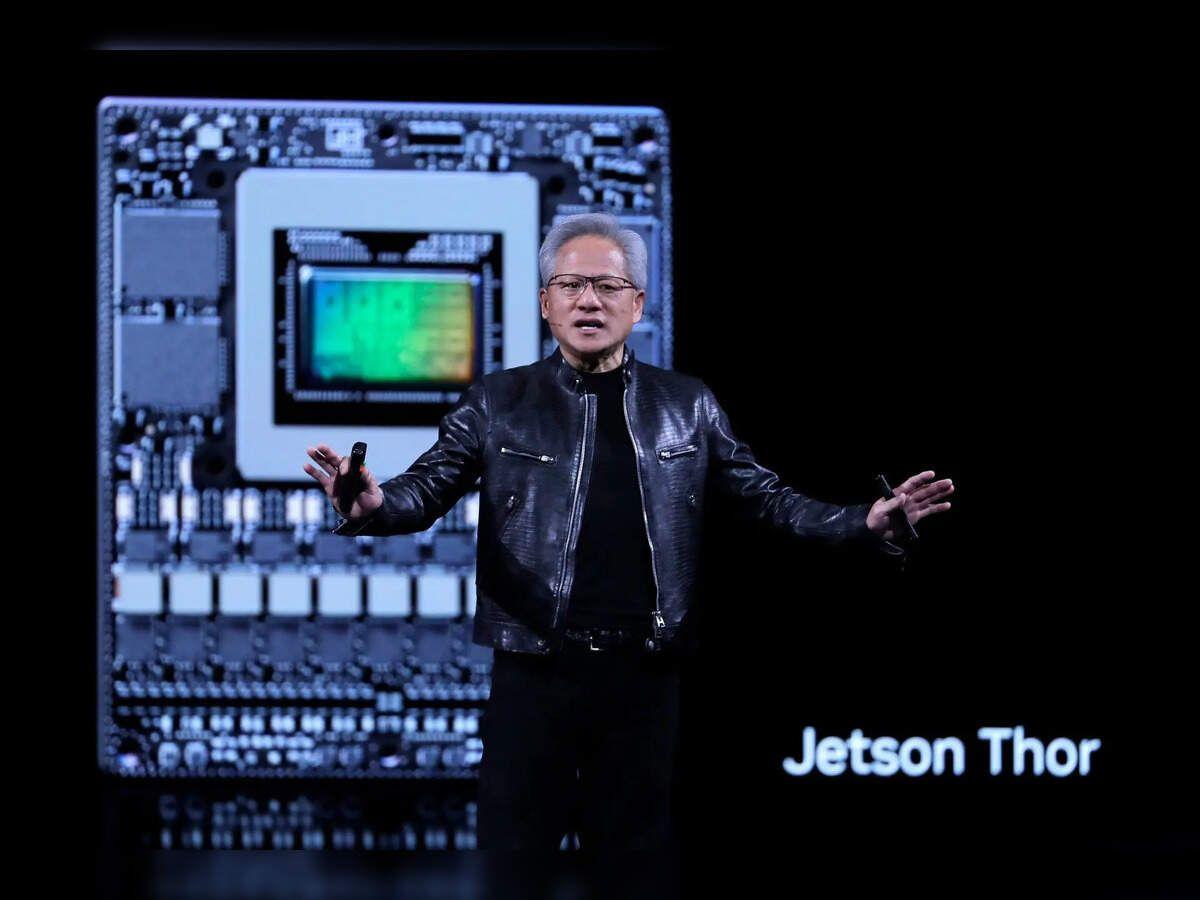
Nvidia CEO Jensen Huang announced a comprehensive humanoid robot platform this week at Computex in Taiwan, marking a significant development in robotics research infrastructure. The Nvidia humanoid robot platform combines a nearly 6-foot-tall, 150-pound robot called H2 Plus from Unitree, a Chinese humanoid robot maker, with Nvidia's Jetson Thor T5000 chip and dual Sharpa Wave tactile five-fingered hands from Singapore-based Sharpa
1
. The open humanoid robot reference design integrates Nvidia's Isaac Gr00t platform software stack, creating what the company describes as the first complete development ecosystem for next-generation humanoid robotics5
.
Source: ET
The platform features 31 degrees of freedom across the robot body and an additional 44 degrees of freedom from the Sharpa five-fingered hands, totaling 75 degrees of freedom
5
. The Jetson Thor computing system includes a Blackwell GPU capable of delivering 2,070 FP4 teraflops of AI performance, 128GB of unified memory, and a configurable 40 to 130-watt power range3
. This AI computing platform enables the robot to run powerful AI algorithms that help it make sense of its environment and control movements in real-time.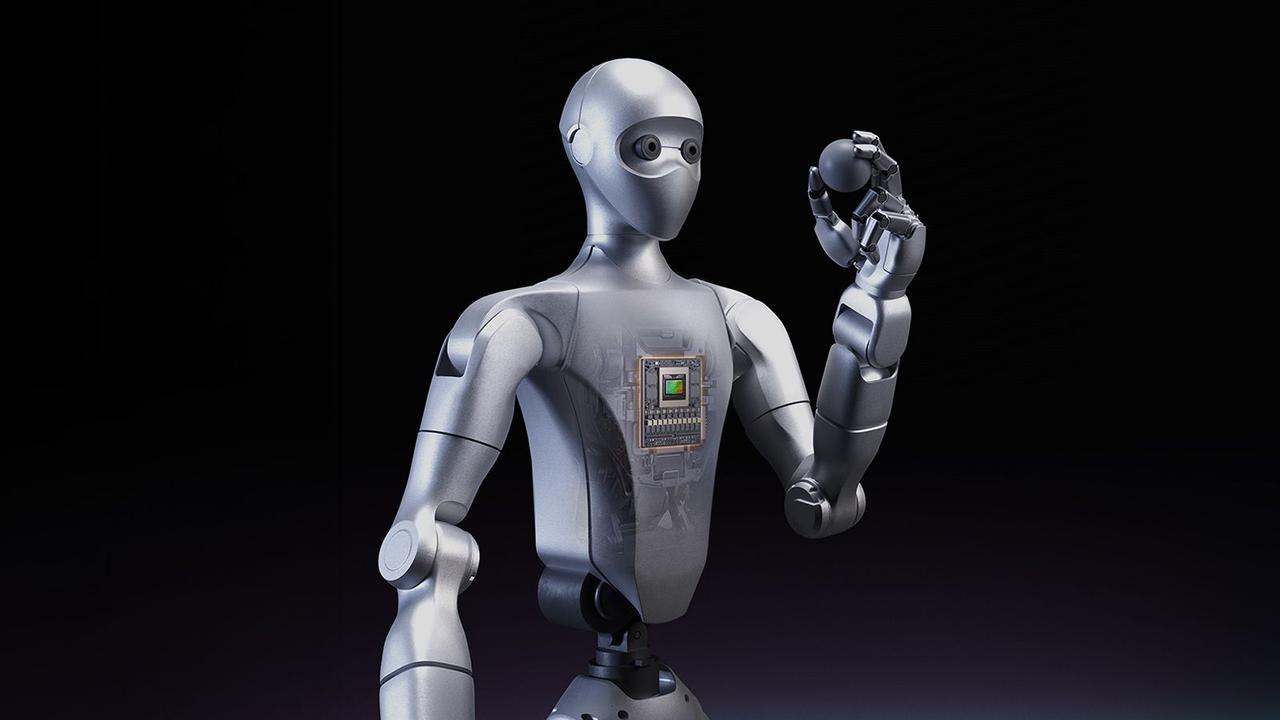
Source: NVIDIA
Chinese Partnership Sparks Security Concerns in Robotics Development
The collaboration with Unitree has emerged as a focal point in US-China techno-competition discussions. US lawmakers have alleged that Unitree maintains extensive ties to the Chinese government and military, introducing legislation that would ban the company's robots from research programs receiving federal funding
2
. Security researchers previously claimed that Unitree's robots could capture and transmit data, raising potential cybersecurity risks1
.Nvidia executives addressed these concerns by implementing enhanced security features in the platform. Any software updates for the robot's subsystems must flow through Nvidia's chip, where code can be verified for authenticity
2
. The system incorporates secure boot and confidential computing technologies—the same protections Nvidia uses for data center servers—to ensure robots cannot run malicious code and that sensitive data cannot leave the robots without permission2
.Strategic Positioning in Physical AI Market
Jensen Huang has positioned humanoid robots as critical to unlocking what he calls "physical AI," predicting a multitrillion-dollar economic opportunity across the world's largest industries
1
. He told investors last month he expects rapid growth in the robotics segment over the next five years4
. Spencer Huang, Nvidia's director of product for robotics and Jensen's son, confirmed that Unitree represents just the first partnership, with plans to work with humanoid robot makers in the US, Europe, and South Korea2
.
Source: Wired
Scott Singer, a fellow at the Carnegie Endowment for International Peace studying AI governance, noted the partnership reflects complementary strengths: the US leads in AI chips while China's supply chain gives its robotics companies a hardware advantage. "Both sides have key parts of the supply chain that they might be able to weaponize, but here they are working together," Singer observed
1
. Unitree's robots already dominate markets inside and outside China due to their affordability—a base G1 humanoid costs around $15,000 compared to competitors priced at several hundred thousand dollars1
.Related Stories


Comprehensive Software Ecosystem Accelerates Robotics Research
The Isaac Gr00t platform addresses fragmentation in robotics development by providing an integrated workflow spanning data collection, simulation systems, training, and deployment
5
. Researchers can use Isaac Teleop for capturing demonstration data, Isaac Sim and Isaac Lab for virtual training and testing, and Isaac ROS middleware to deploy trained policies onto physical robots5
. The platform includes Nvidia's open foundation models for humanoid reasoning and learning, enabling robots to perform multitask behaviors5
.Leading institutions including Ai2, ETH Zurich, Stanford Robotics Center, and the University of California San Diego have committed to using the reference design for robotics research
3
. Steve Cousins, executive director of the Stanford Robotics Center, emphasized that "robotics moves fastest when researchers can build on open platforms, share code and test ideas on real machines"5
. The platform will also support the Unitree G1 humanoid robot, expanding accessibility to institutions already using the popular research platform5
.References
Summarized by

Navi
[1]
[3]
[5]
Related Stories
Recent Highlights
1
Meta Unveils Muse Wonder Frontier AI Models, Claims Performance Matching OpenAI and Anthropic
Technology

2
IMF Report Warns AI Market Correction Could Spark Global Financial Crisis With $1.4T at Risk
Business and Economy

3
OpenAI Releases 722 AI-Generated Math Solutions, Triggering Existential Crisis in Mathematics
Technology

Recent Highlights
Today's Top Stories







Don’t drown in AI news. We cut through the noise - filtering, ranking and summarizing the most important AI news, breakthroughs and research daily. Follow topics that matter to you and stay ahead.


