Taiwan's New AI Supercomputer to Boost Research in Quantum Computing and Climate Science


8 Sources
[1]
NVIDIA-Powered Supercomputer to Enable Quantum Leap for Taiwan Research
Built by ASUS, the National Center for High-Performance Computing's new AI supercomputer will support climate science, quantum research and the development of large language models. Researchers across Taiwan are tackling complex challenges in AI development, climate science and quantum computing.
[2]
NVIDIA Grows Quantum Computing Ecosystem With Taiwan Manufacturers and Supercomputing
Silicon developers, including Compal, Quanta and Taiwan's National Center for High-Performance Computing accelerate quantum computing research with NVIDIA AI supercomputing hardware. Quantum computing promises to shorten the path to solving some of the world's biggest computational challenges,
[3]
NVIDIA Powers World's Largest Quantum Research Supercomputer
COMPUTEX -- NVIDIA today announced the opening of the Global Research and Development Center for Business by Quantum-AI Technology (G-QuAT), which hosts ABCI-Q -- the world's largest research supercomputer dedicated to quantum computing. Quantum processors promise to augment AI supercomputers in
[4]
Nvidia powers world's largest quantum research supercomputer
Nvidia announced the opening of the Global Research and Development Center for Business by Quantum-AI Technology (G-QuAT), which hosts ABCI-Q -- the world's largest research supercomputer dedicated to quantum computing. Quantum processors promise to augment AI supercomputers in solving some of the
[5]
Nvidia-powered supercomputer to enable quantum leap for Taiwan's research
Researchers across Taiwan are tackling complex challenges in AI development, climate science and quantum computing. Their work will soon be boosted by a new supercomputer at Taiwan's National Center for High-Performance Computing that's set to deliver over eight times more AI performance than the
[6]
Jensen Huang Flips Back on Quantum | AIM
NVIDIA announced plans to invest in Taiwan's tech infrastructure, announcing an AI supercomputer in the country. At Computex 2025 in Taipei, NVIDIA delved into its stronghold on the AI and quantum computing capabilities, mentioning not only existing and upgraded solutions but also partnerships
[7]

NVIDIA Powers World's Largest Quantum Research Supercomputer - NVIDIA (NASDAQ:NVDA)
TAIPEI, Taiwan, May 19, 2025 (GLOBE NEWSWIRE) -- COMPUTEX -- NVIDIA today announced the opening of the Global Research and Development Center for Business by Quantum-AI Technology (G-QuAT), which hosts ABCI-Q -- the world's largest research supercomputer dedicated to quantum computing. Quantum
[8]

NVIDIA Powers World's Largest Quantum Research Supercomputer
TAIPEI, Taiwan, May 19, 2025 (GLOBE NEWSWIRE) -- COMPUTEX -- NVIDIA today announced the opening of the Global Research and Development Center for Business by Quantum-AI Technology (G-QuAT), which hosts ABCI-Q -- the world's largest research supercomputer dedicated to quantum computing. Quantum
Share
Copy Link
Taiwan's National Center for High-Performance Computing is set to launch a powerful new AI supercomputer, featuring NVIDIA technology, to accelerate research in quantum computing, climate science, and AI development.

Taiwan's Quantum Leap in Supercomputing
Taiwan is poised to make significant strides in advanced research with the announcement of a new AI supercomputer at the National Center for High-Performance Computing (NCHC). Set to deliver over eight times more AI performance than its predecessor, this NVIDIA-powered system marks a substantial upgrade in the country's computational capabilities
1
5
.Supercomputer Specifications and Capabilities
The new supercomputer, built by ASUS, will feature:
- NVIDIA HGX H200 systems with over 1,700 GPUs
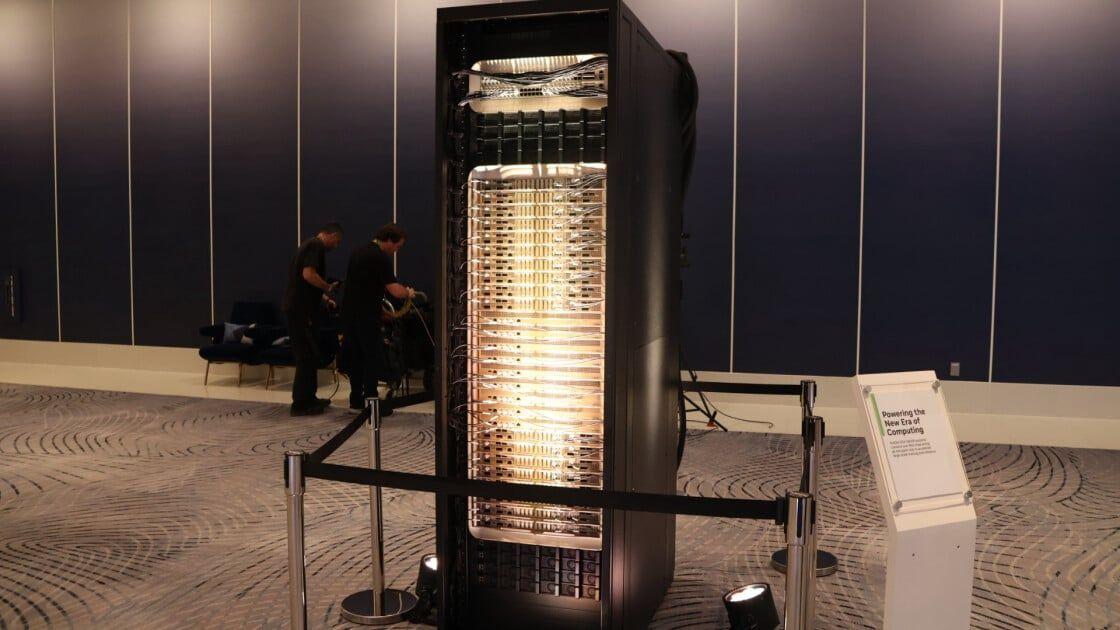
- Two NVIDIA GB200 NVL72 rack-scale systems
- An NVIDIA HGX B300 system built on the NVIDIA Blackwell Ultra platform
- NVIDIA Quantum InfiniBand networking for interconnection
1
Additionally, NCHC plans to deploy NVIDIA DGX Spark personal AI supercomputers and a cluster of NVIDIA HGX systems in the cloud
1
. This powerful configuration is designed to support a wide range of research initiatives, from AI development to climate science and quantum computing.Advancing Sovereign AI and Language Models
A key focus of the new supercomputer will be supporting Taiwan AI RAP, a generative AI application development platform. This initiative aims to create customized AI models that reflect local cultural and linguistic nuances
1
5
. The Trustworthy AI Dialogue Engine (TAIDE), a public sector project, is developing Taiwanese large language models for various applications, including:- Natural language processing
- Intelligent customer service
- Translation
These models are already being used in education, healthcare, and epidemic prevention, demonstrating the practical applications of sovereign AI technology
5
.Climate Research and Earth-2 Platform
The supercomputer will significantly enhance climate research capabilities. NCHC researchers are utilizing NVIDIA's Earth-2 platform to advance atmospheric science, employing models such as:
- CorrDiff AI for improving coarse-resolution weather models
- DeepMind's GraphCast for global weather forecasting
- FourCastNet for predicting global atmospheric dynamics
1
5
The increased computational power will enable more complex simulations and accelerate AI training and inference in climate science.
Quantum Computing Advancements
NCHC is making strides in quantum research using NVIDIA's CUDA-Q platform and cuQuantum library. Notable developments include:
- Quantum Molecular Generator: A tool for generating valid chemical molecules
- cuTN-QSVM: An open-source tool for accelerating large-scale quantum circuit simulations
1
Researchers recently achieved a record-breaking 784-qubit simulation for a quantum machine learning algorithm, showcasing the potential of this technology
5
.Related Stories

Global Context and Collaboration
Taiwan's supercomputing advancements are part of a broader global trend in quantum research. In Japan, the ABCI-Q supercomputer, featuring 2,020 NVIDIA H100 GPUs, has been established as the world's largest research supercomputer dedicated to quantum computing
3
4
.These developments highlight the growing importance of integrating quantum hardware with AI supercomputing to tackle complex challenges in healthcare, energy, and finance
3
.Impact on Taiwan's Technological Landscape
The new supercomputer is expected to empower Taiwan's technological autonomy and foster cross-domain collaboration. Researchers from academic institutions, government agencies, and small businesses will have access to this cutting-edge system, potentially accelerating innovation across various sectors
1
5
.As Chau-Lyan Chang, director general of NCHC, stated, "The new NCHC supercomputer will drive breakthroughs in sovereign AI, quantum computing and advanced scientific computation"
5
, underlining the transformative potential of this technology for Taiwan's research landscape.References
Summarized by

Navi
[4]
Related Stories
Nvidia Launches Accelerated Quantum Research Center to Advance AI-Quantum Integration
19 Mar 2025•Technology
Nvidia and Google Quantum AI Collaborate to Accelerate Quantum Computing Development
19 Nov 2024•Technology

Nvidia releases Ising open AI models to solve quantum computing's biggest bottlenecks
14 Apr 2026•Technology
Recent Highlights



Recent Highlights
Today's Top Stories









Don’t drown in AI news. We cut through the noise - filtering, ranking and summarizing the most important AI news, breakthroughs and research daily. Follow topics that matter to you and stay ahead.


