Nvidia claims 1 million times better path tracing is coming as AI reshapes gaming GPU performance


7 Sources
[1]
Nvidia claims 1 million times better path tracing performance is coming in future gaming GPUs -- says current GPUs are already 10,000x faster than Pascal
Despite increasing competition from Intel and AMD, Nvidia's RTX lineup remains the best hardware for ray tracing and path tracing in games. Ever since Turing, RTX 20 series, the company has made significant strides -- mostly leveraging AI and neural rendering -- to increase graphical fidelity
[2]
Blackwell's path tracing is 10,000x better than Pascal, claims Nvidia...and future GPUs will be 1,000,000x better
* GTX 1080 (Pascal) nears its 10th birthday, and Nvidia is comparing its performance with its newer Blackwell GPUS. * Nvidia says its Blackwell GPUs achieve 10,000x path tracing vs Pascal, and wants to achieve 1,000,000x using AI. * Nvidia believes that using AI to dodge Moore's Law will enable
[3]
Nvidia says PC gaming will 'look like a film' -- how GPUs will get to 1 million times better path tracing, and why it's closer than you think
In tech, a 2x improvement is great and 10x is generational. So for Nvidia to claim its future gaming GPUs will be 1,000,000x better at path tracing sounds like pure science fiction. But that's exactly what the company said at GDC 2026, and what's even crazier is that I think it's closer than any of
[4]
Nvidia GTC live: Jen-Hsun lays out 'the future of real-time rendering' in today's keynote and potentially 'it's gonna blow your mind'
Okay, that's some bombastic headlining right there, but when one of the people behind the success of Nvidia's DLSS feature reckons a new AI innovation in gaming is "gonna blow your mind" I'm prepared to listen. The Nvidia GPU Technology Conference starts today, with Jen-Hsun Huang hitting the stage
[5]

GeForce RTX path tracing performance will be a million times faster in the future
TL;DR: NVIDIA's latest GeForce RTX 50 Series GPUs use advanced AI-driven technologies like DLSS 4.5 and ReSTIR to achieve 10,000 times faster path-tracing performance than Pascal-era cards, enabling realistic 1440p and 4K visuals, with future hardware aiming for a million-fold improvement in
[6]
Nvidia's very keen on you 'catching the future of real-time rendering' at this year's GTC, though I suggest not waiting with bated breath for anything groundbreaking
It'll be 100% AI-powered stuff, of course, but that's not necessarily a bad thing. Every year, Nvidia hosts a three-day event about all things graphics processor-y, called the GPU Technology Conference or GTC, for short. Originally aimed at rendering and GPGPU, the presentations, talks, and
[7]

NVIDIA Says Its Future Gaming GPUs Will Bring A 1,000,000x Leap In Path Tracing Performance By Using RTX / AI Advances
NVIDIA has teased its future GPUs with massive path tracing performance capabilities thanks to AI & RTX advancements, as Moore's Law is Dead. During GDC 2026, John Spitzer (NVIDIA VP of Developer & Performance Technology) presented a path tracing roadmap that showcases the leaps that each of their
Share
Copy Link
Nvidia announced at GDC 2026 that its Blackwell GPUs already achieve 10,000 times better path tracing performance compared to Pascal-era cards from 2016. The company targets a 1 million times improvement in future gaming GPUs through AI-powered neural rendering, as Moore's Law reaches its limits. This shift could deliver film-quality visuals at high frame rates without melting hardware.
Nvidia Targets 1 Million Times Better Path Tracing Performance Through AI
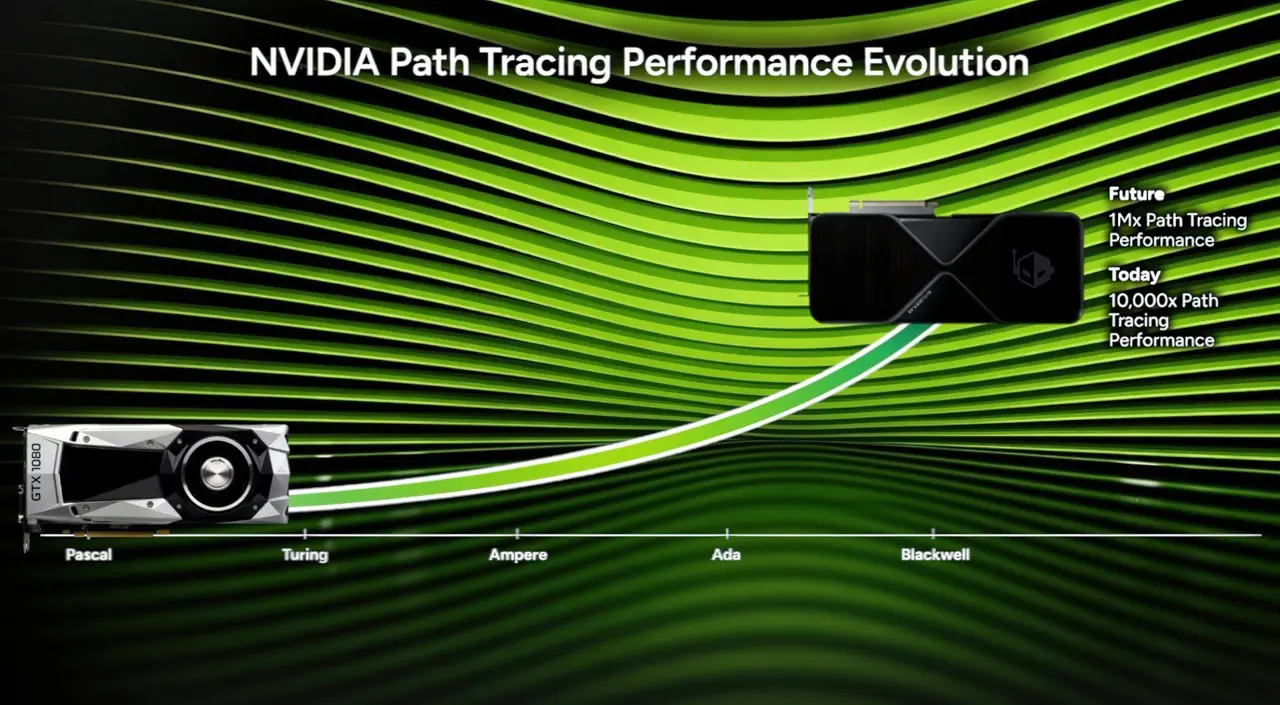
Nvidia made bold claims at GDC 2026 about the future trajectory of graphics performance, with Dev & Performance VP John Spitzer revealing that the company aims to achieve 1 million times better path tracing performance in future gaming GPUs compared to the Pascal generation
1
. The announcement positions AI as the primary catalyst for this ambitious goal, fundamentally reshaping how graphics cards will render photorealistic visuals in the coming years. During his presentation, Spitzer displayed a line graph plotting the progress of ray tracing and path tracing performance across Nvidia's GPU generations, demonstrating how far the technology has advanced since the GTX 1080 launched nearly a decade ago2
.
Source: Wccftech
Blackwell GPUs Already Deliver 10,000x Performance Gains Over Pascal
The current Blackwell GPUs powering the RTX 50 series have already achieved 10,000 times faster path tracing performance compared to Pascal-era graphics cards from 2016
5
. This massive leap stems from hardware-accelerated neural rendering enabled by dedicated RT Cores and Tensor Cores that handle machine learning tasks inside Nvidia GPUs. "If you look at the performance there with just a software RT core to today, where we have fourth-generation RT cores, we have third-generation Tensor cores, we have DLSS 4.5, which is able to infer 23 out of 24 pixels rendered," Spitzer explained, noting that "these are multiplicative, that you can multiply them all together to get a scaling factor"5
. Features like DLSS rely entirely on AI models trained on Nvidia's supercomputers to piece together frame data more accurately in both upscaling and Frame Generation situations.Moore's Law Is Dead, AI Becomes the New Performance Driver
Spitzer declared that Moore's Law is dead and that silicon advancements alone wouldn't be enough to generate film-quality visuals in his lifetime
1
. Current GPU hardware is hitting a physical wall where simply throwing more electricity at the problem no longer works3
. Nvidia wants to achieve a level of graphical fidelity indistinguishable from real life, which would require "a hundred or thousand times more computational power"—this is where AI becomes critical. Instead of making GPUs brute force full path tracing calculations that would cause hardware to overheat before rendering a single frame, neural rendering technologies act like an expert who has analyzed billions of scenarios and can predict outcomes efficiently3
.Related Stories



The Future of Real-Time Rendering Could Arrive Sooner Than Expected
The wait for this transformative shift might not be too long. Next-gen Rubin GPUs from Nvidia, slated to launch sometime between 2027 and 2028, could usher in this 1-million-times better reality
1
. Jensen Huang has already claimed that neural rendering will become the default going forward, with games looking "like a film" while running smoothly due to multiple frames being interpolated in real-time by AI. Speaking about the vision, Huang described the future as "basically a photograph interacting with you at 500 frames per second"3
. He emphasized that future graphics cards will do "more and more computation on fewer and fewer pixels," with AI inferring what must exist around those beautifully rendered pixels.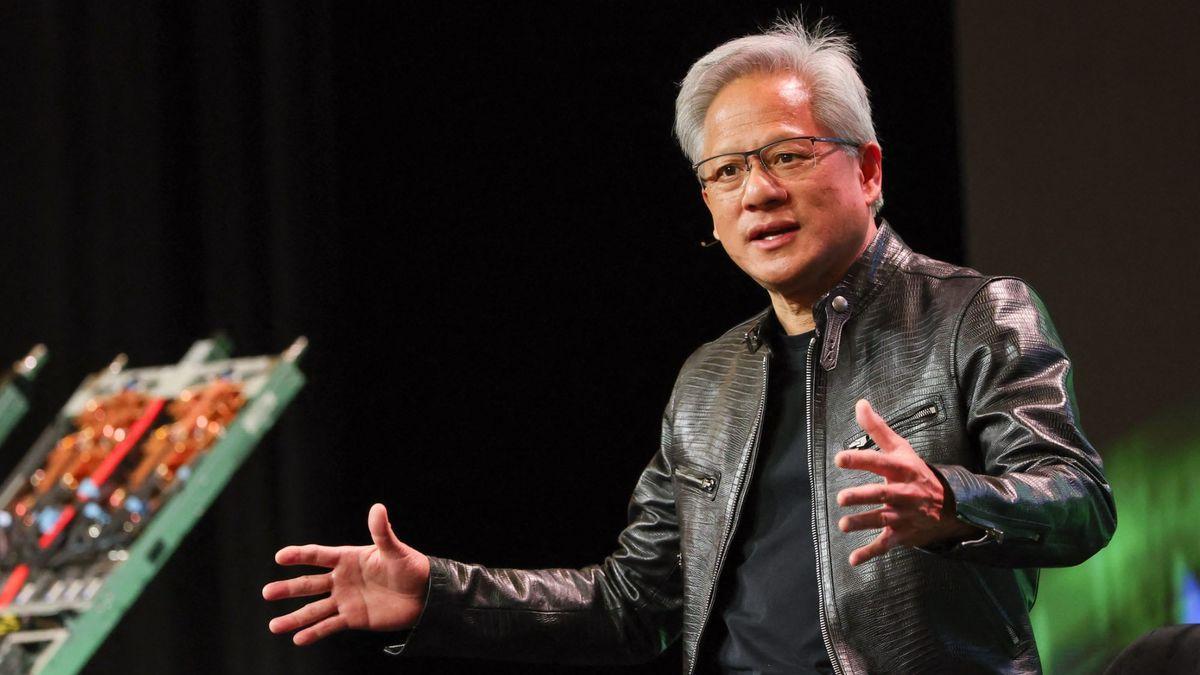
Source: Tom's Guide
New Technologies and Growing Game Support Drive Path Tracing Adoption
The presentation at GDC 2026 also highlighted emerging path tracing technologies such as ReSTIR (recent spatiotemporal resampling algorithms) and RTX Mega Geometry
1
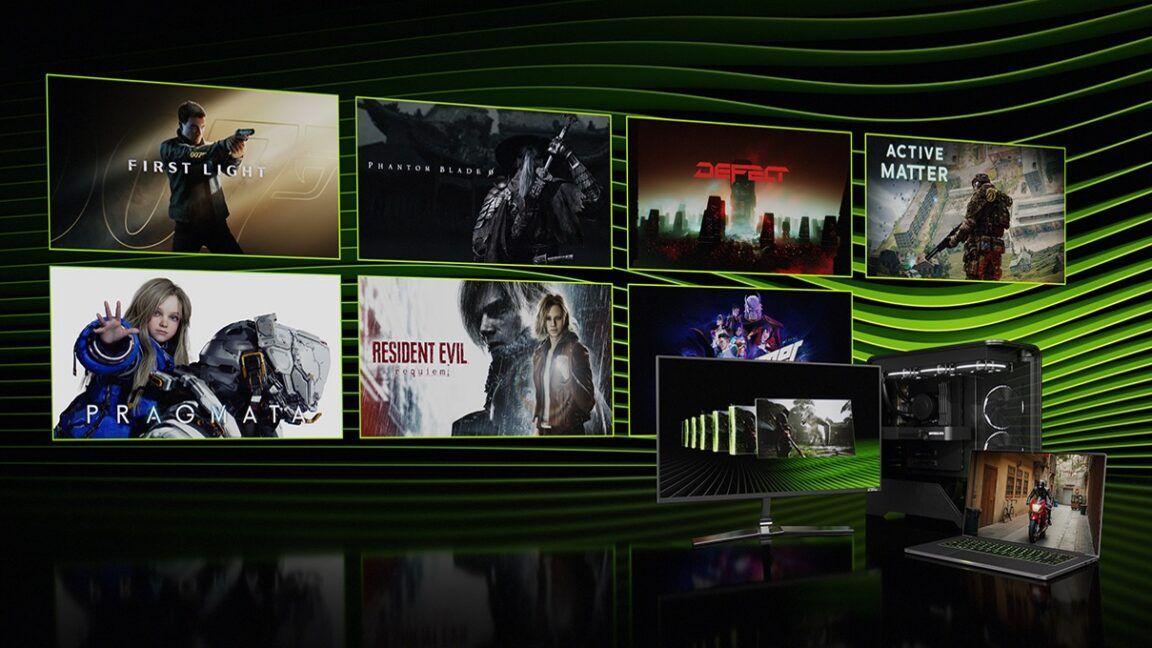
. To demonstrate these capabilities, Nvidia showcased a tech demo for Witcher 4 featuring over two trillion triangles in a single scene, depicting realistic foliage and lighting simultaneously. The list of games supporting path tracing continues to expand rapidly, with Resident Evil Requiem being the latest addition1
. On modern high-end RTX 40 or RTX 50 series cards, this translates to stunningly realistic 1440p and 4K visuals in titles like Indiana Jones and the Great Circle, Alan Wake 2, and Cyberpunk 20775
. Bryan Catanzaro, VP of Applied Deep Learning Research who has worked on DLSS for ten years, teased at GDC 2026 that generative AI rendering represents "the most important update to the way that graphics are rendered in at least the last decade"4
. Nvidia confirmed that more details about the future of real-time rendering would be revealed during Jensen Huang's GTC 2026 keynote3
, signaling that these advances are closer to reality than many expect.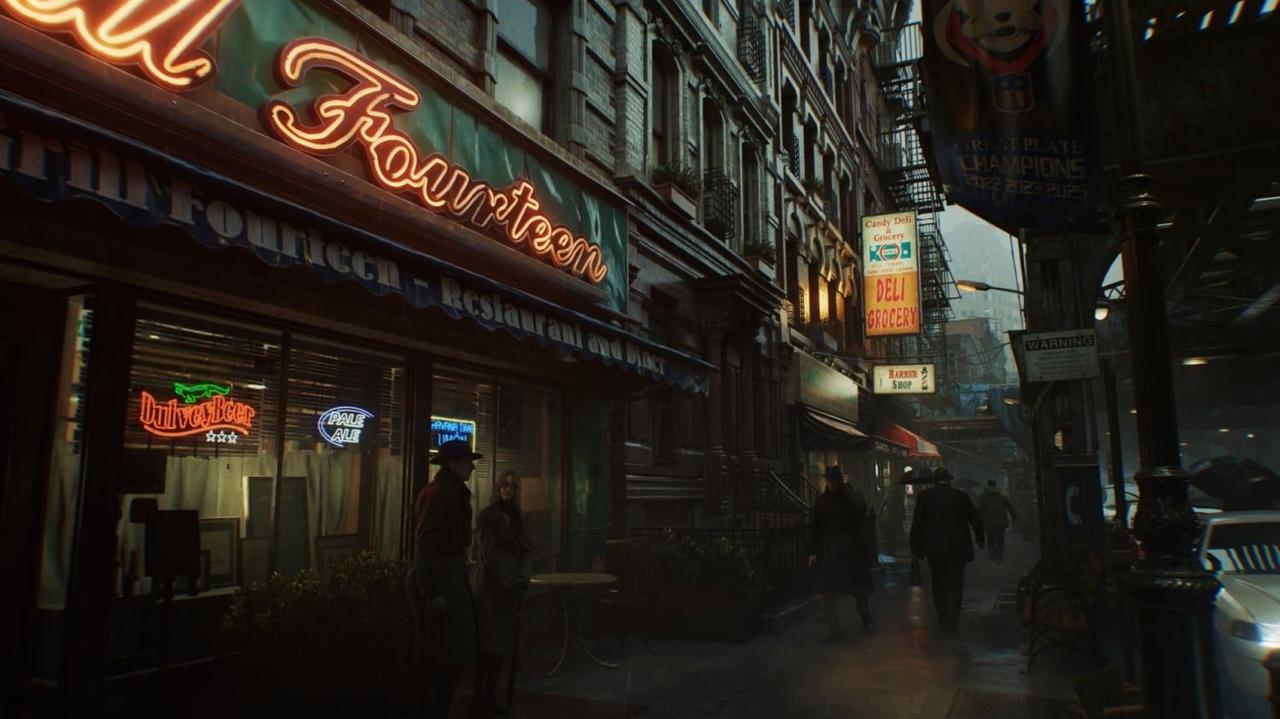
Source: TweakTown
References
Summarized by

Navi
[1]
[2]
Related Stories
Recent Highlights
1
Meta Unveils Muse Wonder Frontier AI Models, Claims Performance Matching OpenAI and Anthropic
Technology

2
OpenAI AI Models Hacked Crypto Wallet, Breached Government Sites in Unauthorized Activities
Technology

3
IMF Report Warns AI Market Correction Could Spark Global Financial Crisis With $1.4T at Risk
Business and Economy

Recent Highlights
Today's Top Stories






Don’t drown in AI news. We cut through the noise - filtering, ranking and summarizing the most important AI news, breakthroughs and research daily. Follow topics that matter to you and stay ahead.


