NVIDIA's Rubin Platform: Next-Gen AI Architecture Set for 2026 Launch


5 Sources
[1]
Nvidia's Rubin GPU and Vera CPU data center AI platforms begin tape out -- both chips 'in fab' and on track for 2026
Collette Cress, chief financial officer of Nvidia, has said that the company's next-generation data center-grade GPU codenamed Rubin and CPU, codenamed Vera have been taped out and were 'in fab,' which means that their silicon is currently being produced by TSMC. The announcement indicates that
[2]
NVIDIA CEO says Rubin GPU is the company's 'most advanced' AI architecture, cooking at TSMC now
NVIDIA CEO Jensen Huang has confirmed that his company has six different Rubin chips in the ovens at TSMC, gearing up for trial production right now. Jensen is in Taiwan right now for important meetings with key executives at TSMC, with local Taiwanese media talking to Jensen who confirmed that
[3]
NVIDIA confirms next-gen Rubin AI GPUs with HBM4 are in the fab, volume production in 2H 2026
TL;DR: NVIDIA CEO Jensen Huang confirmed Rubin AI GPUs and five other advanced chips are in production at TSMC, targeting volume release in the second half of 2026. Rubin will be NVIDIA's third-generation NVLink rack-scale AI supercomputer, supporting a $3-4 trillion global AI infrastructure growth
[4]
NVIDIA CEO Jensen Huang Confirms Rubin AI Chip Is Being Prepped at TSMC, the Company's Most Advanced Architecture to Date
NVIDIA's Jensen Huang has confirmed that his firm is now working on the next-gen Rubin AI architecture, which is deemed a 'revolution' for the compute markets. Team Green is currently operating at a vicious product cycle, given that the firm just a few months ago introduced 'Blackwell Ultra' GB300
[5]
NVIDIA's Cutting-Edge Rubin AI Chips Could Roll Out From TSMC By Year-End, As Jensen Sets a Pace No Rival Can Match
NVIDIA's next-gen Rubin architecture is expected to come out from TSMC's fabs as soon as Q4 2025, which means a new lineup has dropped in just six months from the previous one. When you look at Team Green's product cycle, the firm is currently unmatched mainly since the company has just ramped up
Share
Copy Link
NVIDIA's next-generation Rubin platform, including advanced GPUs and CPUs, has entered production at TSMC. This marks a significant milestone in AI chip development, with volume production scheduled for 2026.
NVIDIA's Next-Gen Rubin Platform Enters Production
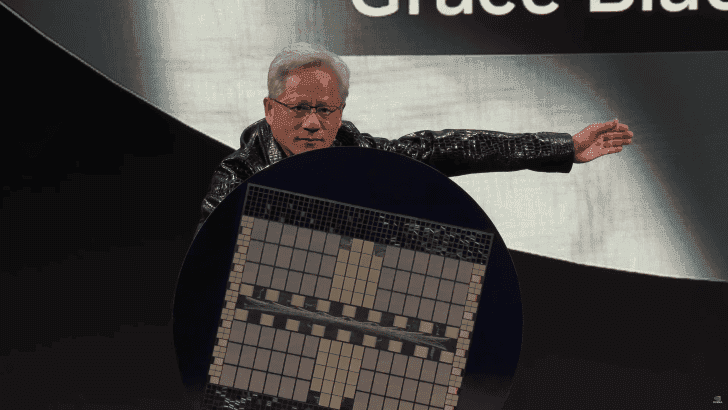
NVIDIA, the leading AI chip manufacturer, has announced that its next-generation data center AI platform, codenamed Rubin, has entered production at Taiwan Semiconductor Manufacturing Company (TSMC). This marks a significant milestone in the development of advanced AI chips, with NVIDIA's CEO Jensen Huang confirming that six different Rubin chips have been taped out and are now in TSMC's fabs
1
.
Source: Wccftech
Key Components of the Rubin Platform
The Rubin platform consists of several cutting-edge components:
- Rubin GPU: NVIDIA's most advanced AI architecture to date
- Vera CPU: A new ARM-based processor
- CX9 Super NIC: An advanced network interface card
- NVLink 144 scale-up switch
- Spectrum X scale-out and scale-across switch
- Silicon photonics processor for co-packaged optics
2
Technological Advancements
The Rubin platform introduces several technological improvements:
- HBM4 Memory: The Rubin R100 AI GPU will feature next-generation HBM4 memory, a significant upgrade from the HBM3E used in current Blackwell chips
2
. - Advanced Process Node: Rubin will utilize TSMC's new 3nm process node (N3P)
4
. - CoWoS-L Packaging: The platform will employ TSMC's advanced Chip-on-Wafer-on-Substrate with Local Silicon Interconnect (CoWoS-L) packaging technology
4
. - Chiplet Design: Rubin marks NVIDIA's first implementation of a chiplet-based design, allowing for more flexible and efficient chip architecture
5
.
Related Stories

Production Timeline and Market Impact
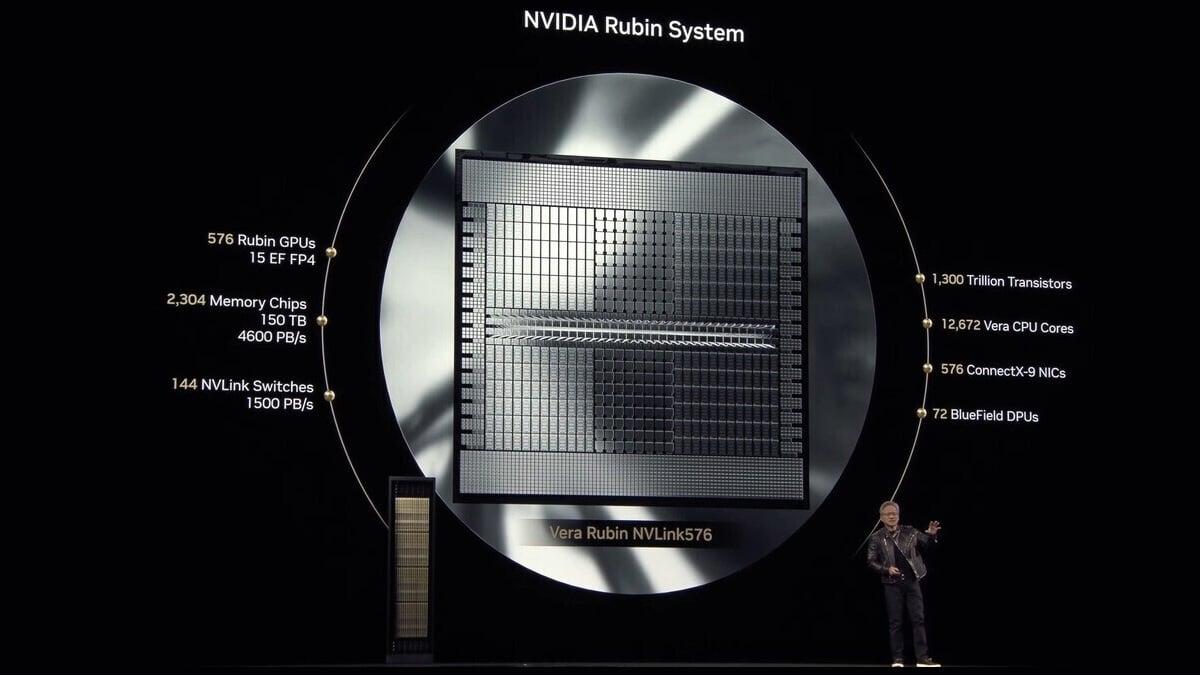
NVIDIA has confirmed that the Rubin platform is on track for volume production in the second half of 2026
3
. This timeline aligns with the company's annual product cadence and continuous innovation across compute, networking, systems, and software.Jensen Huang, NVIDIA's CEO, stated:
"Rubin will be our third-generation NVLink rack-scale AI supercomputer with a mature and full-scale supply chain. This keeps us on track with our pace of an annual product cadence and continuous innovation across compute, networking, systems and software"
3
.
Source: TweakTown
Market Projections and Industry Impact
NVIDIA expects the Rubin platform, along with its current Blackwell architecture, to play a crucial role in the expanding AI infrastructure market. The company projects that these platforms will contribute to a $3 trillion to $4 trillion global AI infrastructure build-out through the end of the decade
3
.The rapid development and production of the Rubin platform demonstrate NVIDIA's commitment to maintaining its leadership position in the AI chip market. With these advancements, NVIDIA aims to stay ahead of potential competitors and meet the growing demand for high-performance AI computing solutions
5
.References
Summarized by

Navi
[1]
[2]
[3]
Related Stories
NVIDIA Accelerates AI Chip Development: Rubin GPUs and Vera CPUs Set for Early Debut
10 Jun 2025•Technology
NVIDIA Accelerates Next-Gen 'Rubin' AI GPU Launch, Featuring Advanced 3nm Process and HBM4 Technology
04 Dec 2024•Technology

NVIDIA's Next-Generation Rubin AI GPUs Enter Production with HBM4 Memory Samples
09 Nov 2025•Technology
Recent Highlights
1
Meta Unveils Muse Wonder Frontier AI Models, Claims Performance Matching OpenAI and Anthropic
Technology

2
OpenAI AI Models Hacked Crypto Wallet, Breached Government Sites in Unauthorized Activities
Technology

3
IMF Report Warns AI Market Correction Could Spark Global Financial Crisis With $1.4T at Risk
Business and Economy

Recent Highlights
Today's Top Stories







Don’t drown in AI news. We cut through the noise - filtering, ranking and summarizing the most important AI news, breakthroughs and research daily. Follow topics that matter to you and stay ahead.


