Nvidia unveils Vera CPU with 88 Arm cores to power next-generation AI infrastructure


12 Sources
[1]
Nvidia updates data center roadmap with Rosa CPU and stacked Feynman GPUs -- optical NVLink, Groq LPUs with NVFP4, and NVLink also on deck
Both quantitative and qualitative improvements over the next several years. Nvidia presented its updated data center product roadmap at its GPU Technology Conference this week, revealing several surprises but mostly reassuring that the company is on track to introduce a brand-new GPU architecture
[2]
Nvidia crams 256 Vera CPUs into a single liquid cooled rack
GTC Intel and AMD take notice. At GTC on Monday, Nvidia unveiled its latest liquid-cooled rack systems. But unlike its NVL72 racks, this one isn't powered by GPUs or even Groq LPUs, but rather 256 of its custom Vera CPUs. The system is designed to support AI training techniques like reinforcement
[3]
Examining Nvidia's 60 exaflop Vera Rubin POD -- how seven chips underpin company's 40 rack AI factory supercomputer
Every chip in the stack has a defined job, from training trillion-parameter models to caching inference tokens on NVMe storage. Nvidia announced seven chips in full production at GTC 2026 on Monday, composing the Vera Rubin platform that the company intends to ship in the second half of this
[4]
Nvidia unveils Vera, an 88-core Arm CPU for AI and analytics racks
Serving tech enthusiasts for over 25 years. TechSpot means tech analysis and advice you can trust. Forward-looking: Nvidia used its GTC 2026 developer conference in San Jose to unveil new details about its Vera data center CPU line, highlighting an 88-core Arm-based design and a dense rack
[5]
Nvidia unveils AI infrastructure spanning chips to space computing
The company says the new processor and rack-scale architecture are built to handle the rapid growth of AI workloads, where software agents increasingly plan tasks, execute code and interact with other systems autonomously. The Vera CPU is designed specifically for these emerging workloads.
[6]
Nvidia demonstrates Rubin Ultra tray, the world's first AI GPU with 1TB of HBM4E memory -- new chips will slot into Kyber racks
Nvidia on Monday demonstrated its next-generation tray for its data center GPU known as Rubin Ultra, which is due to arrive sometime in 2027. The Rubin Ultra features four compute chiplets and features 1TB of HBM4E memory, making it the industry's first AI accelerator equipped with a terabyte of
[7]

NVIDIA Launches Vera CPU, Purpose-Built for Agentic AI
GTC -- NVIDIA today launched the NVIDIA Vera CPU, the world's first processor purpose-built for the age of agentic AI and reinforcement learning -- delivering results with twice the efficiency and 50% faster than traditional rack-scale CPUs. As reasoning and agentic AI advances, scale, performance
[8]
Nvidia unveils details of new 88-core Vera CPUs positioned to compete with AMD and Intel - new Vera CPU rack features 256 liquid-cooled chips that deliver up to a 6X gain in CPU throughput
Nvidia announced more details about its new 88-core Vera data center CPUs at GTC 2026 here in San Jose, California, claiming impressive 50% performance gains over standard CPUs, fueled by a 1.5X increase in IPC from its Olympus cores and an innovative high-bandwidth design that Nvidia says delivers
[9]

Nvidia's new Vera CPU has been designed for 'extremely high' single-core performance, but it's not coming to the PC for now
Dare we hope that those Olympus cores turn up in a future PC chip? What with all the controversy surrounding Nvidia's new DLSS 5 tech, the company's new Vera CPU has gone somewhat unnoticed among the more meme-worthy announcements at the GTC event. But the Vera chip -- or perhaps more specifically
[10]

Nvidia reinvents the CPU for the age of agentic AI - SiliconANGLE
For a while, it was thought that generic central processing units had little role to play in the artificial intelligence revolution, but Nvidia Corp. begs to differ. At its GTC 2026 developer conference today, it announced the all-new Vera CPU, said to be the first chip of its kind designed
[11]

NVIDIA updates roadmap, with new details on its next-gen GPU 'Feynman' coming in 2028
TL;DR: NVIDIA's updated data center roadmap reveals the Vera Rubin architecture launching this year, followed by Rubin Ultra in 2027 with enhanced memory and cooling. In 2028, the Feynman GPU will introduce advanced 3D stacking, custom HBM memory, and new components, advancing AI infrastructure and
[12]
NVIDIA unveils Vera Rubin at GTC 2026, the brain behind the next era AI
TL;DR: NVIDIA's Vera Rubin AI platform, unveiled by CEO Jensen Huang, integrates seven chips and six racks to optimize AI inference and agent-based workloads. Featuring the Vera CPU and Rubin GPU with 288GB HBM4 memory and 50 PFLOPS performance, it aims to reduce inference costs by up to 10x and
Share
Copy Link
Nvidia introduced its Vera CPU at GTC 2026, featuring 88 custom Olympus Arm cores designed for agentic AI workloads. The processor delivers 1.2 TB/s memory bandwidth and 50% higher performance than standard CPUs. Nvidia now offers liquid cooled rack systems with 256 Vera CPUs, competing directly against Intel and AMD in the data center CPU market for the first time.
Nvidia Positions Vera CPU as Core Component of AI Infrastructure
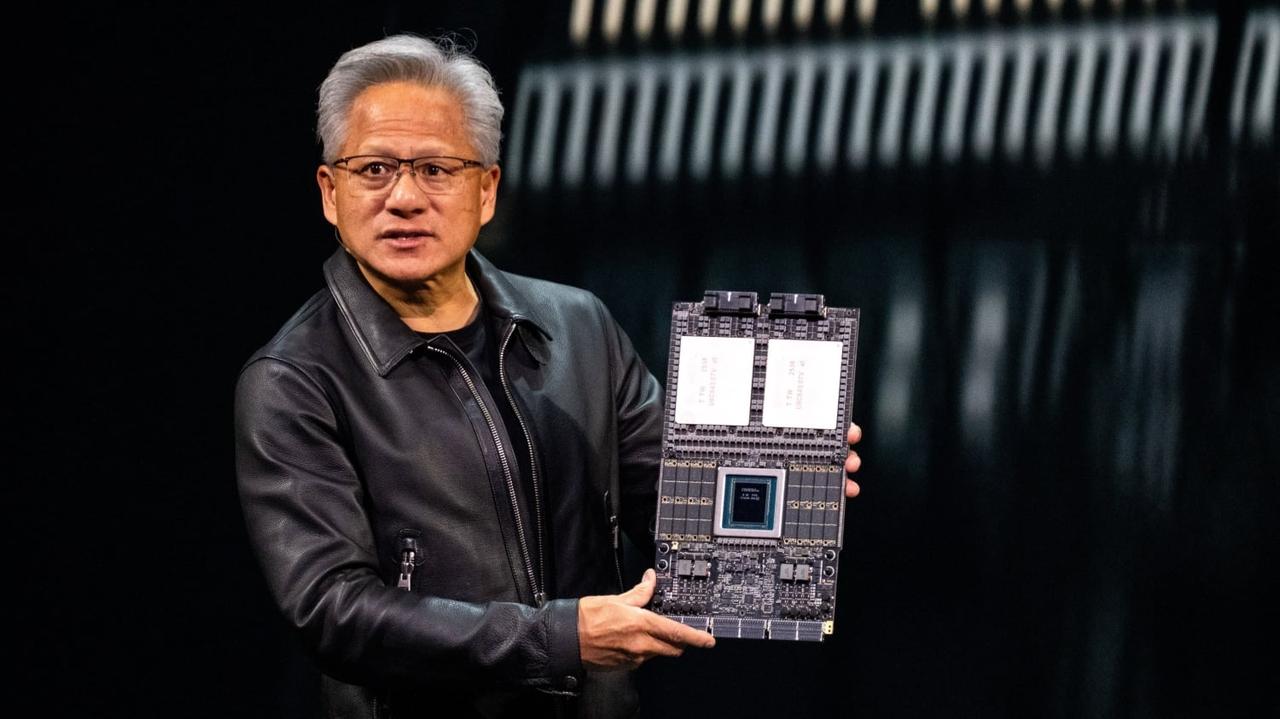
Nvidia unveiled its Vera CPU at the GPU Technology Conference (GTC) 2026, marking a strategic shift in how the company approaches AI infrastructure
1
. The processor features 88 custom Olympus Arm cores built on Arm v9.2-A architecture, representing a significant upgrade from the 72 Arm Neoverse cores found in Nvidia's previous Grace processor4
. Unlike Grace, which primarily served as a companion to GPUs, the Vera CPU is positioned as a general-purpose data center CPU designed to compete directly with offerings from Intel and AMD2
.
Source: TweakTown
"Vera is arriving at a turning point for AI. As intelligence becomes agentic -- capable of reasoning and acting -- the importance of the systems orchestrating that work is elevated," said Jensen Huang, founder and CEO of Nvidia
5
. The chip addresses a critical need in modern AI workloads where agents must execute code, perform SQL queries, and handle tool calling—tasks that cannot run on GPUs alone2
.Technical Architecture Delivers Breakthrough Memory Bandwidth
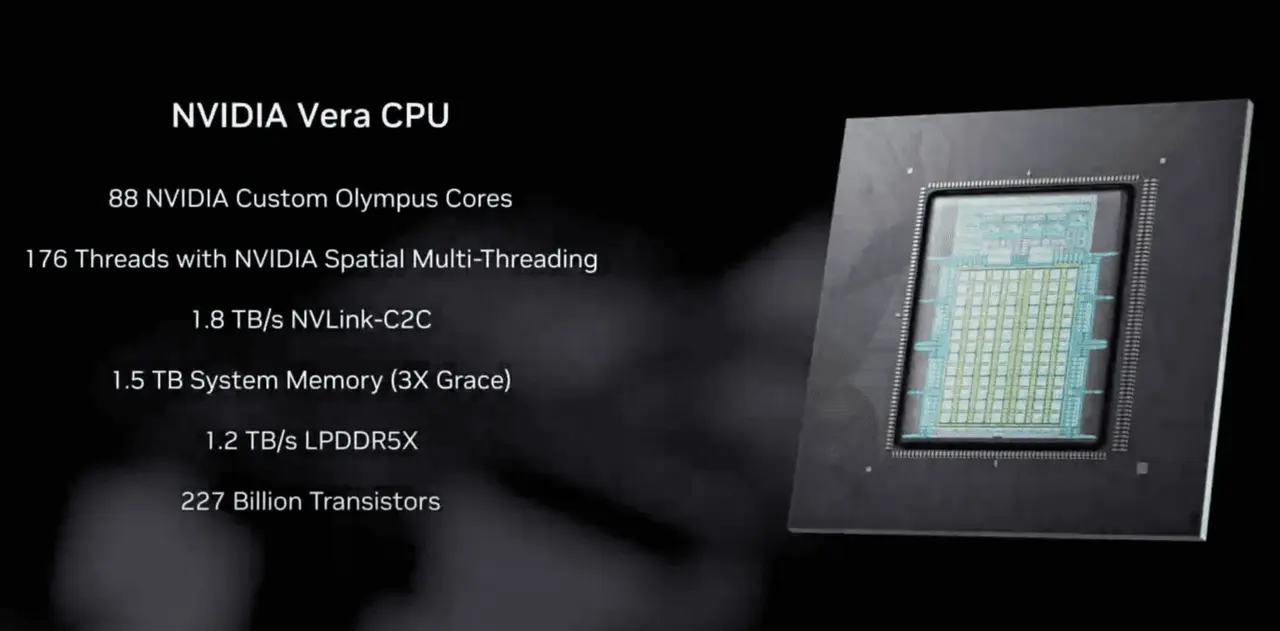
The Vera CPU introduces several architectural innovations that differentiate it from traditional server processors. Each chip delivers 1.2 TB/s of memory bandwidth through support for up to 1.5 TB of SOCAMM LPDDR5X memory
2
. This represents approximately 13.6 GB/s per core under full load, with the fabric capable of delivering up to 80 GB/s per core when other cores are not fully saturated4
. Nvidia claims this provides 3x more memory bandwidth compared to contemporary x86 processors from Intel and AMD2
.
Source: SiliconANGLE
The Olympus Arm cores feature a distinctive spatial multi-threading design that physically partitions execution units, caches, and register files between two hardware threads
4
. This approach enables 176 threads to run concurrently without time-slicing shared resources, delivering more predictable performance in multi-tenant environments. The core complex operates as a single coherent domain using Nvidia's Scalable Coherency Fabric, avoiding the NUMA topology challenges common in high-core-count x86 designs4
.The execution pipeline includes a 10-wide instruction decode block and a neural branch predictor capable of handling two branch predictions per cycle
2
. Nvidia has also integrated a PyTorch-optimized instruction buffer and custom prefetch engine designed for graph analytics, targeting the irregular control-flow patterns common in AI frameworks and data analytics workloads4
.Liquid Cooled Rack System Enables Massive AI Deployments
Nvidia introduced a high-density liquid cooled rack system that packs 256 Vera CPUs alongside 64 BlueField-4 data processing units
2
. This rack-scale architecture delivers more than 22,500 CPU cores and 400 TB of memory, providing approximately 300 TB/s of aggregate memory bandwidth4
. The system is designed specifically for agentic AI frameworks, reinforcement learning, and AI training techniques that require substantial CPU resources2
.Ian Buck, VP of Hyperscale and HPC at Nvidia, explained that agents require CPUs for critical tasks: "Agents don't operate on GPUs alone. They need CPUs in order to do their work, whether we're training agentic models or serving them, GPUs today actually call out to CPUs in order to do the tool calling, SQL queries and the compilation of code"
2
. This sandbox execution capability is essential for both training and deploying agents across data centers.The Vera CPU will be available in both single- and dual-socket configurations from ODM and OEM partners including Foxconn, Wistron, Dell Tech, Lenovo, and HPE
2
. Nvidia's NVL8 HGX systems, which traditionally used x86 processors from Intel, will now offer Vera CPU configurations for the Rubin generation2
.Related Stories

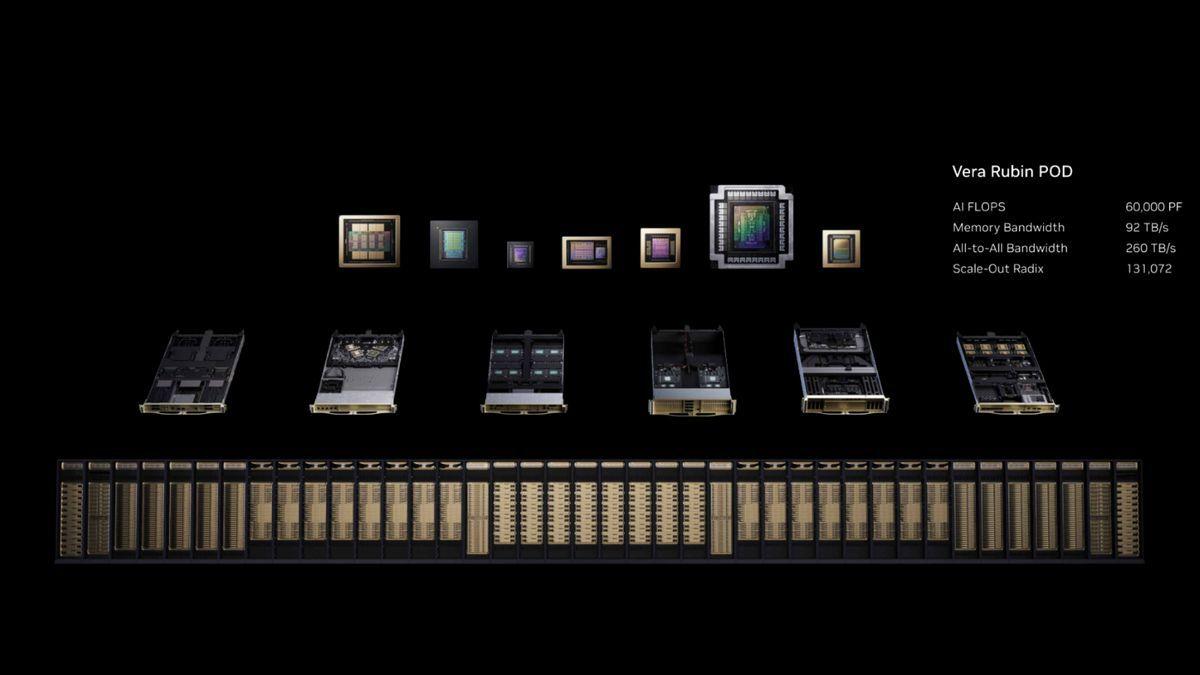
Vera Rubin Platform Integrates Seven Chips for Complete AI Factory
The Vera CPU forms a critical component of Nvidia's broader Vera Rubin platform, which integrates seven chips designed to operate as a single co-designed system
3
. The platform includes the Rubin GPU built on TSMC's 3nm process with 288 GB of HBM4 memory, the Groq 3 LPU for low-latency inference, NVLink 6 switches, ConnectX-9 SuperNICs, and Spectrum-6 Ethernet switches3
.
Source: Tom's Hardware
The Vera CPU connects to Rubin GPUs via NVLink-C2C at 1.8 TB/s of coherent bandwidth, which is seven times faster than PCIe Gen 6
3
. This high-speed interconnect enables the CPU to handle orchestration tasks including scheduling workloads, routing KV cache data, managing context, and running the control plane for agentic AI workflows3
. The platform supports confidential computing across both CPU and GPU domains, enabling encrypted execution and isolation that extend into GPU memory and multi-socket nodes4
.Major Cloud Providers Commit to Vera Deployments
When the Vera CPU debuts in the second half of 2026, major cloud and AI infrastructure providers have already committed to deployments. Alibaba, ByteDance, Meta, Oracle, CoreWeave, Lambda, Nebius, and NScale have all announced plans to integrate the chips into their data centers
2
. Meta recently revealed plans to deploy Nvidia's standalone Grace CPUs at scale, suggesting strong demand for Nvidia's CPU offerings beyond GPU-attached configurations2
.Nvidia claims the Vera CPU delivers 1.5x the performance per core compared to standard CPUs and operates with twice the efficiency
5
. For customers, this translates to the ability to run more AI workloads per rack while reducing power consumption—a critical consideration as AI infrastructure scales. The company's roadmap also reveals plans for the Rosa CPU in 2028, which will focus on ultimate single-thread performance and shorten Nvidia's CPU development cycle from four years to two, matching the cadence of AMD and Intel1
. This aggressive development timeline signals Nvidia's commitment to competing in the data center CPU market long-term, potentially reshaping the competitive landscape dominated by x86 architectures for decades.References
Summarized by

Navi
[1]
[2]
[3]
[5]
Related Stories
NVIDIA Unveils Next-Gen AI Powerhouses: Rubin and Rubin Ultra GPUs with Vera CPUs
19 Mar 2025•Technology

NVIDIA Unveils Roadmap for Next-Gen AI GPUs: Blackwell Ultra and Vera Rubin
28 Feb 2025•Technology

Nvidia Unveils Vera Rubin Superchip: Six-Trillion Transistor AI Platform Set for 2026 Production
29 Oct 2025•Technology
Recent Highlights
1
Meta Unveils Muse Wonder Frontier AI Models, Claims Performance Matching OpenAI and Anthropic
Technology

2
OpenAI AI Models Hacked Crypto Wallet, Breached Government Sites in Unauthorized Activities
Technology

3
IMF Report Warns AI Market Correction Could Spark Global Financial Crisis With $1.4T at Risk
Business and Economy

Recent Highlights
Today's Top Stories







Don’t drown in AI news. We cut through the noise - filtering, ranking and summarizing the most important AI news, breakthroughs and research daily. Follow topics that matter to you and stay ahead.


