Nvidia unveils Vera CPU specs and benchmarks, positioning itself to challenge AMD and Intel


14 Sources
[1]
Nvidia Wants to Own Every Chip Inside AI Data Centers
Nvidia's Vera Rubin platform combines CPUs and GPUs into a single system, reflecting the company's growing ambition to power every layer of AI infrastructure. Nvidia is hyping up its new Vera Rubin chip system this week, revealing new performance benchmarks for the GPU and CPU combo ahead of rival
[2]
Nvidia deep dives Vera CPU for AI data centers -- SPEC CPU 2026 benchmarks revealed, Olympus architecture specifics, and more
Nvidia's Vera CPU is its first bid to become a key player in the data center CPU market. Although Grace has seen some success (most notably with Grace standalone deployments at Meta), Vera is Nvidia's first CPU with a custom core design. It's arriving at an ideal time, as well, with the server CPU
[3]
Nvidia has 'shipped hundreds of thousands of Grace standalone servers' -- GPU firm pivots messaging as CPUs take center stage in agentic data centers
Nvidia's Ian Buck, vice president of hyperscale and high-performance computing and the inventor of CUDA, says the company has "shipped... let's put it in the hundreds of thousands of Grace standalone servers." In May, Nvidia disclosed that it had shipped over 2.5 million Grace CPUs in total, and
[4]
Nvidia details its next-generation Vera CPU for AI, setting up challenge to AMD and Intel
Nvidia became the most valuable company because of insatiable demand for its graphics processing unit, or GPU, the primary chip used for creating and deploying artificial intelligence. But the chip giant is now shipping its own central processing units, or CPUs, which cloud providers could decide
[5]
Nvidia reveals Vera CPU details, claims its custom Olympus cores outperform AMD Epyc Turin
Serving tech enthusiasts for over 25 years. TechSpot means tech analysis and advice you can trust. What just happened? Nvidia has released more information about its upcoming Vera data center CPU this week, including key details about the custom Olympus cores that are purpose-built for agentic AI
[6]

NVIDIA Harnesses Vera CPU to Speed Up Design of Next-Generation CPUs and GPUs
The Vera CPU is speeding up next-generation NVIDIA chip designs, and early testing shows up to 1.5x higher performance on key verification and simulation workloads. The complexity of modern chip design continues to grow as engineering teams work to develop increasingly sophisticated CPUs, GPUs and
[7]

Nvidia is putting its Vera CPUs to work alongside AI agents to speed up chip design
Nvidia Corp. says it's now running the chip design software its engineers are using to design the next generation of its graphics processing units, on its own silicon. It's partnering with Cadence Systems Inc. and Synopsys Inc., the two biggest providers of electronic design automation or EDS
[8]

NVIDIA Uses 88-Core Vera CPU to Accelerate Next-Generation CPU and GPU Design
NVIDIA has started using clusters of its own Vera processors to develop future CPUs, GPUs, and AI accelerators. The company says initial electronic design automation testing shows performance improvements of up to 1.5 times in selected verification workloads compared with its existing development
[9]
Nvidia Vera Rubin: Inside the agentic AI factory that rewrites the CPU playbook
On the surface, this week's Vera Rubin launch is another major platform moment for Nvidia Corp., as the company maintains a steady drumbeat of artificial intelligence infrastructure innovation. Nvidia is positioning Vera Rubin as a full-stack system designed to improve performance per watt and
[10]

NVIDIA's Vera CPU Slashes Chip Verification Times at Cadence and Synopsys by 1.5x, Speeding Next-Gen Silicon
NVIDIA accelerates next-gen CPU and GPU chip designs with its Vera CPUs, delivering a 50% boost to improve system-level processes. Cadence & Synopsys Are Leveraging NVIDIA's Vera CPUs To Accelerate Their Chip-Making Processes NVIDIA's CUDA-X libraries & cuLitho software are already enabling
[11]
NVIDIA Aiming To Produce Up To 1000 Racks With Vera Per Day After Shipping "Hundreds of Thousands" of Grace Standalone Servers As It Guns For Dominance In The AI CPU Market
NVIDIA says that it will be able to make 1,000 Vera Rubin Racks per day following the success of its Grace CPUs in AI markets. Vera Will Be A Monumental Success For NVIDIA After Grace As The Firm Races To Build 1,000 Racks Per Day Since its inception, NVIDIA has been known as a GPU maker, but the
[12]
NVIDIA Vera CPU Rolls Over Traditional x86 Chips With An Agentic-AI Focused Design With 6x Faster Performance & 40% Lower Latency
NVIDIA's Vera CPU trounces x86 chips, such as AMD's EPYC, in Agentic AI workloads, delivering a 6x performance gain with 40% lower latency. NVIDIA Vera's Monolithic CPU Design & Architectural Changes Achieve Over 2x Performance Gain Over x86 CPUs Such As AMD EPYC With Just 88 Cores, Beating 128
[13]
NVIDIA Vera CPU Is Architected For The Agentic AI Era, as It Delivers Max Single-Core & Single-Thread Performance Versus x86; Full Architectural Breakdown Shows
The NVIDIA Vera CPU is designed for Reinforcement Learning and Agentic AI systems, offering 88 Olympus cores for max single-core performance. NVIDIA's x86-Killer, Vera CPU, Is Now Available, Built Purely With Agentic AI In Mind Surge in agentic AI workloads and reinforcement learning emerging as
[14]

Nvidia Unveils Vera to Speed Expansion in Server Processor Market
With Vera, Nvidia is betting on an architecture optimized for artificial intelligence applications, particularly autonomous agents that require rapid communication between CPUs and GPUs. The company says its processor delivers up to 50% higher performance than competing x86 chips on these
Share
Copy Link
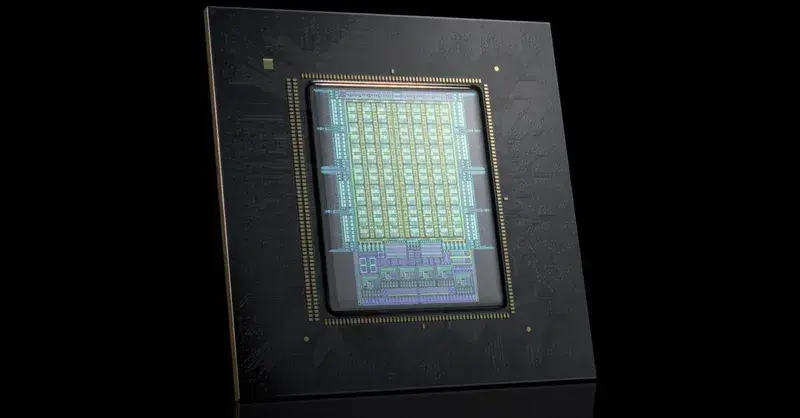
Nvidia released detailed specifications for its Vera CPU, featuring 88 custom Olympus cores designed specifically for agentic AI workloads. The chip is part of the company's Vera Rubin platform and represents its first custom core design for data centers. Early customers including OpenAI, Microsoft, and Oracle are already receiving systems, marking Nvidia's aggressive push into a CPU market traditionally dominated by AMD and Intel.
Nvidia Enters the CPU Battle with Custom Olympus Cores
Nvidia has released comprehensive technical details about its next-generation Vera CPU for AI, marking a significant shift in the company's strategy beyond its GPU dominance
1
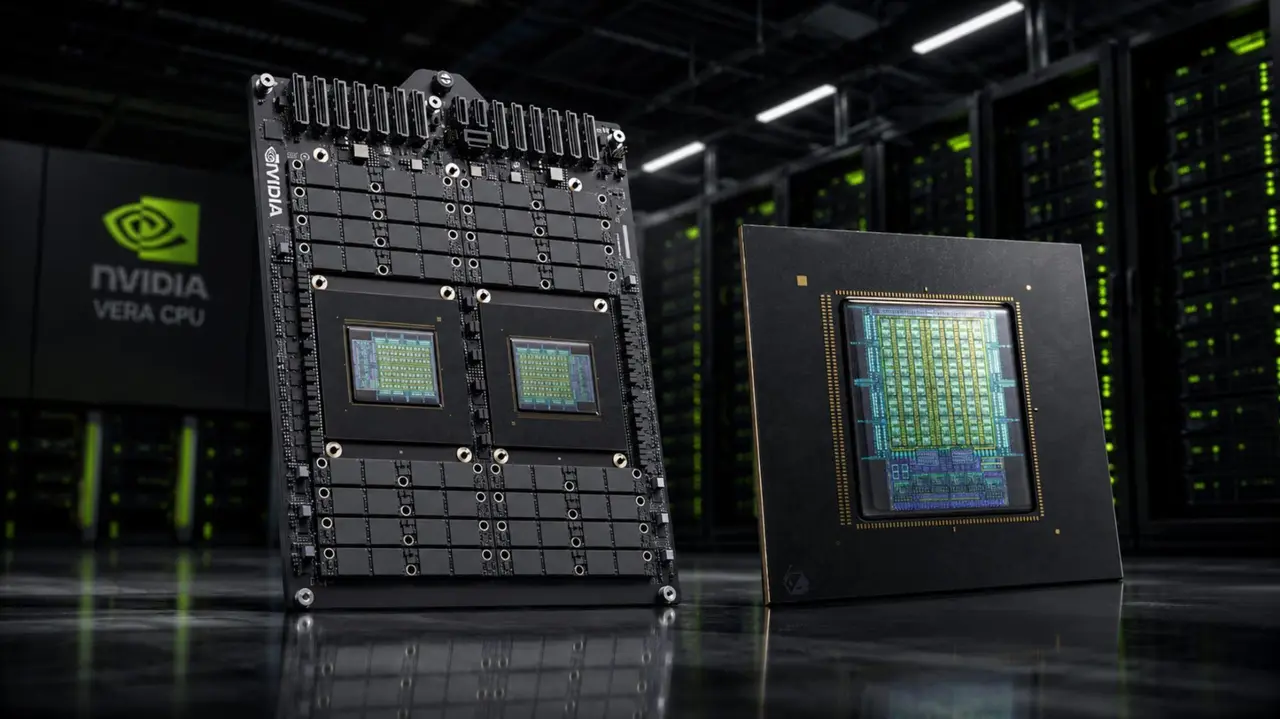
. The Vera CPU features 88 custom Olympus cores built on a monolithic die, distinguishing it from the chiplet-based approaches favored by AMD and Intel2
. Each core incorporates a 64KB four-way L1 instruction cache, 164MB of unified L3 cache, and supports 176 physical threads across the chip5
.
Source: Wccftech
The Olympus architecture integrates several advanced features, including a 10-wide decode engine processing up to ten fused instructions per cycle and a neural branch predictor that reduces wrong-path execution
5
. At the heart of the design lies the Scalable Coherency Fabric, which delivers 3.4 TB/s of core-to-core bandwidth and up to 1.2 TB/s of aggregate LPDDR5X memory bandwidth3
. Ian Buck, Nvidia's vice president of accelerated computing and CUDA architect, emphasized the company's commitment to innovation: "We're on a roadmap to crank out new architectures, not just GPUs but CPUs"1
.Performance Claims Position Vera Against AMD Epyc
Nvidia shared internal SPEC CPU 2026 benchmark results comparing the Vera CPU against AMD Epyc Turin 9755 systems in dual-socket configurations
2
. The data shows Vera achieving a 3% advantage in overall SPECrate integer suite scores despite having fewer threads than the competing AMD Epyc system2
. In specific agentic AI workloads such as code compilation and interpretation tasks, Nvidia claims Vera delivers up to 1.8 times the performance of AMD's Epyc Turin 9755 systems5
.These benchmarks remain unofficial since Vera was tested in reference systems ahead of broad availability, scheduled for the second half of 2026
2
. Nvidia representatives confirmed that Vera chips were delivered to clients including OpenAI, Anthropic, and SpaceX in June4
. During a data center lab tour, Nvidia executives revealed that OpenAI already has one Vera Rubin rack in operation1
.Vera Rubin Platform Targets Complete AI Infrastructure
The Vera CPU forms the centerpiece of Nvidia's Vera Rubin platform, which combines CPUs and GPUs into integrated systems for AI data centers
1
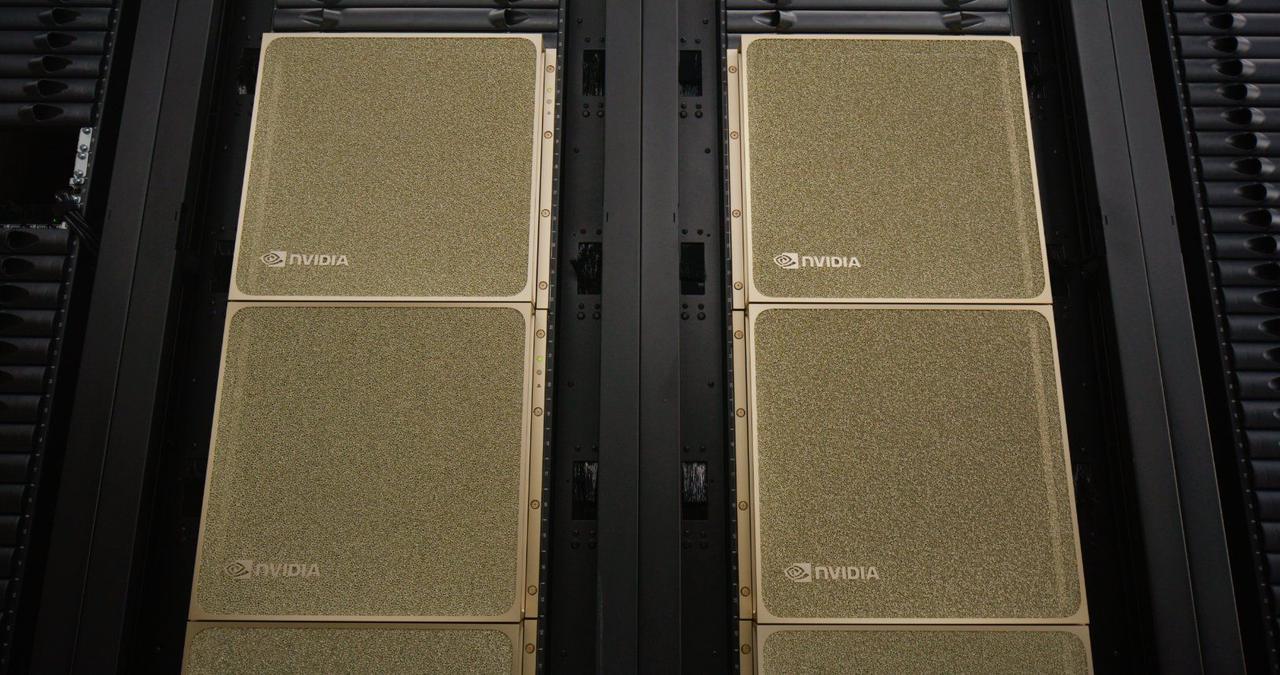
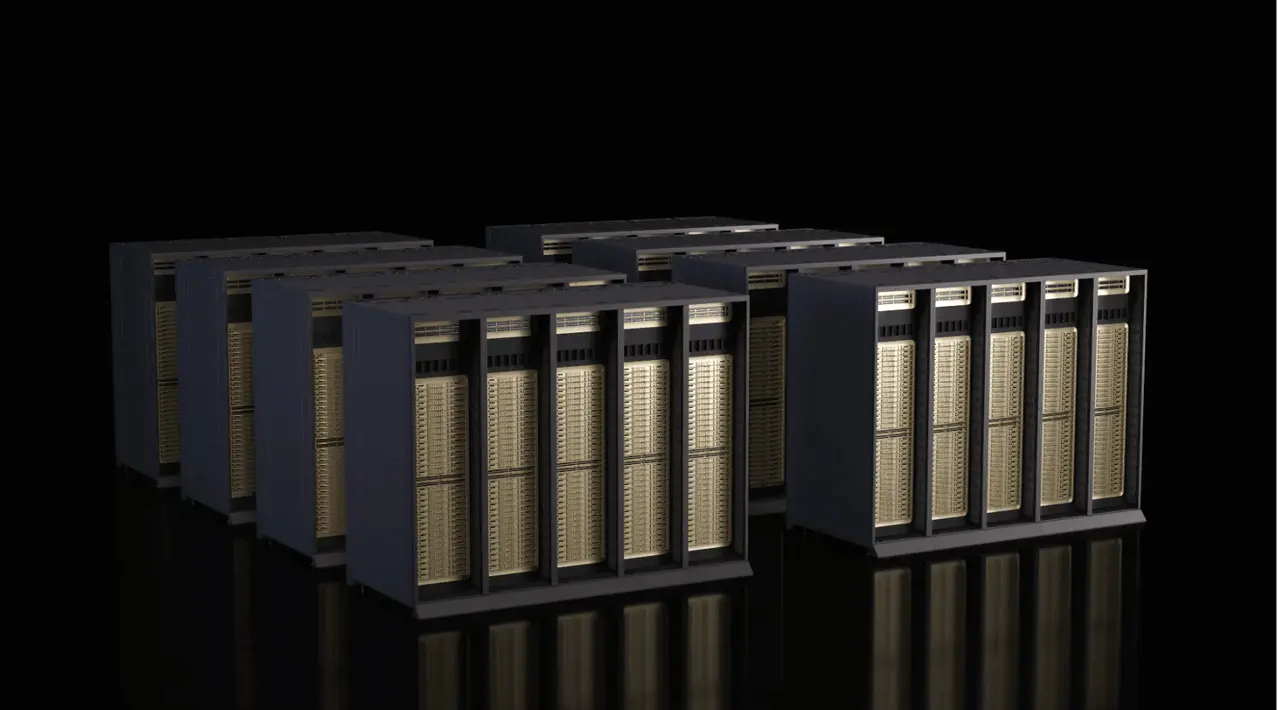
. Each Vera Rubin NVL72 system pairs 36 Vera CPUs with 72 Rubin GPUs in a single liquid-cooled rack containing approximately 1.3 million components3
. The platform processes ten times as many tokens per watt compared to the predecessor Grace Blackwell superchip1
.
Source: Wccftech
Nvidia has significantly reduced cabling requirements in multi-rack configurations, marketing Vera Rubin as "cable-free compute" with hot-swappable capabilities
1
. Installation time per rack theoretically drops from hours to minutes, according to statements from Buck and Andrew Bell, Nvidia's senior vice president of hardware engineering1
. The system uses 100 percent liquid cooling, reducing energy consumption compared to air-cooled alternatives1
. Early customers for the platform include Microsoft, OpenAI, and Oracle1
.Related Stories


Agentic AI Workloads Drive Market Shift
The rise of agentic AI workloads has fundamentally altered hardware requirements in AI data centers, shifting ratios from eight GPUs per CPU to one-to-one configurations in some deployments
3
. CPUs orchestrate data flows, networking, and software tasks for AI agents that run independently with minimal human input4
. This transition has benefited CPU makers, with AMD and Intel stock prices rising 128% and 149% respectively in 2026, compared to Nvidia's 8% gain4
.
Source: SiliconANGLE
Nvidia estimates the data center CPUs market represents a $200 billion total addressable market opportunity, exceeding broader industry forecasts of $120 billion by 2030
3
. Morgan Stanley projected in April that agents could add as much as $60 billion to the AI server market3
. Buck revealed that Nvidia has "shipped hundreds of thousands of Grace standalone servers," building on the company's disclosure of over 2.5 million Grace CPUs shipped by May3
. A partnership with Meta for deploying standalone Grace servers demonstrates demand for Nvidia's CPU offerings beyond integrated GPU systems3
.Strategic Challenge to Established CPU Players
Nvidia's push into data center CPUs represents a direct challenge to AMD and Intel, companies with deep relationships among hyperscalers and cloud providers
4
. The company's vertical integration strategy aims to control more AI chip infrastructure components within complete rack systems rather than selling individual chips4
. Nvidia's marketing push for Vera coincides with AMD's annual conference, where the company revealed details about its competing Helios AI chip rack1
.The monolithic design of Vera contrasts sharply with the chiplet approaches from AMD and Intel, dedicating substantial die area to fabric connectivity rather than maximizing core count
3
. Buck acknowledged the architectural trade-offs: "One of the reasons we don't have 128 cores is because we've dedicated so much of the die area toward the fabric"3
. Nvidia maintains that Vera targets expanding AI infrastructure markets rather than legacy cloud workloads where AMD and Intel remain entrenched3
. The company reportedly told Chinese customers that standalone Vera CPUs could be ready as soon as August1
.References
Summarized by

Navi
[2]
[3]
Related Stories
NVIDIA Vera CPU with Olympus cores delivers unprecedented ARM performance against Intel and AMD
26 May 2026•Technology
Nvidia Vera CPU targets AI agent workloads with focus on single-threaded performance
08 Jul 2026•Technology
NVIDIA Vera CPU Challenges Core Count Race, Prioritizes Single-Threaded Performance for Agentic AI
Today•Technology
Recent Highlights
1
Meta Unveils Muse Wonder Frontier AI Models, Claims Performance Matching OpenAI and Anthropic
Technology

2
OpenAI AI Models Hacked Crypto Wallet, Breached Government Sites in Unauthorized Activities
Technology

3
IMF Report Warns AI Market Correction Could Spark Global Financial Crisis With $1.4T at Risk
Business and Economy

Recent Highlights
Today's Top Stories







Don’t drown in AI news. We cut through the noise - filtering, ranking and summarizing the most important AI news, breakthroughs and research daily. Follow topics that matter to you and stay ahead.


