NVIDIA Vera CPU with Olympus cores delivers unprecedented ARM performance against Intel and AMD


6 Sources
[1]
NVIDIA Vera CPU Benchmarks: Olympus Cores Delivering The Best Performance Ever Seen On ARM Review
NVIDIA's Vera data center CPU isn't ramping up until later this year but I recently had the opportunity to try out this new ARM-based CPU designed for agentic AI workloads. NVIDIA's Vera CPU with its in-house-designed Olympus CPU cores ends up packing a heavy-hitting punch with competitiveness to
[2]
NVIDIA names Anthropic and OpenAI among first users of its Vera chip
The company's in-house processor, built for AI agents and pitched as the successor to Grace, is now in full production. Jensen Huang spent a portion of his Computex keynote reading out a guest list. Anthropic, OpenAI, SpaceX and Oracle, the Nvidia chief executive told the audience in Taipei on
[3]
NVIDIA Vera CPU Is 'Packing a Heavy-Hitting Punch' Against Competition
In the new Phoronix benchmark, Vera delivers winning performance and memory results for agentic AI. The shift to agentic AI creates a new CPU requirement for the AI factory: fast cores, massive memory bandwidth and the ability to sustain high performance when all cores are active. Initial
[4]
NVIDIA Unveils Vera, the CPU for Agents
1.8x Faster Than x86 Processors to Drive Diverse Workloads Across Industries, Generating More Data Center Token Revenue * NVIDIA launches high-performance, energy-efficient NVIDIA Vera CPUs to drive diverse workloads across industries, including agentic AI, reinforcement learning and data
[5]

NVIDIA's Vera CPU With 88 Olympus "Arm" Cores Outperforms AMD EPYC & Intel Xeon In First Benchmarks
The first NVIDIA Vera CPU benchmarks have been released, showcasing a huge gain over Grace while outperforming the latest AMD EPYC & Intel Xeon chips. NVIDIA Vera CPU Brings An Impressive 63% Performance Bump Over Grace CPU, Challenges x86 Chips From AMD & Intel NVIDIA recently announced that its
[6]

Nvidia launches Vera CPU for AI agent workloads By Investing.com
TAIPEI - Nvidia Corp. (NASDAQ:NVDA) announced Saturday the launch of its Vera CPU, designed for artificial intelligence agent workloads, with full production now underway. The $5.11 trillion semiconductor giant continues to expand its product portfolio beyond GPUs as it solidifies its position as a
Share
Copy Link
NVIDIA's Vera CPU with custom Olympus cores has posted benchmark results that challenge the x86 dominance of Intel and AMD in data centers. Early testing shows the ARM-based CPU delivering 63% gains over its Grace predecessor while beating AMD's EPYC 9575F by 10% and Intel's Xeon 6980P by 55%. Anthropic, OpenAI, and Oracle are among the first customers adopting this processor designed specifically for agentic AI workloads.
NVIDIA Vera CPU Emerges as Serious Challenger to x86 Dominance
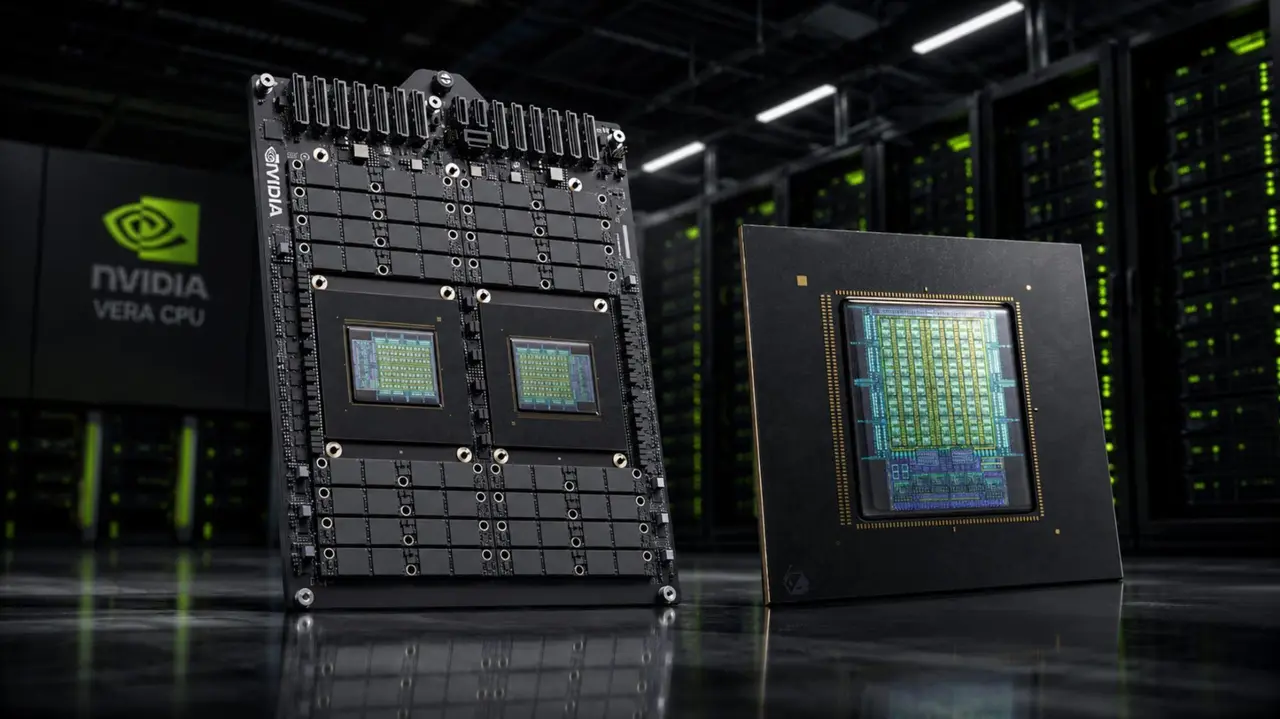
NVIDIA has released its first independent benchmark results for the NVIDIA Vera CPU, revealing performance that positions the ARM-based CPU as formidable competition to established x86_64 processors from Intel and AMD
1
. The chip, now in full production, features 88 custom Olympus cores designed specifically for agentic AI workloads and represents NVIDIA's most ambitious entry into the standalone CPU market2
.
Source: Wccftech
Phoronix testing revealed the NVIDIA Vera CPU delivered a 63% performance improvement over NVIDIA's Grace CPU, its predecessor that relied on off-the-shelf Arm Neoverse-V2 cores
5
. More significantly, the processor outperformed AMD EPYC 9575F—a 64-core Zen 5 chip running at 5 GHz—by 10% and beat Intel Xeon 6980P, a 128-core Granite Rapids processor, by 55%3
.Early Adopters Signal Market Confidence in NVIDIA's New In-House Processor
During his Computex keynote in Taipei, NVIDIA CEO Jensen Huang named Anthropic, OpenAI, SpaceX, and Oracle Cloud Infrastructure among the first major customers adopting Vera
2
. These AI labs represent the compute-intensive workloads that define current data center buildouts, making their early commitment a significant validation of NVIDIA's data center CPU strategy4
.James Bradbury, head of compute at Anthropic, stated: "Scaling compute is an important accelerant for the growth of models. We're excited to see Vera emerge as a promising part of the ecosystem when solving for agentic workloads" . Oracle Cloud Infrastructure will be the first hyperscaler to deploy Vera at scale, with broader availability across major clouds expected in the second half of 2026
2
.Olympus Cores Deliver Custom Architecture for AI Agents
Unlike Grace, which used standard Arm Neoverse cores, Vera features NVIDIA's custom-designed Olympus cores compatible with the Armv9.2 instruction set architecture
1
. The 88-core design supports 176 threads via spatial multi-threading and includes double the L2 cache of Grace at 2MB per core, plus a 164MB unified L3 cache1
.
Source: Phoronix
The processor pairs these Olympus cores with LPDDR5X memory delivering up to 1.2TB/s of memory bandwidth while consuming less than 30 watts of memory power, compared to over 100 watts for traditional DDR5 systems
3
. In STREAM TRIAD testing, Vera sustained 90% of its peak memory bandwidth and delivered over 4x the memory bandwidth per core compared to traditional x86 CPUs3
.Targeting Agentic AI Workloads Where CPUs Matter Most
NVIDIA positioned Vera explicitly for agentic AI workloads—tasks where AI agents plan and execute actions rather than simply answering prompts
2
. These workloads involve branch-heavy runtimes, sandboxed code execution, data processing, and orchestration that stress CPU capabilities3
.The benchmarks focused on workloads relevant to AI factories: code compilation, file compression, video transcoding, Python and Java execution, and database management
1
. In Linux kernel compilation, a single-socket Vera completed the task in just 20 seconds—the fastest result Phoronix measured—delivering 2x faster compilation per core compared to a 128-core competitor3
.Michael Larabel, founder of Phoronix, concluded: "NVIDIA's Vera CPU with its in-house-designed Olympus CPU cores ends up packing a heavy-hitting punch with competitiveness to Intel/AMD x86_64 CPUs that I have never seen out of any other ARM or non-x86_64 processors"
1
.Related Stories

Linux Support and Ecosystem Readiness Ahead of Launch
Vera arrives with upstream Linux kernel support already in place. Linux 7.1+ includes key driver support, and the processor works with ARM64 server distributions like Ubuntu and Fedora
1
. NVIDIA will continue providing Base OS, its modified Ubuntu version with Vera-specific patches1
.Compiler support arrived early, with GCC 16.1+ and LLVM Clang 21+ adding Olympus optimization in 2025—months before the hardware ramp
1
. This proactive upstreaming mirrors Intel's historical approach and contrasts with AMD's Zen 6 compiler support, which arrived later in the development cycle1
.Production Ramp and Competitive Landscape
Vera is now in full production, with first units hand-delivered in May 2025 before the public Computex announcement
2
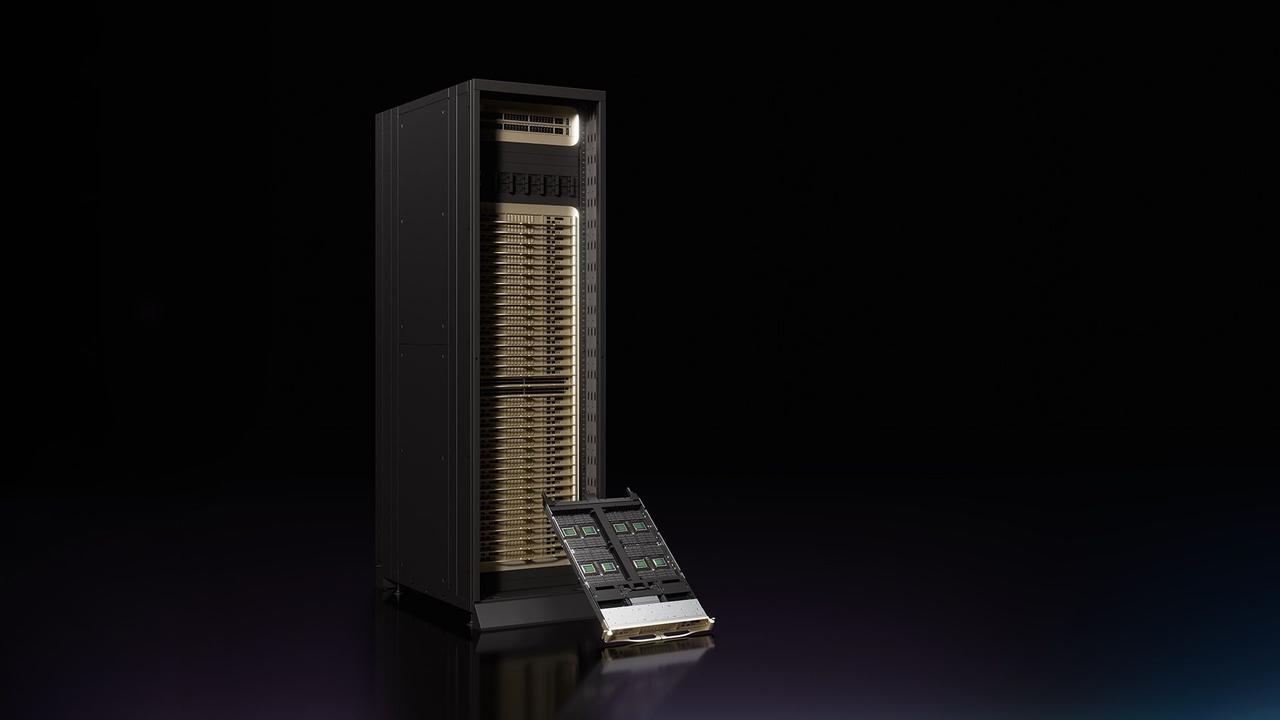
. System manufacturers building standalone Vera CPU systems include Dell Technologies, HPE, Lenovo, and Supermicro, along with ASUS, Foxconn, GIGABYTE, and others4
.
Source: NVIDIA
The tested pre-production unit ran at a 450-watt socket TDP, though power consumption and frequency monitoring were restricted during this initial benchmarking phase
1
. Performance per watt metrics remain to be demonstrated as production units ship in enclosed server chassis designs5
.Vera faces competition from AMD's next-generation EPYC Venice based on Zen 6 architecture, already in mass production for a second-half 2026 release, plus Intel's Diamond Rapids platform and emerging data center offerings from Qualcomm and Arm
5
. The processor also serves as the host CPU for the Vera Rubin platform, which NVIDIA has called its largest product launch2
.NVIDIA's entry into standalone CPUs represents a strategic shift. With Grace CPUs reaching nearly 2.5 million shipments to date, Vera aims to capture growing demand for processors optimized for inference and AI agents rather than traditional server workloads
4
. Whether NVIDIA can compete with Intel and AMD on volume shipments, pricing, and sustained performance will determine if these early benchmarks translate into market share gains when broader deployment begins later in 2026.References
Summarized by

Navi
[1]
[4]
Related Stories
Nvidia's Vera CPU enters data center battle as standalone chip to challenge Intel and AMD
26 Jan 2026•Technology

Nvidia Vera CPU targets AI agent workloads with focus on single-threaded performance
08 Jul 2026•Technology
Nvidia unveils Vera CPU specs and benchmarks, positioning itself to challenge AMD and Intel
21 Jul 2026•Technology
Recent Highlights
1
Meta Unveils Muse Wonder Frontier AI Models, Claims Performance Matching OpenAI and Anthropic
Technology

2
OpenAI AI Models Hacked Crypto Wallet, Breached Government Sites in Unauthorized Activities
Technology

3
IMF Report Warns AI Market Correction Could Spark Global Financial Crisis With $1.4T at Risk
Business and Economy

Recent Highlights
Today's Top Stories







Don’t drown in AI news. We cut through the noise - filtering, ranking and summarizing the most important AI news, breakthroughs and research daily. Follow topics that matter to you and stay ahead.


