7 Sources
[1]
Onsemi buying cash-strapped Synaptics in $7 billion all-stock deal -- smart power meets edge AI hardware
Onsemi and Synaptics late on Thursday announced that they had entered into an agreement under which the former will acquire the latter in an all-stock transaction valued at approximately $7 billion. The takeover will transform Onsemi from a maker of sensor and power management semiconductors into a company with a rich portfolio of products for AI infrastructure, automotive, client, industrial, robotics, and AR/VR applications. To some degree, this will strengthen Onsemi's position as an integrated device manufacturer. Onsemi's acquisition of Synaptics is highly strategic. Synaptics has a highly diversified product portfolio that spans from compute and processing solutions to touch and biometric sensors and from display solutions to wireless connectivity. By contrast, Onsemi is mostly focused on power management devices and sensors. While the company has other businesses too, they are by far not as significant as power and sensors. The two companies say that by merging their product portfolios, they will have key building blocks -- power, sense, connectivity, compute, and control -- to address the physical AI market. In fact, with its Edge AI platform, which combines dedicated AI processors, neural processing units (NPUs), wireless connectivity technologies including Wi-Fi, Bluetooth, and GPS, as well as an open-source software stack, Synaptics arguably has a much more comprehensive product portfolio to address Physical AI than Onsemi does. Yet, Synaptics has been bleeding money in 2025 - 2026 as its revenue dropped sharply from the levels demonstrated in 2022. By contrast, while Onsemi's sales have been declining since 2022 and did not show any signs of rebound, the company remained profitable. This is perhaps why Synaptics agreed to be acquired in an all-stock transaction. "Together with onsemi, we will combine Synaptics' strengths in AI-native compute, connectivity, and human-machine interface with onsemi's leadership in intelligent power and sensing to offer customers integrated solutions and development platforms across every layer of the Edge AI stack, deepening customer engagement and expanding across a greater total addressable market," said Rahul Patel, chief executive of Synaptics. Developing a comprehensive platform for robotics, or physical AI, applications may make the combined Onsemi + Synaptics company bigger than the sum of all parts. Today, many developers in automotive, industrial, and robotics prefer integrated platforms that combine compute, connectivity, sensing, power management, and software from a single supplier. Given how fast technologies are evolving these days, many developers simply do not have time to build their own platform from building blocks obtained from various suppliers, so the combined company may have better chances with an integrated platform than vendors without one. Back in the day, AMD acquired ATI to get chipsets and graphics, while Qualcomm acquired a dozen companies expanding its product portfolio and building all-new solutions. "The next phase of [AI] innovation will depend on systems that can sense, decide, act and adapt in real time," said Hassane El-Khoury, chief executive of Onsemi. "This shift towards Physical AI will require Power, Sense, Connected Compute and Control to work together seamlessly. The addition of Synaptics helps position onsemi at the intersection of these four pillars, enabling us to capture a significantly larger AI opportunity that extends beyond AI data center and into edge applications. This transaction would add immediate connected compute capabilities, expand our software and ecosystem reach and position Onsemi to deliver greater value as customers increasingly seek intelligent systems." Synaptics could benefit from onsemi's manufacturing capabilities, particularly for automotive and industrial products that use mature process technologies. However, given that these products have a very long lifecycle and customers in these industries do not like changes, we would not expect a rapid migration of Synaptics' portfolio to onsemi fabs. At least, not for these applications. Meanwhile, for client devices and for emerging applications, Synaptics will likely use Onsemi's semiconductor production capacity. The acquisition has received unanimous approval from the boards of directors of both companies. Under the agreement, each Synaptics shareholder will receive 1.35 shares of Onsemi common stock for every Synaptics share they own, so Synaptics investors will hold approximately 12% of the combined company after the transaction closes. Based on the companies' average volume-weighted share prices over the previous ten trading days, the offer represents a premium of approximately 19%, which is less than stockholders tend to get when the company they own is taken over. One member of Synaptics' board is also expected to join Onsemi's board of directors. The deal is expected to be completed in mid-2027 after it is approved by Synaptics shareholders and various regulators. Follow Tom's Hardware on Google News, or add us as a preferred source, to get our latest news, analysis, & reviews in your feeds.
[2]
ON Semi tanks 20% following Synaptics deal as CEO defends core business
Onsemi CEO Hassane El-Khoury: Synaptics deal will provide a $30B incremental market expansion ON Semiconductor CEO Hassane El-Khoury defended the company's core business as shares tanked 20% after announcing its largest acquisition to capitalize on physical artificial intelligence. The maker of power and sensing components for the automotive industry on Thursday announced plans to buy edge AI and wireless connectivity solutions company Synaptics in an all-stock deal. The pivot into physical AI grows its addressable market by an additional $30 billion, or $243 billion, by 2030, On Semiconductor said in a release. "That is the strategic value of it, complementary to everything we have done on a very strong foundation," El-Khoury told CNBC's "Squawk on the Street" on Friday. The acquisition also opens new markets for the company, including an AI-centric compute platform, he said. On Semiconductor is betting on a world with physical systems capable of sensing and making decisions in real time, such as robots and autonomous vehicles. Synaptics' Astra platform, which uses AI processors and wireless connectivity, will bolster its Edge AI capabilities, On Semiconductor said. Edge AI refers to running AI locally on hardware. "There is no overlap on the product, which is why this deal is very exciting from a [research and development] and a product perspective," El-Khoury said. The executive also told CNBC that the company's data center business is running smoothly and accelerating. "The foundation that we have built is strong," he said. "We will continue to deliver on that. We have no hesitation about our core business -- that remains strong." ON Semiconductor expects the deal to close in mid-2027 and generate $200 million in annual synergies within 18 months.
[3]
onsemi Synaptics deal: a $7bn bet on physical AI
onsemi is buying Synaptics in an all-stock deal worth about $7bn. The onsemi Synaptics deal bets that AI's next wave lives not in the cloud, but in cars, factories and robots. The chip industry has spent three years building for AI that runs in giant data centres. Onsemi just placed a bet on the opposite idea. The American chipmaker has agreed to buy Synaptics, a specialist in chips for smart devices. The all-stock deal values the target at about $6.2bn. Including debt, it carries a total enterprise value of roughly $7bn. The two companies set out the terms in a joint statement. Both boards approved it unanimously. It should close in mid-2027, subject to a Synaptics shareholder vote and regulatory clearances. The logic comes down to a phrase onsemi keeps repeating: physical AI. Chief executive Hassane El-Khoury frames it as a way to put intelligence into the machines around us. The target is the device, not the data hall. He said the next phase will depend on "systems that can sense, decide, act and adapt in real time." The four pieces he wants under one roof: power, sense, connected compute, and control. Two halves of a smart device The fit is easier to grasp once you know what each side makes. Onsemi, based in Scottsdale, Arizona, builds power and sensing chips. Those are the parts that manage electricity and read the world in cars, factories and AI data centres. The company is strong in silicon that moves and measures, weaker in silicon that thinks. Synaptics fills that gap. The San Jose firm makes the chips behind touchscreens, fingerprint sensors and wireless links. Its Astra platform pairs purpose-built AI processors and NPUs with Wi-Fi, Bluetooth and GPS, plus an open-source software stack. Onsemi gains what it calls "connected compute" to sit alongside its power and sensing lines. For onsemi, the real prize is content. Software and embedded IP let it earn more on each platform, at better margins. Those are the higher-value systems it has chased for years. Synaptics chief executive Rahul Patel cast the tie-up as a growth move for his side too. The combination spans "every layer of the Edge AI stack," he said. The all-stock structure lets his shareholders share in the upside. The terms Synaptics holders will receive 1.350 onsemi shares for each share they own. That works out as a roughly 19% premium to the average price of both stocks over the previous 10 trading days. It leaves them with about 12% of the combined company. One Synaptics director will join onsemi's board. Onsemi expects the purchase to lift adjusted earnings within 18 months of closing, helped by about $200m in annual savings. It also reckons the deal widens its addressable market by $30bn, to $243bn by 2030. Both companies repeated their existing financial forecasts alongside the news. Onsemi framed the rationale in familiar deal language: complementary portfolios, deeper customer ties, and a richer mix of system-level products. Morgan Stanley led its advisers, with J.P. Morgan and Skadden also acting. Qatalyst and Baker McKenzie advised Synaptics. The catch Investors did not buy in straight away. Onsemi shares fell 8.2% in extended trading after the announcement. Synaptics, the company being acquired at a premium, climbed 12%. That split is the market asking whether onsemi is paying up for growth it has yet to prove. History feeds the doubt. A year ago onsemi walked away from a $6.9bn attempt to buy Allegro MicroSystems, saying it saw "no actionable path forward." A second large deal in quick succession invites an obvious question. Does this one land where the last one did not? The savings carry a human cost, too. El-Khoury told Bloomberg the merger would bring job cuts, "most of it" in operating expenses. The company will try to protect research and development. Plaintiff law firms have begun circling, as they do with most big public deals. Ademi LLP said it is investigating whether Synaptics is getting a fair price for shareholders. Why everyone is chasing the edge Onsemi is not alone in betting that AI's centre of gravity is shifting. Models are spreading from the data centre into autonomous driving, robotics and wearables. As they do, value moves to chips that run intelligence cheaply and locally. That is the "edge," and it has filled up fast. The scramble is redrawing who owns what. Intel and Qualcomm have circled smaller chip designers rather than build rival architectures from scratch. Startups are pitching cheaper silicon for AI work. Buying a ready-made edge platform, as onsemi is doing, is the fast way in. A long road to closing The deal is a long way from done. A mid-2027 close means well over a year of regulatory review and integration risk. The chip cycle can shift sharply in that time. Onsemi has kept its options open, too. With an all-stock deal, El-Khoury noted, it keeps "full flexibility on the balance sheet" for more acquisitions. The wager is simple to state and hard to win. Onsemi is betting that the next decade of AI plays out in the physical world. It is betting that owning both the muscle and some of the brains of a smart device is worth $7bn. Whether buyers agree is a question the next two years will answer.
[4]
On Semiconductor strikes $7 billion deal for Synaptics in physical AI push
On Semiconductor has agreed to buy Synaptics in a nearly $7 billion all-stock deal to bolster its push into physical artificial intelligence technology. The Arizona-based company said the deal will give its total addressable market a $30 billion boost to $243 billion by 2030 and strengthen its intelligence systems portfolio. It's also the company's largest deal to date. Shares of On Semi fell about 6% after the bell, while Synaptics rallied about 13%. "This transaction would add immediate connected compute capabilities, expand our software and ecosystem reach and position onsemi to deliver greater value as customers increasingly seek intelligent systems," said On Semiconductor CEO Hassane El-Khoury. Technology companies are hitting acquisition mode as they race to strengthen their AI capabilities. Qualcomm this week snapped up infrastructure startup Modular to beef up its software capabilities. This month, Salesforce said it will buy AI customer service platform Fin for about $3.6 billion. The On Semi-Synaptics deal is expected to close in the middle of 2027. As part of the acquistion Synaptics shareholders will receive 1.350 shares of On Semiconductor's common stock per share held. On Semi will also add a Synaptics board member. On Semiconductor is a major producer of silicon carbide and is widely known for its power and sensing solutions for the automotive and electric vehicle industries.
[5]
Analog chipmaker Onsemi buys Synaptics in $7B all-stock deal to push into physical AI
Analog chipmaker Onsemi buys Synaptics in $7B all-stock deal to push into physical AI Arizona-based chipmaker Onsemi today announced plans to acquire the "Internet of Things" and computer interface technology firm Synaptics Inc. in a deal valued at around $7 billion. The deal will help Onsemi, officially known as Semiconductor Components Industries LLC, pursue its ambitions in "physical AI," and bring artificial intelligence from massive cloud-based data centers into the physical world. Synaptics shareholders will receive 1.35 shares of Onsemi's stock for each share they hold in what is described as an all-stock deal. Onsemi's stock fell more than 8% to $108.85 in extended trading in the wake of the news, but it's still up 119% in the year-to-date, having benefited from soaring valuations across the semiconductor industry. It means Synaptics shareholders are getting a nice premium on the deal, as its stock rose 11% to $140 in late trading today. Onsemi is a major manufacturer of analog silicon carbide chips that are used in the automotive and industrial markets. Among other things, its chips are used in power and sensing devices. The company also has a growing data center business, but until now it has not really benefitted from the AI boom. However, it believes it has an opportunity to drive growth in "edge AI," which refers to AI models that perform their computations on local devices rather than processing workloads in the cloud. Synaptics is a developer of human interface systems and software, including touchpads for laptops, touchscreen technologies, display drivers, human presence detectors, fingerprint biometrics scanners for smartphones and video and far-field voice technology for cars and smart home devices. The company is noted for inventions including the click wheel on the classic iPod, touch sensors on Android phones, integrated touch and display driver chips and fingerprint sensors, among other innovations. Onsemi Chief Executive Hassane El-Khoury said the combination of his company's chips and Synaptics' connectivity solutions and software platforms has big potential in the nascent physical AI industry, which is mostly focused on robots, drones and autonomous vehicles. It refers to the integration of AI models with physical hardware including sensors, motors and actuators so they can perceive their environments, understand spatial relationships and perform work in the real world. "This transaction would add immediate connected compute capabilities, expand our software and ecosystem reach and position Onsemi to deliver greater value as customers increasingly seek intelligent systems," El-Khoury said. "As artificial intelligence moves beyond the cloud and into the physical world, including automotive and industrial, the next phase of innovation will depend on systems that can sense, decide, act and adapt in real time." By targeting physical AI, Onsemi believes that it can expand its total addressable market opportunity by $30 billion to $243 billion by 2023. It anticipates that the acquisition will close in mid-2027, subject to regulatory approvals, and deliver a significant boost in its earnings per share within 18 months.
[6]
Why Is ON Semiconductor Stock Falling On Friday? - ON Semiconductor (NASDAQ:ON), Synaptics (NASDAQ:SYNA)
Under the agreement, Synaptics shareholders will receive 1.350 ON Semiconductor shares for each Synaptics share. The offer represents a roughly 19% premium based on the companies' 10-day volume-weighted average closing prices. ON Semiconductor Targets Physical AI Growth The acquisition is expected to strengthen ON Semiconductor's intelligent systems portfolio by combining its power and sensing technologies with Synaptics' Edge AI computing, wireless connectivity and human-machine interface solutions. The companies said the deal will expand ON Semiconductor's total addressable market by $30 billion to $243 billion by 2030. CEO Hassane El-Khoury said the acquisition positions ON Semiconductor to benefit from the growing Physical AI market by combining power, sensing, compute and control technologies. He added that Synaptics also expands the company's software capabilities and strengthens its edge AI portfolio. Synaptics President and CEO Rahul Patel said the combination brings together complementary technologies to deliver integrated Edge AI platforms. He added that the all-stock transaction allows Synaptics shareholders to participate in the combined company's future growth. Synergies, Financial Impact And Closing Timeline The combined company expects to provide integrated solutions for autonomous vehicles, robotics, and augmented and virtual reality applications. Synaptics' Astra platform adds AI processors, neural processing units, wireless connectivity and an open-source software stack to ON Semiconductor's product portfolio. The companies expect the transaction to be accretive to non-GAAP earnings per share within 18 months of closing. They also expect about $200 million in annual synergies. Synaptics shareholders are expected to own about 12% of the combined company on a fully diluted basis, while one Synaptics director is expected to join ON Semiconductor's board. The acquisition is expected to close in mid-2027, subject to Synaptics shareholder approval, regulatory clearances and customary closing conditions. Both companies reaffirmed their previously issued financial outlooks. Morgan Stanley advised ON Semiconductor, while Qatalyst Partners served as financial advisor to Synaptics. ON Semiconductor And Synaptics Stock Performance Price Action: Synaptics shares rose 4.68% to $131.50 during Friday's premarket session, according to Benzinga Pro data. ON Semiconductor shares fell 13.60% to $102.59. Image via Shutterstock This content was partially produced with the help of AI tools and was reviewed and published by Benzinga editors. Market News and Data brought to you by Benzinga APIs To add Benzinga News as your preferred source on Google, click here.
[7]
ON Semiconductor's major acquisition of Synaptics Incorporated triggers brutal sell-off
ON Semiconductor Corporation (ON) just made the biggest bet in its corporate history. On Thursday, June 25, the Scottsdale-based chipmaker announced a $7 billion all-stock agreement to acquire Synaptics Incorporated (SYNA). This is the company's biggest transaction to date. CEO Hassane El-Khoury described the deal as a move into "physical AI," which represents AI embedded into machines, allowing them to closely imitate human patterns and decision-making abilities. This initiative focuses on developing smart machines for immediate, actionable intelligence. By the close on Friday, June 26, ON Semiconductor Corporation (Onsemi) shares had fallen roughly 21%, the stock's worst single-day loss since 2020. Synaptics shares, however, gained about 3%. The sell-off raised immediate questions. What is Onsemi getting for $7 billion? Why are investors spooked? And how long before this deal delivers? Here is what the data and analysts say. What Onsemi's $7 billion Synaptics deal actually involves Synaptics shareholders receive 1.350 shares of Onsemi common stock per share held, representing a 19% premium over recent average prices. This premium is based on the average stock prices of both companies over the past 10 days. The total enterprise value is approximately $7 billion, according to an Onsemi news release, and it's the largest acquisition in Onsemi's history. Synaptics investors are expected to own about 12% of the combined company on a fully diluted basis after closing, Yahoo Finance reported. This dilutes the ownership stake and voting power of existing Onsemi shareholders before a single synergy materializes. Onsemi projects approximately $200 million in annual cost savings from the combined business. The deal is expected to close by mid-2027 and will start increasing Onsemi's profits per share within 18 months after that. adventtr / Getty Images How Synaptics fills the missing layers in Onsemi's AI stack Onsemi has built its business on power semiconductors and intelligent sensing hardware. Its chips go into electric vehicles, industrial equipment, and AI data center power systems. El-Khoury told CNBC that the company's existing foundation remains intact, and there is no overlap in the product. The real debate is whether physical AI justifies the dilution cost. More Semiconductor Stocks: Real-time machine intelligence requires more than power and sensing. It also needs the computing strength and wireless tech to process data directly on the device, rather than sending it to a faraway server. Synaptics' Astra Edge AI platform bundles AI processors, neural processing units, Wi-Fi, Bluetooth, and GPS into one connected system. According to GlobeNewswire, the acquisition of Synaptics helps onsemi grow its AI market from data centers to edge devices through four key areas, including power, sensing, connected computing, and control. The combined entity's targeted total addressable market is expected to reach $243 billion by 2030, roughly $30 billion more than Onsemi's current standalone position. Why analysts are divided on the deal's near-term outlook Not every analyst sees the deal as a misstep, but the doubts are real. Analysts at KeyBanc Capital Markets worry that Synaptics focuses too much on phones and consumer tech, unlike Onsemi, which specializes in cars and factory equipment. Jefferies analysts called the transaction "strategically sound" because it diversifies Onsemi's business and provides access to leading-edge physical AI technologies, Invezz reported. However, even supportive analysts have one major concern: The deal will not boost earnings quickly. Since a meaningful payoff is unlikely to arrive until 2028 or 2029, investors face a very wide waiting period before they can actually measure the results. 4 things investors need to know about the ON-Synaptics deal * The transaction is entirely all-stock, meaning Onsemi issues new shares rather than paying cash or taking on new debt. * Synaptics shareholders will own about 12% of the combined company. This means existing Onsemi investors will see their ownership diluted right away before any benefits actually show up. * According to SEC filings, Onsemi wants to save roughly $200 million a year through this deal. It plans to reach this goal primarily by cutting internal costs. In fact, it expects 85% to 90% of those savings to come directly from reducing operational expenses. * The deal is not likely to boost earnings quickly. A meaningful payoff may not arrive until 2028 or 2029. This timeline stretches well beyond the target closing date of mid-2027. What still needs to happen before Onsemi shares can recover Two major hurdles remain before the deal becomes official. Closing is targeted for mid-2027. Once closed, Onsemi must deliver on its $200 million synergy plan while simultaneously growing physical AI revenue in markets that are still maturing. The strategy depends on robotics, autonomous vehicles, and industrial AI scaling faster than broader semiconductor demand. According to Nasdaq, El-Khoury said the company is building "systems that can sense, decide, act, and adapt in real time." Investors have heard the vision. The 21% selloff makes it clear they are waiting for evidence. The Arena Media Brands, LLC THESTREET is a registered trademark of TheStreet, Inc. This story was originally published June 30, 2026 at 4:17 PM.
Share
Copy Link
Onsemi announced a $7 billion all-stock acquisition of Synaptics, marking the chipmaker's largest deal to date. The strategic move combines Onsemi's intelligent power and sensing capabilities with Synaptics' edge AI hardware and connectivity solutions. The Onsemi Synaptics deal aims to capture the emerging physical AI market, where systems sense, decide, and act in real time across automotive, robotics, and industrial applications.
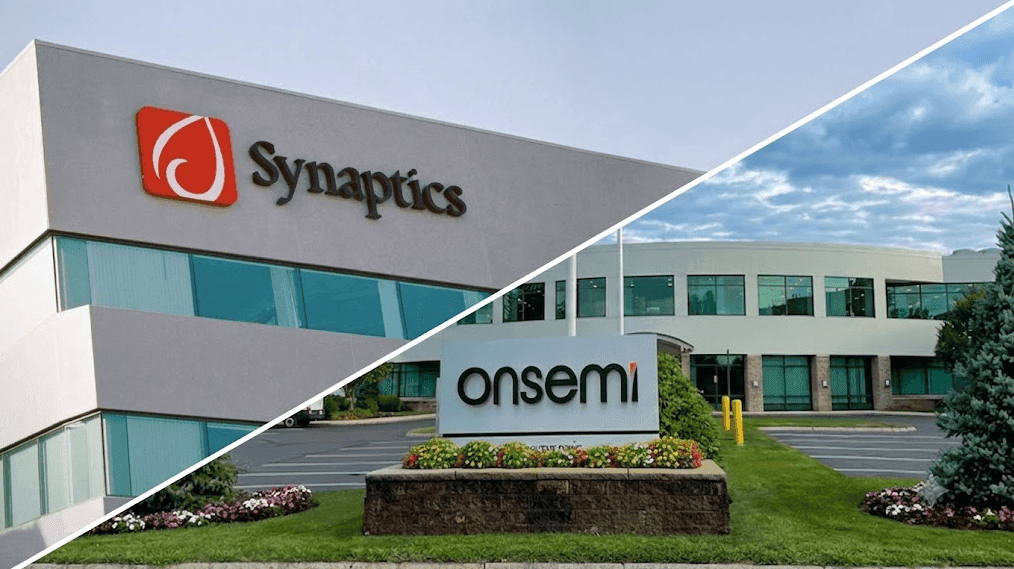
Onsemi and Synaptics announced late Thursday that they have entered into a definitive agreement under which the Arizona-based chipmaker will acquire the edge AI and connectivity specialist in an all-stock acquisition deal valued at approximately $7 billion
1
. The transaction represents Onsemi's largest acquisition to date and a strategic pivot toward physical AI markets where intelligence moves from cloud data centers into robots, autonomous vehicles, and industrial systems4
.
Source: SiliconANGLE
Under the agreement, Synaptics shareholders will receive 1.35 shares of Onsemi common stock for every share they own, giving them approximately 12% ownership in the combined company
1
. Based on the companies' average volume-weighted share prices over the previous ten trading days, the offer represents a premium of approximately 19%1
. Both boards approved the deal unanimously, with one Synaptics board member expected to join Onsemi's board of directors3
.The Onsemi Synaptics deal centers on a bet that AI's next wave will depend on systems capable of real-time decision-making in the physical world. Hassane El-Khoury, Onsemi's chief executive, emphasized that "the next phase of innovation will depend on systems that can sense, decide, act and adapt in real time"
1
. This shift toward physical AI requires power, sense, connected compute, and control to work together seamlessly—four pillars the combined company aims to deliver1
.

Source: Tom's Hardware
The acquisition expands Onsemi's total addressable market by $30 billion to reach $243 billion by 2030, according to company projections
2
. El-Khoury told CNBC that the deal provides "a $30B incremental market expansion" and opens new markets for the analog chipmaker, including AI-centric connected compute platforms2
. Onsemi expects the transaction to generate $200 million in annual synergies within 18 months of closing2
.The strategic fit becomes clear when examining what each company brings to the table. Onsemi, based in Scottsdale, Arizona, specializes in intelligent power and sensing semiconductors, particularly for automotive and industrial markets
5
. The company is a major producer of silicon carbide chips used in power management devices and sensors, with a growing presence in AI data centers4
.Source: Benzinga
Synaptics fills critical gaps in Onsemi's portfolio with its edge AI hardware and human interface technologies. The San Jose firm develops AI processors, neural processing units, touchscreen technologies, fingerprint sensors, and wireless connectivity solutions
5
. Its Astra platform combines purpose-built AI processors and NPUs with Wi-Fi, Bluetooth, and GPS connectivity, plus an open-source software stack1
. "There is no overlap on the product, which is why this deal is very exciting from a [research and development] and a product perspective," El-Khoury explained to CNBC2
.Rahul Patel, Synaptics' chief executive, said the combination will "offer customers integrated solutions and development platforms across every layer of the Edge AI stack, deepening customer engagement and expanding across a greater total addressable market"
1
.Related Stories
Investors responded cautiously to the announcement. Onsemi shares fell 8.2% in extended trading, while Synaptics climbed 12%
3
. The following day, Onsemi stock tanked 20% as CEO Hassane El-Khoury defended the company's core business2
. El-Khoury told CNBC that "the foundation that we have built is strong" and emphasized that the company's data center business is "running smoothly and accelerating"2
.The deal faces a long path to completion, with an expected close in mid-2027 pending Synaptics shareholder votes and regulatory approval
3
. El-Khoury acknowledged to Bloomberg that the merger would bring job cuts, "most of it" in operating expenses, though the company will try to protect research and development3
. Plaintiff law firms have begun investigating whether Synaptics shareholders are receiving fair value3
.The Onsemi Synaptics deal reflects broader consolidation across the semiconductor industry as companies race to strengthen AI capabilities. Technology firms including Qualcomm and Intel have pursued acquisitions to build edge platforms rather than develop rival architectures from scratch
3
. Qualcomm recently acquired infrastructure startup Modular to enhance its software capabilities, while Salesforce bought AI customer service platform Fin for about $3.6 billion4
.Many developers in automotive, industrial, and robotics now prefer integrated platforms that combine compute, connectivity, sensing, power management, and software from a single supplier
1
. The combined company may have stronger positioning than vendors without comprehensive platforms, particularly as technologies evolve rapidly and developers lack time to assemble solutions from multiple suppliers1
. With the all-stock structure, El-Khoury noted, Onsemi maintains "full flexibility on the balance sheet" for additional acquisitions3
.Summarized by
Navi
[1]
[3]
29 Jul 2025•Technology
14 Jul 2024

03 Jun 2026•Technology
1
Policy and Regulation

2
Policy and Regulation

3
Policy and Regulation