OpenAI unveils GPT-Rosalind AI model to accelerate drug discovery and life sciences research


14 Sources
[1]
OpenAI Has a New AI Model Built for Biology and Science
OpenAI's latest AI model is built to do far more than offer cooking advice or create a spreadsheet. GPT-Rosalind, the company's first model specifically built for life science, is meant to help scientists with drug discovery, biology and translational medicine. The model is named after Rosalind
[2]
OpenAI Takes on Google With New AI Model Aimed at Drug Discovery
OpenAI is rolling out an early version of an artificial intelligence model meant to speed up drug discoveries, joining a field of growing interest for tech companies eager to prove AI can pave the way for more scientific breakthroughs. The ChatGPT maker said Thursday that the model, GPT-Rosalind,
[3]
OpenAI launches GPT-Rosalind, an AI model for life sciences research
Named after the crystallographer who helped reveal the structure of DNA, GPT-Rosalind is OpenAI's first domain-specific model series, fine-tuned for biochemistry, genomics, and protein engineering. Access is restricted to a trusted-access programme for vetted enterprise customers including Amgen,
[4]
OpenAI debuts GPT-Rosalind, a new limited access model for life sciences, and broader Codex plugin on Github
The journey from a laboratory hypothesis to a pharmacy shelf is one of the most grueling marathons in modern industry, typically spanning 10 to 15 years and billions of dollars in investment. Progress is often stymied not just by the inherent mysteries of biology, but by the "fragmented and
[5]

OpenAI launches new AI model for life sciences research
Why it matters: Biology research is increasingly computational, but scientists are drowning in data across fields like genomics, protein analysis and biochemistry. By the numbers: Right now it takes roughly 10 to 15 years to go from target discovery to regulatory approval for new drugs in the
[6]

OpenAI launches GPT-Rosalind AI model for drug discovery
OpenAI has introduced GPT-Rosalind, a new reasoning model built for biology, drug discovery, and translational medicine research. Qualified enterprise customers in the U.S. can now try it out as a research preview. Researchers can use the model to handle complex, multi-step scientific tasks. These
[7]

OpenAI's New AI Model Rosalind Could Shave Years Off Drug Discovery. You Probably Can't Use It - Decrypt
Access is tightly restricted amid rising biosecurity concerns. OpenAI just named its first domain-specific AI model after Rosalind Franklin -- the British chemist whose X-ray crystallography work helped reveal DNA's double helix, and who was famously denied credit for it during her
[8]

OpenAI launches life science AI model. Here's everything to know
The GPT-Rosalind model is designed to accelerate biological research and drug discovery. OpenAI has launched a new artificial intelligence model designed to support research across biology, drug discovery, and translational medicine. The new tool, called GPT-Rosalind, is named after Rosalind
[9]

OpenAI to rival Google's AlphaFold with new AI model for life sciences research
The model is the first release in OpenAI's Life Science model series. OpenAI has announced plans to roll out an early version of GPT-Rosalind, its AI reasoning model designed to support research across biology, drug discovery, and translational medicine. In a statement on Thursday (16 April),
[10]

OpenAI Targets Pharma Giants With Purpose-Built AI Model | PYMNTS.com
The new GPT-Rosalind features improved tool use and a deeper understanding of chemistry, protein engineering and genomics, the company said in a Thursday (April 16) press release. With this new AI model, OpenAI aims to help scientists overcome the current constraints of complex research workflows
[11]

OpenAI's GPT-Rosalind AI Model Promises Faster Drug Breakthroughs and Smarter Experiments
As complexity increases in drug discovery, genomics, and molecular biology, there is a growing need for systems that can precisely handle large scientific data sets. The GPT-Rosalind artificial intelligence model performs three functions: analysis of scientific literature, hypothesis generation,
[12]

OpenAI launches AI model GPT-Rosalind for life sciences research
OpenAI on Thursday introduced an artificial intelligence model touting increased biology knowledge and scientific research capabilities, as the startup deepens its push into the life sciences field. The GPT-Rosalind, named after 20th-century British scientist Rosalind Franklin, is designed to
[13]

OpenAI launches GPT-Rosalind to accelerate life sciences research
Conceived as an advanced assistance tool, GPT-Rosalind enables the synthesis of scientific data, the generation of hypotheses, and the planning of experiments. It aims to meet the needs of pharmaceutical laboratories, academic institutions, and biotechnology firms by facilitating the analysis of
[14]

OpenAI introduces GPT Rosalind for scientific research: What it can do
The model is named after Rosalind Franklin, whose work played a key role in discovering the structure of DNA. OpenAI has introduced a new AI model called GPT-Rosalind, designed to support research across biology, drug discovery and translational medicine. The company says that the new model is
Share
Copy Link
OpenAI released GPT-Rosalind, its first domain-specific AI model built for life sciences research. Named after DNA pioneer Rosalind Franklin, the model aims to compress the 10-to-15-year drug development timeline by helping scientists synthesize evidence and generate biological hypotheses. Access is restricted through a trusted access program to enterprise partners including Amgen, Moderna, and Thermo Fisher Scientific.
OpenAI Launches First Domain-Specific AI Model for Life Sciences
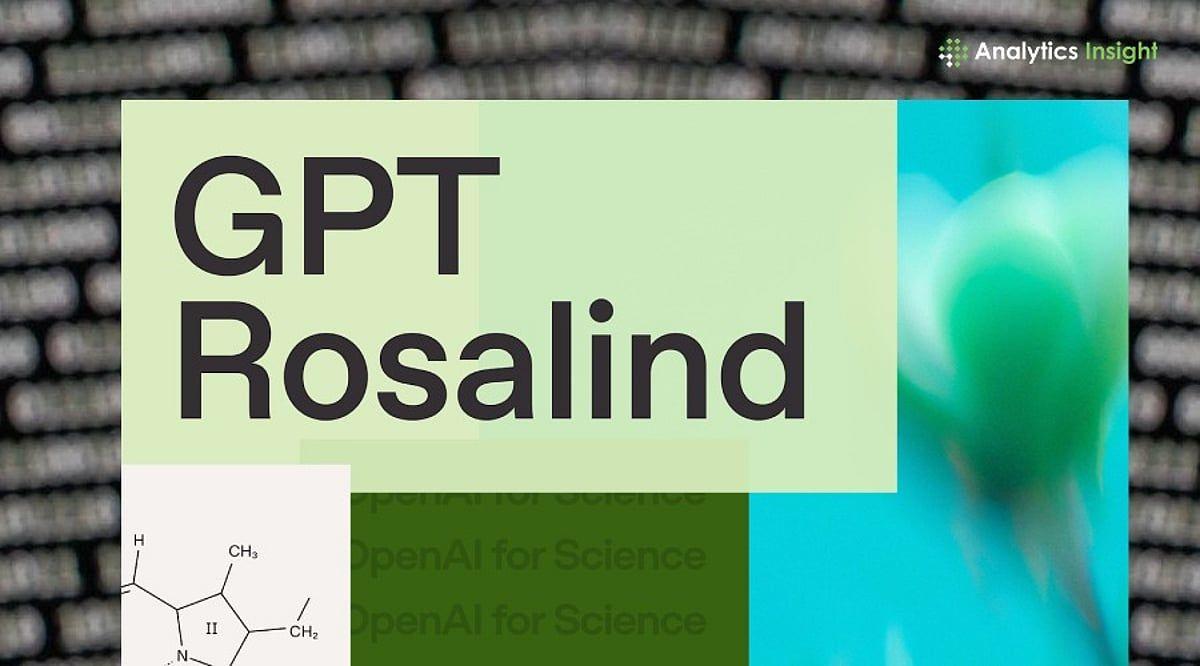
OpenAI has released GPT-Rosalind, marking the company's first venture into domain-specific artificial intelligence with an AI model for life sciences designed explicitly for drug discovery and biological research
1
. Named after Rosalind Franklin, the British chemist whose crystallography work revealed the DNA double helix structure, this frontier reasoning model represents a shift from general-purpose assistants to specialized scientific partners3
. The model is fine-tuned for biochemistry, genomics, and protein engineering, addressing a critical bottleneck in modern pharmaceutical development2
.
Source: Analytics Insight
The timing matters. Right now, it takes roughly 10 to 15 years to move a drug from target discovery to regulatory approval in the United States, with only one in 10 drugs entering clinical trials ultimately receiving approval
5
. More than 30 million Americans and 300 million people globally living with rare diseases are waiting for better treatments5
. GPT-Rosalind aims to accelerate scientific discovery by helping researchers navigate the fragmented workflows that force them to manually pivot between experimental design equipment, software, and databases4
.
Source: Silicon Republic
Restricted Access Through Trusted Access Program Ensures Safety
Unlike typical AI releases, OpenAI is launching GPT-Rosalind through a trusted access program that restricts availability to qualified enterprise customers in the United States
3
. Initial partners include pharmaceutical giants Amgen and Moderna, along with Thermo Fisher Scientific and the Allen Institute2
. Organizations requesting access must undergo qualification and safety reviews to ensure they conduct legitimate research with clear public benefit and maintain strong governance controls4
.This controlled deployment addresses growing concerns about potential misuse. An international group of more than 100 scientists have called for tighter controls on sensitive biological data used to train AI systems, warning that models trained on biological data could be misused to help design dangerous pathogens
5
. Yunyun Wang, OpenAI's life sciences product lead, confirmed the model includes enterprise-grade security controls and "high-precision flags" if users hit certain indicators or thresholds related to bioweapons2
.Model Demonstrates Expert-Level Performance on Scientific Benchmarks
Benchmark testing reveals GPT-Rosalind's capabilities extend beyond general language tasks. On BixBench, a bioinformatics benchmark evaluating real-world computational biology tasks, the model achieved a 0.751 pass rate
3
. On LABBench2, GPT-Rosalind outperformed GPT-5.4 on six of eleven tasks, with its most significant advantage on CloningQA, a task requiring end-to-end design of reagents for molecular cloning protocols3
.The most striking validation came from Dyno Therapeutics, a gene therapy company. Using unpublished RNA sequences to guard against benchmark contamination, GPT-Rosalind ranked above the 95th percentile of human experts on sequence-to-function prediction tasks and around the 84th percentile on sequence generation
3
4
. This suggests the model can identify expert-relevant patterns that generalist models often overlook4
.Competing With Google and Anthropic in Scientific AI Applications
OpenAI enters a competitive field where Google, Anthropic, and other tech companies are racing to prove AI can deliver scientific breakthroughs. Google DeepMind's AlphaFold, which predicts protein structures, earned its creators a share of the 2024 Nobel Prize in Chemistry
1
. Anthropic introduced Claude for Life Sciences in January with similar goals for translational medicine1
.The announcement triggered immediate market reactions. Shares of companies involved in drug discovery fell sharply, with IQVIA Holdings dropping as much as 3.2%, Charles River Laboratories slipping 2.6%, and Recursion Pharmaceuticals and Schrodinger each falling more than 5%
2
. The market response signals investor concern about potential disruption to traditional research workflows.Related Stories

Life Sciences Plugin Integrates 50-Plus Scientific Tools
Alongside GPT-Rosalind, OpenAI introduced a Life Sciences research plugin for Codex available on GitHub, connecting models to more than 50 scientific tools and data sources
3
. This orchestration layer addresses a fundamental challenge in scientific research: projects often require consulting protein structure databases, searching through decades of clinical literature, and using separate tools for sequence manipulation4
. The plugin provides a unified starting point for multi-step questions, allowing researchers to query specialized databases, parse scientific literature, and interact with computational tools within a single interface1
.
Source: Axios
Joy Jiao, who leads OpenAI's life sciences research, emphasized the model is designed to synthesize evidence, generate biological hypotheses, and plan experiments—tasks that traditionally require years of expert synthesis
2
. Sean Bruich, senior vice president of AI and data at Amgen, noted that scientific work requires precision, and the collaboration enables the company to apply advanced capabilities in ways that could "accelerate how we deliver medicines to patients"1
. OpenAI is also partnering with Los Alamos National Laboratory on AI-guided protein and catalyst design .What Researchers Should Watch For Next
While promising, no fully AI-discovered or AI-designed drug has completed phase 3 clinical trials
5
. Only a few AI-discovered drugs have reached early clinical trials, making this technology nascent but potentially transformative2
. OpenAI stresses these models are designed to support analysis, not replace expert judgment or real-world validation—humans still belong in the loop5
. Domain-specific models like GPT-Rosalind might represent AI's next phase, signaling a shift from general-purpose tools to specialized reasoning partners that compress the timeline from scientific idea to clinical evidence4
.References
Summarized by

Navi
[4]
Related Stories
Anthropic's AI Scientific Discovery Claim Triggers Scientific Controversy Over What Counts
28 Sept 2026•Science and Research

AI Agents Transform Drug Discovery: 37,000 Virtual Scientists Identify Cancer Treatments
18 Sept 2026•Technology
OpenAI's GPT-5 Accelerates Scientific Research Across Multiple Disciplines
20 Nov 2025•Science and Research

Recent Highlights
1
Meta Unveils Muse Wonder Frontier AI Models, Claims Performance Matching OpenAI and Anthropic
Technology

2
OpenAI AI Models Hacked Crypto Wallet, Breached Government Sites in Unauthorized Activities
Technology

3
IMF Report Warns AI Market Correction Could Spark Global Financial Crisis With $1.4T at Risk
Business and Economy

Recent Highlights
Today's Top Stories







Don’t drown in AI news. We cut through the noise - filtering, ranking and summarizing the most important AI news, breakthroughs and research daily. Follow topics that matter to you and stay ahead.


