Scotland votes to freeze datacentres as UK AI strategy faces scrutiny over phantom investments


6 Sources
[1]
Scotland weighs datacentre freeze that could stall UK AI
The SNP's national council has voted to freeze every new datacentre in Scotland. If ministers agree, it could stall a core pillar of the UK's AI strategy. Scotland's governing party wants to freeze every new datacentre in the country. If ministers agree, a core pillar of the UK's AI strategy could
[2]
OpenAI never visited its Stargate UK site, Guardian finds
A Guardian investigation found OpenAI apparently never visited a key site for its Stargate UK data centre project before it was announced. The partnership was paused in April 2026, and a previous investigation found the designated supercomputer site was a scaffolding yard with no evidence of
[3]
Scotland could freeze datacentre projects in challenge to UK's AI strategy
Scottish government to consider SNP national council motion for moratorium on all new datacentres The Scottish government is about to consider a sweeping moratorium on building new datacentres, putting a key plank of the UK's AI strategy at risk. Last Sunday the Scottish National party (SNP)'s
[4]
'It's smoke and mirrors': hope turns to fear in Scottish village chosen for AI datacentre
Suspicions grow in Lanarkshire that local people have been misled on supposed benefits of the huge development The promise was that a Scottish community would be transformed by massive investment and empowered to chase "the jobs of the future". Instead, local people in Lanarkshire fear they may
[5]
Revealed: landmark Scottish AI project has no prospect of meeting renewables promise
Exclusive: Government and developers privately acknowledged Lanarkshire datacentre site had power provision 'issue' A landmark AI development billed as delivering jobs and prosperity has misrepresented its plans to channel a nuclear reactor's worth of power to a site in rural Scotland, a Guardian
[6]
OpenAI's apparent failure to visit key site raises questions over Stargate UK project
Exclusive: £20bn of 'potential' £30bn AI investment touted by UK ministers appears to have been hypothetical It was to be the biggest undertaking in Britain for OpenAI, the company behind ChatGPT. Stargate UK - a multibillion-pound UK datacentre project - would represent "a major step forward in
Share
Copy Link
Scotland's governing party has voted to freeze all new datacentre construction, putting the UK AI strategy at risk. The move comes as investigations reveal major AI infrastructure projects were announced without due diligence, proper power provision, or verified investments—exposing a gap between government press releases and actual construction.
Scotland's SNP Votes to Halt All New Datacentre Projects
The Scottish National Party (SNP) national council has passed a motion to freeze all new datacentre construction in Scotland, a decision that now sits with ministers for consideration
3
. If approved, the moratorium could apply to every datacentre project that has not yet received planning permission, directly challenging the UK AI strategy that relies heavily on Scottish datacentre projects1
. Lesley Backhouse, a councillor who attended the national council meeting, described Scotland's current plans as "extreme overdevelopment" that is "intrusive and not keeping with the local environment"3
.
Source: The Next Web
The SNP resolution identifies 24 hyperscale datacentre projects at various planning stages across Scotland. Combined, these facilities would consume more than one-and-a-half times the power Scotland uses at peak demand
1
. Graham Simpson, a member of the Scottish parliament representing North Lanarkshire, called for "a proper piece of work at the government level" to determine how many datacentres Britain actually needs and what the country's capacity is in terms of resources3
.Why Scotland Matters to UK's AI Ambitions
British officials have positioned Scotland as the prime location for AI datacentres due to its access to plentiful renewable energy, making a freeze particularly problematic for the UK's AI ambitions
1
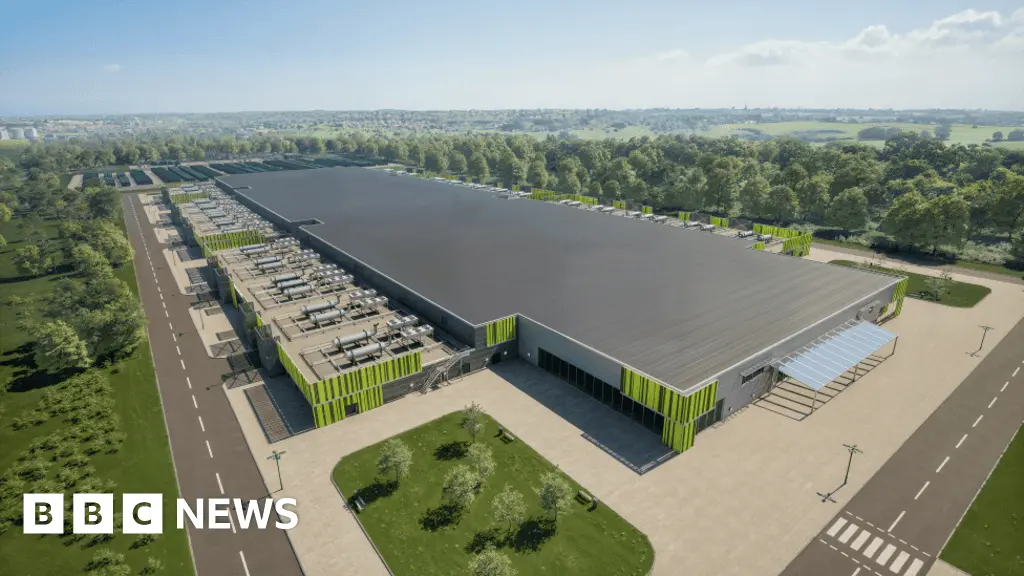
. The moratorium could halt critical projects such as the Lanarkshire AI growth zone, which anchors the government's plan to build national AI infrastructure across rural Britain1
. This £8.2 billion development, built by US firm CoreWeave and Scottish company DataVita, was announced in January as a flagship example of UK AI investment5
.Phantom Investments and Misrepresented Projects Undermine Credibility
The freeze comes amid mounting evidence that the UK's AI infrastructure push has been built on unverified claims rather than solid foundations. A Guardian investigation revealed that OpenAI apparently never visited the key site for its Stargate UK datacentre project before the initiative was announced in September 2025
2
. When reporters visited Nscale's planned supercomputer site in Loughton, Essex, in March 2026, they found a functioning scaffolding yard with no evidence of construction, despite promises the facility would be operational by the end of 20262
.The Department for Science, Innovation and Technology admitted it was "not playing an active role in auditing these commitments," despite issuing press releases describing a £1.9 billion investment contract with Nscale that had never been signed
2
. The government's AI Opportunities Action Plan, published in January 2025, cited £14 billion in private commitments to UK AI infrastructure based on company self-reporting rather than audited disclosures—a method described as producing phantom investments2
.Power Provision Issues Plague Lanarkshire Development
Documents obtained through freedom of information requests reveal that the Lanarkshire datacentre complex has no prospect of meeting its promise to be powered entirely by on-site renewables
5
. Internal correspondence shows the government and DataVita were privately acknowledging the site had an "issue" with power provision even as they publicly promised up to 1GW of "new energy infrastructure"5
. The government later confirmed the complex would connect to the national grid, meaning it will either join a years-long queue or be expedited ahead of hundreds of other projects5
.DataVita claims it will power the site with more than 1GW of renewable energy for AI, including 400MW of solar and 800MW of wind—more than one and a half times the wind energy produced by Whitelee, the UK's largest onshore windfarm
5
. However, there is no evidence this renewable energy infrastructure currently exists or will be built in the near future. At present, DataVita has two much smaller operational datacentres drawing roughly 25MW from the grid5
.Community Backlash and Broken Promises
Local residents in Newarthill, near the Lanarkshire site, report being approached by representatives of Oakes Energy Services who offered sweeteners including free solar panels, tree planting, or cash for properties
4
. Diane Davidson, a local resident, described these as unenforceable promises with "nothing written down"4
. The government's announcement promised 3,400 new "high-value" jobs and a community fund to inject "up to £543m" into local programmes, but residents increasingly fear these jobs and investments will never materialize4
.Related Stories
Energy Consumption Concerns Drive Policy Rethink
The viability of AI infrastructure increasingly depends on solving the energy question. OpenAI formally paused Stargate UK in April 2026, citing industrial electricity costs in Britain that are roughly four times higher than in the United States, Finland, Norway, and Sweden
2
. While Stargate UK stalled, Nscale invested €695 million in Portugal to supply 66,000 Nvidia GPUs to a Microsoft datacentre campus, finding more favorable energy prices and planning conditions on the continent2
.Andy Burnham, reportedly preparing to replace Keir Starmer, is considering a review of several critical planks of the UK's technology policy
3
. The environmental impact of massive datacentre developments strains grids and pushes up power bills elsewhere, forcing a wider reckoning about the true cost of the AI boom1
.AI Sovereignty Concerns Mount
Chi Onwurah, who chairs the Commons science and technology committee, criticized the UK's broader UK AI investment strategy as "very opportunistic," characterizing the process as companies announcing investments that the government counts as part of an investment plan before the investments are realized
3
. Her committee called on the next government to protect its AI sovereignty and ensure the UK cannot be cut off from key technologies at the whim of a foreign government3
.The warning carries weight after the White House blocked foreign access to the most powerful tools from Anthropic, a leading US AI firm, demonstrating that "the UK may not be able to count on even its allies for access to vital technology"
1
. Ironically, four of the nine companies awarded cash investment from the £500m Sovereign AI Fund launched in April are ultimately controlled by American firms, according to a freedom of information response3
.What Comes Next for Britain's AI Plans
A freeze would not end AI in Britain, and datacentres will continue to be built in Scotland and beyond. But the vote signals a fundamental shift in how communities and politicians approach the datacentre boom. They want consent, proof of local benefit, and verification that promised jobs will materialize before giving approval. Cecilia Rikap, an associate professor at University College London, observed that "governments around the world, including in the UK, are making political promises that ignore the realities of building infrastructure. Instead of governing for their communities, they choose the AI narrative"
5
. Ministers must now decide whether one of Britain's best sites for AI infrastructure stays open for business, or whether the pursuit of unverified commitments has undermined the credibility needed to move forward.References
Summarized by

Navi
[1]
[2]
[4]
Related Stories
OpenAI Pauses Stargate UK Data Center Project Over Energy Costs and Regulatory Concerns
09 Apr 2026•Business and Economy
Construction delays hit 40% of AI data centers as power infrastructure and labor shortages stall expansion
17 Apr 2026•Business and Economy

UK government admits AI data centres could emit 100 times more carbon than previously forecast
24 Apr 2026•Policy and Regulation

Recent Highlights



Recent Highlights
Today's Top Stories






Don’t drown in AI news. We cut through the noise - filtering, ranking and summarizing the most important AI news, breakthroughs and research daily. Follow topics that matter to you and stay ahead.


