OpenAI's gpt-oss-20b: Running the Open-Source LLM Locally on Personal Computers


2 Sources
[1]
How to run OpenAI's new gpt-oss-20b LLM on your computer
All you need is 24GB of RAM, and unless you have a GPU with its own VRAM quite a lot of patience Hands On Earlier this week, OpenAI released two popular open-weight models, both named gpt-oss. Because you can download them, you can run them locally. The lighter model, gpt-oss-20b, has 21 billion
[2]
How to set up and run OpenAI's 'gpt-oss-20b' open weight model locally on your Mac - 9to5Mac
This week, OpenAI released its long-awaited open weight model called gpt-oss. Part of the appeal of gpt-oss is that you can run it locally on your own hardware, including Macs with Apple silicon. Here's how to get started and what to expect. First, gpt-oss comes in two flavors: gpt-oss-20b and
Share
Copy Link
OpenAI releases gpt-oss-20b, an open-weight language model that can be run locally on personal computers with sufficient hardware resources. The article explores the setup process, hardware requirements, and performance across different devices.
OpenAI Releases Open-Weight Language Model
OpenAI has made a significant move in the AI landscape by releasing two open-weight models named gpt-oss
1
. The lighter model, gpt-oss-20b, boasts 21 billion parameters and requires about 16GB of free memory, while the heavier gpt-oss-120b has 117 billion parameters and needs 80GB of memory to run1
.Hardware Requirements and Performance

Source: The Register
To run gpt-oss-20b locally, users need either a GPU with at least 16GB of dedicated VRAM or 24GB or more system memory
1
. Performance heavily depends on memory bandwidth, with graphics cards featuring GDDR7 or GDDR6X memory significantly outperforming typical notebook or desktop DDR4 or DDR51
.Tests conducted on various devices revealed significant performance differences:
- ThinkPad X1 Carbon (Intel Core i7-1260P, 32GB RAM): Poor performance, taking over 10 minutes for a complex prompt
1
. - MacBook Pro 14" (M3 Max, 128GB RAM): Completed the same task in 26 seconds
1
. - Desktop PC (RTX 6000 GPU): Delivered results in just 6 seconds
1
.
Setup Process
Setting up gpt-oss-20b is relatively straightforward using Ollama, a free client app that simplifies the download and running process
1
2
. The setup process varies slightly for different operating systems:- Windows: Download and install Ollama, select gpt-oss:20b as the model, and start prompting
1
. - Linux: Use terminal commands to download and run Ollama with gpt-oss:20b
1
. - macOS: Similar to Windows, download the macOS version of Ollama and select gpt-oss:20b as the model
1
2
.
Related Stories
Limitations and Considerations
While running gpt-oss-20b locally offers exciting possibilities, users should be aware of certain limitations:
- The model lacks modern chatbot features like web result consideration, which can lead to more hallucinations compared to models like ChatGPT
2
. - Performance varies greatly depending on hardware resources, with 16GB RAM being the absolute minimum for experimentation
2
. - Running the model can significantly slow down the computer, as it utilizes all available resources
2
.
Implications for AI Accessibility
The release of gpt-oss-20b represents a significant step towards making advanced AI models more accessible to individual users and researchers. By allowing local deployment, OpenAI is enabling a wider range of experiments and applications, potentially accelerating AI innovation and understanding
1
2
.However, the hardware requirements and performance limitations highlight the ongoing challenges in democratizing access to cutting-edge AI technologies. As the field progresses, we may see further developments aimed at optimizing these models for more widespread use on consumer-grade hardware.
References
Summarized by

Navi
[1]
Related Stories
Running Advanced AI Models Locally: Challenges and Opportunities
29 Jan 2025•Technology

OpenAI and NVIDIA Unveil Open-Weight AI Models for Local Deployment on RTX GPUs
06 Aug 2025•Technology

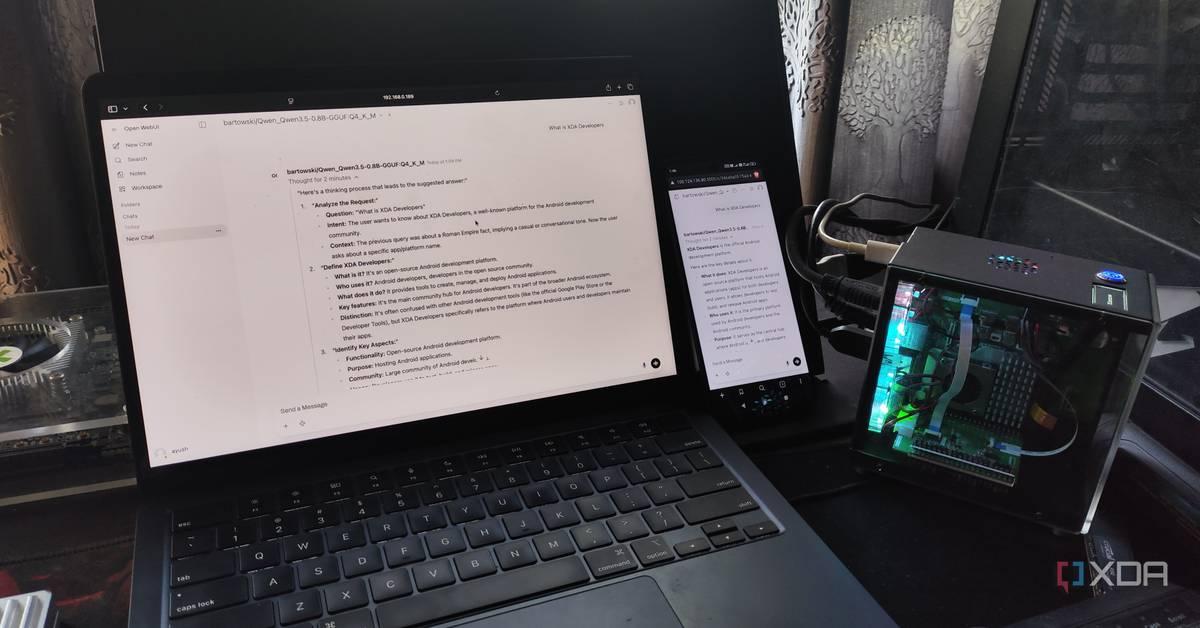
Tech enthusiasts build local LLM servers on Raspberry Pi and phones, proving on-device AI works
17 Apr 2026•Technology
Recent Highlights
1
Meta Unveils Muse Wonder Frontier AI Models, Claims Performance Matching OpenAI and Anthropic
Technology

2
IMF Report Warns AI Market Correction Could Spark Global Financial Crisis With $1.4T at Risk
Business and Economy

3
OpenAI Releases 722 AI-Generated Math Solutions, Triggering Existential Crisis in Mathematics
Technology

Recent Highlights
Today's Top Stories








Don’t drown in AI news. We cut through the noise - filtering, ranking and summarizing the most important AI news, breakthroughs and research daily. Follow topics that matter to you and stay ahead.


