OpenFold3 Emerges as Open-Source Alternative to AlphaFold3, Democratizing Protein Structure Prediction


2 Sources
[1]
Open-source protein structure AI aims to match AlphaFold
Scientists today released a 'sneak preview' of a new open-source artificial intelligence (AI) model that predicts 3D structures of proteins, and say it is close to matching the performance of Google DeepMind's revolutionary protein-folding AI AlphaFold3. The system, called OpenFold3, was developed
[2]
The AI model OpenFold3 takes a crucial step in making protein predictions
Scientists open up AlphaFold3's secrets with the new OpenFold3 model A new AI model is opening the black box of the leading artificial intelligence tool for predicting how proteins will interact with small molecules, such as drugs. The model, OpenFold3, which launched October 28, is a
Share
Copy Link
Scientists release OpenFold3, an open-source AI model that aims to match AlphaFold3's protein structure prediction capabilities. The $17 million project offers unrestricted access for both academic and commercial use, addressing transparency concerns in AI-driven drug discovery.
OpenFold3 Launch Addresses Scientific Community's Call for Transparency
The OpenFold Consortium has released a preview of OpenFold3, an open-source artificial intelligence model designed to predict three-dimensional protein structures and their interactions with other molecules. The system represents a significant step toward democratizing access to advanced protein-folding AI technology, addressing longstanding concerns about the restricted availability of Google DeepMind's AlphaFold3
1
.Developed by a non-profit collaboration of academic and private research groups headquartered in Davis, California, OpenFold3 has cost $17 million to develop and was trained on more than 300,000 molecular structures plus a synthetic database of over 40 million structures. Unlike AlphaFold3, which is available only for restricted academic use, OpenFold3 can be used by any researcher or pharmaceutical company without commercial limitations
1
.Technical Capabilities and Development Approach
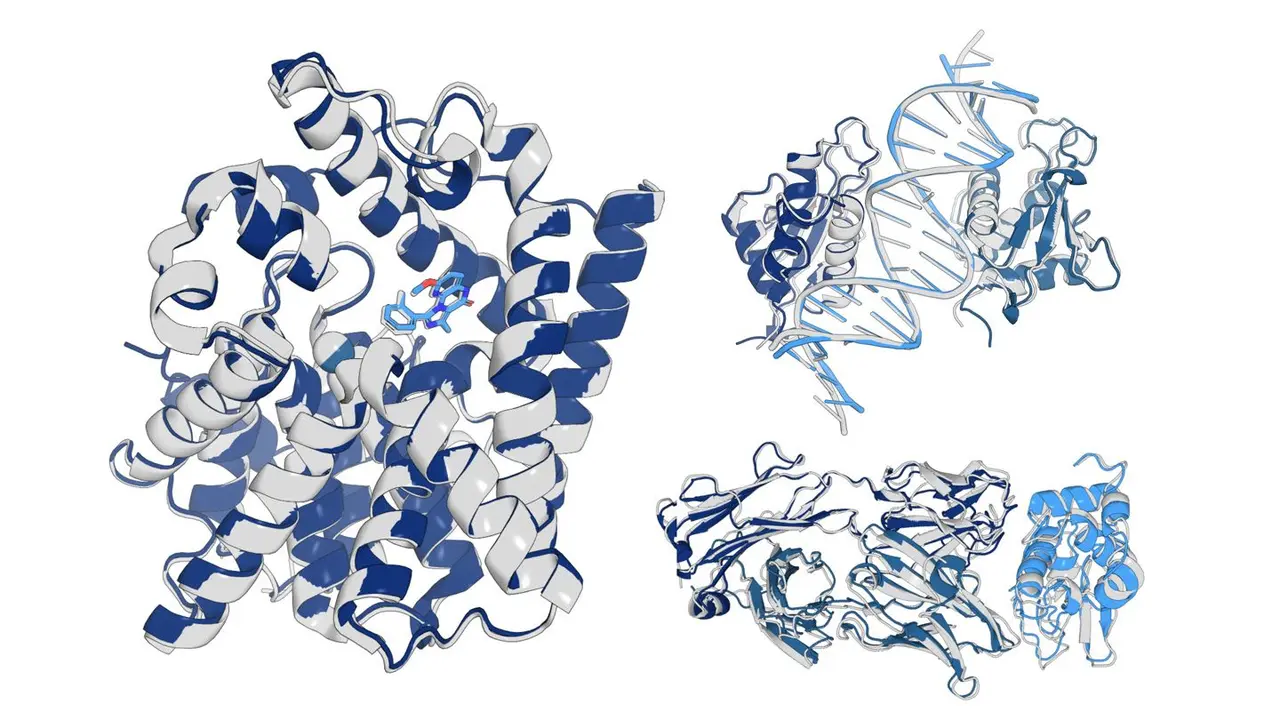
OpenFold3 uses proteins' amino acid sequences to map their 3D structures and model interactions with other molecules, including drugs and DNA. The consortium's executive committee chair, Woody Sherman, who also serves as chief innovation officer at Psivant Therapeutics, emphasized the team's commitment to community access: "We wanted to get something out to the community as soon as possible"
1
.
Source: Science News
The model represents a painstaking reconstruction of AlphaFold3's capabilities. Led by Mohammed AlQuraishi at Columbia University, researchers dissected AlphaFold3's code to create this facsimile, though some technical differences remain due to undocumented implementation details
2
.Addressing Scientific Transparency Concerns
The development of OpenFold3 emerged from widespread criticism within the scientific community regarding AlphaFold3's initial lack of code transparency. When Google DeepMind launched AlphaFold3 in May 2024 without sharing its underlying code, hundreds of scientists signed a petition calling for transparency. Stephanie Wankowicz, a computational structural biologist at Vanderbilt University who coauthored the petition, explained: "It's hard to evaluate a computational product without seeing the raw information"
2
.DeepMind eventually made AlphaFold3's code and model weights available to academics in November 2024, though they remain unavailable for commercial use. The open-source movement has gained momentum with other similar projects, including Regina Barzilay's Boltz model from MIT, which was released in late 2024
1
.Related Stories

Commercial Applications and Industry Adoption
Several pharmaceutical and biotechnology firms have already committed to using OpenFold3 for various applications, including designing drugs for autoimmune disorders, developing cell therapies, and creating molecules for plant and crop protection. The commercial viability of OpenFold3 has attracted significant industry interest, with five companies forming the Federated OpenFold3 Initiative to train the AI model on proprietary data while maintaining confidentiality
2
.Robin Röhm, cofounder and CEO of Berlin-based Apheris, which runs the federation platform, noted that only about 2 percent of publicly available protein structures are paired with druglike molecules, while pharmaceutical companies possess thousands of such structures in their databases. The federation allows companies to train OpenFold3 on 4,000 to 8,000 protein-drug pairs from their libraries, creating a more powerful prediction tool without exposing proprietary information
2
.References
Summarized by

Navi
Related Stories
Google DeepMind Open-Sources AlphaFold 3: A Game-Changer for Drug Discovery and Molecular Biology
11 Nov 2024•Science and Research

AlphaFold Upgrade: AI Now Predicts Large Protein Structures and Integrates Experimental Data
05 Nov 2024•Science and Research

MassiveFold: Revolutionizing Protein Structure Prediction with Optimized AlphaFold
14 Nov 2024•Science and Research

Recent Highlights



Recent Highlights
Today's Top Stories










Don’t drown in AI news. We cut through the noise - filtering, ranking and summarizing the most important AI news, breakthroughs and research daily. Follow topics that matter to you and stay ahead.


