5 Sources
[1]
Lumo, Proton's privacy-focused AI chatbot, gets an upgrade
Proton, the privacy-focused productivity app company, released a public AI chatbot, Lumo, last year. On Tuesday, the chatbot received an upgrade. Lumo 2.0 gives the chatbot a variety of newfound powers including image recognition and image generation capabilities. Users can now upload pictures into Lumo, then use the chatbot to analyze or edit them. Similar to other LLMs, Lumo can also generate imagery based on a user's prompt. 2.0 also expands Lumo's capabilities for Projects -- the widget that allows users to upload documents and conduct work via Proton's other products like email, cloud storage. Projects now come with user-controlled persistent memory, which is a function that allows Lumo to recall a user's preferences across various conversational sessions. Additionally, the company says Lumo's update makes it significantly more powerful than its previous version. The 2.0 version responds to most queries up to 76 percent faster than its previous iteration, the company says. The chatbot also comes with a new "thinking mode" for more complex problems or questions. "Lumo 2.0 has been re-engineered from the ground up and the introduction of thinking mode gives it powerful new capabilities," said Andy Yen, Founder and CEO at Proton. "Lumo 2.0 demonstrates that users no longer need to choose between powerful AI capabilities and meaningful privacy protections." The public version of Lumo appears roughly equivalent to other major chatbots in terms of usefulness. It answers questions in a similar format as Gemini and ChatGPT, with approximately the same level of detail and context. Yet, Proton distinguishes Lumo from other chatbot providers with its privacy protections. It uses what it calls zero-access encryption architecture, which encrypts users data in transit and at rest, only allowing access to the user. The company also claims that no server-side logging of sessions is retained, so nobody at Proton can see the contents of conversations. Proton also promises to never use customer data for AI training or share it with third-parties. Lumo 2.0 is available immediately. In addition to the free public version, Proton offers paid tiers (Plus and Professional) that give those users significantly more access and resources.
[2]
Want a private ChatGPT alternative? How Proton's Lumo 2.0 locks down your data, EU style
Follow ZDNET: Add us as a preferred source on Google. ZDNET's key takeaways * Proton debuts Lumo 2.0, overhauling the chatbot for increased security and responsiveness. * The maker of ProtonMail and ProtonVPN says its AI bot is never trained on user data. * The latest Lumo targets consumers and businesses that want to keep conversations private. Proton, best known for its ProtonMailVPN and encrypted email service ProtonMail, has announced Lumo 2.0, the second iteration of its 'privacy-first' AI chatbot, featuring "the most significant change since launch." First announced in 2025, Lumo arrived as a privacy-preserving alternative to popular AI models such as OpenAI's ChatGPT and Anthropic's Claude. While able to perform many of the same tasks -- answering user queries, searching the web, generating content including text and images, and analyzing uploaded files -- Proton emphasizes security and privacy features that other AI models don't prioritize. Also: Privacy in the AI era is possible, says Proton's CEO, but one thing keeps him up at night To date, over 10 million people have used the open source chatbot. What's new in Lumo 2.0? According to Proton, the AI chatbot's capabilities are steadily growing. On the independent Artificial Analysis Intelligence Index, which measures AI across 10 benchmarks, Lumo 2.0 has recorded a 127% improvement in functions, including speed, reasoning, and knowledge, compared to Lumo 1.4. Other upgrades include: Also: Chrome vs. Edge vs. Firefox: I tested each browser's AI, but I'm only sticking with one * Modes: Two new modes are now available, which give you the option between rapid responses for generic and basic queries ("fast" mode) or more in-depth answers that require multi-step reasoning ("reasoning" mode). * Images: Lumo can now process both text and images in the same conversation, and the same encryption standards apply to images as well. Image generation based on prompts has also improved. * Web search: Proton has also improved Lumo's web search functionality. In Lumo 2.0, you can pull live results and view citations, which should reduce the risk of error. The model now stays up to date on recent news, events, finance, and weather, which Proton says will provide "more accurate, more complete answers with fewer hallucinations." * Memory: An improvement that business users in particular may appreciate is deeper contextual memory functions. You can choose how much information is retained about you and your preferences, which can improve the quality of future conversations and work tasks -- such as managing documents and datasets. * Projects: Dedicated, secure workspaces are now available to store conversations, files, and instructions. * Custom personas: You can also develop Lumo to work to your preferences and to create a persona that is most beneficial to you. For example, you can instruct Lumo to act as a trainer, teacher, or personal assistant. How does Lumo 2.0 protect my privacy? In the second version of Lumo, the AI assistant's architecture has been overhauled, and it runs entirely on Proton's European infrastructure -- which keeps the technology and any associated data outside areas with weak or non-existent data protection laws. Proton is based in Geneva, which means its software and solutions are protected by Swiss privacy laws, among the most stringent in the world. Swiss laws align with many of the principles enshrined in the EU's GDPR protections, but tend to go further, with a guaranteed right to privacy and strict requirements for foreign data requests. Also: How to troubleshoot your PC problems with Copilot or ChatGPT - effectively Another significant privacy measure is Proton's use of zero-access encryption. Messages are encrypted, and once a response has been generated, this information is stored locally so only the user can access and decrypt it, meaning that even Proton can't read or use your data. "Your messages are encrypted across the entire network, including Proton's internal pipeline, until they reach the LLM, which keeps no logs of your chats," Proton says. "On the way back, the reply is secured with the same encryption strategy, ensuring your message never crosses any network boundary unencrypted." There's also a Ghost mode, which users can enable to ensure chats disappear once conversations are over, and your conversations, data, and inputs are not used to train the AI model. Proton also doesn't store logs or share or sell user information across its security suite, which now includes its LLM. How to try Lumo 2.0 Anyone can try out Lumo for free. You will need to sign up for an account, but an optional subscription is not required. Also: The new enterprise AI expert every company needs - and why However, those who intend to use Lumo daily or businesses that require more than just a private AI window will want to explore Lumo Plus and Lumo Professional. Available for $9.99/month, Lumo Plus offers unlimited daily chats and history, web search, the option to upload and analyze large files, access to advanced AI models, and priority support. Lumo Professional is the most appropriate option for business use, with features available including secure collaborative tools, cloud storage, email aliases, and additional Proton security features. Plans start at $11.99/month.
[3]
Proton launches Lumo 2.0 with image generation, memory, more
Today, Proton is introducing Lumo 2.0, in what the company says is the largest upgrade to its privacy-first AI assistant to date. Here are the details. Proton Lumo 2.0 now available Last July, Proton announced Lumo, a privacy-focused AI assistant built around five core principles: no logs, zero-access encryption, no data sharing, no use of conversations for AI training, and open-source language models. Today, the company best known for its encrypted email service, Proton Mail, announced Lumo 2.0, which builds on that foundation to deliver improved performance and new capabilities. Here's what's new with Lumo 2.0: * Image recognition and generation: New multimodal capabilities, allowing users to analyze, edit, and generate images all in the same conversation, protected by zero-access encryption * Deeper context with memory: User-controlled memory, encrypted Projects, and Custom Lumos for more personalized and productive AI workflows * Powerful new web search capabilities: Enhanced web search with live results and source citations, providing more accurate, transparent, and up-to-date answers Proton says that while more than 10 million people have adopted Lumo "as a private alternative to other leading AI platforms," Lumo 2.0 is also aimed at businesses looking to use advanced AI without exposing sensitive company data: Lumo for Business is built for organisations that can't afford those risks. Every conversation is zero-access encrypted, never logged, and never used to train future models. Administrative tools let them manage their team's access, and the company's data stays on independent European infrastructure meaning access to Lumo cannot be subject to US Executive Orders and user data is not subject to American data collection requests. One of the highlights of today's launch is Lumo 2.0 Max, which Proton says scored 240% higher than Lumo 1.4 on the Artificial Analysis Intelligence Index. The index combines results from nine benchmarks, including GDPval-AA v2, Terminal-Bench v2.1, Humanity's Last Exam, and GPQA Diamond. The company adds that Lumo 2.0 Lite also posts a substantial gain, scoring 127% higher than Lumo 1.4 on the same index. Here's Andy Yen, Founder and CEO at Proton, on today's launch: "Lumo 2.0 has been re-engineered from the ground up and the introduction of thinking mode gives it powerful new capabilities. User testing demonstrates that the gap has closed to the point that for many use cases, users can no longer perceive a qualitative difference between Lumo 2.0 Max and the latest models from OpenAI and Anthrophic.(sic) [...] Lumo 2.0 demonstrates that users no longer need to choose between powerful AI capabilities and meaningful privacy protections." Lumo 2.0 is available now, with core AI features included in the free tier for what Proton calls "everyday private use." Two paid plans are also available: * Lumo Plus: Unlimited chats, Projects, advanced image generation, and access to Proton's most capable models * Lumo Professional: Advanced capabilities for teams requiring secure AI collaboration To learn more about Lumo 2.0, follow this link. Worth checking out on Amazon
[4]
I Tried Proton's Privacy-First AI Chatbot to See If It's Better Than ChatGPT
If you're a regular Lifehacker reader, you'll know Proton develops a range of privacy-first products, including an email service, a VPN, and cloud storage. It also now has its own AI chatbot, called Lumo -- first launched in August 2025, and recently upgraded with a host of new capabilities, including image generation. Having given Lumo 1.0 a test run last year, I found it a capable AI assistant. While it wasn't on the same level as apps like ChatGPT and Gemini, it got close enough to make it worth considering if you didn't want to deal with OpenAI and Google. Now that Lumo 2.0 is live, I was keen to give it another go. Lumo is available on the web, on Android, and on iOS, and you can get started for free -- you don't even need a Proton account. As you might expect, there's a $12.99 per-month Pro tier available, which gets you features like a full chat history, more advanced AI models, and higher usage rates in terms of chats and file sizes. Unfortunately, the Pro tier is not included in Proton's other subscription packages -- it's separate. How Proton's privacy stacks up Read the Lumo 2.0 launch post, and you'll see the company is very keen to make its AI assistant stand out in terms of how little data and personal info it keeps. Of course, some data storage is necessary for the bot to actually work, and if you want, you can keep your chats around to refer back to. First of all, your chats aren't used to train the AI models Lumo is built on. That's something you'll find as an option you can toggle in bots such as ChatGPT and Gemini, while it's also a selling point for Apple Intelligence. Other AIs are less transparent when it comes to this aspect, so it's good to see Proton mentioning it up front. There's also zero-access encryption for your chats, which means no one can take a peek at what you're reading -- not law enforcement, government agencies, or even Proton staff. That's a clear advantage over other AI platforms, though the likes of Google and OpenAI would argue there are strict legal procedures and strong regulations in place to keep your saved chats private. However, like other AIs using LLMs, Lumo can't offer full end-to-end encryption, as Proton explains here. It's hard to be definitive here in comparing Lumo to other services, because a lot depends on whether you're saving or erasing chats as you go. To complicate matters further, OpenAI is currently having to hang on to a good chunk of all user chats (even the deleted ones) as part of its ongoing lawsuit with the New York Times. What is clear is that Proton takes the issue more seriously than just about anyone else at the moment. There is no review of chats by humans, which happens with other chatbots like Gemini -- in order to "help improve Google services" for you and everyone else, supposedly (which is why you should never share anything too private with an AI chatbot). What's more, Lumo runs on open source AI models, which should mean more transparency. There's no partnership with any third party in terms of how the service is run, so you can be sure that the policies and protections Proton has implemented aren't going to be compromised through connections to other companies. You can read more on Lumo privacy on the Proton website, including information on the large language models (LLMs) used by the chatbot. As ever with Proton, it's worth remembering that it operates out of Europe -- meaning it's not subject to the same kind of data surveillance and retention policies as somewhere like the U.S. Lumo 2.0 vs ChatGPT In my Lumo 1.0 hands-on, I mentioned that image generation and deep reasoning were a couple of the features that it lacked compared to other chatbots -- but that's no longer the case. To begin with, Lumo 2.0 can both generate and analyze images, so I was eager to give this new functionality a go right away. I set Lumo to work on generating an image of a spaceship, a forest cabin, and a cartoon cityscape, and the results were pretty even: Lumo can certainly hold its own against ChatGPT in terms of the pictures it creates, and I actually preferred its space one. ChatGPT's efforts were a little bit more impactful overall, though they also went off-script (or off-prompt) more. Lumo lets you modify images you've created through follow-up prompts like ChatGPT does, and it really impressed me in terms of how quickly the images were generated -- it produced something usable in fewer seconds, though to be fair, the graphics it produced were also at slightly lower resolutions. Lumo 2.0 comes with a new Thinking mode, which is slower than the alternative Fast mode but better at reasoning. I put it to work on a few dense scientific research papers, and its analysis and summaries appeared to be on a par with ChatGPT's in terms of how well they were written and structured. On a couple of occasions, Lumo actually presented the relevant information in a more accessible way than the OpenAI chatbot. Web search is another area where Lumo 2.0 brings improvements, and again, Proton's AI app matched ChatGPT in terms of how it collected and organized information from the web. I got both bots to summarize a few current tech news stories, and they were equally capable in terms of summaries, complete with updates on search progress along the way, and references at the end. ChatGPT tended to be a little more thorough, but I liked the way Lumo presented its info. Other upgrades in Lumo 2.0 include improved memory recall and management, and Custom Lumos that match the Custom GPTs in ChatGPT: They let you create siloed AI assistants for specific tasks, like polishing text or outputting web searches in specific formats. Lumo has clearly come a long way since the initial release, both in terms of the quality of its answers and the features on offer. ChatGPT is still the more mature AI product, with features like live voice mode and professional coding assistants, but the gap between Lumo and the established AI chatbots is now significantly smaller -- certainly for casual, everyday use. If you're looking for AI with a few more principles built in, it's worth considering.
[5]
Proton launches Lumo 2.0 with image AI and zero-access encryption
Proton has launched Lumo version 2.0, its most significant update to the privacy-focused chatbot nearly a year after its initial release. The updated version introduces image recognition and generation capabilities, positioning Lumo 2.0 as a competitor to established models like ChatGPT and Gemini. Lumo 2.0 can generate, analyze, and edit images while ensuring that conversations involving images are protected by zero-access encryption. This encryption allows accessibility solely on the user's device, preventing third-party access, including from Proton itself. The update includes a new "thinking mode" designed to enhance the chatbot's reasoning capabilities. Proton reports that Lumo 2.0 Lite scored 127 percent higher than its predecessor, Lumo 1.4, on the Artificial Analysis Intelligence Index benchmark. Lumo 2.0 Max achieved a score 240 percent higher than Lumo 1.4 on the same benchmark, which evaluates models across various tasks. Improvements in context awareness allow Lumo 2.0 to conduct deeper searches for background information and provide more accurate responses. The chatbot can now also deliver the latest information and source citations in its responses. Lumo 2.0 is available for use with its core AI capabilities offered for free. A subscription option, Lumo Plus, is available for $10 per month, which provides unlimited chats, advanced image generation, and access to Proton's more sophisticated models. Proton founder and CEO Andy Yen stated, "Lumo 2.0 has been re-engineered from the ground up and the introduction of thinking mode gives it powerful new capabilities." He added that user testing indicates the gap between Lumo 2.0 Max and competing models from OpenAI and Anthropic has narrowed significantly, allowing users to benefit from both advanced AI capabilities and robust privacy protections.
Share
Copy Link
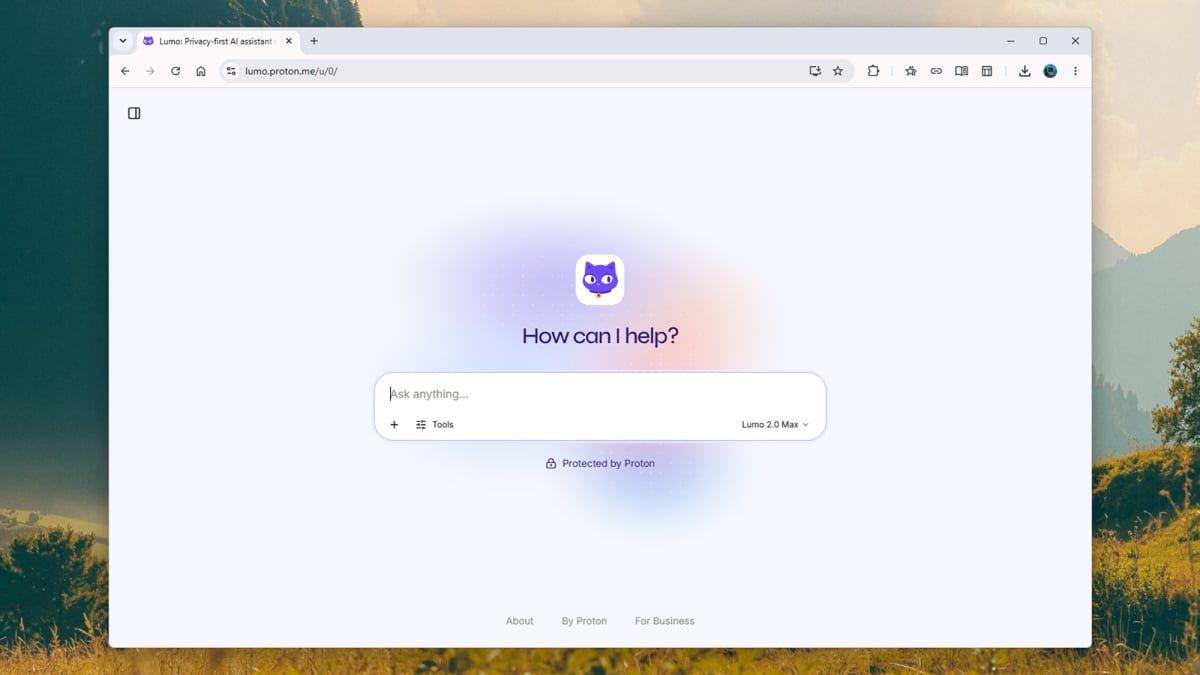
Proton launched Lumo 2.0, the most significant upgrade to its privacy-focused AI chatbot since its 2025 debut. The update introduces image generation and recognition, a new thinking mode for complex reasoning, and enhanced web search capabilities. With over 10 million users, Lumo positions itself as a privacy-preserving alternative to ChatGPT and Gemini, running entirely on European infrastructure with zero-access encryption that prevents even Proton from accessing user conversations.
Proton has released Lumo 2.0, marking the most substantial upgrade to its privacy-focused AI chatbot since its August 2025 launch
1
. The update transforms Proton's privacy-first AI chatbot into a multimodal assistant capable of generating, analyzing, and editing images while maintaining the company's stringent privacy protections. Users can now upload pictures into the AI chatbot and use it to analyze or edit them, with all image-related conversations protected by zero-access encryption5
.The update introduces two distinct operational modes: a fast mode for rapid responses to generic queries and a reasoning mode that enables multi-step analysis for complex problems
2
. This thinking mode represents a significant enhancement to Lumo's capabilities, positioning it as a more competitive privacy-preserving alternative to ChatGPT and other mainstream platforms. According to Proton, the AI chatbot now responds to most queries up to 76 percent faster than its previous iteration1
.
Source: ZDNet
Proton Lumo 2.0 has demonstrated substantial performance gains across multiple benchmarks. On the independent Artificial Analysis Intelligence Index, which evaluates AI models across 10 different benchmarks including GDPval-AA v2, Terminal-Bench v2.1, Humanity's Last Exam, and GPQA Diamond, Lumo 2.0 Lite scored 127 percent higher than Lumo 1.4
2
. The more advanced Lumo 2.0 Max achieved an even more impressive 240 percent improvement over the previous version3
.Andy Yen, Founder and CEO at Proton, stated that user testing demonstrates the gap has closed to the point where users can no longer perceive a qualitative difference between Lumo 2.0 Max and the latest models from OpenAI and Anthropic for many use cases
3
. This performance parity matters because it eliminates the traditional trade-off between capability and privacy that has characterized the AI chatbot landscape.What distinguishes Proton Lumo 2.0 from competitors like ChatGPT and Gemini is its comprehensive approach to privacy through zero-access encryption
1
. This architecture encrypts user data both in transit and at rest, ensuring that only the user can access their conversations. Messages remain encrypted across Proton's entire network, including its internal pipeline, until they reach the large language model, which keeps no data logging of chats2
.The AI chatbot runs entirely on Proton's European infrastructure, which keeps the technology outside jurisdictions with weaker data protection laws
2
. Based in Geneva, Switzerland, Proton operates under Swiss privacy laws that align with EU/GDPR standards while often exceeding them in stringency. This means access to Lumo cannot be subject to US Executive Orders, and user data is not subject to American data collection requests3
. Proton promises never to use customer data for AI training or share it with third parties1
.
Source: Lifehacker
Related Stories
Proton Lumo 2.0 introduces user-controlled memory within its Projects feature, allowing the AI chatbot to recall user preferences across multiple conversational sessions
1
. This persistent memory function enables more personalized interactions while maintaining privacy controls, as users determine how much information is retained. Projects now serve as dedicated, secure workspaces where users can store conversations, files, and instructions2
.The update also brings improved live web search capabilities with source citations, reducing the risk of hallucinations and providing more accurate, up-to-date information on recent news, events, finance, and weather
2
. Hands-on testing revealed that Lumo's image generation matched or occasionally exceeded ChatGPT's output quality, with notably faster generation times4
. The chatbot's analysis of dense scientific research papers appeared on par with ChatGPT in terms of structure and accessibility4
.Proton Lumo 2.0 is available immediately with core AI features included in a free tier for everyday private use
3
. The service can be accessed on the web, Android, and iOS without requiring a Proton account4
. For users requiring more advanced capabilities, Lumo Plus is available at $9.99 per month, offering unlimited chats, Projects, advanced image generation, and access to Proton's most capable models1
5
.Lumo Professional targets businesses that cannot afford the risks associated with exposing sensitive company data to conventional AI platforms. With over 10 million people having adopted the privacy-preserving alternative to ChatGPT since launch, Proton is positioning Lumo 2.0 as a solution for organizations seeking secure AI tools without compromising on capability
2
. The chatbot is built on open-source language models, providing additional transparency compared to proprietary alternatives3
.Summarized by
Navi
1
Policy and Regulation

2
Policy and Regulation

3
Policy and Regulation