Qlik makes data governance the foundation for enterprise AI as agentic analytics reshape decisions


4 Sources
[1]
AI-driven decision-making reshapes analytics - SiliconANGLE
The dashboard is dead, but what comes next requires a lot more than just faster AI AI-driven decision-making has arrived, putting a focus on trusted data and strong governance so outputs stay reliable at scale. The shift is rewriting the relationship between people and data. Instead of relying on
[2]
Qlik's most important AI feature is knowing when to say nothing . Boring is brilliant
There's a phrase that's stuck with me since a conversation with Martin Tombs, VP Global Go-to-Market for Analytics and Field CTO EMEA at Qlik, back in February: "boring is brilliant." He used it to describe the unglamorous but essential work of data governance. I deployed it back at him in the
[3]
Governed data is AI's real competitive edge, says Qlik - SiliconANGLE
It's not governance slowing down enterprise AI -- it's the lack of it, says Qlik executive Enterprises are chasing AI models at a dizzying pace, yet the organizations pulling ahead are the ones that paused to build something less glamorous: a trusted, governed data foundation. Pressure is
[4]
Qlik Looks To Boost AI Effectiveness, Predictive Capabilities With New Agents
The data integration, governance and analytics giant, which is holding its Qlik Connect conference this week, is emphasizing the need for trusted data as businesses and organizations look to put AI into production and generate business value. Qlik is expanding the agentic analytics capabilities of
Share
Copy Link
Qlik positioned data governance as the critical enabler for enterprise AI at its Connect 2026 conference, announcing new agentic analytics capabilities including Predict Agent and Automate Agent. CEO Mike Capone addressed widespread frustration over AI investments that aren't delivering returns, pointing to data quality and governance as the primary blockers. The company also unveiled a ServiceNow partnership and expanded its AI agent portfolio beyond analytics to data engineering.
Qlik Positions Data Governance as Enterprise AI's Critical Accelerator
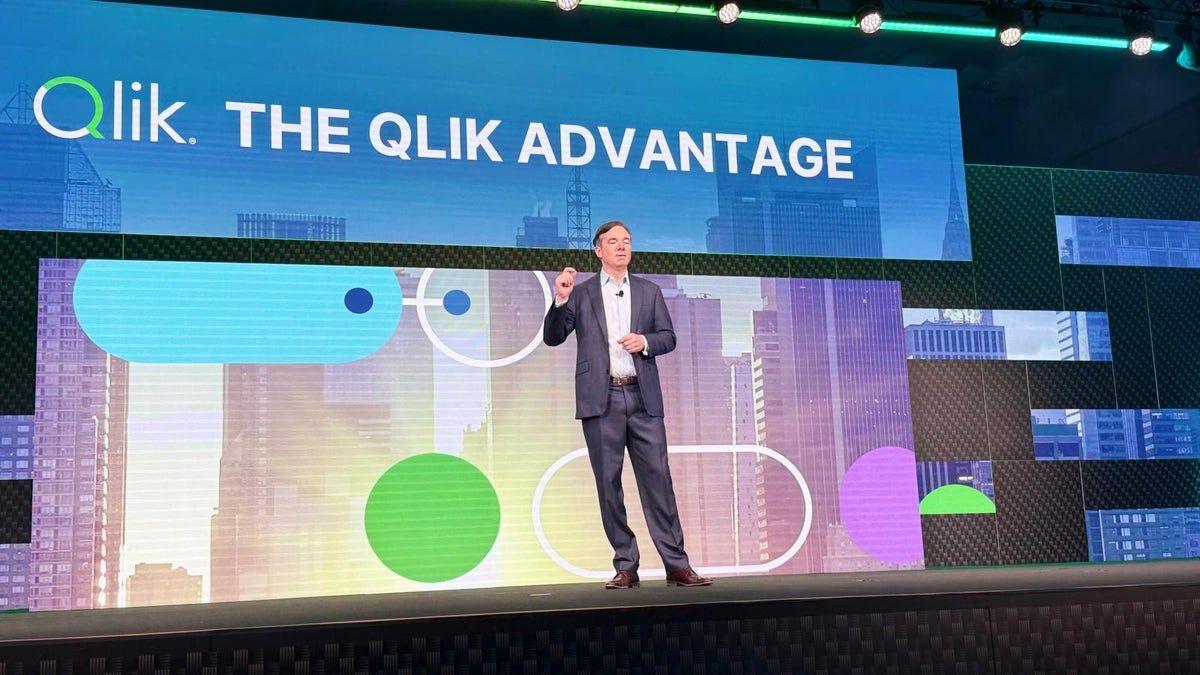
Qlik is reframing data governance from a perceived bottleneck into the essential foundation for enterprise AI success. At Qlik Connect 2026 in Orlando this week, the data integration and analytics company announced expanded agentic analytics capabilities while emphasizing that organizations achieving AI momentum are those that invested in governed, trusted data foundations first
3
.CEO Mike Capone opened the conference keynote by acknowledging widespread executive frustration with AI investments that fail to deliver returns. "Companies are spending a lot of money on AI, but they are not getting the return. They're not getting the value," Capone told thousands of attendees, declaring that "the reckoning is here"
4
. Research from Qlik and Enterprise Technology Research confirms that data quality, availability and governance remain the top blockers to scaling agentic AI deployments across industries3
.
Source: CRN
AI-Driven Decision-Making Demands Trusted Data Foundation
The shift toward AI-driven decision-making is fundamentally changing how organizations interact with data. Nick Magnuson, head of AI at Qlik, explained that AI can now handle work previously done through dashboards and reports, and even act autonomously on behalf of users. But this autonomy only creates value when the underlying data can be trusted
1
."It's changing a lot of paradigms -- how we think about acting on that information, how we think about constructing data and supporting that data through that life cycle now, because we've got autonomous things in the mix that aren't human in nature," Magnuson said. The frameworks organizations relied on in the past need rethinking from the ground up to accommodate these autonomous systems
1
.
Source: SiliconANGLE
James Fisher, chief strategy officer at Qlik, advocates for what he calls the "go slower to go faster" approach. "By creating and taking the time to build that foundation -- to think about where it's gonna be used, how it's gonna be applied -- just that little step, that little extra time you take there will provide exponential benefits long term," Fisher explained
3
.Qlik Expands Agentic Analytics Portfolio With Predictive Capabilities
Building on the February general availability of Qlik Answers, the company's AI-powered analytical assistant, Qlik announced that more than 1,000 customers have now activated the platform's agentic capabilities
4
. At Connect this week, Qlik expanded its agent portfolio with two significant additions.Predict Agent, slated for availability later this quarter, enables users to ask forward-looking questions using natural language. The agent builds machine learning models, generates predictions, and interprets results without requiring data science expertise
4
.Automate Agent creates a direct link from analytics to execution, allowing data teams to trigger workflows based on analytic results through natural language prompts. This bridges the gap between insight and action, addressing a longstanding challenge in enterprise analytics
4
.The Discovery Agent, launched in March, continuously monitors key data areas for important changes and anomalies, proactively alerting users to emerging risks without requiring manual investigation. Martin Tombs, VP Global Go-to-Market for Analytics and Field CTO EMEA at Qlik, described this capability as identifying "anomalies, trends, and risk" and telling "decision-makers that without me finding it all for them"
2
.
Source: diginomica
ServiceNow Partnership and Model Context Protocol Extend Reach
Qlik announced a partnership with ServiceNow designed to improve the quality of data and analytics flowing into ServiceNow's AI-driven workflows
4
. This collaboration complements Qlik's February announcement of its Model Context Protocol (MCP) server, which enables third-party AI assistants like Anthropic Claude to securely access Qlik's analytical capabilities and governed data products2
.Tombs uses a door analogy to explain MCP's role: if Qlik Answers is the front door to the company's analytics house, MCP is the side door that external agents can use. But governance remains essential. "By opening this front door, you've always got to have a bouncer on the door that says, 'What are you coming in for? What are you doing?'" Tombs explained
2
.The MCP implementation standardizes not just API calls but capability discovery itself, enabling external agents to understand what a tool does before deciding whether to invoke it. This matters particularly for multi-agent orchestration, where agents select tools dynamically rather than following hard-coded instructions
2
.Related Stories

Human Oversight and Glass Box AI Build Trust
One of Qlik's most significant design decisions addresses the hallucination problem plaguing many AI systems. When Qlik Answers receives a query outside its governed dataset, it refuses to generate a response rather than risk providing incorrect information. "If I give you three wrong answers, you're going to be out very quickly in asking me questions. And that's really how I see the adoption of any vendor's product," Tombs said
2
.This approach contrasts sharply with what Igor Alcantara, director of data science at Qlik consulting partner IPC Global, described as the "black box" nature of many AI products on the market. "You have no idea of the reasoning behind the results, you have no idea of how the AI delivered the results," Alcantara said during a panel session at the Qlik Partner Summit. Qlik's technology, he explained, operates as a "glass box" where the reasoning, source data, and other elements of AI output remain transparent
4
.Magnuson emphasized that human oversight remains critical even as AI takes on more autonomous roles. "We have that superpower that we kind of sit above it, and the ability to put in the governance frameworks and the things that make it work over time," he explained. "AI is not a point in time, it's an over time situation. You've got to be able to have humans that can get in there and assess the thing, put together the system and then monitor it"
1
.Data Engineering Gets Agentic Capabilities
Qlik extended its agentic AI strategy beyond analytics to include data engineering, bringing autonomous capabilities to teams who manage data pipelines and infrastructure. The new strategy focuses on engineering execution for declarative pipelines, real-time data routing, and data lakehouse streaming. Qlik says these capabilities reduce friction in how data pipelines are built, altered, and operated
4
.The company's Analytics Agent technology now supports analytics software development tasks in addition to generating analytical insights. Qlik also announced expanded trust and governance capabilities for AI centered on data products—curated, reusable datasets with the operational controls required to make them reliable for both human decision-making and AI-driven actions
4
.Fisher noted that data products built around specific consumer needs create organizational momentum. Solving one use case with a well-structured data product tends to unlock the next, creating a compounding effect. "While we're all worrying about data infrastructures and building agents and the cost of deployment, I think it's always important we understand about the user, about the individual that's working with it," Fisher said. "We need to not only democratize access to AI, but democratize the value that can come from it"
3
.References
Summarized by

Navi
[1]
Related Stories
Qlik Unveils AI-Driven Data Lakehouse and Agentic Capabilities at Qlik Connect 2025
17 May 2025•Technology
AI Agents Trigger Security Crisis: 65% of Enterprises Report Incidents Amid Scaling Challenges
06 Aug 2026•Technology
AI on Bad Data Risks Faster Failures as 57% Pilot Agents But Only 8% Have Production-Ready Data
01 Oct 2026•Technology

Recent Highlights



Recent Highlights
Today's Top Stories








Don’t drown in AI news. We cut through the noise - filtering, ranking and summarizing the most important AI news, breakthroughs and research daily. Follow topics that matter to you and stay ahead.


