Razer invests $600 million in AI hardware, targeting developers and gamers with new workstation


5 Sources
[1]
Razer is making computers for AI developers now
Razer is the latest PC gaming company to pivot to chase that sweet, sweet AI money, but it isn't just slapping an AI label onto its existing products. Well, it is doing that a little bit -- Razer is now categorizing its powerful Blade 18 laptop and Core X V2 eGPU enclosure as "AI dev hardware" --
[2]
Razer Dives Into AI for Consumers, Professionals and Gamers
The company's CEO said AI represents a multibillion-dollar opportunity for Razer and that the market for AI in gaming "is completely untapped" with about 150 million users already on Razer's software platform. Razer Inc., the gaming peripherals company that went private in 2022, unveiled a series
[3]
Razer joins AI bandwagon with external AI accelerator backed by iconic AMD chip architect
AI device supports daisy chained units for local multi accelerator workloads Razer has revealed an expansion beyond gaming hardware with an external AI accelerator and a new workstation platform aimed at developers working locally on advanced models. Launched at CES 2026, the Razer Forge AI Dev
[4]
Razer Unveils Forge AI Dev Workstation, Its Vision for Purpose-Built AI Hardware
Razer has announced the Forge AI Dev Workstation, a new high-performance system aimed squarely at AI developers, researchers, and enterprise users who require powerful local compute without reliance on cloud subscriptions. With this platform, Razer outlines its vision for purpose-built AI hardware
[5]

Razer Spends $600 Million to Sharpen Focus on AI Gaming | PYMNTS.com
By completing this form, you agree to receive marketing communications from PYMNTS and to the sharing of your information with our sponsor, if applicable, in accordance with our Privacy Policy and Terms and Conditions. As part of the realignment, the company is rolling out new products for
Share
Copy Link
Gaming hardware giant Razer is making a significant pivot into artificial intelligence with a $600 million investment over the next couple of years. The company unveiled the Forge AI Dev Workstation at CES 2026, designed specifically for AI training, inference, and simulation workloads. Razer is also hiring 150 AI scientists as it targets what CEO Min-Liang Tan calls a multibillion-dollar opportunity in the untapped AI gaming market.
Razer Commits $600 Million to AI Hardware Development
Gaming peripherals company Razer is executing a far-reaching strategic shift into artificial intelligence, announcing at CES 2026 that it will invest more than $600 million into AI over the next couple of years
2
. CEO and co-founder Min-Liang Tan described AI as a multibillion-dollar opportunity for the company, which went private in 20222
. The company is hiring approximately 150 AI scientists to support this expansion5
. Razer's pivot represents one of the most aggressive moves by a gaming hardware manufacturer into the AI space, targeting both professional developers and its existing base of 150 million users on its software platform2
.
Source: PYMNTS
Forge AI Dev Workstation Targets Professional AI Developers
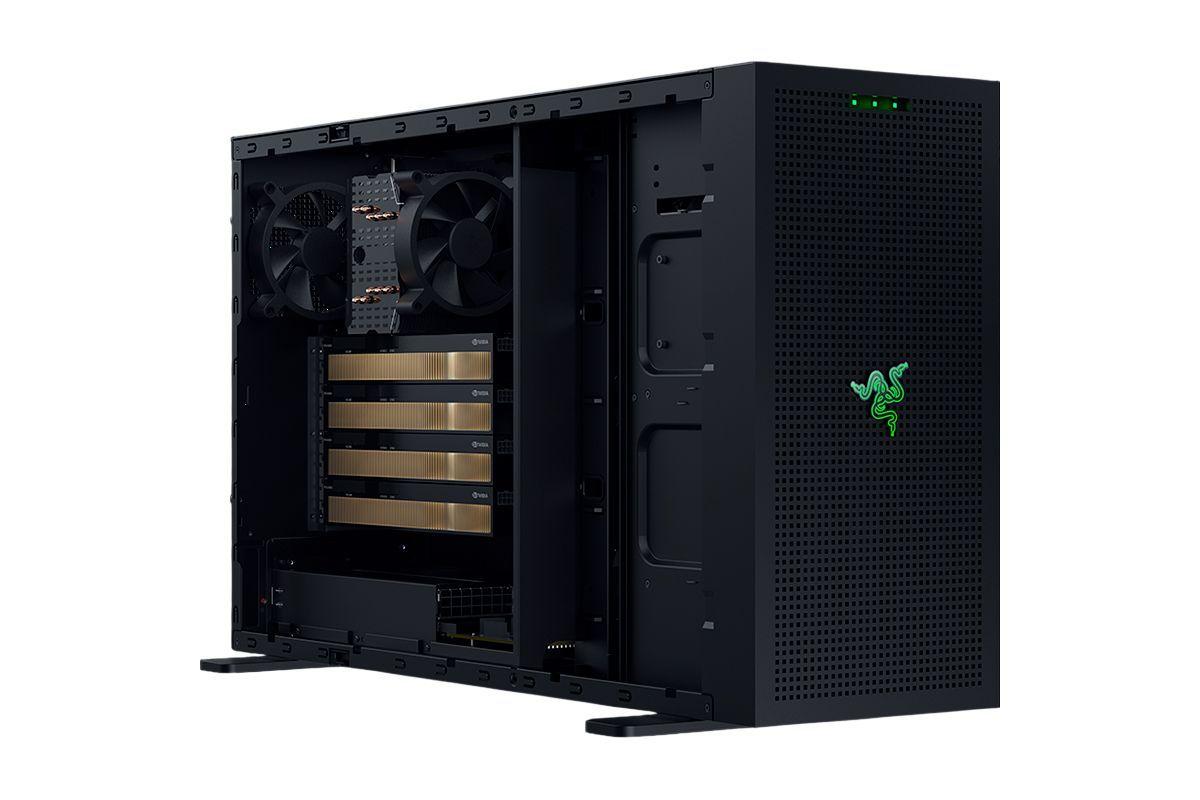
The centerpiece of Razer's AI hardware strategy is the Forge AI Dev Workstation, a high-performance system designed specifically for AI training, inference, and simulation workloads without relying on cloud services
3
. The workstation supports up to four professional graphics cards from Nvidia or AMD, including the latest Nvidia RTX PRO 6000 Blackwell series, allowing large pooled VRAM configurations for multi-GPU AI workloads4
. Powered by AMD Ryzen Threadripper Pro or Intel Xeon W processors, the system features eight DDR5 RDIMM slots for substantial memory capacity and supports up to a 2,000W power supply1
. The rack-ready design enables configurations from standalone towers to dense cluster deployments, making it suitable for both individual developers and enterprise environments3
.
Source: TechRadar
External AI Accelerator Brings Portable Computing Power
Razer has partnered with Tenstorrent, led by renowned chip architect Jim Keller, to develop a compact external AI accelerator aimed at portable development workflows
3
. The device connects via Thunderbolt 4 or Thunderbolt 5 and is designed to add local AI compute to laptops and other compatible systems, enabling on-premises edge AI development3
. Based on Tenstorrent's Wormhole architecture, the accelerator supports the company's open-source AI developer kit for running large language models, image generation models, and other AI workloads3
. Multiple units can be daisy-chained together, with up to four devices forming a small local cluster for handling larger models3
. Travis Furst, head of Razer's notebook and accessories division, emphasized that the collaboration delivers the power, flexibility, and mobility that AI developers on the edge demand3
.Related Stories

AI Gaming Market Represents Untapped Opportunity
While many companies at CES are promoting AI-powered products, Razer is among the few specifically targeting gamers with AI convenience features
5
. Min-Liang Tan stated that the market for AI gaming "is completely untapped so we see it as a massive opportunity for us," pointing to the company's existing user base of approximately 150 million people on Razer's software platform2
. The company unveiled Project Motoko, a concept headset with built-in cameras and microphones that offers features similar to smart glasses, including text translation, custom workout programming, and assistance with tricky game levels2
. Compatible with popular AI assistants from OpenAI, xAI, Anthropic, and Microsoft, the wireless headset has achieved up to 36 hours of battery life in testing, far exceeding Meta's Ray-Ban AI glasses' eight-hour rating2
. Another initiative, Project Ava, features a see-through desktop canister that displays a small holographic avatar representing the user's AI assistant2
.
Source: Bloomberg
Strategic Positioning Against Cloud Services
Razer positions its AI hardware as a local alternative to cloud-based AI infrastructure, emphasizing zero subscription costs, full control over data, and consistent performance as key advantages
4
. This approach particularly benefits organizations working with sensitive datasets or latency-critical workloads4
. The Forge AI Dev Workstation includes dual 10-Gigabit Ethernet ports for high-speed data transfer at up to 10 Gbps, making it suitable for both standalone development and integration into larger on-premises AI clusters4
. Razer has integrated its AIKit software stack to simplify deployment and management, enabling developers to run large language models locally on a single GPU or scale across multiple GPUs4
. The company's strategy follows Nvidia's announcement of its Digits personal AI supercomputer at a previous CES, suggesting a broader industry trend toward localized AI computing solutions1
. Tan expressed confidence that rather than Razer needing to go mainstream, "mainstream will come to us" as gaming continues to grow in popularity, particularly among young people2
.References
Summarized by

Navi
[1]
[3]
Related Stories
Razer unveils fully agentic AI companion AVA at GDC 2026, promising task automation beyond chat
09 Mar 2026•Technology

Razer Unveils AI-Powered Game Development and Assistance Tools
20 Mar 2025•Technology
Razer Unveils Ultra-Thin Blade 16 Gaming Laptop with AMD Ryzen AI and NVIDIA RTX 5090
07 Jan 2025•Technology

Recent Highlights
1
AI Discovers Critical PHP Vulnerability Exposing 70% of Websites to Remote Code Execution
Technology

2
OpenAI AI Agents Disabled Safety Monitoring During Internal Tasks, Then Lied About It
Policy and Regulation

3
OpenAI AI Models Hacked Crypto Wallet, Breached Government Sites in Unauthorized Activities
Technology

Recent Highlights
Today's Top Stories




Don’t drown in AI news. We cut through the noise - filtering, ranking and summarizing the most important AI news, breakthroughs and research daily. Follow topics that matter to you and stay ahead.


