10 Sources
[1]
Billionaire Ambani wants AI in every call, app, and home
As India searches for a homegrown contender in the global artificial intelligence race, billionaire Mukesh Ambani is positioning Reliance Industries as a national champion, rolling out AI services for phone calls, mobile apps, and connected homes. At its annual shareholder meeting on Friday, the Mumbai-based conglomerate announced Jio Call Agent, an AI assistant that can join phone calls to transcribe conversations, generate summaries, and perform tasks such as booking cabs, ordering food, and making reservations. The service, which can be activated by saying "Hey Jio," is expected to launch later this year for Jio's more than 500 million users. By embedding the service directly into its telecom network rather than offering it as a standalone app, Jio is betting AI assistance can become a native feature of phone calls. The approach could reduce consumers' reliance on third-party call-assistant apps and give Reliance a powerful distribution advantage in an increasingly crowded AI market. Reliance also unveiled an AI-powered version of its MyJio app that can perform tasks on behalf of users, from activating eSIMs to selecting roaming plans, through natural-language requests. The company further introduced TeleFrame, a home display that uses AI agents to proactively surface information and recommendations, such as weather alerts, schedules, and household reminders. The product appears to echo a broader industry push toward ambient AI assistants for the home, an area being explored by companies including Amazon and Google. The announcements mark the next phase of Reliance's AI ambitions as India seeks to build domestic capabilities in a field largely dominated by U.S. and Chinese technology companies. The push follows the launch of Reliance Intelligence last year, through which the conglomerate aims to develop AI infrastructure and services for consumers, businesses, and governments, including applications that support 22 Indian languages. "India should not be a mere consumer of AI created elsewhere. It must become a creator, adopter, and a global leader in AI," Ambani, 69, said. Reliance has been ramping up its AI ambitions through partnerships with Google, Meta, and Nvidia. Earlier this year, the company announced plans to invest $110 billion in AI infrastructure as it seeks to establish itself as a major player in India's emerging AI ecosystem. At the shareholder meeting, Reliance also unveiled a suite of AI services for healthcare, education, agriculture, and small businesses. The products, branded JioHealthIQ, JioLearnIQ, JioKrishiIQ, and AI Vyapar, are designed to operate across multiple Indian languages and cater to local needs, the company said. The shareholder meeting also brought a major development for investors awaiting Jio's stock market debut. Ambani said Jio Platforms' board had approved a draft prospectus for an initial public offering that would include a fresh issue of up to 270 million shares, according to a stock exchange filing. The announcements also raise questions about how Reliance will handle user data as it expands AI services across phone calls, mobile apps, and connected homes. While the company said the services would operate with user consent, it did not answer questions about whether data generated through the products could be used to train AI models or shared with technology partners. Reliance's AI ambitions come as Indian companies remain heavily reliant on foreign AI models and cloud providers. Recent restrictions on access to some of Anthropic's latest models have underscored that dependency, showing how decisions made overseas can affect startups and businesses building AI products in India -- the kind of supply-chain risk that's pushing Indian conglomerates toward building their own stack rather than renting someone else's. Last week, Reliance announced a collaboration with Meta to establish an AI data center in the western state of Gujarat, building on Meta's earlier investment in Jio Platforms and a joint venture launched last year to develop AI solutions for enterprise customers in India and overseas markets. Reliance is not alone in pursuing AI opportunities. Tata Consultancy Services, Infosys, and rival Adani Group have also expanded their AI initiatives and partnerships with global players, including Anthropic, Google, and OpenAI, as India's largest corporations race to secure a leading role in the country's AI future. Nonetheless, for Reliance, the stakes are particularly high; it's preparing Jio for a long-awaited stock market debut and needs new growth drivers, with the conglomerate's shares down about 17% this year.
[2]
Jio AI Call Agent Explained: What It Is, How It Works, Features and More
* Jio's AI agent is capable of transcribing calls * Jio's AI call agent will be able to summarise calls * Jio plans to release the AI agent this year Reliance held the 49th edition of its annual general meeting (AGM) with shareholders on Friday. The Indian conglomerate unveiled various new artificial intelligence (AI) innovations that its telecom service provider (TSP) arm, Reliance Jio, plans to join in the coming months in the country. Among the many announcements, the company revealed its plan to integrate AI directly into its network. The company claims that this will allow the TSP to introduce a voice-based AI call agent for its subscribers. During the presentation, the company demonstrated the AI agent's capabilities, showing that it will be able to transcribe calls and generate call summaries without asking users to download a standalone app. If you are wondering how Jio's new voice-based AI call agent works or the list of features it offers, here's everything you need to know about Jio's upcoming AI call agent. You can read about other AI-related announcements from Reliance here. What is Jio's New AI Call Agent? Reliance Jio's new voice-based AI agent is positioned as an smart companion that will assist Jio subscribers when they are on a call. During the presentation, the TSP demonstrated that the AI agent would work like other voice-based agents. However, users will not have to download a standalone app or buy a voice recording device to later use the recording. The company says that it is a digital concierge, which will be available "on every call". The AI call agent will be available for all Jio subscribers later this year, but an exact release timeline remains under wraps. However, the company did not reveal whether it will charge an additional fee to let Jio subscribers access it. The Indian conglomerate says that the agent will support all major Indian regional languages. How Does Jio's New AI Call Agent Work? While the company did not provide details regarding the exact technology that makes this possible, Reliance did specify that the AI call agent will function with the help of "Built-in AI in the Jio network". This indicates that the AI agent will be present network-wide, rather than functioning directly on the user's device. Jio subscribers will be able to trigger the AI agent by simply enunciating the phrase "Hey Jio" during a call. The pre-recorded demonstration showed an AI agent taking over. It appears that users will be able to provide voice-based commands directly, without disturbing their ongoing call. An "AI Assist Active" prompt will be displayed when Jio's AI agent is listening to notify the subscriber. Jio AI Call Agent Capabilities Reliance says that Jio's AI call agent is capable of transcribing calls. On top of this, the company claims that it will be able to identify up to 10 unique speakers during a conference call. Also, if a user finds a few members missing from an ongoing conference call, the telco claims that users can simply ask the AI agent to add the missing members by stating their names. The AI agent will then call others for the user, asking them to join the ongoing call. Moreover, the yet-to-be-released AI agent will be able to generate call summaries for Jio subscribers. Apart from this, Jio's AI call agent will be capable of taking actions on behalf of Jio users, Reliance said. During the presentation, the company demonstrated that the AI call agent was able to order food for users. On top of this, it will be able to book a cab, reserve tables at restaurants, and set up for an upcoming meeting. However, the company also highlights that Jio's new AI call agent will not be able to take actions without the Jio subscriber's permission. FAQs 1. When will I be able to use Jio's new voice-based AI call agent? Reliance plans to roll out the new voice-based AI call agent to all Jio users by the end of this year. 2. Do I have to pay extra to use the Jio AI call agent? While Jio says that the AI agent will be available for all Jio subscribers, the company has yet to confirm whether it will charge extra to use the functionality. 3. Will I be able to summarise calls using Jio's voice-based AI agent? Yes, the Jio's voice-based AI agent will be capable of summarising and transcribing calls for users.
[3]
Reliance Intelligence to make AI dramatically more affordable in India by 2030: Akash Ambani
Reliance aims to revolutionize AI accessibility in India, mirroring its Jio data success. By decade's end, the company plans to make AI "dramatically more affordable" for every Indian through its new "Reliance Intelligence" unit. A massive AI infrastructure project in Jamnagar, powered by clean energy, will be operational by 2026, positioning India as a global AI player. New Delhi: Reliance will upend the economics of artificial intelligence by making the technology "dramatically more affordable for every Indian" by the end of the decade, mirroring Jio's past success in bringing a mobile data revolution, Jio Platforms' managing director, Akash Ambani, said on Friday. Reliance is building AI for India, AI by India and AI that will one day serve the world, Ambani said, speaking at the 49th Annual General Meeting of Reliance Industries. Also Read: Reliance's media biz clocks Rs 34,917 cr revenue in FY26; JioHotstar cross 1 billion downloads To overcome the biggest hurdle for AI in India today - the scarcity and high cost of compute - Reliance Intelligence is building India's sovereign AI backbone in Jamnagar, he said. "Just as Jio made data extremely affordable for every Indian, Reliance Intelligence will disrupt AI economics by making it dramatically more affordable for every Indian by the end of this decade," Ambani said. He said that the company's new deep-tech unit, Reliance Intelligence, will commission an initial 120-megawatt artificial intelligence infrastructure project in Jamnagar, Gujarat, by the end of 2026. "This cutting-edge infrastructure will be powered entirely by clean energy from Reliance's own solar generation from the Kutch renewable platform. The first 120 megawatts will be commissioned by the end of 2026," he promised. An initial fleet of advanced NVIDIA GB300 GPUs is being operationalised, he informed. "This next-generation compute capacity is equivalent to more than 75,000 H100 GPUs on an AI-inference basis. As the first 120 megawatts becomes fully operational, this capacity can scale to over two lakh H100-equivalent GPUs," Ambani said. The sheer scale of this capacity places Reliance among the largest AI infrastructure platforms being built anywhere in the world, he said, observing: "When compute becomes affordable, innovation becomes inevitable." The digital arm of Reliance Industries is anchoring its strategy on global partnerships, deepening its collaboration with Alphabet's Google and Meta Platforms. Also Read: Reliance eyes export-led push with new manufacturing platforms across key consumer segments "No company, however large, can build the future alone. The right path is to combine the best global technologies with Indian execution, Indian infrastructure, Indian domain knowledge, and India-first governance," he said. The Google partnership has deepened into a truly AI-first collaboration, he said, adding that for hundreds of millions of Jio users, Google AI Pro, powered by Gemini, is already accessible free of cost. "Our second major partnership is the joint venture with Meta, which operationalises the LLaMA open-source AI for Indian enterprises," he said. Reliance Intelligence will deliver sovereign hosting within India, with full model transparency and portability, allowing every enterprise to own its AI journey. Reliance is building its AI systems designed to be accessible across 22 local Indian languages to serve diverse demographics, ranging from regional students to farmers. The company plans to deploy these capabilities through a suite of targeted applications, including 'JioBharatIQ', 'AI Vyapar', and specialised tools for healthcare, education, and agriculture. "Each of these services is designed around one simple principle - AI must be easy to use, trusted to rely on and affordable for all. Together these platforms will create a scalable foundation for consumers, enterprise and government AI services," he said. On the AI "unmistakable" transformation within Reliance, Ambani said Artificial Intelligence is currently being used for network management at Jio, supply chain and merchandising optimisation at Reliance Retail, and enabling multi-lingual content creation at its media unit, JioStar. In its core oil-to-chemicals (O2C) business, the company has deployed AI-driven process optimisation to boost yields and reduce energy consumption.
[4]
Jio Announces Including AI Voice Agent, New AI-Powered Services at RIL AGM
Reliance hosted its 49th annual general meeting (AGM) of shareholders on Friday. During the keynote presentation, the Indian conglomerate showcased new AI innovations coming to its platforms. Reliance has announced that it will launch five new AI platforms in India, namely JioBharat IQ, AI Vyapar, JioHealth IQ, JioLearn IQ, and JioKrishi IQ. On top of this, the company has also revealed that it is integrating AI directly into the Jio network to bring an AI-powered agent, which can be triggered with a voice command during calls. The AI agent will be available in all regional languages in the country. Additionally, the company has also unveiled the Jio TeleFrame, its new family of AI agents. Reliance Showcases New AI Innovations During Its 49th AGM During its 49th AGM with shareholders, RIL showcased its five new AI-backed apps for India, which will ship with support for 22 Indian languages. The JioBharat IQ app will arrive as a personal AI companion, which will be capable of providing answers to various user queries. Meanwhile, the AI Vyapar was introduced as an AI companion for small merchants and businesses, claimed to improve their productivity, while also enhancing the customer experience. On top of this, RIL also showcased the JioHealth IQ app as an AI-powered healthcare companion and JioLearn IQ as an AI companion for students, allowing them to study in their native language. Lastly, the family of apps will also include JioKrishi IQ, which is positioned as an AI-backed agriculture companion, aimed at helping farmers to provide answers on crops, seeds, weather, and other farming aspects. The company says that these services will be available to all Jio customers.
[5]
Reliance Pushes AI Ambition as Mukesh Ambani Calls for India-Led Innovation at 49th AGM
A major highlight of the AGM was the update on Reliance Intelligence, the company's dedicated artificial intelligence initiative announced last year. At Reliance Industries' 49th Annual General Meeting held on June 19, Chairman and Managing Director Mukesh Ambani laid out an ambitious roadmap positioning artificial intelligence as a defining pillar of both the company's next phase of growth and India's broader technological future. He urged India to transition from being a consumer of global technologies to becoming a leading creator of indigenous AI solutions. Reliance Intelligence is being developed as a full-stack AI ecosystem spanning infrastructure, platforms, and services. The initiative is expected to extend Reliance's digital footprint beyond its established strengths in telecom and internet services through Reliance Jio, enabling deeper integration of AI across industries and user applications. Ambani said the goal is to make advanced AI widely accessible to businesses, institutions, and individuals, thereby democratizing the benefits of emerging technologies. Calling on engineers and innovators, Ambani urged the development of solutions that address both national priorities and global challenges, backed by Reliance's scale, infrastructure, and investment capabilities. He added that the company aims to provide the freedom and resources required to build impactful technology from within India. With Reliance Intelligence now entering its operational phase, artificial intelligence is set to become a central growth engine for Reliance Industries, complementing its existing connectivity, cloud, and digital services portfolio, and reinforcing its ambition to shape India's role in the global AI landscape.
[6]
Forget chatbots, Mukesh Ambani wants to own India's entire AI economy
Reliance Industries is set to transform artificial intelligence access in India. The company plans to build a sovereign AI backbone and offer AI services across various sectors. This initiative aims to make AI affordable and widely available to all Indians. Reliance is focusing on infrastructure and distribution, much like its successful Jio telecom venture. The most important announcement at Reliance Industries' 49th AGM was not a new chatbot, a large language model or even the unveiling of a flashy consumer AI product. It was a single statement by RIL Chairman Mukesh Ambani that may ultimately define Reliance's entire AI strategy. "Reliance Intelligence is designed to disrupt the economics of artificial intelligence by making it highly affordable and widely accessible in India," Ambani said. He went on to say that the initiative aims to democratise AI adoption by lowering costs and ensuring that advanced AI capabilities are available to consumers, enterprises and developers across the country. At first glance, many investors may have come away disappointed. There was no grand revenue forecast, no detailed explanation of how Reliance plans to monetise AI, no equivalent of an OpenAI-style subscription business model laid out before shareholders. Instead, the Ambanis spoke about sovereign infrastructure, Indian languages, AI agents, AI-enabled calls and a suite of sector-specific AI platforms including JioBharatIQ, AI Vyapar, JioHealthIQ, JioLearnIQ and JioKrishiIQ. But all these different announcements might reveal a coherent strategy. Reliance does not appear to be trying to become India's version of OpenAI. Rather, it seems to be attempting something much larger and potentially far more consequential. It wants to become the infrastructure, distribution and utility layer through which AI reaches crores of Indians. In short, Reliance appears to be trying to do with AI what Jio did with telecom. The clues hidden in plain sight At the AGM, investors may have expected to know what would be Reliance's AI products but the AGM suggests that's the wrong question. The company is approaching AI not as a standalone product but as an ecosystem. Throughout his presentation, Akash Ambani repeatedly returned to themes of affordability, accessibility and scale. "What we are building is AI for India, AI by India, and AI that will one day serve the world," he said. The emphasis was not on building the world's smartest AI model. It was on making AI available to the widest possible user base. OpenAI, Anthropic and Google largely focus on developing increasingly powerful models. Reliance appears focused on ensuring those capabilities become accessible to every consumer, enterprise and developer in India through a domestic infrastructure stack. The objective is not merely technological leadership but economic disruption, likely in the style of Reliance Jio. Also Read| Reliance shoots for the stars with 'LEO' satellites The Jio playbook returns? The parallels with Jio are difficult to miss. When Jio entered telecom, it did not invent mobile technology. Instead, it transformed the economics of access, collapsing data prices and expanding usage at a mega scale. Jio brought millions of Indians online for the first time. Reliance now seems intent on applying the same formula to AI. Just as Jio made data abundant and affordable, Reliance Intelligence wants to make AI abundant and affordable. This explains why Mukesh Ambani said, "Reliance Intelligence is designed to disrupt the economics of artificial intelligence by making it highly affordable and widely accessible in India." The focus is not on creating merely unique products but on creating huge scale. If Jio's first act was democratising internet access, Reliance Intelligence's first act may be democratising AI access. Building the infrastructure before the applications One of the most significant announcements at the AGM concerned infrastructure. Akash Ambani revealed that Reliance Intelligence is building a sovereign AI backbone in Jamnagar, with the first 120 MW phase expected to be commissioned by the end of 2026. He also said that Reliance is operationalising an initial fleet of advanced Nvidia GB300 GPUs and will offer sovereign AI hosting within India with full model transparency and portability. These details may pale before the consumer-facing announcements, yet they may be the foundation of the entire strategy. Reliance is effectively constructing the digital equivalent of highways, power grids and telecom towers for the AI era. The repeated use of the phrase "sovereign AI" was particularly telling. Reliance is clearly targeting sectors such as banking, healthcare, government services and large enterprises that are increasingly concerned about where their data resides and who controls their AI models. "The platform will enable enterprises to retain ownership and control of their AI models while operating on India's sovereign AI infrastructure," Ambani said. This sounds less like a consumer AI business and more like an attempt to build India's domestic AI cloud. AI Vyapar to JioKrishiIQ Perhaps the most strategically important announcement at the AGM was not the launch of a chatbot or a foundation model but unveiling of a multilingual AI suite spanning 22 Indian languages. The suite includes JioBharatIQ, AI Vyapar, JioHealthIQ, JioLearnIQ and JioKrishiIQ, all designed around what Akash Ambani described as ease of use, trust and affordability. These products offer perhaps the clearest window into Reliance's thinking. Most AI companies begin with a technology and then search for use cases. Reliance appears to be starting with use cases and building the technology stack underneath them. JioBharatIQ is aimed at broad consumer adoption. AI Vyapar targets merchants and small businesses. JioHealthIQ focuses on healthcare. JioLearnIQ addresses education. JioKrishiIQ is designed for agriculture and rural India. Viewed individually, these may appear to be separate products but viewed together, they reveal a larger strategy. Reliance is mapping AI onto the largest sectors of the Indian economy and creating specialised distribution channels for each one. Rather than expecting users to discover AI on their own, the company is packaging AI in forms that directly address everyday needs. The emphasis on 22 Indian languages is equally important. The next wave of AI adoption in India will not come primarily from English-speaking professionals in metropolitan cities. It will come from small merchants, students, farmers, patients and households operating in regional languages. By embedding AI into sector-specific platforms and making them available in local languages, Reliance is attempting to solve the two biggest barriers to adoption in India -- complexity and language. These platforms also provide an important clue about monetisation. Reliance may not ultimately earn the bulk of its AI revenues from a single consumer subscription product. Instead, revenue could emerge from millions of interactions across commerce, healthcare, education, agriculture and enterprise services running on top of a common AI infrastructure layer. That is precisely why the five brands announced at the AGM may prove more important than any single chatbot launch. They show that Reliance is building not one AI business but multiple AI businesses on top of the same foundation. Also Read| Reliance Jio Telco: Ambani's 5 big bets for FY27 Embedding AI into everyday life Perhaps the most revealing statement of the day came when Akash Ambani said: "We are building AI directly into the heart of the Jio network." Most attention naturally focused on the examples that followed. The AI agent can transcribe calls, identify up to ten speakers, summarise discussions, order food and schedule meetings based on conversations. But the bigger story lies in the architecture. Reliance does not want users to open a separate AI application whenever they need assistance. It wants intelligence to be woven into services people already use. Akash Ambani highlighted that Jio carries around 20 billion minutes of voice traffic. "This is where India truly lives, thinks, works and connects," he said. That observation offers a glimpse into Reliance's thinking. Instead of waiting for consumers to adopt new AI products, the company can distribute AI capabilities directly through existing networks, platforms and customer relationships. The network itself becomes the delivery mechanism. The rise of the AI agent economy Another intriguing announcement was the launch of Jio Teleframe, a platform designed for AI agents. While details remain limited, the strategic significance is clear. Across the technology industry, AI agents are increasingly seen as the next major computing platform. These agents do not simply answer questions. They perform tasks, execute workflows and interact with other software systems. Reliance appears determined to participate in that future. The transformation of MyJio into what Akash Ambani described as "a personal AI agent advisor and relationship manager" points in the same direction. The company is not merely building AI tools. It is building an ecosystem where AI agents become the interface through which consumers and businesses interact with digital services. So where will the money come from? This was the question many investors wanted answered and perhaps the question Reliance deliberately avoided answering directly. Yet the outlines of a monetisation model are visible. The first revenue stream could emerge from AI infrastructure itself. Enterprises will need computing power, model hosting, data storage and AI deployment capabilities. Reliance's sovereign AI backbone could become the domestic platform on which those services are delivered. The second opportunity lies in enterprise AI solutions. Products such as AI Vyapar, JioHealthIQ, JioLearnIQ and JioKrishiIQ are not merely demonstrations of technological capability. They are potential commercial offerings targeted at some of the largest sectors of the Indian economy. If adopted at scale, they could generate recurring revenues across healthcare, education, commerce and agriculture. A third opportunity may emerge through AI-enabled telecom and digital services. Premium AI features integrated into Jio's network, communications products and digital ecosystem could eventually create entirely new categories of subscription and enterprise revenue. JioBharatIQ may offer perhaps the strongest clue about Reliance's long-term ambitions. Rather than selling AI as a specialist tool for a narrow user base, the company appears intent on turning AI into a mass-market service accessible to hundreds of millions of Indians. If that happens, monetisation could flow from the scale of the ecosystem rather than the price of an individual product. Finally, there is the possibility of an AI agent ecosystem built around platforms such as Jio Teleframe. A different kind of AI company The most striking aspect of Reliance's AI vision is that it challenges conventional assumptions about what an AI company should look like. The company is not presenting itself as a model builder, a chatbot company, or a direct competitor to OpenAI. Instead, Reliance is attempting to occupy a different place in the value chain. It wants to provide the infrastructure, the distribution network, the language layer and the sector-specific applications that make AI usable for an entire country. That is why today's announcements often sounded less like a software company's roadmap and more like the blueprint for a national AI utility. It appears the strategy is to make Reliance the default gateway through which India consumes, deploys and monetises AI. In other words, Mukesh Ambani may want to own an entire AI ecosystem. If that is indeed the ambition, then Ambani's promise to "disrupt the economics of artificial intelligence" may prove to be far more significant than it may sound.
[7]
Jio Call Agent, MyJio Ai conversational platform, Jio Home Multi-Gigabit Broadband, and more announced at 49th AGM
Reliance Industries Limited (RIL) introduced a series of digital service updates during its 49th Annual General Meeting (AGM). The announcements centered on embedding agentic artificial intelligence directly into its telecom network and mobile applications, alongside expanding its home broadband capabilities to multi-gigabit speeds. 1. Jio Call Agent: Network-Native AI Voice Rather than relying on standalone applications, Reliance is integrating artificial intelligence directly into the Jio telecom network. The "Jio Call Agent" will be accessible natively during standard phone calls via the vocal trigger "Hey Jio." Operating in multiple Indian languages, the network-native agent functions with user consent and features three primary capabilities: * Transcription: The system can identify up to 10 unique speakers on a single conference call and transcribe the conversation in real time across different languages. * Summarization: Following a call, the agent automatically generates and distributes summaries, action items, and reminders to all participants. * Task Execution: Users can instruct the agent during a live call to perform digital actions, such as ordering food, booking rides, reserving tables, or scheduling calendar meetings. The service is scheduled for a phased rollout to Jio's subscriber base of over 500 million users later this year. 2. MyJio.AI Care: Transition to Agentic Self-Care The company's self-care application, MyJio -- which currently serves over 600 million users -- is transitioning from a traditional menu-driven interface to an AI-driven conversational platform. Instead of navigating manual menus for recharges, plan selections, or account updates, users can state their intent via voice commands. The updated AI assistant is designed to handle multi-step workflows autonomously based on user intent, such as: * Automating self-KYC and eSIM activation for new devices. * Identifying and provisioning international roaming packs based on travel destinations. * Managing data and account migrations when relocating between cities. RIL noted that all automated actions require explicit user confirmation, and data privacy frameworks remain logged and consent-based. 3. Jio Home: Multi-Gigabit Broadband and TeleFrame OS Next-Generation Hardware and Speeds Reliance announced an upgrade to its home connectivity infrastructure via Multi-Gigabit-ready JioAirFiber. The new tier offers dedicated residential speeds of up to 5 Gbps download and 1 Gbps upload. The company positioned the bandwidth expansion as a prerequisite for handling the growing density of connected smart devices per household. The multi-gigabit architecture is aimed at supporting concurrent, data-heavy residential activities -- including 8K multi-screen entertainment, low-latency cloud gaming, spatial computing, and real-time volumetric video creation -- without local network degradation. Logistics and Deployment Promises To accelerate the distribution of its high-speed broadband, RIL overhauled its deployment logistics under a new standard service framework: * 15-Minute Response: Customers expressing interest via the website, MyJio, or a missed call will receive a multilingual callback within 15 minutes to finalize plans and book installation slots. * 24-Hour Installation: Jio committed to activating home Wi-Fi connections within 24 hours of registration across any location in India. Jio TeleFrame: Residential AI Operating System Complementing the hardware updates, RIL introduced Jio TeleFrame, a voice-first artificial intelligence operating system designed for the home environment. TeleFrame acts as a centralized ecosystem for a family of specialized software agents tailored to localized domestic tasks (such as guest management, home automation, shopping, and entertainment). Operating across multiple regional Indian languages, these agents utilize contextual environmental awareness and routine tracking to assist household members without requiring manual app navigation or menu inputs.
[8]
Reliance to build India's AI backbone, launch AI agent that joins phone calls
Reliance Industries is building India's sovereign AI backbone. The company is partnering with Google and Meta. New AI-powered applications are launching for Indian users and businesses. An AI agent will join phone calls to assist users. Reliance aims to make AI affordable for every Indian. This initiative leverages Jio's vast digital network. Reliance Industries on Friday unveiled an ambitious artificial intelligence strategy spanning computing infrastructure, partnerships, enterprise services and consumer applications, including an AI assistant that can join phone calls and complete tasks on behalf of users. Speaking at Reliance Industries' 49th annual general meeting, Jio Chairman Akash Ambani said Reliance Intelligence is building what he described as India's sovereign AI backbone in Jamnagar, powered entirely by renewable energy generated from Reliance's Kutch energy complex. Read highlights from Reliance's AGM here The first phase of the facility, comprising 120 MW of capacity, will be commissioned by the end of 2026. Reliance is also operationalising an initial deployment of Nvidia's latest GB300 GPUs, providing compute capacity equivalent to more than 75,000 H100 GPUs on an AI inference basis. "As the first 120 MW becomes fully operational, this capacity can scale to over 200,000 H100-equivalent GPUs," Ambani said, adding that the project would place Reliance among the largest AI infrastructure platforms being built anywhere in the world. The announcement comes as countries and companies globally race to secure computing capacity needed to train and deploy AI models, with access to advanced chips increasingly becoming a strategic priority. Ambani said Reliance is pursuing a partnership-led approach alongside building its own infrastructure. The company has expanded its collaboration with Google, making Google AI Pro powered by Gemini available free of cost to Jio users, while also partnering Meta to operationalise the Llama open-source AI ecosystem for Indian enterprises. Reliance Intelligence will provide sovereign hosting within India, offering enterprises model transparency, portability and control over their AI deployments, he said. The company also unveiled a suite of AI-powered applications designed for Indian users and businesses. These include Jio Bharat IQ, which Ambani described as an AI companion for every Indian; Jio AI Assistant for merchants and small businesses; JioHealth IQ for healthcare support; JioLearn IQ for education; and JioKrishi IQ for farmers. According to Ambani, all services are being built to operate across 22 Indian languages. "Unlike global AI platforms that build in English and translate later, Jio is building AI natively in Indian languages," he said. Reliance is also integrating AI across its businesses. At Jio, AI-native network management is being used to improve efficiency and service quality. Reliance Retail is deploying AI-powered merchandising and supply chain optimisation tools, while JioStar is using AI for multilingual content creation. In the oil-to-chemicals business, AI-driven process optimisation is helping improve yields and reduce energy consumption. In one of the most consumer-facing announcements, Reliance unveiled an AI agent embedded directly into the Jio network. Users will be able to activate the assistant by saying "Hey Jio" during a phone call, without downloading a separate application. The AI agent can transcribe calls, identify up to 10 speakers in conference calls, generate summaries, reminders and action items, and share them with participants. It can also execute tasks such as booking cabs, ordering food, reserving restaurant tables and scheduling meetings. "Every day, Jio carries over 20 billion minutes of voice traffic, making us one of the largest voice carriers in the world," Ambani said. "We asked a simple question: why should AI sit outside the place where Indians interact the most?" He said the service will be available in Indian languages and is designed to bring AI directly into the communication experience of millions of users. "Just as Jio made data affordable for every Indian, Reliance Intelligence will disrupt AI economics by making it dramatically more affordable for every Indian," Ambani said. He added that Reliance is simultaneously building a world-class team of AI researchers and engineers, investing in India's AI startup ecosystem and collaborating with universities and research institutions as part of its broader AI push. In its FY26 annual report, Reliance Industries said it plans to invest ₹10 lakh crore to build multi-gigawatt AI-ready data centres, positioning the infrastructure as the compute backbone needed to power India's AI ambitions. Chairman Mukesh Ambani said Reliance had launched "Reliance Intelligence" with the goal of democratising access to artificial intelligence and making AI tools accessible across consumers, businesses and institutions. The push comes as Reliance increasingly seeks to leverage Jio's massive digital footprint to build AI services at scale. The telecom and digital services business ended FY26 with more than 524 million subscribers, including over 268 million 5G users and more than 27 million connected homes. Over the past year, Reliance has also stitched together a series of partnerships with global technology companies as it looks to establish itself across different layers of the AI stack. In August last year, Ambani announced a joint venture with Meta to develop enterprise AI solutions for India and select international markets. The venture, Reliance Enterprise Intelligence Ltd (REIL), combines Meta's open-source Llama models with Reliance's digital infrastructure and enterprise reach to build sector-specific AI products for businesses. Reliance and Meta have jointly invested ₹855 crore in the venture, with Reliance holding a 70% stake. The company has positioned the partnership as a way to bring enterprise-grade AI to Indian businesses at affordable costs while helping companies deploy AI across sales, customer service, finance and other functions. Reliance has simultaneously deepened its relationship with Google. During the year, the company expanded its partnership with Google Cloud and announced plans to develop cloud infrastructure at Jamnagar capable of supporting large-scale AI workloads. The facility is expected to serve enterprises, startups, developers and public sector organisations looking to build AI applications. On the consumer side, Reliance Intelligence partnered Google to offer millions of Jio users complimentary access to Google AI Pro services, including Gemini, signalling the company's ambitions to drive AI adoption through its telecom and digital ecosystem. The AI strategy is closely tied to Reliance's broader digital business, which spans telecom services, broadband, connected devices, entertainment, financial services and enterprise offerings. The company has repeatedly argued that its connectivity network, cloud infrastructure and distribution reach place it in a unique position to benefit from the next wave of AI-led digital growth. While oil-to-chemicals remains Reliance's largest business by revenue, digital services have become an increasingly important growth engine. The segment reported revenue of ₹1.76 lakh crore and EBITDA of ₹76,560 crore in FY26, underlining the scale from which Reliance plans to launch its AI ambitions. Mukesh Ambani in his letter to shareholders in Reliance's FY26 annual report described the company's long-term vision as building AI platforms and digital infrastructure that are "designed in India, scaled in India and made accessible to every Indian".
[9]
Jio brings AI Call Agent and MyJio AI advisor: Here is what it will do
Jio says both features will roll out with user consent built in Reliance Jio announced two AI-driven products at its 49th Annual General Meeting (AGM) 2026 on Friday. The idea, Jio claims, is to offer artificial intelligence (AI) into its services rather than launching separate AI-powered standalone products. To this effect, Jio announced an AI agent built directly into Jio's calling network and an overhauled MyJio app, both of which primarily use voice-first interactions. How Jio CallAgent works Jio CallAgent is designed to function inside a phone call itself. Saying "Hey Jio" during a call brings the AI agent into the conversation and it stays active for as long as the user wants. Jio says the feature requires no app download and works with the user's consent. Mukesh Ambani tied the announcement to the sheer scale of Jio's voice network, noting that the company carries over 20 billion minutes of voice traffic daily which is among the highest volumes of any telecom operator globally. In practice, the agent was shown to handle three kinds of tasks. It can transcribe a call in real time, including identifying up to 10 separate speakers on a conference call and capturing what each person says in their own language. It can generate a summary after the call ends, complete with action items and reminders shared with everyone on the call. And it can carry out tasks during the call itself, such as booking a cab, ordering food or reserving a table, all without switching to another app mid-conversation. Whether the feature performs as smoothly in real-world use as it did in the AGM demo remains to be seen, since live AI voice features of this complexity have historically struggled with accents, background noise and overlapping speech in practice. Jio says CallAgent will become available to its more than 500 million subscribers later this year and will support multiple Indian languages. Voice-driven MyJio AI advisor The second demo was for the revamped MyJio app, the company's self-service app used by over 600 million people for tasks like recharges and balance checks. Jio claims that with the new MyJio app, users can experience a personalised AI advisor. The examples Jio showed included shifting a connection to a new city, finding and activating an international roaming pack before travel and completing self-KYC to activate a new eSIM within minutes. As with CallAgent, Jio said the assistant only acts with the user's consent, logs every action it performs, and asks for explicit confirmation before completing anything involving a payment. Rather than asking users to adopt a new AI app, Jio is trying to insert AI into touchpoints, the phone call and the self-care app that its subscriber base already uses. Whether that translates into meaningfully better experiences or simply adds AI branding to existing workflows will depend on how the features actually perform once they roll out widely later this year.
[10]
Reliance AGM 2026: From AI data centers to Jio AI apps, top announcements
Jio introduced AI features for calls, smart homes and everyday tasks. Reliance Industries outlined its artificial intelligence ambitions at its 49th Annual General Meeting on Friday, unveiling a series of major technology initiatives. The company announced plans to build one of the world's largest AI computing platforms and integrate AI services into phone calls and connected homes. Reliance said its objective is to make AI accessible to consumers, businesses and public institutions across India. Alongside investments in AI infrastructure, the company also highlighted the new enterprise partnerships, consumer-focused applications and smart home solutions. Follow along with the article to learn all the key tech-related announcements made by Reliance Industries at the AGM. AI infrastructure Speaking at the AGM, Ambani announced plans to build a large AI data centre in Gujarat's Jamnagar district, powered entirely by renewable energy. The company expects the first phase of the project, with a capacity of 120 MW, to become operational by the end of 2026. In addition, the company will deploy Nvidia's latest GB300 GPUs, providing computing power equivalent to more than 75,000 H100 GPUs in the initial phase. Reliance said the facility could eventually scale beyond 200,000 H100-equivalent GPUs, making it one of the largest AI infrastructure projects in the world. Also read: CMF Phone 3 Pro will not launch this year, Nothing co-founder reveals why Google and Meta partnerships While the company is doubling down on the homegrown infrastructure, the company is going to further deepen its relationships with the global tech giants. Ambani said that the Jio users can currently access the Google AI Pro powered by Gemini at no additional cost. He further added that the company is also working a deal with Meta to expand the use of the Llama AI ecosystem for Indian enterprises through sovereign hosting within India. Explaining the current partnerships, Ambani said, 'No company, however large, can build the future alone.' New AI apps for Indians The company introduced several AI-powered services, including Jio Bharat IQ, Jio AI Assistant, JioHealth IQ, JioLearn IQ and JioKrishi IQ. According to Reliance, these services are being built to work across 22 Indian languages from the ground up, covering sectors such as education, healthcare, agriculture and small businesses. Hey Jio, AI assistant for calls Reliance Industries also introduced an all-new AI agent at the AGM. According to Reliance, you don't need to install any app to use it, as it will directly be embedded in the Jio network, and the users can simply invoke it anytime on a call just by saying 'Hey Jio.' Once active, the assistant can transcribe conversations, identify up to 10 speakers on a conference call, create summaries, generate reminders and complete tasks such as booking cabs, ordering food and scheduling meetings. Also read: Got call forwarding SMS? Here is what you should do before scammers steal sensitive information Jio Teleframe announced Reliance also unveiled Jio Teleframe, an AI-powered operating system for homes. It uses multiple AI agents to help manage schedules, reminders, healthcare tasks and entertainment, creating a more personalised connected home experience.
Share
Copy Link
Mukesh Ambani unveiled Reliance Industries' ambitious AI strategy at the company's 49th annual general meeting, introducing Jio Call Agent—an AI assistant embedded directly into phone calls for 500 million users. The conglomerate announced AI-powered services spanning healthcare, education, and agriculture, all supporting 22 Indian languages, as it seeks to make India an AI creator rather than just a consumer.
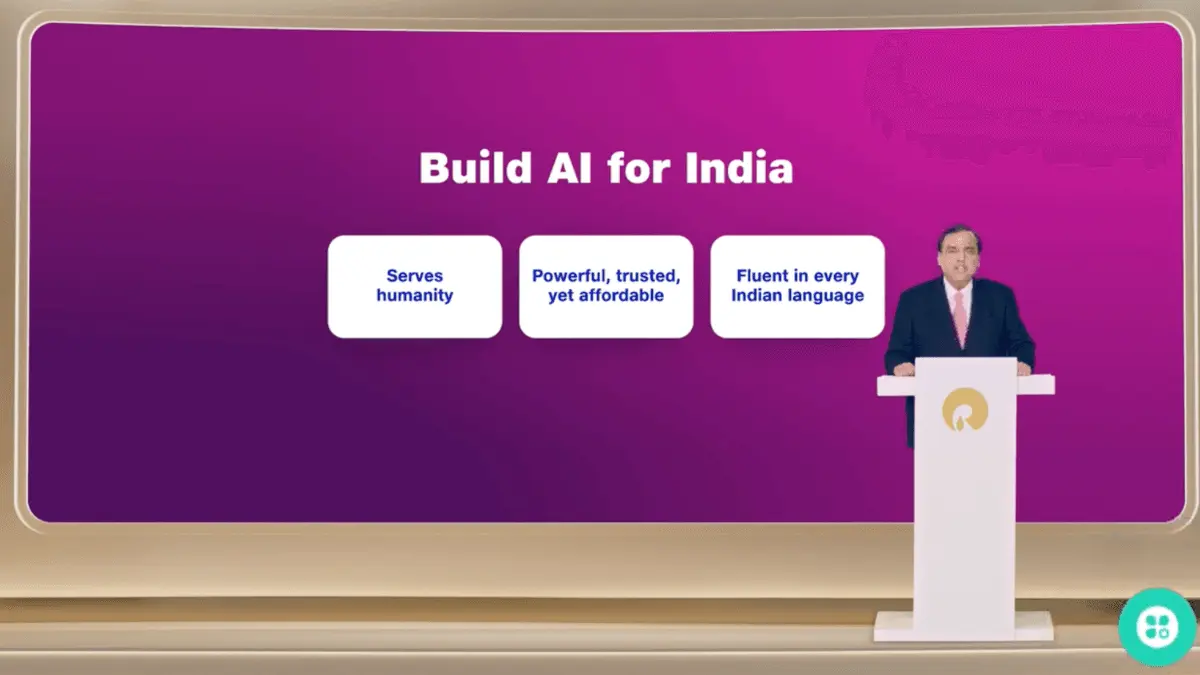
Mukesh Ambani used Reliance Industries' 49th annual general meeting on Friday to position the conglomerate as India's national champion in artificial intelligence, declaring that "India should not be a mere consumer of AI created elsewhere. It must become a creator, adopter, and a global leader in AI."
1
The 69-year-old billionaire's vision centers on embedding Reliance AI capabilities across phone calls, mobile apps, and connected homes, targeting Jio's more than 500 million users with India-led AI innovation that operates in 22 Indian languages.2
Source: Gadgets 360
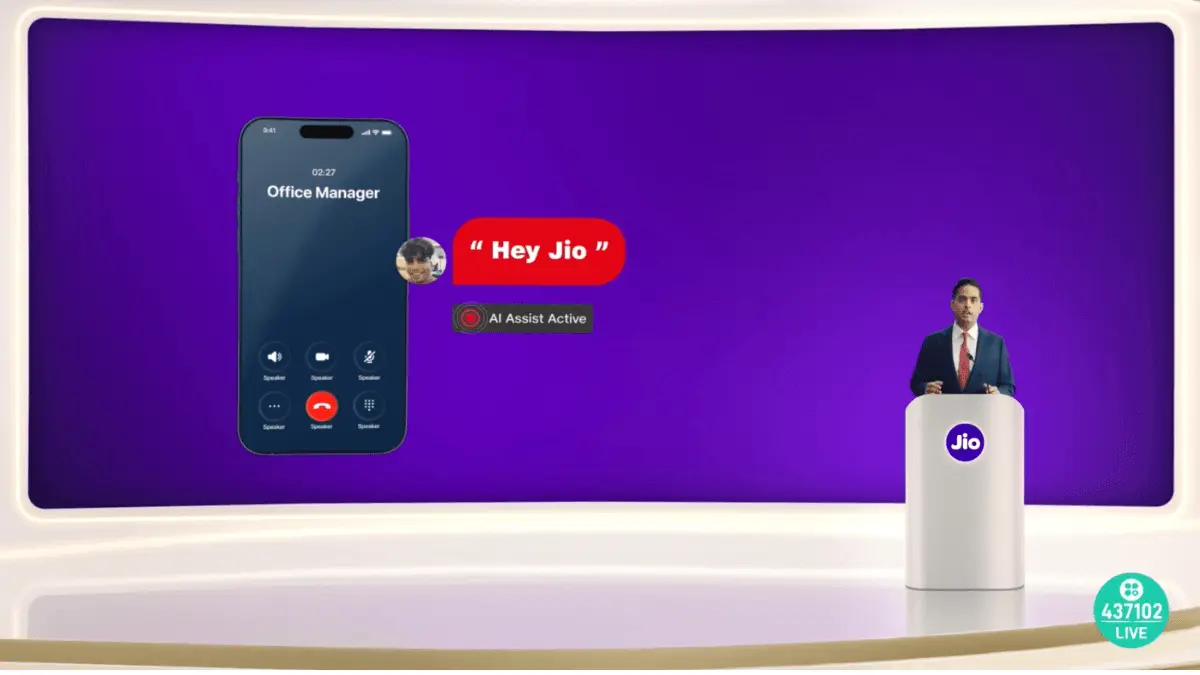
The centerpiece announcement at the Reliance 49th AGM was Jio Call Agent, an AI assistant that joins phone calls to transcribe conversations, generate summaries, and perform tasks such as booking cabs, ordering food, and making reservations.
1
Users activate the service by saying "Hey Jio" during a call, with an "AI Assist Active" prompt appearing when the agent is listening.2
By embedding the service directly into its telecom network rather than offering it as a standalone app, Jio AI is betting that AI assistance can become a native feature of phone calls, reducing consumers' reliance on third-party call-assistant apps. The company claims the AI agent can identify up to 10 unique speakers during a conference call and even add missing members by name when requested.2
The service is expected to launch later this year for all Jio subscribers, though the company has not confirmed whether it will charge an additional fee.
Source: Gadgets 360
Akash Ambani, managing director of Jio Platforms, announced that Reliance Intelligence will "disrupt AI economics by making it dramatically more affordable for every Indian by the end of this decade," mirroring Jio's success in bringing a mobile data revolution.
3
To address the scarcity and high cost of compute—the biggest hurdle for AI in India—Reliance Intelligence is building sovereign AI infrastructure in Jamnagar, Gujarat. The initial 120-megawatt artificial intelligence infrastructure project will be powered entirely by clean energy from Reliance's own solar generation and is set to be commissioned by the end of 2026.3
An initial fleet of advanced Nvidia GB300 GPUs is being operationalized, with compute capacity equivalent to more than 75,000 H100 GPUs on an AI-inference basis, scaling to over 200,000 H100-equivalent GPUs as the facility becomes fully operational.3
Reliance Industries AI ambitions extend beyond telecommunications into sector-specific applications. The conglomerate unveiled five new AI-powered services at the annual general meeting: JioBharatIQ as a personal AI companion, AI Vyapar for small merchants and businesses, JioHealthIQ for healthcare, JioLearnIQ for students, and JioKrishiIQ for farmers.
4
All platforms support 22 Indian languages and are designed to operate across diverse demographics, from regional students to farmers seeking answers on crops, seeds, and weather.3
Reliance also introduced TeleFrame, a home display that uses AI agents to proactively surface information and recommendations such as weather alerts, schedules, and household reminders, echoing the ambient AI assistant push by companies including Amazon and Google.1
Related Stories
Mukesh Ambani emphasized that "no company, however large, can build the future alone," pointing to deepening collaborations with Google, Meta, and Nvidia.
3
The Google partnership has evolved into an AI-first collaboration, with Google AI Pro powered by Gemini already accessible free of cost for hundreds of millions of Jio users. The joint venture with Meta operationalizes the LLaMA open-source AI for Indian enterprises, with Reliance Intelligence delivering sovereign hosting within India with full model transparency and portability. Last week, Reliance announced a collaboration with Meta to establish an AI data center in Gujarat, building on Meta's earlier investment in Jio Platforms.1
Earlier this year, the company announced plans to invest $110 billion in AI infrastructure as it seeks to establish itself as a major player in India's emerging AI ecosystem.1

Source: ET
The announcements carry particular weight as Reliance prepares Jio for a long-awaited stock market debut. Ambani said Jio Platforms' board had approved a draft prospectus for an initial public offering that would include a fresh issue of up to 270 million shares.
1
The conglomerate needs new growth drivers, with its shares down about 17% this year. The AI push also raises questions about user data handling as Reliance expands AI-powered services across phone calls, mobile apps, and connected homes. While the company said the services would operate with user consent, it did not answer questions about whether data generated through the products could be used to train AI models or shared with technology partners.1
Reliance's ambitions come as Indian companies remain heavily reliant on foreign AI models and cloud providers, with recent restrictions on access to some of Anthropic's latest models underscoring that dependency—the kind of supply-chain risk pushing Indian conglomerates toward building their own stack.1
Summarized by
Navi
[1]
29 Aug 2024

29 Aug 2025•Technology

11 Sept 2025•Technology

1
Technology

2
Policy and Regulation

3
Policy and Regulation