5 Sources
[1]
Robinhood now lets your AI agents trade stocks | TechCrunch
As the tech industry rallies around AI agents, some companies are building capabilities to enable AI agents to make payments and trade stocks on users' behalf. Stock trading app Robinhood is also moving in that direction: The company on Wednesday said it is launching support for AI agentic trading, as well as a new agentic credit card. Robinhood said users on its platform can now create a separate account for their AI agents and connect them to a dedicated wallet. While these agents would be able to read and analyze users' portfolios to come up with trading strategies and suggest investments, they'll only be able to access the pre-loaded balance in the dedicated wallet to place orders. Users will get notifications of all trades their AI agent makes, and will be able to monitor their activities within the Robinhood app itself. For some trades, agents will show a preview that users may have to approve before the order is executed. The company said it has also built in fraud detection protection, in which a team from Robinhood would review suspicious trades and help users resolve disputes. Robinhood says users can connect their AI agents to its Model Context Protocol (MCP) service to do things like analyze concentration risk and sector exposure, execute trades, or look through analyst notes to identify new investment opportunities across various sectors. The agentic trading feature is launching in beta and only allows stock trading right now. The company says it plans to add support for options, crypto, event contracts, futures, and prediction markets soon. Robinhood is also debuting a new virtual credit card meant to be used by AI agents. With this card, users can connect their AI agents to the company's banking MCP server to enable them to make payments. The virtual card is currently only available to Robinhood Gold Card holders, who can link their account to this new card. Users can set monthly limits on this virtual card, and can choose if their AI agent should seek approval every time it makes a payment. The company said its Robinhood Platinum Card will also get support for a similar virtual an agentic card feature when it launches later this year. Robinhood has been ramping up its AI efforts for the past few years. The company acquired AI-powered research platform Pluto in 2024, and last year added an AI assistant that offers investment advice. "We've heard a lot of demand from our customers to bring their own tools, LLMs, and agents, and connect them to Robinhood. That is why we are launching our new products," Abhishek Fatehpuria, VP of product at Robinhood, told TechCrunch over a call. Robinhood is not alone in enabling AI agents to make payments, with major players like Stripe, Amazon, Google, and newer startups like Prava Pay building products that give AI agents the ability to buy stuff on users' behalf.
[2]
Your AI agent can now trade for you on Robinhood. And buy stuff with your credit card too
Vlad Tenev, CEO and co-founder of Robinhood, speaks during the Robinhood Markets, Inc. event in New York City, U.S., March 4, 2026. Retail investors may soon be able to hand the keys to their portfolios, and even their wallet, to artificial intelligence. Robinhood unveiled tools on Wednesday that let AI agents trade stocks and make purchases on users' behalf, marking one of the first attempts to bring autonomous finance technology to ordinary investors rather than institutions. The new products -- Agentic Trading and an Agentic Credit Card -- allow customers to connect third-party AI assistants to carry out investing strategies or spending instructions with minimal human involvement. Users can instruct agents to rebalance portfolios, monitor themes such as AI stocks or execute trading strategies automatically. Separate AI agents can also search for deals and complete purchases using designated credit cards. "Our mission has always been to democratize finance for all, and now, that mission extends to AI agents," CEO Vlad Tenev said in a statement. The rollout comes as hedge funds and exchange-traded fund providers increasingly deploy AI-driven and quantitative systems to automate investment decisions, but such technology has largely remained out of reach for retail customers. The Robinhood move raises some safety issues, putting autonomous trading in the hands of the less sophisticated smaller trader without the same risk controls as a Wall Street institution. Robinhood tried to address this with some guardrails. The company said the dedicated "agentic trading" accounts are separated from their main portfolios, limiting access to only the capital users specifically allocate. The system also provides notifications whenever trades occur and lets customers immediately disconnect an agent if needed. Initial beta support covers stock trading, with plans to add options, cryptocurrency and futures later. Robinhood also said investors will retain control through spending limits, manual approvals and fraud-monitoring systems that can review both user instructions and an agent's actions if disputes arise.
[3]
Robinhood launches credit card for AI agents with 3% cash back | Fortune
In the latest sign of AI's growing footprint in online commerce, Robinhood announced on Wednesday that users can now instruct agents to make purchases on their behalf using the Robinhood Gold card. To illustrate the potential of agentic shopping, the company cited examples: "A sneakerhead can tell their agent to buy a coveted new release in their size whenever it drops below $300" and "A foodie can instruct their agent to book the most exclusive restaurant reservation in town as soon as their preferred date and time becomes available." As a practical matter, the agent is not given the same card number as the customer's Robinhood Gold card, but is instead assigned a related virtual card that can be deleted at any time. The service also comes with additional safety precautions, including options to put a monthly cap on the agent's spending, or to receive notifications for agentic transactions that exceed a given dollar amount. And, as with its traditional Robinhood Gold card, purchases carried out by an agent will receive 3% cash back. Robinhood is not the only company to offer agentic shopping with a credit card. The payment firms Stripe and Ramp offer virtual cards for agents too, while Visa and Mastercard have rolled out related processing and security services for such cards. But Robinhood's move stands out since it is the first big retail brand to offer agentic credit card shopping to its users. The company currently has around 700,000 Robinhood Gold customers, whose purchases could meaningfully increase both the volume and scope of agentic payments. While Robinhood and others, including Coinbase, are clearly bullish on agentic commerce, practical obstacles remain. Those include persuading a critical number of merchants to accept payments from agents, while also determining who is responsible for failed and fraudulent transactions. There will also be a technical learning curve for many consumers. In order to make agentic purchases, Robinhood Gold cardholders must direct their agents to connect with the company's MCP, an acronym that describes a type of AI software that can receive and understand commands delivered by an agent. According to Abhishek Fatehpuria, a product VP at Robinhood, the company's initial wave of AI offerings is aimed primarily at a subset of users who are particularly tech savvy. "We want to encourage early adopters of agents to bring their own tools," said Fatehpuria. "It's still a nascent phase [and we] want to learn from that audience." In addition to its new credit card service, Robinhood also announced that users will be able to engage in agent-based trading. In practice, this will mean describing various trading activities -- such as rebalancing a portfolio in response to certain events or jumping on a stock at a given price -- and relying on the agent to execute them. "Our mission has always been to democratize finance for all, and now, that mission extends to AI agents," said Vlad Tenev, CEO of Robinhood, in a statement.
[4]
Robinhood opens its platform to AI agents for trading and credit card spending - SiliconANGLE
Robinhood opens its platform to AI agents for trading and credit card spending Robinhood Markets Inc. today opened its trading and banking platforms to artificial intelligence agents, launching a beta Agentic Trading product and a virtual Agentic Credit Card that can place stock orders and make purchases on a customer's behalf. Customers can now connect third-party agents to Robinhood through Model Context Protocol servers for both the brokerage and Robinhood Banking. The move makes Robinhood one of the first mainstream consumer finance brands to give outside agents direct, sanctioned access to a retail brokerage and a credit line, rather than forcing developers to scrape the app or rely on unofficial application programming interfaces. Agentic Trading runs through a dedicated account that sits separate from a user's main portfolio, with the agent restricted to whatever funds the customer deposits into it. Customers receive push notifications for every trade and can watch a real-time activity feed and profit-and-loss view inside the Robinhood apps. The connection can be cut at any time. The beta supports equities only at launch, with options, crypto, event contracts, futures and prediction markets to follow. Robinhood is pitching the feature as a way for customers to encode strategies they would otherwise execute by hand, including portfolio rebalancing, sector-concentration analysis and automated mean-reversion trades. Agents will, where appropriate, surface a trade preview for the customer to approve before execution. The Agentic Credit Card pairs an agent with a virtual card linked to a customer's Robinhood Gold Card account. Spending limits, monthly caps and a manual-approval toggle are set during configuration and the agent never sees the primary card number or other account details. Agent-driven purchases earn the same 3% cash back as the underlying Gold Card. Support for the forthcoming Robinhood Platinum Card will follow when that product ships later this year. Robinhood cited use cases such as buying limited-release sneakers below a target price, booking restaurant reservations the moment they open and filling small-business shopping lists within a set budget. Fortune reported that Robinhood currently has around 700,000 Gold cardholders, giving the agentic card a meaningful initial addressable base. "Our mission has always been to democratize finance for all and now, that mission extends to AI agents," said Vlad Tenev, chief executive of Robinhood. Abhishek Fatehpuria, vice president of product at Robinhood, told TechCrunch that the initial rollout targets technically sophisticated customers who want to plug their own models and tools into the platform. "We want to encourage early adopters of agents to bring their own tools," he said. "It's still a nascent phase [and we] want to learn from that audience." Using automated AI agents is not without risk and Robinhood paired the launch with a lengthy disclosure warning that agents can misinterpret instructions, act on stale data and behave unpredictably and that customers bear responsibility for monitoring positions and for any data shared with third-party AI providers. The company added that its support team can review the gap between what a customer asked an agent to do and what it actually did when disputes arise. The launch comes as payment networks and platforms race to build infrastructure for agent-initiated commerce. Stripe Inc., Visa Inc., Amazon.com Inc.'s Bedrock AgentCore Payments and Google LLC have all rolled out tooling aimed at giving agents the ability to transact. Robinhood is the first major U.S. retail brokerage to extend that model to securities trading.
[5]
AI Is Reaching Deeper Into Your Pockets: Robinhood Now Lets Your Agents Trade Stocks
Get personalized, AI-powered answers built on 27+ years of trusted expertise. AI is crawling out from the confines of the chat box -- and it's reaching for your wallet. Robinhood (HOOD) is "now open to agents," the company said Wednesday, meaning that its customers can now deploy their AI agents on the fintech platform to trade on their behalf. Per the firm's examples, long-term investors can have their agents analyze their portfolios for concentration risk, determine areas they are underweight, and rebalance accordingly; thematic and active investors can set criteria for buying and selling certain stocks after events such as an analyst upgrade or when they hit price thresholds. For now, the launch pertains only to stocks, but crypto, futures, and options will likely follow. "We're putting the financial intelligence coupled with our market data in your pocket," said Robinhood CEO Vlad Tenev of the company's AI efforts in its first-quarter earnings call last month, per transcripts provided by AlphaSense. Agentic AI -- in short, AI in which users set the technology to investigate and even accomplish tasks for them -- appears poised to deliver a full-service brokerage experience to the masses, a glimpse of which can be seen in Robinhood's latest rollout; in Coinbase's (COIN) tools for using AI to trade or lend crypto; and in offerings from startups like Public.com, which promises to "bring AI into every part of your investing experience." (Public promises, for example, that investors can turn an idea into an investable index with a thesis backtested against the S&P 500, or to trade via prompts like "buy the close and sell the open for up to $5,000" of a Nasdaq 100 ETF.) Some ChatGPT users can now connect the chatbot to their financial accounts and get insights in return. A similar race to deliver a shopping experience minus the guesswork is underway. Robinhood now has an "agentic credit card," that can automatically buy things like limited-edition sneakers or make a reservation at the new hot spot in town when a choice table becomes available. Alphabet's Google (GOOGL) last week launched its "universal cart," which will crawl the web for deals and price drops when an item is placed in it. Amazon (AMZN) recently dropped "Alexa for Shopping," a souped-up shopping assistant; it also has AI tools for retailers to help them better sell things. Big bank chiefs also see agentic AI figuring into the future. In response to a question about what the future looks like for Bank of America during the company's earnings call last month, CEO Brian Moynihan said to expect "more technology, more intimacy with the customers, more agentic versus prompt, more built into the process rather than have it be delivered by teammates doing something." As you might expect, the combination of AI and investing comes with risk disclosures. Among Robinhood's is that "AI agents can make errors, misinterpret instructions, act on incomplete or outdated information and may behave in unexpected ways." But because Robinhood merely enables customers' AI agents, their customers are responsible for how those AI agents behave.
Share
Copy Link
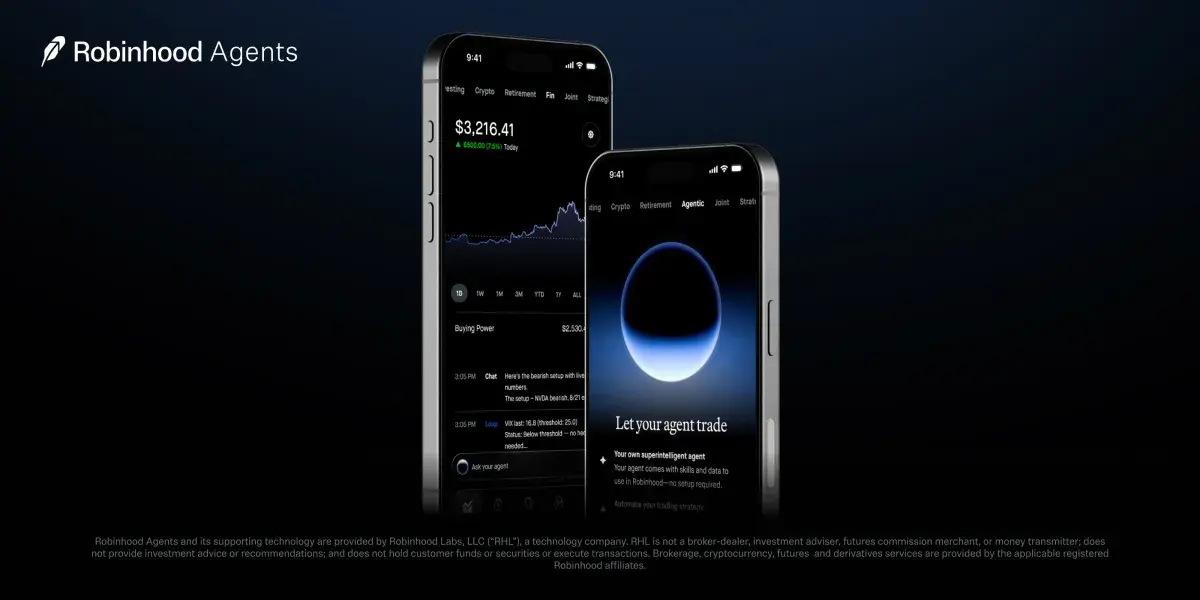
Robinhood now allows customers to deploy AI agents that can trade stocks and make purchases autonomously. The company launched agentic trading accounts and virtual credit cards for its 700,000 Gold Card holders, complete with spending limits and fraud monitoring. The move marks a shift toward autonomous finance technology for retail investors.
Robinhood unveiled tools on Wednesday that allow AI agents trade stocks and execute purchases on behalf of users, positioning itself as one of the first mainstream consumer finance brands to bring autonomous finance technology to retail investors
1
2
. The company launched two products: Agentic Trading and an Agentic Credit Card, enabling customers to connect third-party AI assistants to carry out investment strategies or spending instructions with minimal human involvement4
.
Source: TechCrunch
Users can now create separate accounts for their AI agents and connect them to dedicated wallets through Robinhood's Model Context Protocol (MCP) service
1
. While these agents can read and analyze portfolios to develop trading strategies and suggest investments, they can only access pre-loaded balances in dedicated wallets to place orders. CEO Vlad Tenev stated, "Our mission has always been to democratize finance for all, and now, that mission extends to AI agents"3
.The agentic trading feature launches in beta with support for stock trading only, though Robinhood plans to add options, crypto, event contracts, futures, and prediction markets soon
1
. Users receive notifications for all trades their AI agent makes and can monitor activities within the Robinhood app itself1
. For certain trades, agents display a preview that users may need to approve before execution4
.Robinhood has implemented fraud monitoring systems, with a dedicated team reviewing suspicious trades and helping users resolve disputes
1
. The dedicated agentic trading accounts remain separated from main portfolios, limiting access to only the capital users specifically allocate2
. Customers can immediately disconnect an agent if needed, maintaining control through spending limits and manual approvals2
.Robinhood also debuted a virtual credit card for AI agents, currently available only to Robinhood Gold Card holders who can link their accounts to this new card
1
. The company has around 700,000 Gold Card customers whose purchases could meaningfully increase both the volume and scope of agentic shopping3
. Users can set monthly limits on the virtual card and choose whether their AI agent should seek approval for every payment1
.
Source: Fortune
Agent-driven purchases earn the same 3% cash back as the underlying Gold Card
4
. The agent never sees the primary card number or other account details4
. Robinhood cited use cases such as a sneakerhead instructing their agent to buy a coveted new release in their size whenever it drops below $300, or a foodie having their agent book exclusive restaurant reservations when preferred dates become available3
.Through Robinhood's MCP service, AI agents can analyze concentration risk and sector exposure, execute trades, or review analyst notes to identify new investment opportunities across various sectors
1
. Long-term retail investors can have their agents analyze portfolios for concentration risk, determine underweight areas, and rebalance accordingly5
. Thematic and active investors can set criteria for buying and selling certain stocks after events such as analyst upgrades or when they hit price thresholds5
.Abhishek Fatehpuria, VP of product at Robinhood, told TechCrunch, "We've heard a lot of demand from our customers to bring their own tools, LLMs, and agents, and connect them to Robinhood. That is why we are launching our new products"
1
. The initial rollout targets technically sophisticated customers who want to plug their own models and tools into the platform, as Fatehpuria noted it's "still a nascent phase" and the company wants to learn from early adopters4
.Related Stories

Robinhood is not alone in enabling AI agents to make payments and trades. Major players like Stripe, Amazon, Google, and newer startups like Prava Pay are building products that give AI agents the ability to buy items on users' behalf
1
. Payment firms Stripe and Ramp offer virtual cards for agents, while Visa and Mastercard have rolled out related processing and security services3
. However, Robinhood stands out as the first major U.S. retail brokerage to extend this model to securities trading4
.The move raises questions about putting autonomous trading in the hands of less sophisticated smaller traders without the same risk controls as Wall Street institutions
2
. Robinhood paired the launch with lengthy disclosures warning that AI agents can make errors, misinterpret instructions, act on incomplete or outdated information, and may behave in unexpected ways5
. Because Robinhood merely enables customers' AI agents, their customers bear responsibility for how those AI agents behave5
.To make agentic purchases, Gold Card holders must direct their agents to connect with the company's MCP, a type of AI software that can receive and understand commands delivered by an agent
3
. The company's Robinhood Platinum Card will also receive support for a similar virtual agentic card feature when it launches later this year1
.Robinhood has been ramping up AI efforts for several years, acquiring AI-powered research platform Pluto in 2024 and adding an AI assistant that offers investment advice last year
1
. The company's support team can review the gap between what a customer asked an agent to do and what it actually did when disputes arise4
. Practical obstacles remain, including persuading merchants to accept payments from agents and determining responsibility for failed and fraudulent transactions3
.Summarized by
Navi
[4]
10 Nov 2025•Business and Economy

22 Apr 2026•Business and Economy

19 Aug 2025•Technology

1
Policy and Regulation

2
Science and Research

3
Technology