Sapiom Raises $35M Series A to Slash AI Agent Costs as Companies Scrutinize Spending


2 Sources
[1]
Sapiom raises $35M to cut AI agent running costs
Sapiom raised $35 million to cut the runtime cost of AI agents, sometimes by tenfold. Among the investors backing it is Anthropic, one of the model makers whose bills it is built to shrink. Sapiom is a San Francisco startup that sits between AI agents and the models they run on. It has raised a
[2]
Sapiom Secures $35 Million to Help Companies Control AI Agent Costs | PYMNTS.com
The Series A came 11 months after Sapiom was founded, six months after its launch and six months after a seed round in which it raised $15 million, the company said in a Wednesday (Aug. 5) press release. Sapiom's platform addresses the cost of running AI agents by making real-time decisions on the
Share
Copy Link
San Francisco startup Sapiom secured $35 million in Series A funding led by Dragonfly to tackle escalating AI agent costs. The platform sits between AI agents and models, routing calls to the cheapest capable option and enforcing budgets before spending occurs. One customer, Polsia, slashed its monthly bill from $1.2 million to $100,000 after implementing Sapiom's cost optimization infrastructure.
Sapiom Secures $35M to Address Escalating AI Agent Costs
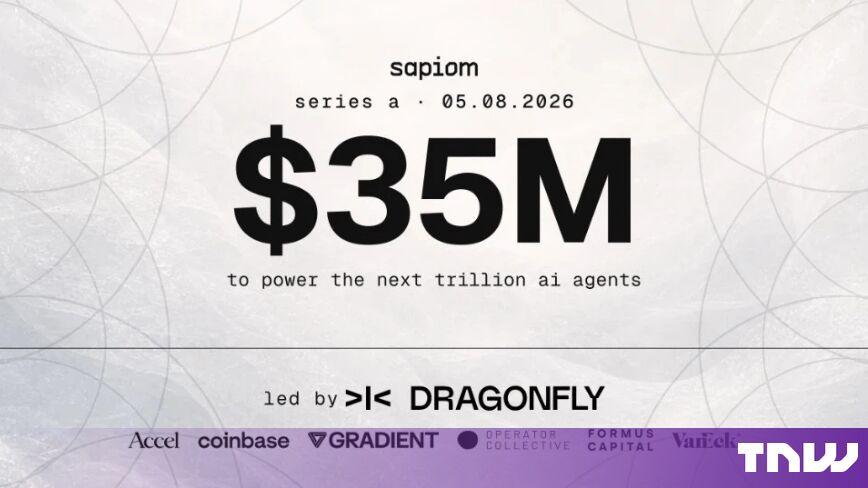
Sapiom, a San Francisco-based AI agent infrastructure company, raised $35 million in Series A funding to tackle one of the industry's most pressing challenges: the escalating costs of running AI agents.
1
Dragonfly led the round, with participation from returning investor Anthropic, alongside Okta Ventures, Menlo Ventures, and Array Ventures. The funding arrives just 11 months after the company's founding and six months after a $15 million seed round led by Accel, bringing total capital raised to $50 million.2
Source: The Next Web
The startup's platform addresses a fundamental infrastructure problem: AI agents operate with no budget constraints, forcing CTOs to allocate substantial resources with limited visibility into spending. Dragonfly Managing Partner Haseeb Qureshi, who is joining Sapiom's board, emphasized that this isn't a governance issue solved with dashboards. "Agents are becoming employees with no manager and no budget," Qureshi explained, "and increasingly, the CTO is the one acting as CFO, allocating real money with no visibility into where it goes."
1
How Sapiom's Platform Reduces Runtime Costs of AI Agents
Sapiom positions itself between AI agents and the models they run on, making real-time decisions about model selection, compute resources, tools, and services based on task requirements, cost, quality, latency, reliability, and company policy.
2
The platform enforces budgets before money is spent, preventing runaway costs that have plagued early AI deployments.At the core of the offering is Sapiom Router, which routes each call to the cheapest capable model rather than defaulting to expensive frontier options. Founder and CEO Ilan Zerbib told Semafor that "in 95% of cases, it doesn't make sense to go to a very expensive frontier model."
1
This approach to AI agent cost optimization has already demonstrated significant impact—the platform has processed more than 270 million transactions in the six months since launching and now powers over 100,000 agent runs daily.2
Tenfold Cost Reduction: The Polsia Case Study
The most compelling validation of Sapiom's approach comes from Polsia, an AI startup that runs swarms of agents to operate other businesses without employing any human staff. As Polsia's projected revenue surged from $100,000 to $10 million in a year, its token bill climbed proportionally, reaching $1.2 million per month on Anthropic.
1
After Sapiom ran evaluations and implemented its cost-efficient AI infrastructure, that monthly bill plummeted roughly tenfold to approximately $100,000."It's just unsustainable," Zerbib remarked about pre-optimization costs, arguing that startups cannot deploy AI agents at the prices frontier labs charge, even when demand exists.
1
This dramatic reduction demonstrates how effective routing and budget enforcement can transform the economics of agentic AI projects.New Product Suite for Control AI Agent Costs
Alongside the Series A funding announcement, Sapiom unveiled three products designed to help companies control AI agent costs throughout the development and deployment lifecycle. Beyond Sapiom Router, the company introduced Sapiom Agent Studio, which provides engineering teams with a local environment for building, testing, inspecting, and deploying agents. Sapiom Runtime offers managed production infrastructure where agents can operate at scale.
2
Source: PYMNTS
Zerbib explained that the platform aims to remove barriers preventing builders from deploying agents economically and reliably. "Every team is being forced to re-create the same infrastructure before its agents can perform real work," he said. "Sapiom exists to remove those barriers. We are starting with cost because it is where the economics break first, but our ambition is much larger: to remove whatever stands between builders and the next trillion agents."
2
Corporate AI Spending Faces Intensifying Scrutiny
Sapiom's rapid funding success reflects a broader shift in how companies approach AI investments. After two years of pushing employees toward the biggest models and heaviest usage, organizations are now demanding proof that AI spending delivers measurable returns. Gartner forecasts that companies will cancel more than 40% of agentic AI projects by the end of 2027, with escalating costs among the leading reasons.
1
A KPMG survey of 2,100 executives in June revealed that just 7% could identify established returns from their AI investments.
1
Corporate AI budgets are receiving their first rigorous audits, with some firms already capping staff spending. This environment creates urgency for solutions that reduce the runtime costs of AI agents while maintaining performance.Related Stories

The Anthropic Paradox and Market Dynamics
An intriguing aspect of the Series A funding is Anthropic's participation as an investor. The AI model maker is backing a startup whose explicit purpose is helping customers spend less on model makers like Anthropic itself. Zerbib frames this relationship as aligned rather than adversarial, arguing that cheaper inference enables companies to build more agents, some of which will still require the most powerful models.
1
This partnership suggests that model providers recognize cost barriers are limiting AI adoption. By supporting infrastructure that makes deployment economically viable, they may expand the overall market even if individual transaction margins decrease. Zerbib projects explosive growth ahead: "We're talking about trillions of agents that will operate in the economy in the next three years," he told Semafor, compared to tens of millions of software developers today.
1
Competitive Landscape and Differentiation Strategy
Sapiom enters a crowded field, competing against OpenRouter, the best-known name in model routing, along with approximately 80 active routing competitors.
1
Major cloud providers Amazon and Microsoft now bundle routing capabilities into Bedrock and Azure, while open-source alternatives offer free options. OpenRouter alone processes around 25 trillion tokens weekly.Sapiom's differentiation lies in what it owns beneath the routing layer. Unlike most rivals that act purely as middlemen, Sapiom serves open-weight models from its own racks in a San Jose data center, charging for compute directly rather than adding markup.
1
The company is betting that owning the inference infrastructure and the controls around it will separate a sustainable business from a commoditized feature as routing becomes table stakes in AI infrastructure.References
Summarized by

Navi
[1]
Related Stories
Sail Research raises $80M to slash costs for running AI agents by up to 10 times
25 Jun 2026•Startups

OpenRouter raises $113M Series B, doubles valuation to $1.3B as multi-model AI approach takes hold
26 May 2026•Startups

Sycamore Raises $65M Seed to Build Governance Layer for Enterprise AI Agents
31 Mar 2026•Startups

Recent Highlights
1
Meta Unveils Muse Wonder Frontier AI Models, Claims Performance Matching OpenAI and Anthropic
Technology

2
IMF Report Warns AI Market Correction Could Spark Global Financial Crisis With $1.4T at Risk
Business and Economy

3
Eight States Sue OpenAI Over ChatGPT Safety Concerns and Unlawful Collection of Children's Data
Policy and Regulation

Recent Highlights
Today's Top Stories











Don’t drown in AI news. We cut through the noise - filtering, ranking and summarizing the most important AI news, breakthroughs and research daily. Follow topics that matter to you and stay ahead.


