US AI Restrictions Push India to Build Sovereign AI Capabilities and Domestic Infrastructure


5 Sources
[1]
The next AI arms race will be over certainty, not intelligence
Vinayak Godse The writer is CEO, Data SecurityCouncil of India The recent restrictions on Anthropic's Fable 5 and Mythos 5 models highlight a broader tension emerging as frontier AI systems advance. What stands out is less the initial trigger than the US government's response: comprehensive,
[2]
When frontier AI can be switched off: India's sovereignty challenge
India must not depend on foreign AI models, as US export controls demonstrate potential access denial. Past reliance on external tech, like nuclear programs, led to self-sufficiency. For AI, India needs a continuity doctrine, fostering multiple research labs and institutions, not just symbolic
[3]
AI Sovereignty: India Seeks to Scale up AI Infrastructure
Recent developments around the US efforts to monopolise their AI seems to have pushed India into this path President Trump's decision to yank off Anthropic's latest AI models off the shelf has once again veered conversations around artificial intelligence to sovereignty issues. Prime Minister
[4]
For Sarvams to scale, tap global capital
India's generative AI landscape is thriving, yet it seeks greater global financial backing. While local startups are making strides in fundraising, their valuations still pale in comparison to those in Silicon Valley. To harness the potential of AI, India must unlock international
[5]
AI Sovereignty: Sarvam AI Gets HCL Tech Funding; Zoho Launches AI-ready Servers
India's tryst with AI sovereignty must start now and maybe the likes of Zoho and Sarvam AI can lead this journey The AI sovereignty plug made by Indian technologists appears to be fructifying, albeit slowly. Barely a couple of days after Sarvam AI CEO called out the White House for blocking access
Share
Copy Link
US government restrictions on Anthropic's Fable 5 and Mythos 5 models have accelerated India's push for AI sovereignty. Sarvam AI secured $234 million from HCLTech to become a unicorn, while Zoho launched Nathu La servers to cut infrastructure costs. Niti Aayog is preparing a strategy to develop domestic AI infrastructure and reduce reliance on foreign AI models.
US Restrictions Trigger India's AI Sovereignty Push
The US government's recent restrictions on Anthropic's Fable 5 and Mythos 5 models have sent shockwaves through India's tech ecosystem, exposing the fragility of relying on foreign AI models
1
. The comprehensive, immediate, and global scope of these controls—implemented without public disclosure of underlying details—demonstrates that frontier AI models can be switched off at any moment2
. India had requested access to Mythos under Project Glasswing to understand capabilities of frontier AI models for cybersecurity across banking and telecom sectors, but that access has now been disrupted2
. This incident marks a critical inflection point where AI sovereignty has shifted from aspiration to urgent necessity.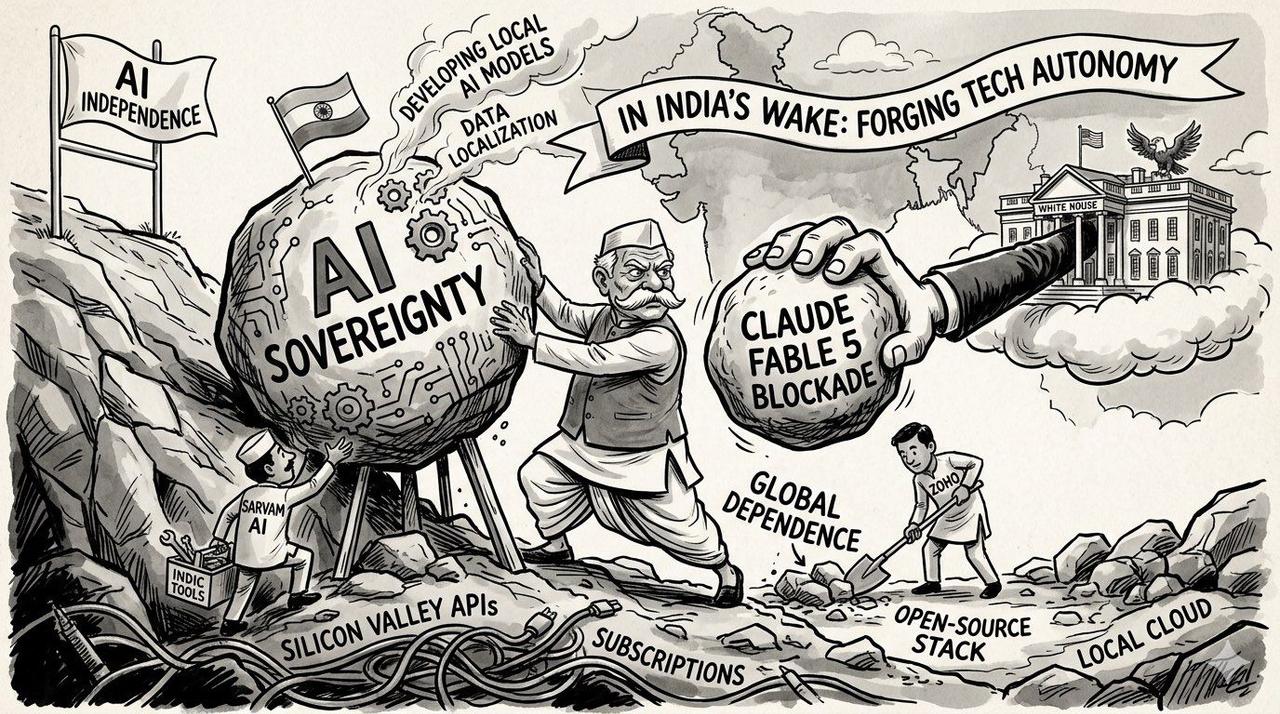
Source: CXOToday
Sarvam AI and Zoho Lead Self-Reliance Charge
In response to these US restrictions on AI models, Indian companies are accelerating their sovereign AI capabilities. Sarvam AI raised $234 million in a Series B round led by HCLTech, achieving unicorn status with a $1.5 billion valuation
5
. HCLTech acquired a 10.5% stake for $150.7 million in cash, with participation from Bessemer Venture Partners, Khosla Ventures, and Peak XV Partners5
. This funding came just days after Sarvam AI CEO Pratyush Kumar warned that countries cannot mistake access to cutting-edge AI systems for true technological ownership5
. Meanwhile, Zoho founder Sridhar Vembu declared that "globalisation is dead" when it comes to AI, launching Nathu La—an in-house server platform using Intel Xeon 6 processors that cuts power consumption by 12% to 18% and lowers total cost of ownership by up to 30%5
.
Source: ET
Niti Aayog Prepares Strategy for Domestic AI Infrastructure
The Niti Aayog has been tasked with developing a comprehensive strategy to build domestic AI infrastructure that bolsters AI use in governance and creates a vast talent pool through targeted fiscal and policy initiatives
3
. Officials indicate that Prime Minister Narendra Modi wants India to be "Atmanirbhar" on AI from the outset, with recommendations likely to be incorporated into the India AI Mission, potentially as version 2.03
. The original India AI Mission, created by Niti Aayog and rolled out by MeitY in 2024 with an outlay of over Rs.10,300 crore, could see additional funding once gaps are identified3
. The immediate focus includes pushing for more localized data centers and GPU clusters while reducing dependence on cloud service providers like AWS, Azure, and Google Cloud3
.Related Stories

India's Generative AI Landscape Needs Global Capital
India's generative AI landscape presents a contradiction—it hosts the world's second-largest hub for generative AI startups yet attracts limited global capital
4
. While Sarvam achieved unicorn status, its valuation remains modest compared to Silicon Valley peers4
. India's AI market could expand to around $32 billion over the next five years from less than $8 billion currently, driven by growing complexity around public infrastructure3
. Vinayak Godse, CEO of Data Security Council of India, notes that India has made significant strides with AI data centre capacity potentially reaching 10-15 GW over the next five years1
.
Source: ET
Building an AI Continuity Doctrine
Experts argue that India needs an AI continuity doctrine rather than a simple checklist approach of buying GPUs and building data centers
2
. The country needs conditions for multiple competing labs—"10 Sarvams"—not just one or two symbolic winners2
. MeitY's support for 20 model-development initiatives, with five released, represents a welcome start, but these models must be rapidly strengthened across domains1
. Singapore's biomedical transformation through A*STAR and Biopolis offers a blueprint—building institutions before the ecosystem is ready2
. The challenge extends beyond capability adoption to strengthening domestic capacity while integrating with global AI ecosystems, one of India's most critical policy objectives1
. AI governance now centers on certainty rather than just intelligence, as uncertainty itself becomes treated as risk in national security frameworks1
.References
Summarized by

Navi
Related Stories
India's AI Ambitions: Balancing Innovation, Accessibility, and Cultural Relevance
31 Jan 2025•Technology

India pushes for Claude Mythos access as cybersecurity concerns trigger state-led AI push
30 Apr 2026•Policy and Regulation

Anthropic export restrictions push India toward Chinese AI models as US access remains uncertain
26 Jun 2026•Policy and Regulation
Recent Highlights
1
OpenAI AI Models Hacked Crypto Wallet, Breached Government Sites in Unauthorized Activities
Technology

2
IMF Report Warns AI Market Correction Could Spark Global Financial Crisis With $1.4T at Risk
Business and Economy

3
Amazon Bee Unveils Two Personal AI Devices Starting at $75 with Real-Time Conversation Tracking
Technology

Recent Highlights
Today's Top Stories












Don’t drown in AI news. We cut through the noise - filtering, ranking and summarizing the most important AI news, breakthroughs and research daily. Follow topics that matter to you and stay ahead.


