Semrush unveils Agentic Search Optimisation as AI search rewrites brand visibility rules


2 Sources
[1]
Semrush Brand Visibility Framework launches at Adobe Summit as AI search rewrites discovery rules
Summary: Semrush launched a Brand Visibility Framework at Adobe Summit introducing "Agentic Search Optimisation" as a new discipline for measuring brand presence across AI-generated answers, traditional search, and autonomous AI agents, drawing on 213 million LLM prompts. The framework arrives as
[2]
Agentic Search Optimization reshapes brand visibility in AI search
Search is evolving fast, brands must adopt ASO to stay visible in AI-driven discovery For the last 18 months, AI has fundamentally disrupted the way people search and find information. The SEO industry's response was disjointed, and -- let's be honest -- entirely reactive. We simply did not have
Share
Copy Link
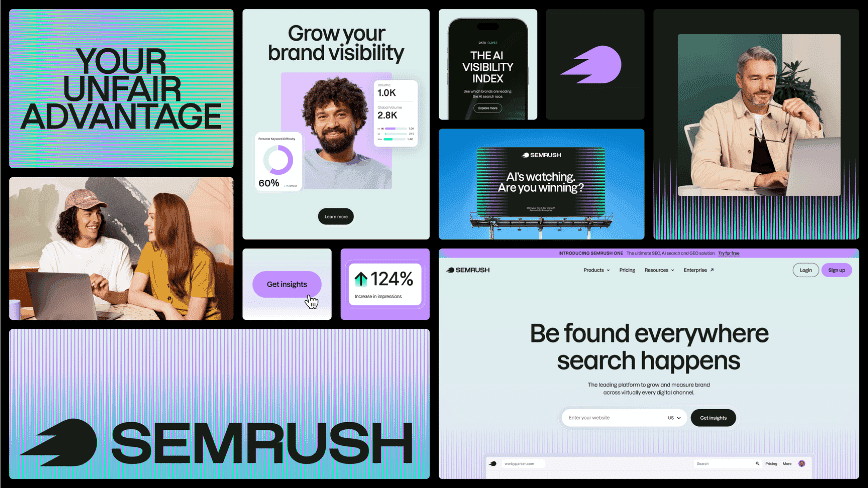
Semrush launched its Brand Visibility Framework at Adobe Summit, introducing Agentic Search Optimisation to measure brand presence across AI-generated answers and autonomous AI agents. The framework draws on 213 million LLM prompts and reveals stark numbers: organic click-through rates have plummeted 61% on queries with AI Overviews, while 62% of brands remain invisible to generative AI systems.
Semrush Introduces Brand Visibility Framework at Adobe Summit
Semrush launched its Brand Visibility Framework at Adobe Summit in Las Vegas, introducing Agentic Search Optimisation as a new discipline for measuring how brands appear across traditional search engines, AI-generated answers, and autonomous AI agents
1
. The framework draws on a database of more than 213 million LLM prompts to show brands exactly how they are being discussed, recommended, or ignored inside systems where no human ever clicks a link1
. The timing aligns with Semrush's pending $1.9 billion acquisition by Adobe, announced in November 2025 and expected to close in the first half of this year1
.
Source: The Next Web
The Decline in Traditional Search Traffic Accelerates
The data behind the framework reveals a dramatic shift in the AI-driven search landscape. Google's AI Overviews now trigger on 48% of all tracked search queries, representing a 58% increase year over year, and on 80 to 88% of informational queries depending on the industry
1
. Organic click-through rates have plummeted 61% for queries where AI Overviews appear, according to Seer Interactive1
. Zero-click searches, where users get answers without visiting any website, increased from 56% to 69% of all queries between May 2024 and May 20251
. ChatGPT now has 800 million weekly active users, while Perplexity processed 780 million queries in May 2025 alone1
. AI-driven search traffic grew from under 2% to more than 9% of desktop search traffic between 2024 and 2025, while traditional Google searches per user in the U.S. declined by nearly 20% during the same period2
.Brand Presence Across AI-Generated Answers Shows Alarming Gaps
The most striking finding reveals a disconnect between investment and search visibility in the AI era. While 94% of brands invest heavily in traditional SEO, 62% are what Semrush calls "technically invisible" to generative AI models
1
. Only 8 to 12% overlap exists between results that appear in AI-generated answers and those that rank well in traditional search1
. ChatGPT Search primarily cites pages ranked 21st or lower, meaning the entire edifice of search engine optimisation does not reliably translate into visibility in the systems replacing it1
. The traffic that does arrive from AI search converts at 14.2%, compared with 2.8% from traditional Google search, but there is dramatically less of it1
.How AI Agents Evaluate Digital Footprint Understood by AI Agents
Agentic Search Optimisation differs fundamentally from traditional SEO because AI agents evaluate brand relevance and authority on behalf of users, then surface recommendations without presenting alternatives. AI systems don't rank pages—they synthesize answers from training data, real-time retrieval, and internal reasoning
1
. Every time an AI system processes your brand, compares it to others, and determines whether to include it in a response, that is an agentic decision2
. These decisions are not based solely on websites—AI agents interpret the entire digital footprint, including media coverage, Reddit discussions, YouTube videos, reviews, and partner mentions2
.
Source: TechRadar
Related Stories

Brand Signals and Signal Alignment Become Critical
Brand visibility in AI search is built on the same foundations that have always driven great SEO: crawlable infrastructure, authoritative content, and consistent brand signals
2
. But SEO alone is no longer enough as AI search systems construct answers rather than simply ranking links2
. Growing visibility today requires synchronized alignment across content, brand, product, and communications to create consistent, AI-trusted signals at every touchpoint2
. When visibility depends on consistency, misalignment becomes a growth risk—if your content says one thing, your product signals another, and your external presence tells a different story, AI systems don't reconcile that in your favor2
.Discovery Rules Shift as Large Language Model Queries Replace Traditional Search
The framework builds on Semrush's AI Visibility Index, launched in October 2025, which tracks brand mentions, mention position, website citations, and share of voice across ChatGPT, Google AI Mode, Perplexity, and Gemini
1
. The index functions as "keyword research for AI," mapping the topics, intent, and volume of queries that users direct at AI systems rather than search engines1
. Semrush reported $443.6 million in revenue for fiscal 2025, up 18% year over year, with its AI product revenue growing 850% to $38 million ARR1
. The framework positions Semrush's capabilities as the visibility layer within Adobe's marketing stack at a moment when the question of where brands appear is being fundamentally rewritten by AI1
. Brands must now understand that entity authority matters more than ever, and what industry experts call "The Beige Tax"—the cost of safe, generic, average content—means mediocre content doesn't just underperform in an AI-driven environment, it disappears2
.References
Summarized by

Navi
[1]
Related Stories
AI Search Transforms How Businesses Compete for Digital Visibility Through New GEO Platforms
23 Sept 2026•Technology

AI Visibility Gap Exposes Critical Flaws in Traditional Search Strategies
01 Sept 2026•Business and Economy

Marketers Shift Budgets to AI Search as Generative Engine Optimization Overtakes Traditional SEO
04 Aug 2026•Technology
Recent Highlights
1
Microsoft and Nvidia Launch Surface Laptop Ultra: A $2,599 AI-Ready PC With RTX Spark Chip
Technology

2
Google Unveils Gemini 4 Argon AI Model, Restricts Access to Trusted Cyber Defenders
Technology
3
Trump Consulted Grok AI Before Ordering Venezuela Invasion and Capture of Nicolás Maduro
Policy and Regulation

Recent Highlights
Today's Top Stories






Don’t drown in AI news. We cut through the noise - filtering, ranking and summarizing the most important AI news, breakthroughs and research daily. Follow topics that matter to you and stay ahead.


