Serve Robotics partners with NoScrubs to expand autonomous delivery beyond food


2 Sources
[1]
Serve Robotics partners with NoScrubs for laundry delivery By Investing.com
LOS ANGELES - Serve Robotics Inc. (NASDAQ:SERV) announced today a partnership with NoScrubs to deliver laundry orders using its autonomous sidewalk robots, marking the company's first commercial delivery service outside prepared food. The $728 million market cap company has posted revenue growth of
[2]
Serve Robotics Enters New Partnership With On-Demand Laundry Service Provider NoScrubs
Serve Robotics, Inc. is engaged in developing next generation robots for last-mile delivery services. The Company designs, develops and operates low-emission robots on its artificial intelligence (AI)-powered robotics mobility platform that serves people in public spaces, starting with food
Share
Copy Link
Serve Robotics has launched a pilot program with NoScrubs to deliver laundry orders using autonomous sidewalk robots in Los Angeles. This marks the company's first commercial delivery service outside prepared food, as it aims to expand into additional verticals including dry cleaning, retail, pharmacy, and grocery with its fleet of 2,000 robots across the United States.
Serve Robotics Expands Beyond Food with NoScrubs Partnership
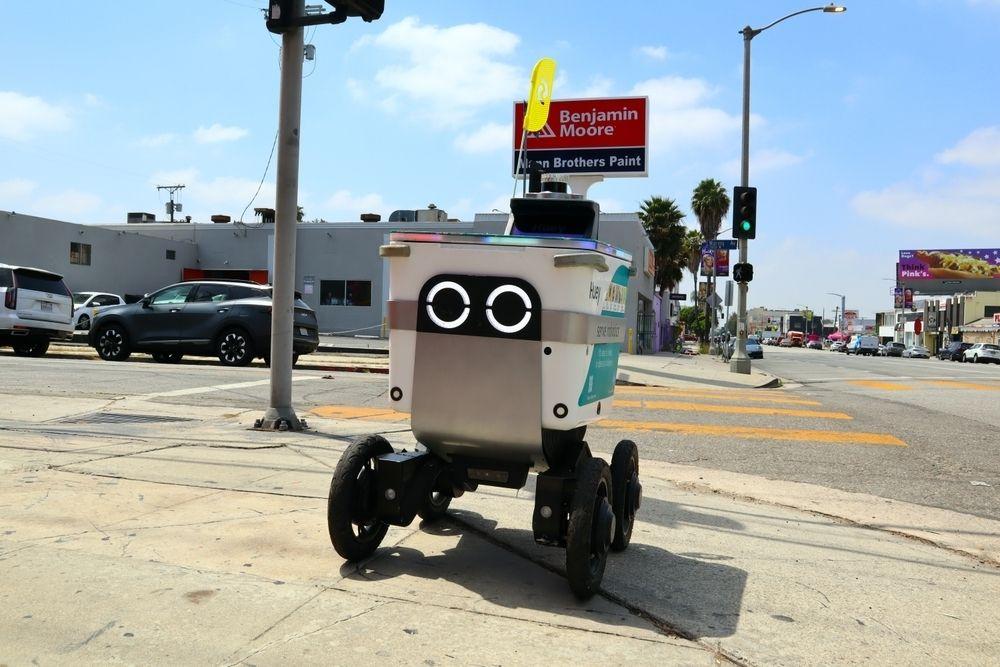
Serve Robotics has announced a partnership with NoScrubs to deliver laundry orders using its autonomous sidewalk robots, marking a significant shift for the company as it ventures beyond its core food delivery business
1
. The pilot program launches this week in select Los Angeles neighborhoods, where Serve's AI-powered robots will handle on-demand laundry service alongside their existing food delivery operations1
. This collaboration represents the first time the company has deployed its robotic fleet for commercial verticals outside prepared food, signaling an ambitious expansion strategy.How the Last-Mile Delivery Service Will Work
Serve Robotics operates approximately 2,000 robots across the United States, with 500 deployed in Los Angeles alone
1
. The company's existing fleet will now fulfill NoScrubs orders alongside their ongoing food delivery operations, with laundry pickups and returns strategically scheduled outside mealtime peaks to maximize efficiency. Users select their preferred delivery window in the NoScrubs app, and NoScrubs assigns each order to a Serve robot based on availability and storage requirements1
. NoScrubs operates across seven major U.S. metros—Austin, Dallas-Fort Worth, Houston, Los Angeles, Miami, Phoenix, and the San Francisco Bay area—offering 3-4 hour laundry pickup and delivery1
.AI-Powered Technology Behind the Robots
Serve Robotics develops next generation robots on its AI-powered robotics mobility platform designed to serve people in public spaces
2
. The company uses AI methodologies to design, train and deploy models that perform tasks including identification of sidewalk surfaces, intersections, traffic signals, obstacles, pedestrians and vehicles2
. The robots feature automatic emergency braking, vehicle collision avoidance, and fail-safe mechanical braking capabilities2
. Serve has platform-level integrations with Uber Eats, allowing robots to provide real-time presence and status updates and receive delivery requests for customer orders2
.Related Stories

Financial Performance and Growth Trajectory
The $728 million market cap company has posted revenue growth of nearly 300% over the last twelve months, though it remains unprofitable as it scales operations
1
. In its first-quarter 2026 earnings, Serve Robotics achieved revenue of $3 million, marking a substantial 578% increase year-over-year and a 238% rise sequentially, though the company reported a non-GAAP earnings per share of -$0.50, indicating ongoing financial challenges1
. The company is quickly burning through cash as it expands—a common challenge for growth-stage robotics firms1
.Future Expansion Plans and Market Implications
"The same Serve robots that bring you dinner will soon bring you your laundry and more," said Ali Kashani, CEO and Co-Founder of Serve Robotics
1
. The company views laundry delivery as a step toward expansion into additional verticals, including dry cleaning, retail, pharmacy, and grocery1
. Serve Robotics has deployed robots that reach a population of approximately 3 million and support delivery for more than 4,000 restaurants1
. The company acquired Diligent Robotics in January, expanding its operations into indoor service robots used in hospitals1
. Matt O'Connor, Co-founder and CEO of NoScrubs, noted that "Partnering with Serve allows us to explore innovative ways to serve customers while improving operational efficiency"1
.References
Summarized by

Navi
Related Stories
Serve Robotics acquires Diligent Robotics for $29M, expanding AI platform into hospitals
21 Jan 2026•Startups
Serve Robotics Unveils Advanced Gen3 Autonomous Delivery Robots, Paving the Way for Nationwide Expansion
17 Oct 2024•Technology

Serve Robotics' Stock Surges as Wall Street Recognizes Potential in AI-Driven Delivery Robots
28 Aug 2025•Technology

Recent Highlights
1
Microsoft and Nvidia Launch Surface Laptop Ultra: A $2,599 AI-Ready PC With RTX Spark Chip
Technology

2
OpenAI Releases 722 AI-Generated Math Papers on GitHub, Igniting Fury Among Mathematicians
Science and Research

3
Trump Consulted Grok AI Before Ordering Venezuela Invasion and Capture of Nicolás Maduro
Policy and Regulation

Recent Highlights
Today's Top Stories












Don’t drown in AI news. We cut through the noise - filtering, ranking and summarizing the most important AI news, breakthroughs and research daily. Follow topics that matter to you and stay ahead.


