11 Sources
[1]
Shopify says AI search is driving more traffic and sales, not replacing Google
E-commerce software maker Shopify seems to be benefiting handily from people using AI to search. On the company's second-quarter earnings call, Shopify President Harley Finkelstein said AI has become a "complement to search, rather than a substitute for it," and had particularly benefited the long tail of e-commerce, including the smaller merchants that make up the majority of its customer base. Indeed, the company credited its earnings beat and soaring revenue to AI search, at least partly. This is quite different from how AI is impacting online publishing, where AI summaries have led to a measurable drop in click-through rates, which lowers traffic and consequently eats into advertising revenues. Instead, Shopify believes that AI is a boon to its business. The company noted that AI-driven traffic and orders to Shopify stores had tripled year-over-year in the second quarter. And, this was not a result of AI taking share from search. "In fact, search remains one of our largest sources of buyer traffic to our merchants, and it's still growing," Finkelstein told analysts on the call. "Traditional search sessions are up 1.3x over the past two years, holding roughly a third of all storefront sessions." The e-commerce platform reported strong results in the quarter, with revenue rising 36% to $3.6 billion from a year earlier, outstripping Wall Street's forecast of $3.4 billion. Gross operating profit rose 31% to $1.71 billion, also ahead of analysts' expectations of $1.63 billion. The company went into further detail about why AI search was working for its business. "While search engines rank by popularity against a handful of keywords, AI agents make multiple calls into Shopify's catalog, working with richer structured data to match products with the buyer's specific intent, rather than just keywords," Finkelstein explained. "When a buyer asks an AI assistant for the best car seat that fits three across a sedan, traditional search focuses on the keyword 'car seat.' An agent, however, understands the actual need, the dimensions, the vehicle type, and the fact that they need three. It searches across all of those constraints at once to find the product that actually works, not just the one that ranks highest," he said. In other words, AI's capability to search across many dimensions to find the best product for users is resulting in better conversions for merchants. "Buyers' shopping journeys are being compressed as half of all AI-referred sessions are landing directly on a product description page. That is 2.5 times more than what we see with traditional search," Finkelstein added. Plus, the company said 75% of AI-attributed purchases in Q2 happened outside the top 100 categories, or what Shopify called its "sweet spot." In addition, the company suggested Shopify stands to benefit from AI playing a larger role in transactions thanks to its trusted checkout experience. The company pointed out that it's also working with AI tools and agents, having built connectors to Claude, ChatGPT, Perplexity, Manus, Replit and Vercel, as well as vibe-coding platforms like Lovable that let merchants build on Shopify however they choose.
[2]
Canada's Shopify forecasts quarterly revenue above estimates
Aug 5 - Canada's Shopify (SHOP.TO), opens new tab, projected current-quarter revenue growth above Wall Street estimates on Wednesday, signaling the company's AI efforts were drawing more merchants to its suite of e-commerce services and driving broader consumer demand. The upbeat forecast coupled with second-quarter revenue that beat estimates pushed U.S.-listed shares of Shopify up more than 15% in premarket trading. The stock had fallen more than 23% so far this year, as of last close. While geopolitical tensions and gas price spikes resulting from the Iran war have put a strain on shopping budgets, consumers have still shown resilience thanks to a strong labor market and continued wage growth. Through its partnerships with OpenAI, Google and Microsoft, Shopify has also been able to drive consumer demand by helping retailers on its platform reach more customers through AI chatbots or search queries. Meanwhile, the company's AI tools - such as its Sidekick AI assistant - have also seen steady adoption from small- and medium-sized businesses that are increasingly leaning on AI to execute tasks faster and cheaper. Shopify generates revenue by taking a cut of sales from sellers on its platform and by selling subscription plans to merchants. The company said total revenue rose 34% to $3.58 billion in the second quarter ended June 30, compared with analysts' average estimate of $3.45 billion, according to data compiled by LSEG. It expects revenue to grow in the low-thirties percentage range in the third quarter, above analysts' estimate for a 26.3% increase. Reporting by Deborah Sophia in Bengaluru; Editing by Shinjini Ganguli Our Standards: The Thomson Reuters Trust Principles., opens new tab
[3]
Shopify shares soar as forecast shows AI is boosting business, not disrupting
Shopify issued a rosy third-quarter forecast on Wednesday as the company's AI efforts draw more merchants to its suite of e-commerce services, assuaging fears over growing competition and sending its shares up more than 18%. The strong outlook and a market-beating June quarter show that AI is shaping up to be a major growth driver for Shopify, and no longer the threat it was once expected to be, with chatbots such as ChatGPT and Claude increasingly becoming better at handling routine tasks for businesses. If current gains hold, Shopify shares are set to recoup most of their losses this year. Through last close, the stock was down 23.4%, as investors fretted over competitive threats, as well as ballooning AI costs at Shopify. Through its partnerships with OpenAI, Google and Microsoft, Shopify has been able to boost demand by helping retailers on its platform reach more customers through AI chatbots or search queries. "AI search has been particularly helpful to some of the smaller brands ... These are brands that also happen to make up the majority of Shopify's merchant base," Shopify President Harley Finkelstein said in an earnings call. The company said that AI-driven customer traffic and orders at stores running on its platform both tripled in the second quarter. Shopify's AI tools for merchants - particularly its Sidekick assistant - have also seen strong adoption from small- and medium-sized businesses that are increasingly leaning on AI to execute tasks faster and cheaper. Daily active merchants using Sidekick surged 3.6 times year-over-year, Shopify said. The company generates revenue by taking a cut of sales from sellers on its platform and selling subscription plans to merchants. It expects third-quarter revenue to grow in the low-thirties percentage range, above analysts' estimate for a 26.3% increase, according to data from LSEG. It also forecast a mid-to-high twenties percentage rise in gross profit, above market expectations. "Shopify's guidance left no doubt in investors' minds about the durability of growth in the second half of the year, and the commitment to delivering margin expansion even with AI investments," Jefferies analyst Samad Samana said. While its AI initiatives have helped Shopify boost its revenues, rising AI token and cloud infrastructure costs have sparked worries of prolonged margin disruption. The company, however, handily beat second-quarter adjusted profit estimates. It reported 42 cents per share in the June quarter, above estimates of 40 cents. Gross merchandise volume (GMV), or the total value of goods sold on Shopify, rose 32% to $115.57 billion during the quarter, with solid growth across all merchant sizes, product categories, and geographies. That helped revenue surge 34% to $3.58 billion and beat analysts' estimate of $3.45 billion.
[4]
Shopify shares soar 18% as AI push helps revenue beat estimates
Shopify's stock soared following the release of strong second-quarter financial results. The e-commerce giant outperformed analyst projections in terms of revenue and gross merchandise volume, mitigating concerns about the effects of artificial intelligence on service demand. Shopify shares surged 18% after the e-commerce software company reported stronger-than-expected second-quarter results and gave a sales forecast above Wall Street estimates, easing concerns that new AI tools could hurt demand for its services. The company posted adjusted earnings of 42 cents per share on revenue of $3.58 billion. Analysts polled by Visible Alpha had expected earnings of 40 cents per share and revenue of $3.46 billion. Revenue rose 34% from a year earlier, showing that Shopify continues to attract merchants to its online selling tools even as competition rises in the e-commerce and artificial intelligence space. Gross merchandise volume, or the total value of goods sold through Shopify's platform, rose 32% year-on-year to $115.57 billion. Analysts had expected $111.98 billion. US MarketsPowered By As on 05 Aug 2026, 08:18 PM IST S&P 500 Top Gainers Charles River261.96(11.89%) Wynn Resorts108.31(10.97%) Intl Flavors & Fragrances87.26(7.87%) Newmont105.05(7.49%) Gainers" S&P 500 Top Losers DaVita185.86(-18.48%) Insulet136.71(-18.05%) CDW135.47(-12.04%) Coterra Energy32.56(-8.62%) Losers" Revenue, GMV beat estimates The quarter showed broad strength across Shopify's key metrics. Revenue, gross merchandise volume, gross profit and free cash flow all grew more than 30%. "This was a monster quarter: more than 30% growth in GMV AND revenue AND gross profit AND free cash flow," Shopify President Harley Finkelstein said. "We power every kind of business, and with AI, we're expanding what's possible for all of them." Shopify provides tools that help merchants build online stores, process payments, manage sales and run digital commerce operations. The company has also been adding AI features to help sellers improve product listings, customer engagement and business operations. The strong numbers suggest that AI is helping Shopify strengthen its platform rather than weaken demand for it. For the third quarter, Shopify expects revenue to grow at a low-thirties percentage rate. Investors had been worried that smaller merchants could start using new AI tools to build and run online stores without relying as much on Shopify. The company's forecast signalled that demand remains healthy and that its own AI investments are helping bring more merchants to its platform.
[5]
Shopify Q2 -- 'Another Exceptional Quarter' from 'Most AI-Pilled' Company - Shopify (NASDAQ:SHOP)
Shopify (NASDAQ:SHOP) is positioning itself as an AI-first company by embedding artificial intelligence across its operations and decision-making. * SHOP stock is soaring. See the chart and price action here. On the company's Q2 earnings call, president Harley Finkelstein said "AI is now baked into how Shopify operates... Every decision, every experiment, every merchant interaction," adding that over the past year Shopify has moved from "experimenting with AI" to "rebuilding teams and our work around what it can do." "Shopify is probably the most AI-pilled company in the world," Finkelstein added. SHOP Stock Price Activity: Shopify stock was up 17.45% at $144.82 at the time of publication Wednesday, according to Benzinga Pro. AI-Driven Orders and Traffic Surge This AI momentum is yielding results. Shopify reported AI-driven traffic and orders to merchant stores tripled year over year. New buyer orders via AI channels are arriving nearly twice as fast as those from other sales channels. While AI-driven commerce is still a small share of Shopify's overall gross merchandise volume, growth trends are encouraging, with AI search delivering higher conversion rates. Shopify's Q2 results showed a 34% revenue increase to $3.58 billion, easing investor concerns about AI-related spending. CEO's AI Updates Boost Sentiment Shopify's AI focus is underscored by CEO Tobias Lütke's updates. In posts on X, Lütke showcased the new NVIDIA DGX Workstation for AI workloads, used to build a new implementation of Shopify's Liquid programming language. These developments contributed to a surge in Shopify's stock, as investors seek companies leveraging AI. Image: Shutterstock This content was partially produced with the help of AI tools and was reviewed and published by Benzinga editors. Market News and Data brought to you by Benzinga APIs To add Benzinga News as your preferred source on Google, click here.
[6]
Shopify's AI Traffic Triples as Shoppers Skip the Search Bar | PYMNTS.com
Search on Shopify still works the way it always has. Traditional search sessions rose 1.3 times over the past two years and continue to hold roughly a third of all storefront traffic. What's changed is what happens after a shopper leaves a chatbot or AI assistant instead of a search bar. Those AI-referred sessions land directly on a product page, skipping the browsing and comparison steps that used to precede a purchase. Half of all AI-referred sessions on Shopify now go straight to a product description page, a rate 2.5 times higher than sessions arriving through traditional search, Finkelstein told analysts during the call. AI Shoppers Buy Twice as Often on Shopify Shopify's product catalog functions as a structured index of merchant inventory, built so AI systems can query it directly rather than scraping web pages for product details. The company has invested in that index for nearly two years, organizing data on more than a billion products so external AI systems can access accurate, complete listings. That structure produces measurably better outcomes than unstructured data. Finkelstein said AI search powered by Shopify's catalog converts at twice the rate of AI search relying on scraped product data. He attributed the gap to context: a catalog entry carries complete specifications, while scraped listings often arrive incomplete or without the attributes a shopping agent needs to match a buyer's request. Shopify also pointed to Sidekick, its AI assistant built into the merchant dashboard, as a second layer of AI infrastructure. Daily active merchants using Sidekick grew 3.6 times year over year, and the tool handled nearly 34 million conversations in the quarter. Merchants used Sidekick to build more than 36,000 custom apps, up from 12,000 in the first quarter. Small Merchants Gain the Most From AI Discovery AI search is reshaping which merchants get found, and the shift favors Shopify's core customer base of small and specialized sellers. The company said its share of sales outside major product categories has held steady since 2025, even as AI systems surface niche listings that broader keyword search tends to bury under higher-volume competitors. Finkelstein pointed to specific examples surfaced through AI search this quarter, including a car seat sized for three-across sedan installation and reef-safe sunscreen formulated without a white residue. Both are Shopify merchant products that gained visibility through AI query matching rather than keyword ranking. Shopify's identity and payments network, Shop Pay, surpassed $400 billion in lifetime accelerated gross merchandise volume (GMV) in June. Shop app's native GMV grew more than 70% during the quarter. Cart Sync, a feature that preserves a shopping cart as a buyer moves between a merchant's site and the Shop app, representing more than 30% of Shop app GMV. Shopify Also Grew Payments, B2B and AI Partnerships * Shopify launched its first local payment method offering in Mexico while expanding managed markets to Canada and the U.K. * Shopify expanded native B2B capabilities beyond its Plus tier for the first time, letting more merchants manage wholesale and direct-to-consumer sales from one admin dashboard. * Enterprise brands including Guess, Aritzia, e.l.f. Cosmetics and Claire's moved onto the platform during the quarter, part of a trend of larger retailers migrating away from legacy commerce systems. * Shopify connected its AI toolkit to external coding and agent platforms including Claude, ChatGPT, Perplexity and Replit, letting merchants build storefronts using tools outside Shopify's own interface. Shopify's Second-Quarter Numbers and Third-Quarter Outlook Shopify reported second-quarter revenue of $3.6 billion, up 34% year over year, or 33% on a constant currency basis. GMV reached $116 billion, up 32% year over year, marking a fifth consecutive quarter of GMV growth above 30%. Merchant solutions revenue grew 37%, driven by GMV strength and payments penetration, which reached 68% of global GMV. Subscription solutions revenue grew 22%. Gross profit rose 31% to $1.71 billion. Merchant solutions gross profit grew 39%, while subscription solutions gross profit grew 19%, and gross margins were just under 80%. Operating expenses fell to 34% of revenue, a nearly two-point improvement from the prior year. For the third quarter, Shopify guided revenue growth in the low 30% range year over year and gross profit growth in the mid-to-high 20% range.
[7]
Why Is Shopify Stock Skyrocketing Wednesday? - Shopify (NASDAQ:SHOP)
Shopify Says AI-Driven Orders Are Tripling As New Buyers Arrive Nearly Twice As Fast The company reported adjusted earnings of 42 cents per share, topping the analyst consensus estimate of 40 cents. Revenue increased 34.3% year over year to $3.58 billion, exceeding the consensus estimate of $3.45 billion. The results eased investor concerns about AI-related spending and increasing competition. Shopify Key Metrics Adjusted net income increased to $439 million from $338 million a year earlier. Gross merchandise volume (GMV) rose 32% year over year to $115.57 billion. On a constant-currency basis, GMV increased 30%. Merchant Solutions revenue climbed 37% to $2.78 billion, while Subscription Solutions revenue increased 22% to $802 million. Gross margin declined to 47.67% from 48.58% a year earlier. Gross profit increased 31% to $1.71 billion. Operating cash flow totaled $658 million, while free cash flow reached $654 million. Free cash flow margin expanded 200 basis points year over year to 18%. AI Orders And Traffic Surge Shopify highlighted accelerating adoption of AI-powered commerce during the quarter, saying AI-driven traffic and orders to merchant stores both tripled year over year. Management also said new buyer orders generated through AI channels are arriving at nearly twice the rate of other sales channels, suggesting AI is becoming an increasingly effective customer acquisition tool. While AI-driven commerce still represents a small share of Shopify's overall gross merchandise volume, the company said the growth trends are encouraging, with AI search delivering higher conversion rates and helping smaller merchants reach more buyers. Executive Commentary President Harley Finkelstein said Shopify delivered a strong quarter, with GMV, revenue, gross profit and free cash flow each growing more than 30%. The company said it expects revenue growth in the low-30% range, above Wall Street's estimate of about 27%, which would mark a sixth consecutive quarter of revenue growth exceeding 30%. Finkelstein said Shopify continues to support businesses of all sizes and is using AI to expand merchants' capabilities on the platform. Chief Financial Officer Jeff Hoffmeister said GMV growth accelerated from an already strong prior-year comparison, driven by broad-based strength across merchant sizes, sales channels and geographic regions. Hoffmeister said Shopify continued to improve operating leverage, contributing to an 18% free cash flow margin. He said the quarter reflected the company's focus on broad-based growth, consistency, compounding momentum and financial discipline. Bloomberg Intelligence analyst Anurag Rana said investors had expected higher AI-related spending to pressure margins, but second-quarter operating expenses increased 21%, slightly below analyst expectations. Shopify Outlook Shopify expects third-quarter 2026 revenue to grow in the low-30% range year over year. The guidance implies revenue of approximately $3.73 billion to $3.78 billion, above the analyst consensus estimate of $3.59 billion. The company also expects free cash flow margin to remain in the high-teens to low-20% range. SHOP Price Action: Shopify shares were up 19.14% at $146.90 at the time of publication on Wednesday, according to Benzinga Pro data. Photo via Shutterstock Market News and Data brought to you by Benzinga APIs To add Benzinga News as your preferred source on Google, click here.
[8]
Shopify earnings loom: Can AI strategy offset Meta threat? By Investing.com
Shopify Inc. reports second-quarter earnings Wednesday before the market opens, with investors watching whether the e-commerce platform can bounce back from a disappointing prior quarter and prove its artificial-intelligence strategy can fend off intensifying competition from Meta Platforms. Analysts expect Shopify to post earnings of 40 cents a share on revenue of $3.45 billion for the quarter ended June 30. That would represent a sharp sequential improvement from the first quarter, when Shopify earned 23 cents a share on revenue of $3.17 billion -- missing EPS estimates by more than 30% despite beating revenue forecasts. The consensus forecast implies revenue growth of roughly 29% year-over-year, a deceleration from first-quarter levels but still well above broader e-commerce trends. EPS estimates have remained steady over the past week but have edged slightly higher over the past two months, while revenue estimates have remained largely unchanged. Analysts rate the stock a Buy, with a mean price target of $148.39, implying 27% upside from the current price of $117.01. Of the 51 analysts covering Shopify, 39 rate it a Buy, 11 Hold, and just one Sell. Recent analyst activity has been mixed but tilted positive. In July, both Jefferies and Stifel upgraded Shopify to Buy, citing the company's positioning to become the infrastructure layer for agentic commerce -- a model where AI agents autonomously handle shopping on behalf of consumers. BofA Securities initiated coverage with a Buy rating, while RBC Capital reiterated its Outperform rating with a $170 price target. However, Rothschild Redburn downgraded the stock to Hold, warning that Meta's new small-business commerce tools could erode Shopify's same-store sales growth, which has been a key driver of recent outperformance. What Investors Are Watching The biggest question is whether Shopify can prove its role as the infrastructure winner in AI-driven commerce. Multiple analysts have argued that Shopify's checkout, payments, and merchant system of record position it to capture incremental gross merchandise volume as AI agents intermediate more of the buyer journey. Investors will look for management commentary on early traction with agentic storefronts and API integrations with platforms like ChatGPT and Microsoft Copilot. Second, can Shopify sustain mid-to-high-20s revenue growth in the face of new competition? Rothschild's downgrade highlighted the risk that Meta's commerce push could cut into Shopify's same-store sales growth, which has outpaced broader e-commerce trends by two to four times. Management's outlook for the second half will be closely scrutinized. Finally, investors will watch for free-cash-flow guidance. Benchmark noted that higher cash taxes and an elevated effective tax rate are pressuring FCF margins this year, though partially offset by accounting tailwinds from merchant cash advances. With Shopify having announced a $5 billion buyback authorization in June, capital allocation priorities will be in focus. Shopify shares have fallen roughly 36% from their 52-week high of $182.19, reflecting broader software-sector pressure and uncertainty over how AI reshapes e-commerce economics. Wednesday's results will test whether Shopify's infrastructure bet can deliver both growth and profitability in a rapidly evolving landscape. This article was generated with the support of AI and reviewed by an editor. For more information see our T&C.
[9]
Shopify shares soar as forecast shows AI is boosting business, not disrupting
Aug 5 (Reuters) - Shopify issued a rosy third-quarter forecast on Wednesday as the company's AI efforts draw more merchants to its suite of e-commerce services, assuaging fears over growing competition and sending its shares up more than 18%. The strong outlook and a market-beating June quarter show that AI is shaping up to be a major growth driver for Shopify, and no longer the threat it was once expected to be, with chatbots such as ChatGPT and Claude increasingly becoming better at handling routine tasks for businesses. If current gains hold, Shopify shares are set to recoup most of their losses this year. Through last close, the stock was down 23.4%, as investors fretted over competitive threats, as well as ballooning AI costs at Shopify. Through its partnerships with OpenAI, Google and Microsoft, Shopify has been able to boost demand by helping retailers on its platform reach more customers through AI chatbots or search queries. "AI search has been particularly helpful to some of the smaller brands ... These are brands that also happen to make up the majority of Shopify's merchant base," Shopify President Harley Finkelstein said in an earnings call. The company said that AI-driven customer traffic and orders at stores running on its platform both tripled in the second quarter. Shopify's AI tools for merchants - particularly its Sidekick assistant - have also seen strong adoption from small- and medium-sized businesses that are increasingly leaning on AI to execute tasks faster and cheaper. Daily active merchants using Sidekick surged 3.6 times year-over-year, Shopify said. The company generates revenue by taking a cut of sales from sellers on its platform and selling subscription plans to merchants. It expects third-quarter revenue to grow in the low-thirties percentage range, above analysts' estimate for a 26.3% increase, according to data from LSEG. It also forecast a mid-to-high twenties percentage rise in gross profit, above market expectations. "Shopify's guidance left no doubt in investors' minds about the durability of growth in the second half of the year, and the commitment to delivering margin expansion even with AI investments," Jefferies analyst Samad Samana said. While its AI initiatives have helped Shopify boost its revenues, rising AI token and cloud infrastructure costs have sparked worries of prolonged margin disruption. The company, however, handily beat second-quarter adjusted profit estimates. It reported 42 cents per share in the June quarter, above estimates of 40 cents. Gross merchandise volume (GMV), or the total value of goods sold on Shopify, rose 32% to $115.57 billion during the quarter, with solid growth across all merchant sizes, product categories, and geographies. That helped revenue surge 34% to $3.58 billion and beat analysts' estimate of $3.45 billion. (Reporting by Deborah Sophia in Bengaluru; Editing by Shinjini Ganguli)
[10]
Shopify Signals Revenue Acceleration as AI Tools, Merchant Growth Drive 2Q Beat -- 2nd Update
Shopify quieted fears of a mid-year slowdown, forecasting accelerating third-quarter sales growth as artificial intelligence-driven search and broad merchant expansion fuel market-share gains. The optimistic outlook puts to rest investor anxieties that have weighed on the company after its first-quarter report, when management signaled potential topline deceleration. Instead, the ecommerce platform is guiding for revenue to grow at a low-thirties percentage rate in the third quarter, which tops Wall Street consensus of about 27% after beating second-quarter expectations. Driving the momentum was a 32% surge in gross merchandise volume, which measures the total value of goods sold across its platform, and which reached $115.57 billion in the second quarter. "Gross merchandise volume growth was up 32% with broad growth across our merchant sizes, geographies, and sales channels," President Harley Finkelstein said on the earnings call Wednesday. Shopify, whose platform lets businesses sell, manage orders and process payments, is also seeing an early boost from AI. Finkelstein noted that AI-driven traffic and order volumes have tripled year-over-year. "AI search was starting to disproportionately benefit the long tail in 2025, and that trend has continued, with 75% of AI attributed orders coming from outside our top 100 categories in the second quarter," Finkelstein said on the call. Shares surged Wednesday morning by 22% to $149.52. The day's trading has walked back much of the loss from the past 52 weeks, where the stock reached a low of $94, and is now up about 14%. The stock is still down 10% year-to-date, due largely to broader software sector concerns over potential AI disruption and higher tech valuations. The dynamic led to a 34% rise in revenue in the second quarter, reaching $3.58 billion, beating its own growth forecast of rising in the high-twenties percentage rate, and analyst forecasts which expected a growth of 29%. The growth in revenue was driven by a strong performance across subscription solutions, where revenue rose to $802 million from $656 million, and merchant solutions, its largest unit, which generated revenue of $2.78 billion, up from $2.02 billion. Net income rose to $1.5 billion, or $1.16 a share, up from $906 million, or 69 cents a share, in the comparable quarter a year ago. On an adjusted basis, earnings came to 42 cents a share, topping forecasts of 40 cents a share. As well as the rosier revenue expectations for the third quarter, Shopify expects gross profit dollars to grow at a mid-to-high twenties percentage rate, while operating expenses are expected to be in the range of 33% to 34% of revenue. Free cash flow margin is expected to be in the high-teens to low-twenties.
[11]
Canada's Shopify forecasts revenue above estimates, shares surge
Aug 5 - Canada's Shopify projected current-quarter revenue growth above Wall Street estimates on Wednesday, signaling the company's AI efforts were drawing more merchants to its suite of e-commerce services, sending its U.S.-listed shares up 26% premarket. The company's solid outlook and a second-quarter revenue beat are set to quell investor concerns about growing competition from new AI tools targeting small businesses that have dented Shopify's shares. If premarket gains hold, Shopify shares are set to recoup all losses this year. Through last close, the stock was down 23.4% year to date. While geopolitical tensions and gas price spikes resulting from the Iran war have put a strain on shopping budgets, consumer demand has still shown resilience thanks to a strong labor market and continued wage growth. Through its partnerships with OpenAI, Google and Microsoft, Shopify has been able to drive demand by helping retailers on its platform reach more customers through AI chatbots or search queries. Shopify's AI tools - such as its Sidekick AI assistant - have also seen steady adoption from small- and medium-sized businesses that are increasingly leaning on AI to execute tasks faster and cheaper. "This was a monster quarter ... We power every kind of business, and with AI, we're expanding what's possible for all of them," said Shopify President Harley Finkelstein. The company, which generates revenue by taking a cut of sales from sellers on its platform and selling subscription plans to merchants, said it saw solid growth across all merchant sizes, product categories, and geographies in the quarter. Gross merchandise volume (GMV), or the total value of goods sold on Shopify, rose 32% to $115.57 billion during the quarter ended June, helping total revenue jump 34% to $3.58 billion and beat analysts' average estimate of $3.45 billion, according to data from LSEG. Shopify expects third-quarter revenue to grow in the low-thirties percentage range, above analysts' estimate for a 26.3% increase. It forecast gross profit growth at a mid-to-high twenties percentage rate, versus expectations of a 24.1% rise. (Reporting by Deborah Sophia in Bengaluru; Editing by Shinjini Ganguli)
Share
Copy Link
Shopify reported a 34% revenue increase to $3.58 billion in Q2, surpassing Wall Street expectations as AI-driven traffic and orders to merchant stores tripled year-over-year. The e-commerce platform's shares soared 18% following a strong third-quarter forecast, demonstrating that AI is boosting business rather than disrupting it.
Shopify delivered exceptional second-quarter revenue results, reporting a 34% increase to $3.58 billion, significantly outpacing Wall Street's forecast of $3.45 billion
1
2
. The e-commerce platform also reported gross operating profit rising 31% to $1.71 billion, ahead of analyst estimates of $1.63 billion1
. Adjusted earnings came in at 42 cents per share, beating expectations of 40 cents3
4
. Gross merchandise volume, representing the total value of goods sold through Shopify's platform, surged 32% to $115.57 billion, exceeding analyst estimates of $111.98 billion3
4
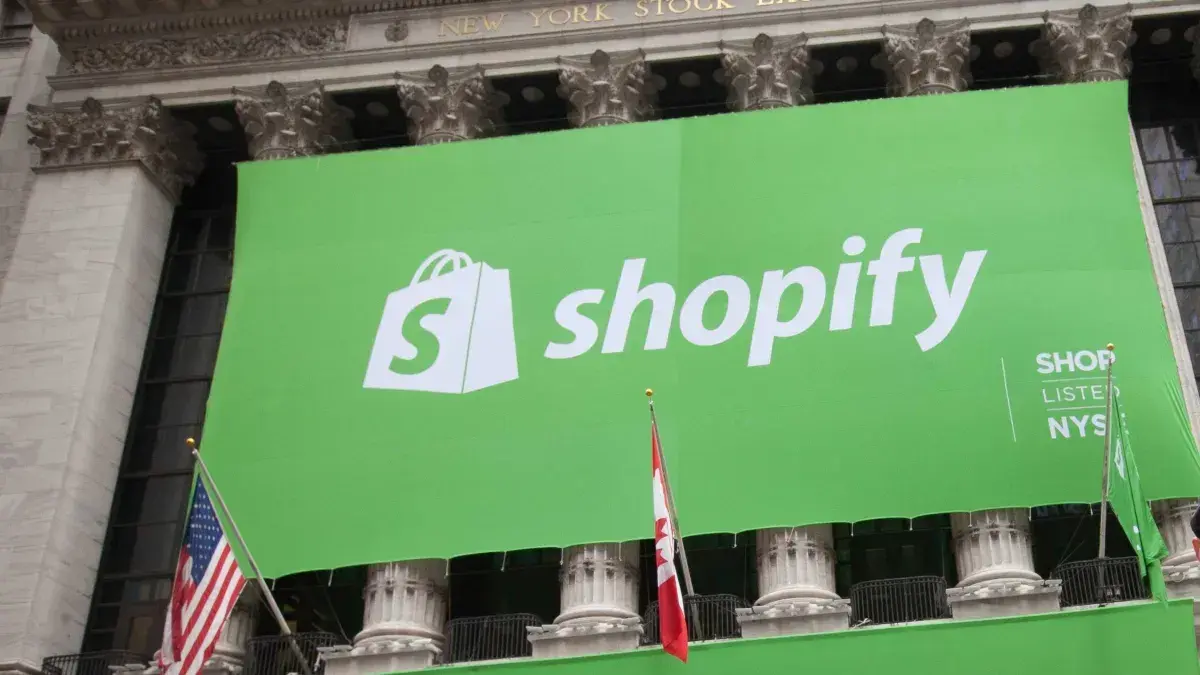
.Shopify shares surged more than 18% following the company's upbeat forecast for the third quarter
3
4
. The company expects revenue to grow in the low-thirties percentage range, well above analyst estimates of 26.3% growth2
3
. Shopify also forecast gross profit to rise in the mid-to-high twenties percentage range, surpassing market expectations3
. The stock surge represents a significant recovery, as Shopify shares had fallen more than 23% year-to-date through the previous close2
3
. Jefferies analyst Samad Samana noted that "Shopify's guidance left no doubt in investors' minds about the durability of growth in the second half of the year, and the commitment to delivering margin expansion even with AI investments"3
.
Source: TechCrunch
Shopify President Harley Finkelstein revealed that AI-driven traffic and orders to Shopify stores tripled year-over-year in the second quarter
1
3
. Critically, AI has become a "complement to search, rather than a substitute for it," with traditional search sessions up 1.3 times over the past two years and still accounting for roughly a third of all storefront sessions1
. New buyer orders via AI channels are arriving nearly twice as fast as those from other sales channels5
. Finkelstein explained that AI search particularly benefited the long tail of e-commerce, including small- and medium-sized businesses that make up the majority of Shopify's merchant base1
3
. Notably, 75% of AI-attributed purchases in Q2 happened outside the top 100 categories, representing Shopify's "sweet spot"1
.Related Stories
Shopify's success with AI search stems from its ability to understand user intent rather than just matching keywords. Finkelstein illustrated this with a specific example: "When a buyer asks an AI assistant for the best car seat that fits three across a sedan, traditional search focuses on the keyword 'car seat.' An agent, however, understands the actual need, the dimensions, the vehicle type, and the fact that they need three. It searches across all of those constraints at once to find the product that actually works, not just the one that ranks highest"
1
. This enhanced product discovery capability is compressing buyers' shopping journeys, with half of all AI-referred sessions landing directly on a product description page—2.5 times more than traditional search1
. The company has built connectors to major AI platforms including OpenAI, Google, Microsoft, Claude, ChatGPT, Perplexity, Manus, Replit and Vercel1
2
.

Source: Benzinga
Shopify's AI tools for merchants, particularly its Sidekick AI assistant, have seen robust adoption from small- and medium-sized businesses looking to execute tasks faster and cheaper
2
3
. Daily active merchants using Sidekick surged 3.6 times year-over-year3
. Shopify President Harley Finkelstein emphasized that "AI is now baked into how Shopify operates... Every decision, every experiment, every merchant interaction," noting that the company has moved from "experimenting with AI" to "rebuilding teams and our work around what it can do"5
. Finkelstein declared that "Shopify is probably the most AI-pilled company in the world"5
. CEO Tobias Lütke has been actively showcasing AI developments, including the new NVIDIA DGX Workstation for AI workloads used to build a new implementation of Shopify's Liquid programming language5
. Shopify generates revenue by taking a cut of sales from sellers on its platform and by selling subscription plans to merchants1
3
. While rising AI infrastructure costs have sparked concerns about margin expansion, the company handily beat second-quarter adjusted profit estimates, demonstrating its ability to manage AI investments while delivering strong financial performance3
.Summarized by
Navi
07 Aug 2025•Business and Economy

12 Feb 2025•Business and Economy

05 Nov 2025•Business and Economy

1
Technology

2
Technology

3
Science and Research