SiMa.ai's Palette 3.0 promises 3.5 times faster AI. Its own tests show where that number comes from


4 Sources
[1]
SiMa.ai Palette 3.0 promises up to 3.5x faster on-device LLMs
Palette 3.0 uses speculative decoding to speed up language models on SiMa.ai's Modalix chips. SiMa.ai's own white paper shows the 3.5x peak came on one model, under favourable test conditions. SiMa.ai has released Palette 3.0, the next version of the software for its Modalix AI chips. The San Jose
[2]
Local and offline edge AI gets a boost as SiMa.ai launches Palette 3.0 with 3.5X faster text generation and a new model browser
For companies putting AI into a robot, drone or industrial camera, a model's intelligence is only part of the problem. The device also has to process sensor inputs, generate useful responses and keep other applications running without exhausting its memory or power supply. SiMa.ai is targeting
[3]
SiMa.ai's Palette 3.0 runs many AI models on one chip and lifts throughput up to 3.5 times
Physical artificial intelligence chip startup SiMa Technologies Inc. today released Palette 3.0, a new version of its Palette software suite intended to allow many AI models to run concurrently on one chip. According to the company, the release, which builds on the Palette Neat agentic development
[4]
SiMa.ai Builds on Its Industry-First Agentic Palette Software Suite and Unlocks High Performance for Any Physical AI Model
SiMa.ai SiMa.ai Builds on Its Industry-First Agentic Palette Software Suite and Unlocks High Performance for Any Physical AI Modeltoday announced Palette 3.0, a major software release designed to scale high performance across any Physical AI model. Building on June's industry-first Agentic Palette
Share
Copy Link
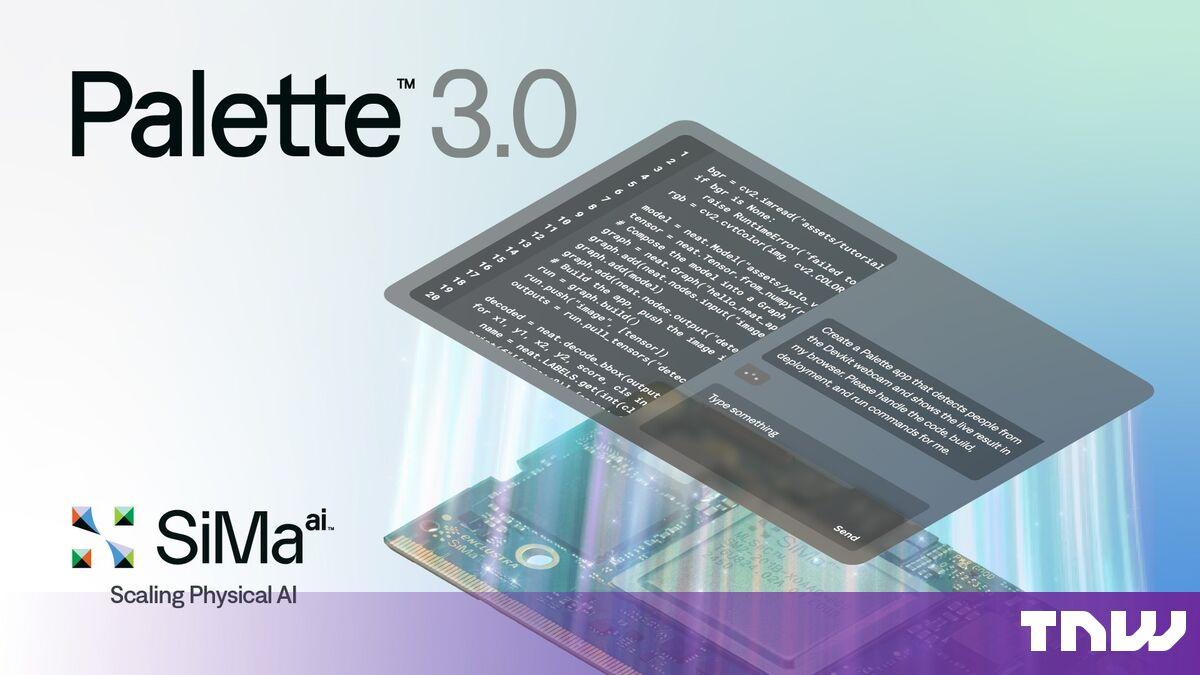
SiMa.ai released Palette 3.0 on November 17, a software update for its Modalix chips that lets drones, robots and other machines run several AI models at the same time on one low-power chip
3
2
. The company says text generation on those chips can run up to 3.5 times faster1
.
Source: The Next Web
SiMa.ai is a San Jose startup founded in 2018 that builds chips and software for what it calls physical AI, meaning intelligence that runs on the device itself rather than in a data center, and it raised $150 million at a $1.45 billion valuation in September
3
1
. Founder and CEO Krishna Rangasayee framed the release as breaking a cycle in which software improves monthly and silicon takes years to catch up: "The fundamental bottleneck in Physical AI today is the glaring mismatch between software that evolves monthly and legacy silicon that takes years to adapt. We are breaking that cycle."4
The fine print on 3.5x
The speed claim rests on speculative decoding, a method where the chip drafts several likely next words at once and checks them in one pass. It speeds the generation of new text, not the processing of the prompt that came before, which is why the gains shrink on realistic workloads
1
2
.The 3.5x peak comes from a single model under favourable conditions in SiMa.ai's own white paper
1
2
. Across four models the measured range was 2.21x to 3.49x, and a more realistic 900-request test showed 1.35x to 2.06x1
2
. That test asked the chip to act as an automotive assistant, turning spoken commands such as a passenger saying they are cold into one correct function call1
2
. Every request came back correct1
2
.Many models, one chip
The central change is concurrency. Multiple models, including separate Docker containers, run at once on a single Modalix chip while keeping its low power profile
3
2
. Requests now go straight to the kernel drivers with per-request priorities3
2
. The company says the goal is to clear bottlenecks in integration and validation that hold up autonomous development, so perception and reasoning models can share one low-power chip3
4
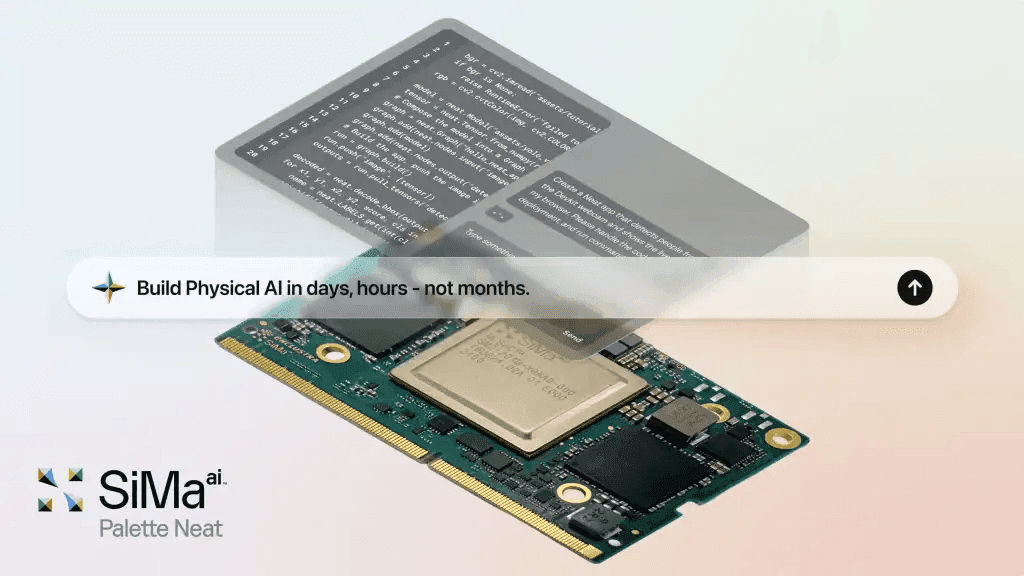
. In one demo, a single chip ran a language model alongside three vision-language models and six containers2
.
Source: SiliconANGLE
"It's all software," said Manuel López Roldán, the executive in charge of agentic software and generative AI work
2
. Customers with chips already deployed get the update without buying new hardware2
. The 16GB Modalix module can now run a 20-billion-parameter model from OpenAI3
1
2
. A new Model Browser, live since November 17, publishes the company's measured throughput, latency, power draw and precision trade-offs3
2
. The software can be downloaded to run offline, with update packages for devices already in the field3
2
. Partner additions cover sensor fusion, depth sensing and digital twin simulation3
4
.Related Stories

The market, the price and the timing question
The company positions itself against incumbents it says are adapting data-center technology, while it builds silicon and software only for machines that act in the physical world
3
4
. Its named rivals include Nvidia's Jetson systems and Hailo's accelerators. Hailo's route is cheaper but handles smaller models, about 6 billion parameters against the 20 billion SiMa.ai demonstrated1
2
.The DevKit 3.0 development system costs $1,499 in the US and Europe; production-volume pricing has not been disclosed
2
. Existing customers have work to do: moving from version 2.1.3 requires a migration, and native applications must be rebuilt against matching components2
. The core Palette Neat library is open source under an Apache 2.0 license, but how the compiler and firmware are licensed is still unconfirmed3
2
.The demos leave timing untested. Whether object detection keeps answering within its deadline while a language model generates on the same chip is something developers will have to test on their own applications
2
. The company's own briefing materials do not say how long a high-priority request might wait under sustained load2
.
Source: VentureBeat
References
Summarized by

Navi
[1]
[2]
[3]
Related Stories
SiMa.ai slashes Physical AI deployment to days with Palette Neat agentic development tool
17 Jun 2026•Technology

SIMA.ai Expands Edge AI Capabilities with New MLSoC Modalix Product Family for Generative AI
11 Sept 2024

SiMa.ai Launches Modalix: A Game-Changing Chip for On-Device Physical AI
13 Aug 2025•Technology

Recent Highlights


Recent Highlights
Today's Top Stories












Don’t drown in AI news. We cut through the noise - filtering, ranking and summarizing the most important AI news, breakthroughs and research daily. Follow topics that matter to you and stay ahead.


